Dateline: Ho Chi Minh City (Saigon), Vietnam – Thursday, May 6, 2010
I hate the French. Not for everything, mind you. Of course, I love them as parents. I love them as chefs. I love them as little people with funny mustaches and silly hats. I hate them, however, as city planners. They are utter failures when it comes to designing a practical city. Because of them, my day was a debacle.
After a late breakfast of pancakes and writing at a local café, I went in search of a motorbike. The old guy who I rented from gave me three options: a snazzy new automatic for $7/day; an old automatic for $5/day; a crappy old manual for $4. Is there any question? I went for the cheapest option.
Right off the bat the bike felt better than the one I lived through in Phnom Penh. The gears shifted easily. The gear ratio felt more rational; I could shift through three gears not just two. I felt good as I powered my way through traffic. I slid in and out of the motorbike herd enjoying the artificial breeze.
I stopped at a light and a Vietnamese guy turned to me, an amused smile on his face, and pointed at the front of my bike and said something. In my imagination he said, “See that part there? That’s the one that’s going to fall off and kill you.” The bike was definitely old and a bit underpowered, but I didn’t care. I was moving for four bucks.
I laughed and said, “I don’t speak Vietnamese.” He laughed and zipped off, perhaps to tell his friends about the American who’d died on the streets of Vietnam.
I drove down a main boulevard for a bit when I realized I didn’t have any gas. The gauge was actually below the red. Suddenly, I couldn’t help but notice the bike hiccupping like it was on its last legs. I slowed down to conserve gas and started looking for a station. A distressing amount of time later, I still hadn’t found one. I decided to turn off the big road and search elsewhere. I had visions of running out of gas and pushing the thing down the side of the road in the heat.
Just when I was on the verge of asking for directions (desperate times), I found a station. Tank full, I threw myself back into traffic. The plan was to go to a pagoda in a different part of town. First though, I had to find a main road to orient myself.
Finding that main road took, unfortunately, three hours. Three midday-sun-baked hours. The following thoughts crossed my mind as I wandered HCMC:
**”Traffic in Vietnam seems more sane than Phnom Penh traffic—the reality is that it’s twice as mad.”
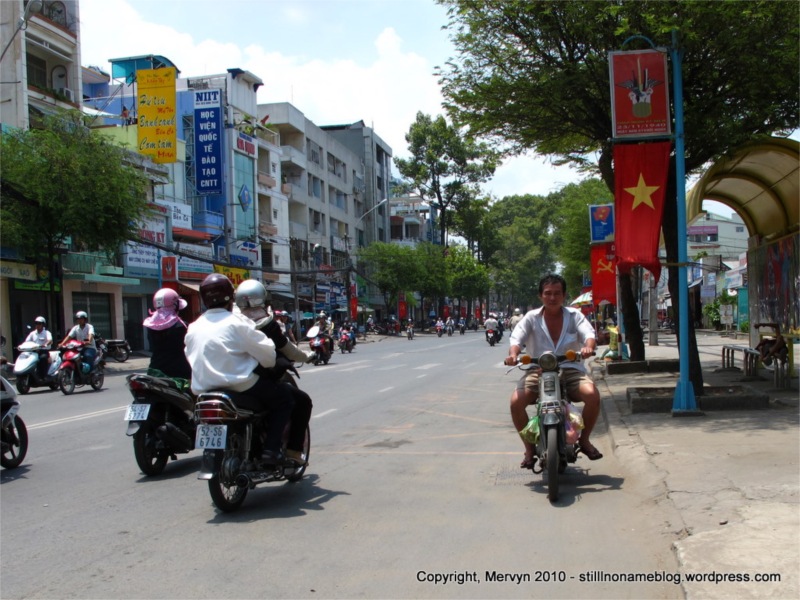
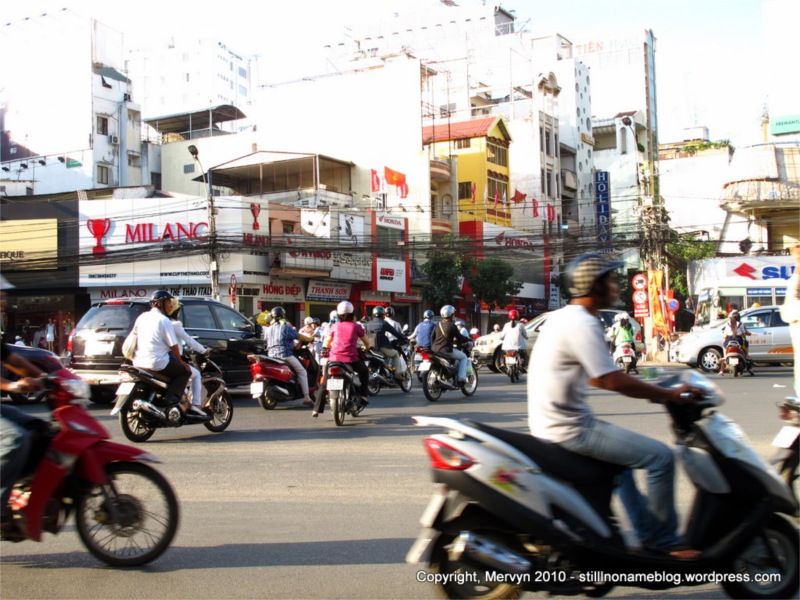
The drivers here seem to pay more attention to traffic lights. That gives the illusion of sanity. I think, though, that this “sanity” is really “necessity.” The reason why drivers respect traffic lights here more than in Phnom Penh is because they have to—there are way more people.
My Viet Cong guide said there are 10 million people in HCMC and 9 million motorbikes. Stand at a busy street corner and you start to believe him. There are also a ton of cars. If the guide’s math is right, there are robots driving vehicles around this city.
The overwhelming numbers means that if you don’t stop at traffic lights, at least for a moment, you will be trampled by every kind of wheeled vehicle known to man. Those murderous robots might even hit you twice.
The “rules” are much the same as in Phnom Penh. People still drive on the wrong side of the road, block traffic, and push hot dog stands through busy intersections. They just do it a bit more cautiously. A bit.
Phnom Penh is also a smaller city. A quaint village really, compared to the sprawling metropolis that is HCMC. You can turn off a main road in Phnom Penh and escape the masses. Take a break from the madness and motor through a quiet neighborhood.
In HCMC, there’s no respite. The madness never ends. Kilometer after kilometer of wide boulevard is crammed with humanity. It’s like there’s a U2 concert and Super Bowl in every direction. That, mixed with the heat, makes trying to find your way around all the harder.
**”WTF, is that the airport?”
After driving for one hour I saw an airliner take off from my left to my right. That’s when I realized I was near the international airport. This surprised me. The airport is north of the city and I kind of thought I’d been driving south. This is kind of like how I imagine it’d be like if my parents told me I was born a hermaphrodite and they’d chosen to make me a male by having me undergo thousands of hours of baby genital plastic surgery—finding this out is totally screwed up, but what am I going to do now other than deal? No use crying or complaining. Can’t go back in time and change things or wonder what it’d be like if I was south instead of north.
**”Lonely Planet can shove its head in a squat toilet.”
The HCMC city map in the guidebook I have is donkey butt. It labels streets intermittently, omits streets, and gives no indication of one-way versus two-way. I turned on the publisher when I pulled out my map and tried to locate where I was in relation to the airport. They might as well have dropped a pile of toothpicks on a piece of paper and called it a map. Almost nothing was labeled and what was labeled didn’t tell me if it was a big or small street. If I’m fair about it, though, it probably wouldn’t have made any difference because. . .
**”Every street in HCMC seems like a main boulevard.”
I pulled over whenever I hit what looked like a big street. I’d pull out the map and see if I could match up the street name with one labeled on the map. I figured if it was a big street it must be a main street and thus warrant a mention on even a crappy Lonely Planet map.
No luck. Turns out HCMC is so big that there are hundreds of streets that look like main streets. Hunting for a main street is worse than trying to find the fattest kid in fat camp, it’s like trying to find the skinniest heroin addict at Studio 54 with all the disco lights going while you’re piss drunk and high. Everything looks like pink elephants.
I kept pulling over and trying to find “Tung Dung Trang” or “Thi Quat Khoi Thanh” on the map. It never worked. Phoc Thinay.
**”The sun is bullshit.”
I tried to go Boy Scout and use the sun for navigation. Sun sets in the west and rises in the east, right? What they don’t ever tell you is that using the sun only works if it’s near the horizon. When it’s anywhere more than 45 degrees in the sky you might as well spin a bottle and pretend that where it lands is north. Any other time, the sun makes totally unhelpful shadows, especially when you’re closer to the equator like I am.
Apparently, Boy Scouts all live in Canada and only hike at the beginning or end of the day. They and their frickin’ sun are totally useless.
**”Burn in hell French planners. Burn in hell.”
The French originally colonized Vietnam and during their reign Saigon took its present form. That means lots of Franco influenced city planning. There are plenty of roundabouts and, best of all, almost none of the streets are parallel. Those that are don’t stay that way for very long. That means getting from Point A to Point B is like trying to maneuver your way through a pissed off girlfriend’s logic—put too much effort into it and you’ll find yourself trying to gouge your eyes out with a wet noodle. Best to just accept it as it is and move on.
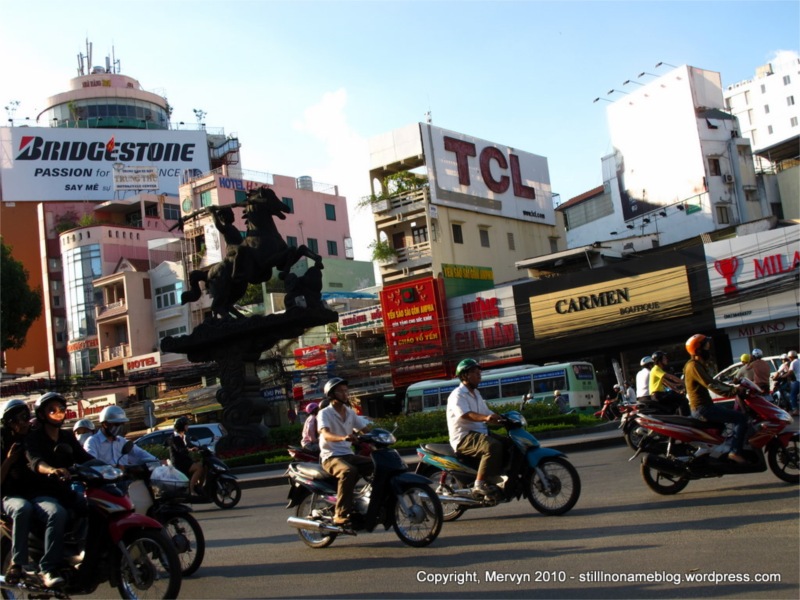
I swear to you. Look at an overhead map of HCMC. Googlemaps it. Seriously. I’ll wait. There’s nothing there to hang on to direction-wise. When I’m lost I usually head off in one direction and wait until I hit a landmark of some kind (a river, highway, giant building, etc.). That’s nearly impossible when a city won’t let you travel in a straight line for very long.
Just when you think you’ve figured out where you’re going, you hit a roundabout or the road curves away from your destination. I always thought Washington, D.C. was bad. D.C.’s got nothing on what the French have done to HCMC.
The city is big, too. The sprawl goes on forever. Even near the airport, where the roads thin a bit, there are still neighborhoods with little back alley streets, turn offs, and roundabouts. It never ends.
It sure is pretty though. The odd angles create boulevards that meet at interesting intersections. The roundabouts give the city an old world feel.
It’s so French. A lovely piece of art but a total failure function-wise. The spaghetti noodle streets combine with the weird-to-Westerner street names to make a maze worthy of the most skilled rats. I, unfortunately, am one dumb rodent.
Eventually I stumbled my way to the Saigon River (I think) and then staggered my way back to the tiny sliver of HCMC that I recognized. The thing that tipped me that I was close: a gaudy sign stuffed with headshots of pop stars (I think) advertising (I think) an upcoming concert. I thought I recognized it from my moto cab ride from the day before. For once my thinking got it right. I limped back into my hotel and unparched my dry throat with five gallons of water and a soda.
I sat there trying to decide whether I dared venture back out into the maze. Weary, I decided that I wouldn’t let the city conquer me, dammit. I embraced some Vietnamese defiance and I hopped back on the bike.
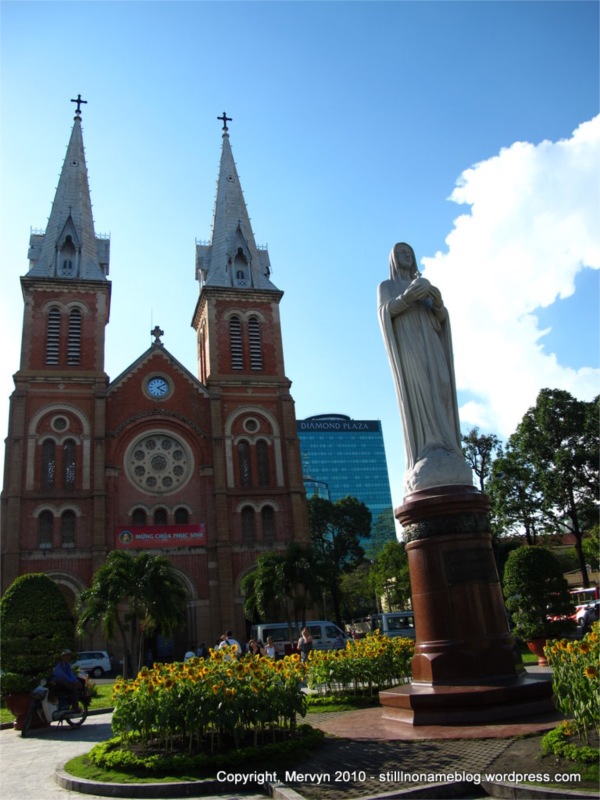
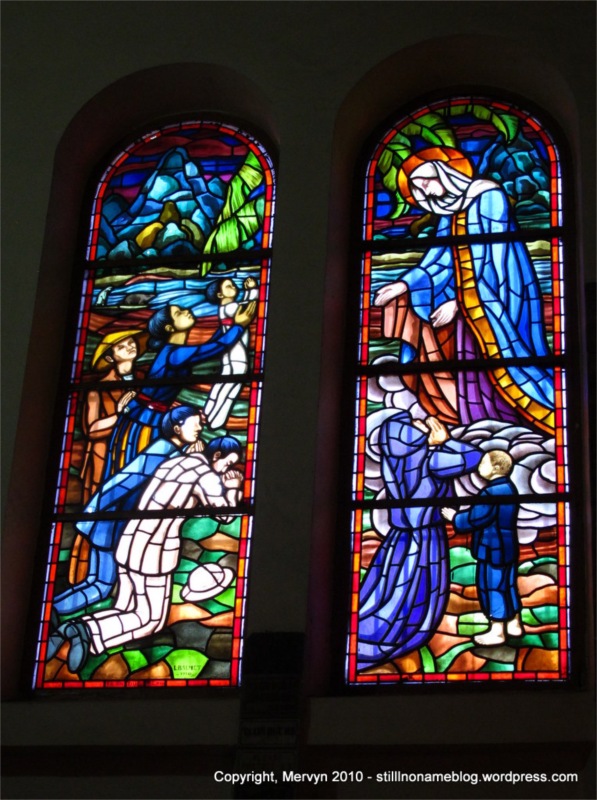
I found my way to the Notre Dame cathedral, another gift from the French. It’s big. It’s red. It has stained glass depicting Vietnamese on their knees before the sweet Virgin Mary. Very progressive.
I also stood outside the entrance to the Reunification Palace, the place you see in pics of the fall of Saigon. It’s the place where the tank crashed the gate.
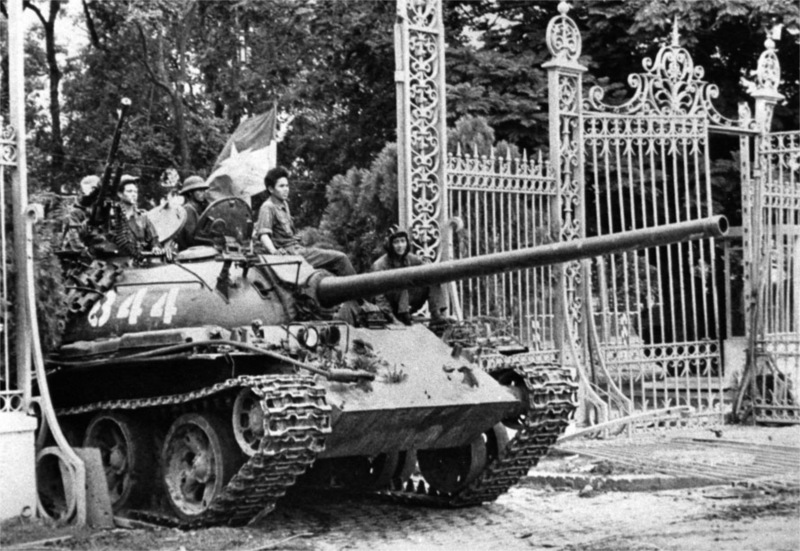
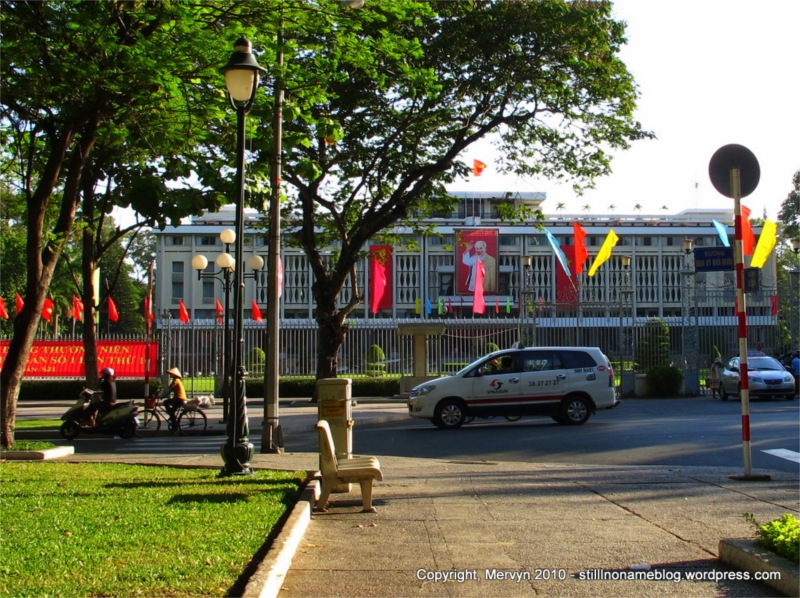
These were consolation prizes, really. The day, on the whole, was a bit of a disaster. Lots of driving around, lost in the heat. If I take some personal responsibility, it’s mostly my fault for not paying attention to where I was going when searching for gas. If I had, I could have backtracked to where I started and easily found my way to the pagoda (I think).
Luckily, it’s much easier to blame the French.
____________________
Random Note: This was written in a café playing almost exclusively Western music. One song that I didn’t recognize had the following lyric: “This used to be a fun house, now it’s full of evil clowns.” Man pop music sucks. Either that or, to enjoy it, you’ve got to get more high than you did back in the day. If that’s the case, it must take a haystack size mound of burning weed to take some of this stuff seriously.
Dateline: Ho Chi Minh (Saigon), Vietnam – Wednesday, May 5, 2010
I’m in an alternate universe. A place where the Vietnam War is the American War. Where U.S. soldiers are war criminals. Where Americans purposefully dropped Agent Orange on Vietnamese to create deformities and inflict them with cancer. Where former Senator Bob Kerrey isn’t a statesman, he’s a murderer.
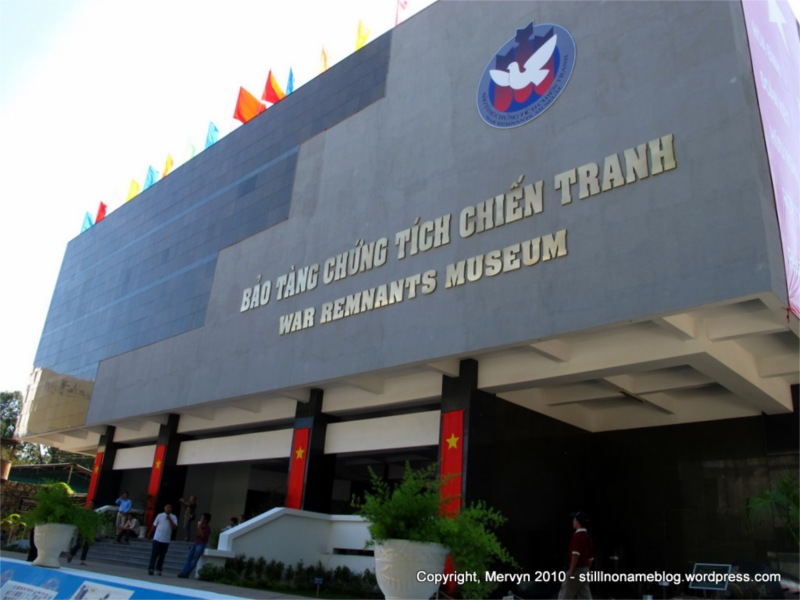
Today I went to the War Remnants Museum and got the Vietnamese side of the war. Let’s just say we don’t come off that well. First off, though, I woke up with a bit of a sensitive stomach. Little achy, little unsettled. I spent the morning in bed trying to get myself right.
When I dragged myself into the street, I found a Vietnamese sandwich roadside cart and ordered one with a Sprite to tame my stomach. Again, I got confused when paying. I thought she said, “70,000” a price which is more than I’d pay for a Vietnamese sandwich in San Francisco (there: $2.50). I was too weakened to argue, though, and handed her a 100,000 note. Turns out the price was “17,000” and I just heard her through paranoid ears. That, my friends, is a bargain. Less than $1 for a sandwich and a soda? Guess I’m still waiting to get ripped off.
After slowly working my way through my meal and drink on a nearby park bench, I found a motorcycle driver willing to take me to the museum for a reasonable price (20,000 dong/$1.05). A short ride later, we stopped outside the museum gates. From the street, the place would be nondescript except for the tanks and warplanes out front.
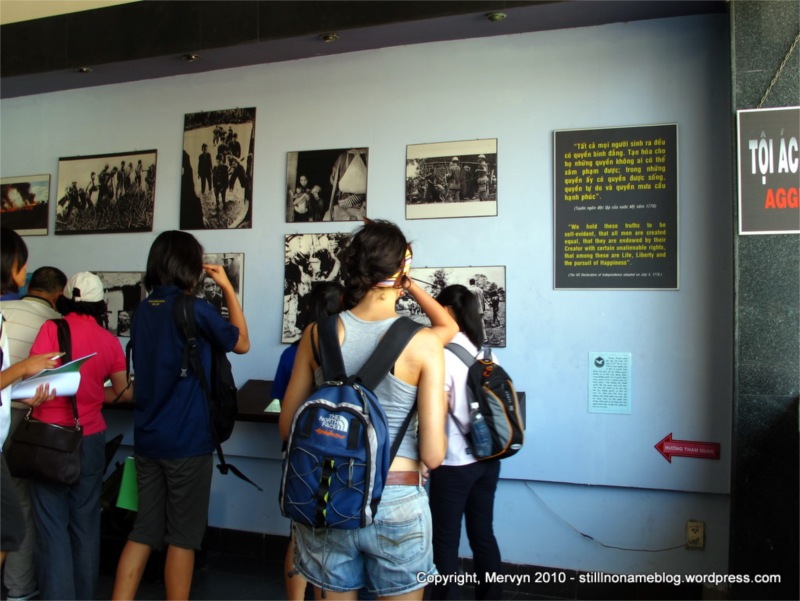
Inside, my journey through an interdimensional portal began. On the first floor, exhibits describe “Aggression War Crimes.” A sign immediately disoriented me with the following:
“We hold these truths to be self evident, that all men are created equal, that they are endowed by their Creator with certain unalienable rights that among these are Life, Liberty and the pursuit of Happiness.”
Yup. The United States Declaration of Independence. From there, the assault began. Picture after picture of U.S. troops pointing guns at helpless Vietnamese. Peasants being driven from their homes by American soldiers. It was relentless. I guess the point is that America didn’t really treat Vietnamese equally or allow them Life, Liberty, or Happiness.
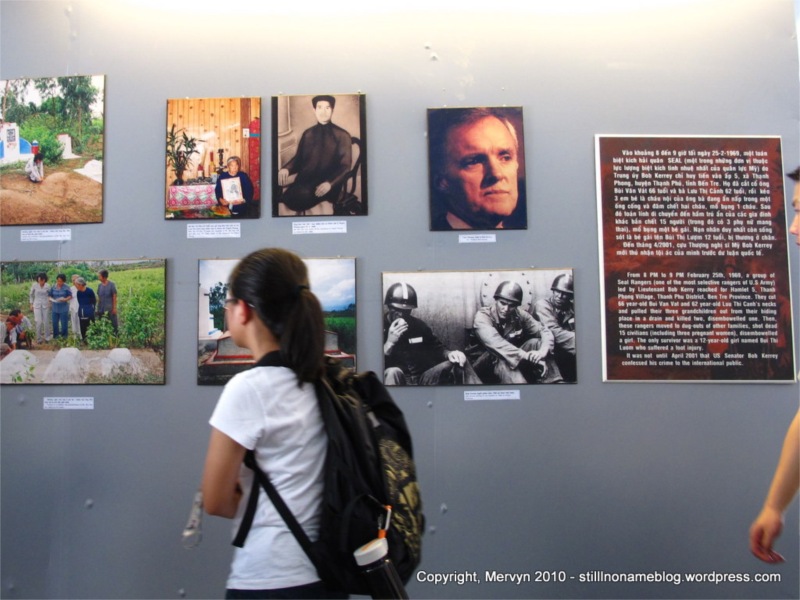
Another wall was devoted exclusively to Ex-Senator Bob Kerrey and an incident where he led a group of SEALs in killing innocent civilians. He is touted as a baby killer, a murder of grandparents. I’m guessing Mr. Kerrey hasn’t visited Vietnam since the war.
Another shows pictures of people harmed by defoliants used by the U.S. to clear jungle. Babies that look like they were born in Picasso paintings, adults with their faces melting like Dali clocks, spontaneously aborted fetuses that look more alien than human. It is not pretty.
Upstairs exhibits tout Vietnam’s acceptance into the world community. A map shows every country that maintains diplomatic relations with Vietnam. This is odd because I wasn’t aware that Vietnam was ostracized, particularly after President Clinton normalized relations in the ‘90s. I spent a few minutes trying to find a country on the world map that didn’t maintain relations with Vietnam. I found one: Greenland. I always knew those Greenlanders were up to no good, all hidden away in their forgotten land of ice.
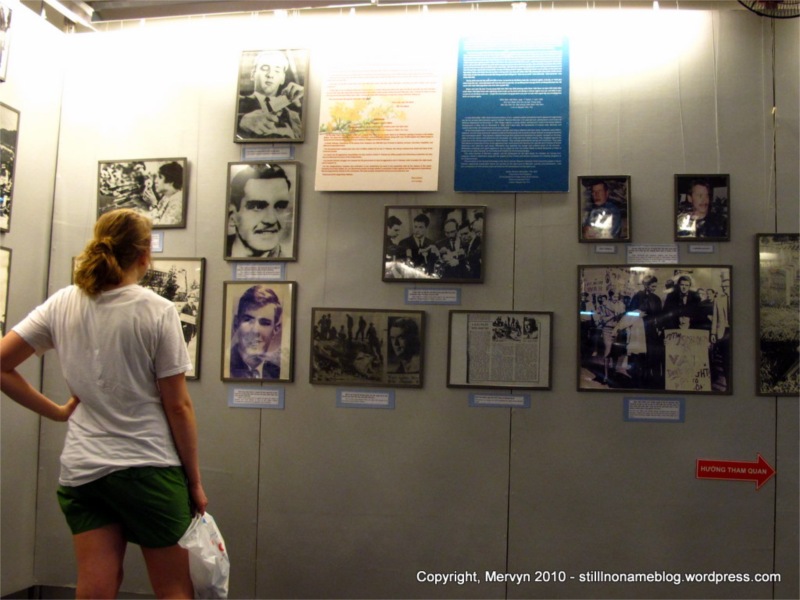
One wall upstairs showcased Americans who’d dramatically decried America’s war with Vietnam. There were two headshots of All American looking men. One had burned himself alive in front of the United Nations to protest the war. Another had done the same in Washington D.C. They were given hero treatment as were draft card burners and Berkeley protesters. I’m surprised Muhammad Ali wasn’t on the wall.
Outside a recreated prison recounted the atrocities committed by the America-supported Vietnamese regime. According to the exhibit, the Diem regime had oppressed political dissidents, tortured men and women for political reasons, imprisoned poor people, and forced confessions out of innocents.
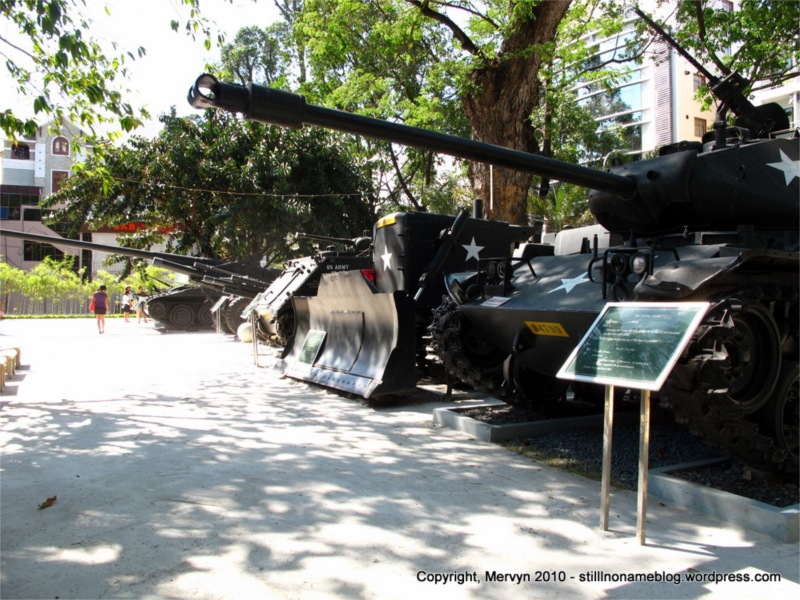
Walking out of the museum, I stopped to look at the American military vehicles and ordinance. Chinook helicopters, fighter jets, tanks, artillery batteries. A sign said one bomb destroyed anything within 100 m and did damage up to a kilometer away. Guns on display had miles of range. Jet fighters on display could rain down rockets and bombs.
Looking at all this stuff, it’s a wonder America didn’t win the war. The army had overwhelming technological superiority.
As I walked out of the museum, I thought about America’s written history. Here, the Vietnamese had their perspective of what happened. To them, it’s clear that America committed a great evil and that the Viet Cong were fighting a righteous fight. They won, so they wrote the story. Without a doubt, the same thing happens in the U.S. We’ve been quite successful and have been able to write our own story. That story may not be as objective or nuanced as we might like to think.
I know I do this to myself as well. I rewrite my personal history to suit my own interests. How much though? Would an outsider even recognize the stories that I tell myself? It’s an interesting question.
I, for one, like my story. In the dimension of my creation, I am a hero. I do make mistakes and do wrongs, but all of them are charming, understandable, or unique. Like the Vietnamese, I’ve overcome oppressors. I have fought a righteous fight.
Often the stories I tell are sanitized. Cleaned up so as not to embarrass myself or others. For example, today I have an “unsettled stomach.” Sometimes the story is prettier than the reality. See, sometimes a little storytelling benefits us all.
Contact Mervyn
You may now attempt to call Mervyn in Vietnam. The Contact Mervyn page, available here or through the top menu, has been updated with the pertinent information.
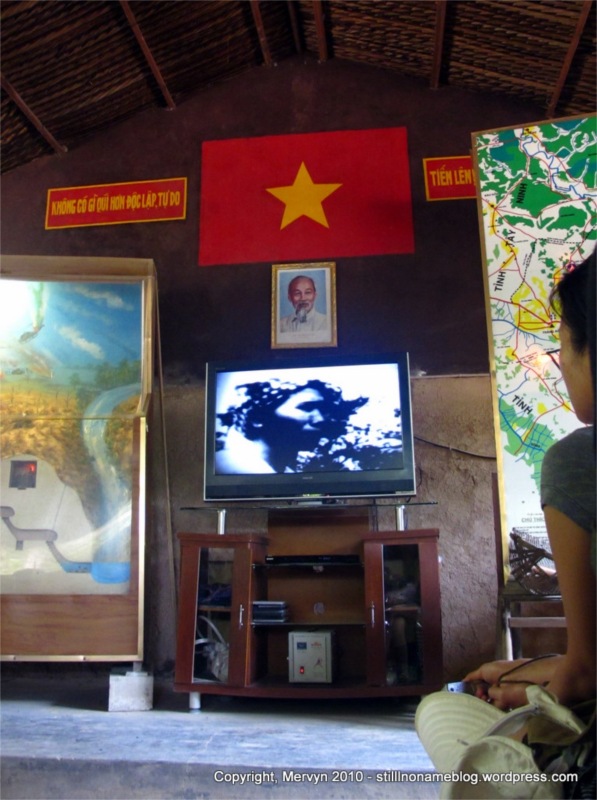
Dateline: Cu Chi Tunnels and Ho Chi Minh City (Saigon), Vietnam – Tuesday, May 4, 2010
This man has killed before. He’s felled many Americans. He is a warrior. And now, this man is singing a wobbly song about our upcoming day at the Cu Chi tunnels. It’s his own tune and lyrics. It’s a surreal moment.
I was just northwest of Ho Chi Minh touring a battlefield that, during the Vietnam War, was riddled with over 200 km of tunnels and underground bunkers. Previously, the Viet Ming used the tunnels to fight the French for independence. When the Americans came to Vietnam, the Viet Cong took a page from their predecessors and expanded the tunnel system. From this area, just 70 km from HCMC, they harassed the American forces trying defend what was then called Saigon.
Our 63-year-old guide grew up in the Cu Chi area. He moved to Saigon with his father to study. At the age of 20, he joined the North Vietnamese to fight the American invaders. He helped build these tunnels. He fought in them through bombardments, Agent Orange drops, U.S. cavalry assaults, and napalm strikes. Throughout his presentation, he described the difference between the sounds of helicopter machine guns (“Pap pap pap pap”) and the six-barreled gunship guns (“Wooooooooo”).
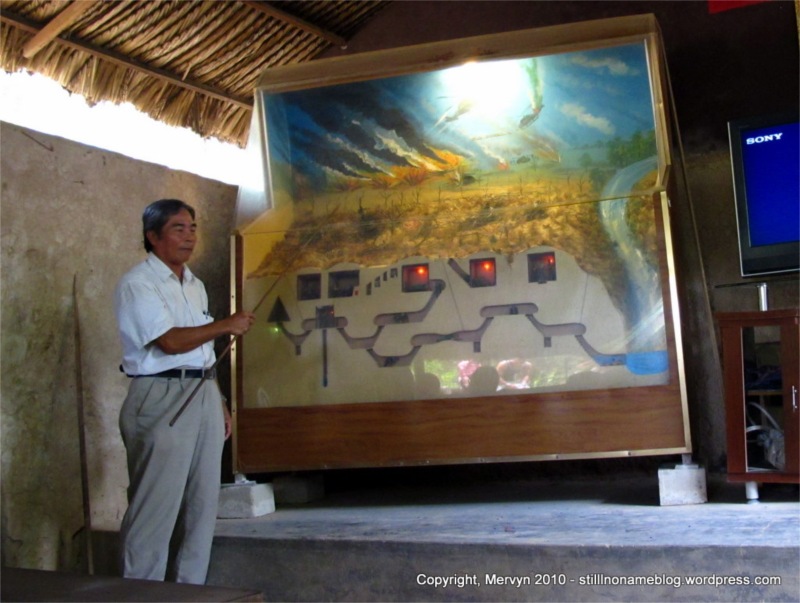
He seemed awfully good natured, considering what he experienced. He said he lived underground in the dark for years, crawling from place to place, only coming out at night to get supplies and mount military assaults. He described how Ho Chi Minh instructed the troops not to shoot until the Americans were very close. That way, the American helicopters, artillery, and air support wouldn’t be able to fire for fear of harming their friends. That and the Viet Cong had to conserve the bullets donated by their communist allies—it wouldn’t do to waste these gifts. He talked about techniques to get tanks to turn so that the outgunned Viet Cong could fire on the weak spots on the tank’s treads.
The man also likes to sing. On the bus on the way to Cu Chi he entertained us with a song he composed about our upcoming day. His lyrics are set to the Vietnamese musical scale (think Chinese tones) and included a gem that went something like this, “Today we visit the tunnels of Cu Chi, and watch a documentary movie to learn about strugggggle for freedom.”
We were not disappointed. When we arrived, we watch a grainy black-and-white film about heroes of the “American War.” It looked like it was shot in the ‘60s. English dub was rough. A lithe, female Vietnamese voice tells us about a young boy who killed many U.S. soldiers. About a girl whose family was killed and took up arms “with revenge in her heart.” The exploits of each warrior were detailed including the number of troops killed. Each was called a “hero American killer.”
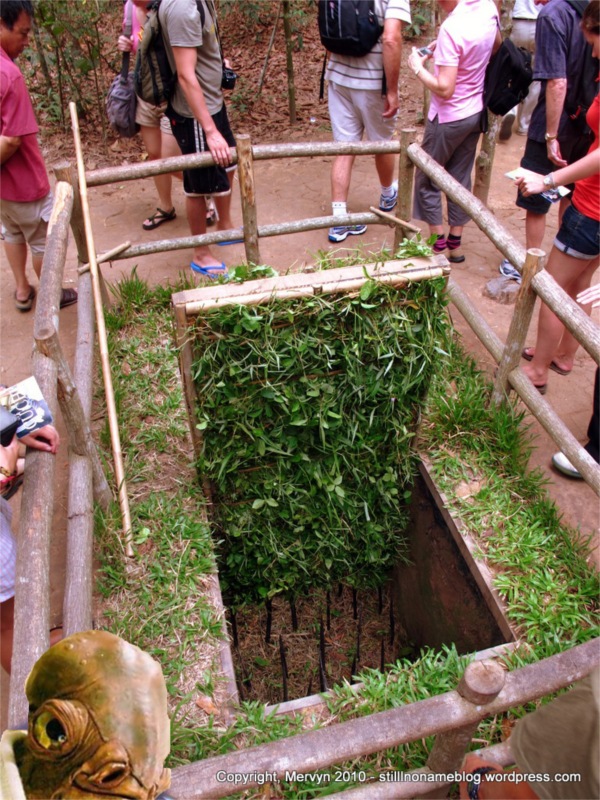
After the film, we were led through exhibits that showed us booby traps created to ensnare Americans. Most were surprisingly sophisticated despite being made out of only nails and wood. Swinging gates, traps concealing more traps, all camouflaged to blend with the terrain.
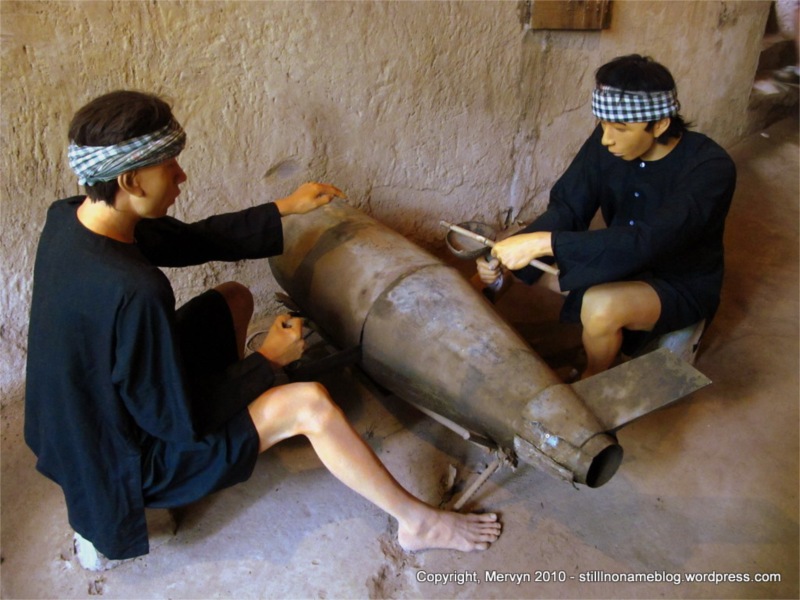
That really was the theme of the tour: the freedom fighters did their best with what they had. They collected unexploded U.S. ordinance and harvested the explosives inside to create their own makeshift mines and traps. To illustrate this, two mannequins were posed as if they were sawing a bomb in half. Our guide helpfully added that he didn’t saw all the way through and that his mates constantly poured water on the sides to prevent it from exploding. I couldn’t help but think that they must have gone through a trial and error phase—what’re the odds that they never made an error?
The tunnels themselves were a trip. They’d kept one original entrance to show us how the Viet Cong made them just big enough for one man to squeeze through. They would paste dirt and leaves to the top of the covers for camouflage. I’m not a big guy, but it wasn’t a simple thing to get in and out. I can imagine it would have been hard for the typically larger American.
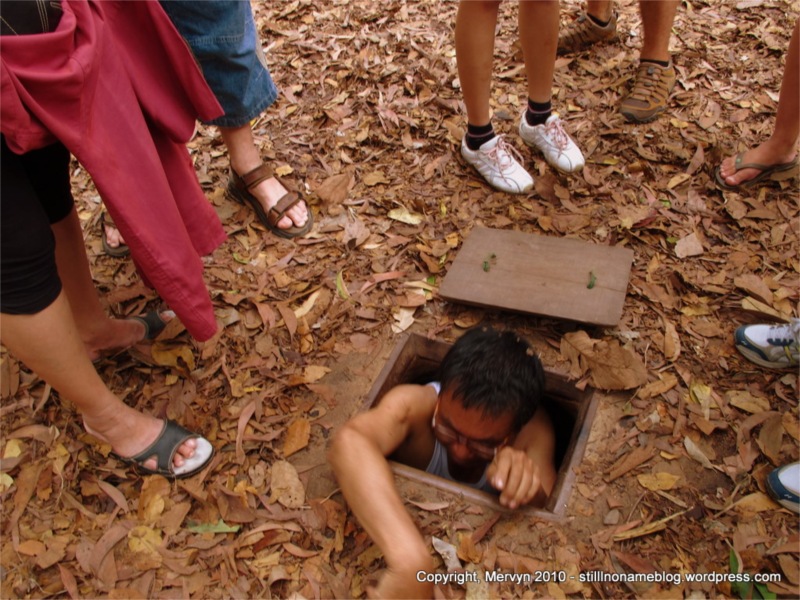
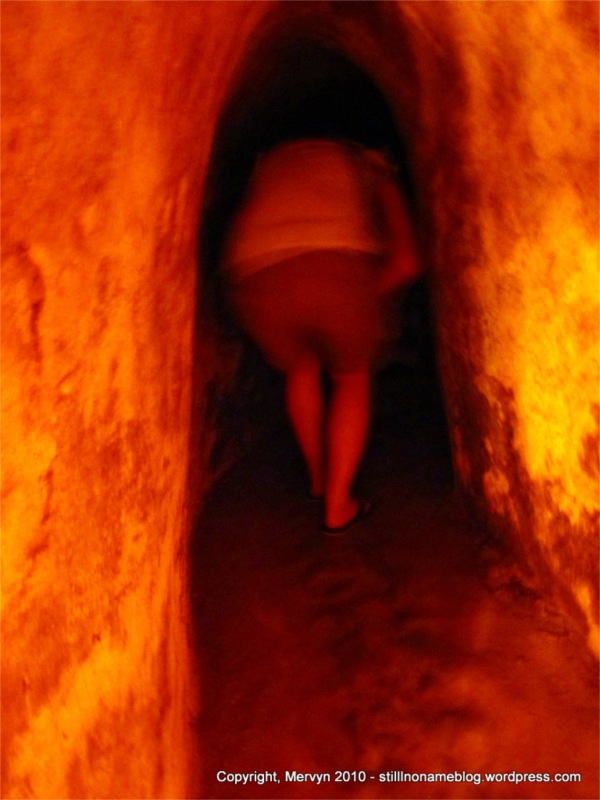
The Viet Cong would pop out of these holes, fire, then pop back in. The tunnels underneath were just crawlspaces dug by hand. They would make air holes to the surface to circulate fresh air. They dug three layers of tunnels. Near the surface they’d sometimes put kitchens where they could make fires to cook food. There would be a series of holding rooms attached where they’d trap the smoke. When no one was around, they’d slowly release the smoke to the surface.
Some tunnels led to dug out wells that reached below the water table. The earth acted as a giant water filter for Agent Orange and the napalm.
Some tunnels led to the river and swim through where the Viet Cong could get outside only at low tide. They would fish under cover of dark or mount assaults from these secret entrances.
They allowed us to go into the tunnels and we got a sense of what life was like. My first impression: it was hot. Very hot. The curators had been kind enough to put concrete in the tunnels, probably to ensure that they didn’t collapse and kill tourists. Back in the day, there were no lights and everything was dirt. The Viet Cong had to feel their way around and memorize which tunnels led where. I can’t imagine being a U.S. soldier trying to crawl your way through these things looking for the enemy. The girl in front of me was five feet tall or so and when she bent at the waist, she couldn’t straighten her legs. I was doing the Asian squat, shuffling along, trying not to sweat on my camera. We went maybe 40 yards and we were all drenched in perspiration. I can imagine the Viet Cong being covered in mud, crawling from place to place, bombs shaking the ground overhead, fleeing the grenade that’s been thrown in after them.
Our guide confirms the experience. He says he lost his hearing in the war because of all the bombs and close gunfire. Only after the war did his hearing return. Even now, he says, it continues to improve.
At the end of our tour, our guide serenades us with two more songs. Some of the younger tourists from Britain start to tease him sarcastically about, “Just one more song, please.” Me, I have no problem with the songs. They’re fanciful and he enjoys presenting them. He’s got a pretty good attitude considering he’s one of only seven of his company to survive the war.
Besides, the guy gets a lot of leash from me. He’s put his money where his mouth is in a way I probably never will have to. He fought and was willing to die for his freedom. Sing on my man. Do your thing.
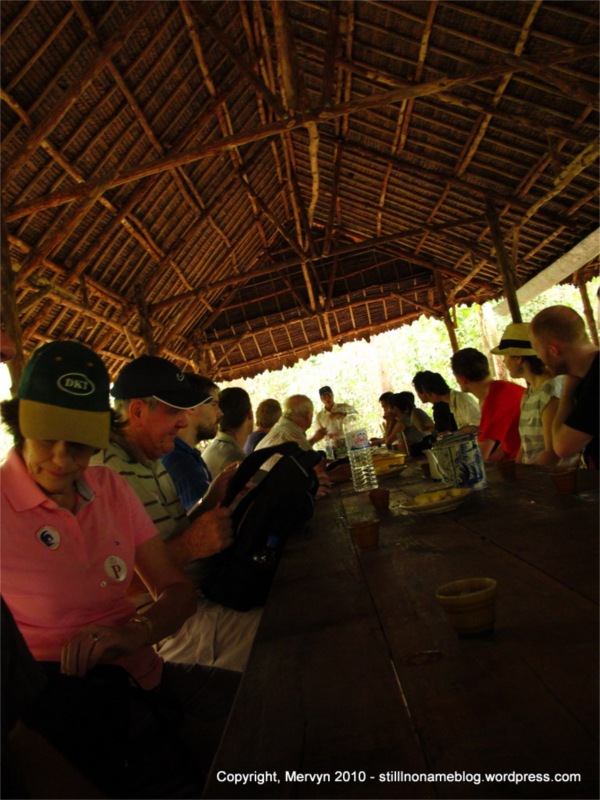
I think I can sense a difference between Cambodia and Vietnam. This culture seems to have an energy and defiance that’s not present in Cambodia. There, it seemed there was a tone of melancholy even as we raised glasses and cheered (“Cheung moi!”). Sad songs were just around the corner.
That’s understandable. The Cambodian culture is one of tragedy, much of it inflicted by Cambodians on Cambodians. The Khmer Rouge killed Khmer people. Millions of them.
Here, millions of Vietnamese died, but at the hands of foreign invaders. That blood was spilt in the name of freedom, which the Vietnamese won. Whether communism was the better choice, they made it and drove out the interlopers. They can sing fanciful songs about tourists visiting their battlefields because they prevailed. (Heck, the Vietnamese even freed Cambodia from the rule of the Khmer Rouge. In 1979, they took it upon themselves to invade Phnom Penh and drive out the murderous regime.) These people can look you in the eye and say, “We are winners. Nothing you did or ever can do can take away our freedom.”
As conflicted as America’s involvement was in Vietnam, the Viet Cong were without ambivalence. Their predecessors, the Viet Ming, drove out the French and gained independence. Immediately, the Americans got involved and the Viet Cong rose up to fight for independence again. For them, nothing less than their freedom was at stake. They were going to win this war or die trying.
In the face of that determination, it’s a wonder that the U.S. thought it could ever win.
Dateline: Phnom Penh, Cambodia and Ho Chi Minh (Saigon), Vietnam – Monday, May 3, 2010
I’m all for going for low hanging fruit. I mean, it’s low isn’t it? Easy to reach. Minimal effort. Sometimes, though, it’s so low that you have to bend over to reach it. Stoop, even. One might say that fruit of that kind is “beneath” them.
Me. Nothing’s too low. Not if it’s there for the taking. Stoop? Son, don’t even get me started. I will get down on my belly if it means reaching something juicy. I won’t let anything be beneath me so long as it’s easy.
With that in mind, can I just say that I’ve seen more dong today than I’ve ever seen in my entire life. In fact, I’ve handled more dong in one day than I did all week long at 5th-grade summer camp. Today, I fondled dong. I played with dong in my pocket. I stared at other people’s dong. They yearned for mine.
People gave me their dong and I took it with a smile. Sometimes we’d get the timing right and we’d be holding the same dong at the same time. Neither one of us paid it any mind there was so much dong between us.
Sometimes dong confused me. I’d have so much in front of me I’d start getting nervous. Was I giving and taking the right dong? Do you take the dong or wait till it’s given to you? Was that his dong or mine?
And you know what, size matters. The longer the dong the more it gets you. If you gave me a choice between you giving me short dong or long dong, I’d take your long dong every time. I’m serious. You would too. Don’t let anyone tell you otherwise.
If you can’t tell, I’m in Vietnam. I’m also a juvenile (obviously). Oh, and dong is the local currency. So they tell me. I call it easy pickin’s.
Best of all, it’s true about the size thing. The bills get longer the more they’re worth. I can’t wait to see my first million-dong bill. It’s gonna be like 10 inches long, real, and spec-tacular.
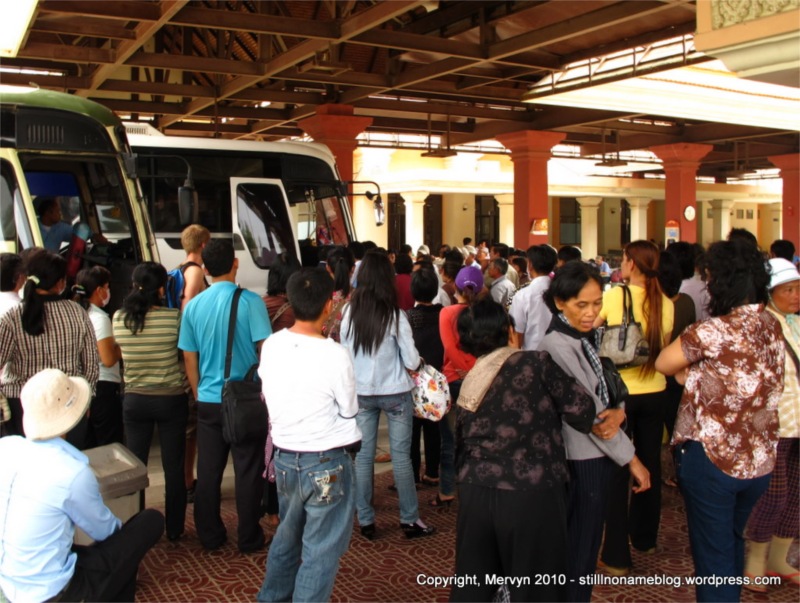
To get here, I hopped a Phnom Penh to Ho Chi Minh bus at 6:30 a.m. with a bunch of Cambodians and a few foreigners. We hit the border at 11 a.m. There, a guy on the bus collected all our passports to “get stamp.” While he carted off a pile of our travel documents, we waited at a rest stop.
In Cambodia, the calculation for Cambodian riel to U.S. dollars was easy enough: roughly 4000 riel for one dollar. It also helped that Cambodia uses the U.S. dollar as currency. It was odd to receive five or one dollar bills as change, but it did simplify my mental budget.
Vietnam is a different story. The exchange rate is about 18,900 dong per dollar. That’s a lot of dong. It’s also not a very round number of dong. When I exchanged some dollars at the rest stop I had to borrow the lady’s calculator to make sure I was getting the correct amount of money. I stared at the currency and counted the zeroes to make sure that I got 100,000 dong bills and not 10,000. It’s higher math. Back on the bus I practiced: 100,000 dong = $5.25? 80,000 dong = $4.20? This was going to be tough.
Unfortunately, the bus ride didn’t last long so I didn’t get much practice. Our bus basically crossed the road near the rest stop and kicked us out to do Cambodian immigration. This meant piling out of the bus and waiting. The bus guy called out a couple of people, me included, to get our passports and get stamped out of Cambodia. Then we were called one-by-one to board the bus where we again surrendered our passports to the bus guy. We drove a few hundred meters, then got back off the bus to wait in line at the Vietnamese immigration building.
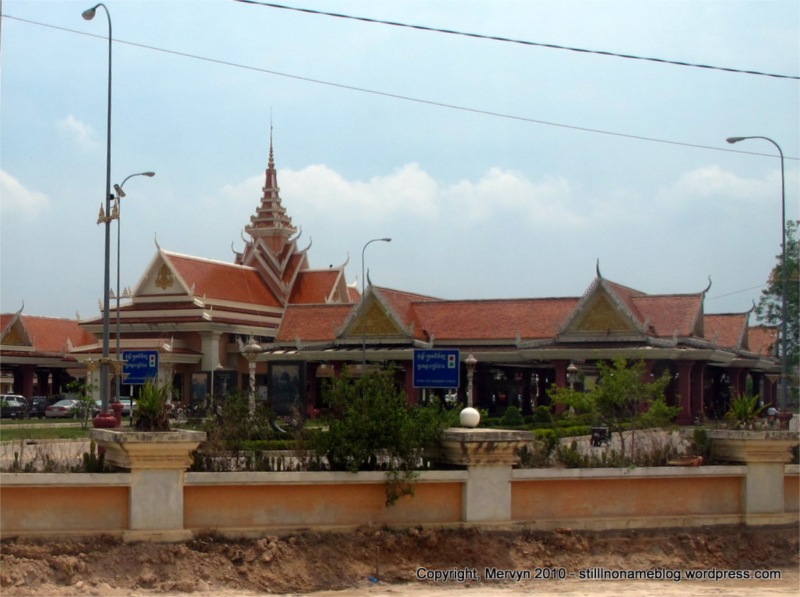
Nobody had a passport. Our helpful bus guy had them, I think. I joked about this with a Chilean guy. “I won’t worry unless you’re all across and I’m still here alone,“ I said.
The immigration officer at the little booth worked his way through stacks of passports. Every once in a while an official would call out people’s names and countries. Those lucky people would elbow their way past the waiting crowd, grab their passport, and officially be in Vietnam.
It’s like the Vietnamese authorities didn’t really care if we were the people on our passports. They were just trying to work their way through paperwork. We waited under the watch of heat sensors that were seemingly there to weed out the sick and infirm.
I was one of the first Westerner’s on our bus to make it through. I grabbed my passport, waited in one more line to show a guard that I had a proper visa, then I was through. I hopped back on the bus where I waited. And waited.
Turns out Ho Chi Minh City is only a bit over an hour from the Cambodian border. Of the 6 hour plus journey from Phnom Penh to Ho Chi Minh, two hours of it was working our way through immigration. The bureaucracy lives strong.
A few first impressions of Vietnam. It seems cleaner than Cambodia. There appears to be less garbage on the side of the roads. The river I saw seemed trash free. Who knows if this is representative.
The dress is a tad different. The women on motorbikes seem to be even more covered up than usual. They’ve got long fitted sleeves, gloves, and face masks. Some even wore those wide, flat, pointy rice paddy hats that you see in pictures.
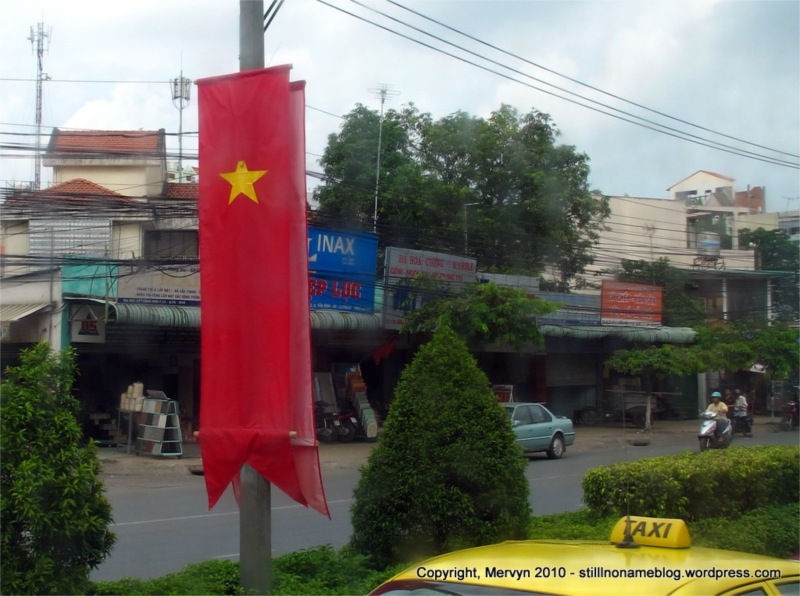
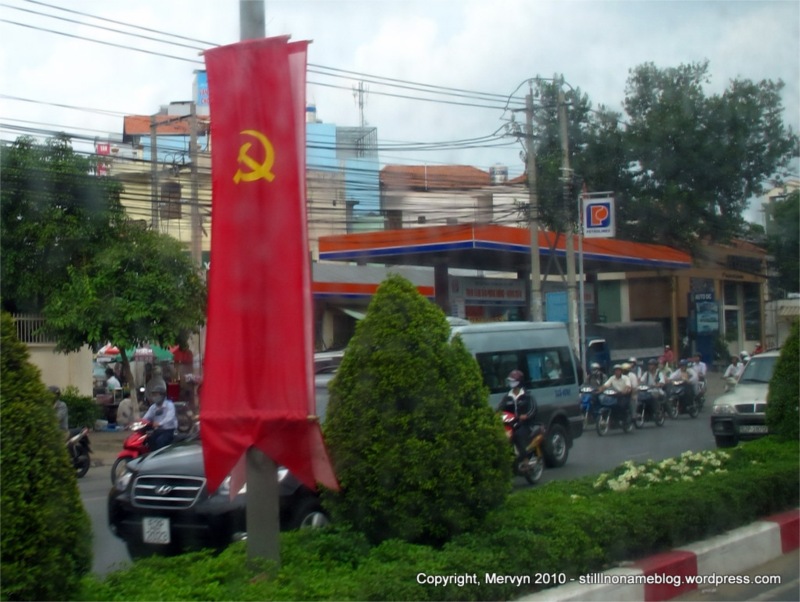
There are also Vietnam flags everywhere. If I didn’t know better, I’d guess that it was their independence day. If it’s not, this is a hell of a nationalistic country.
While the red flag with yellow star is not a surprise, what is is the plentiful banners with the hammer and sickle, yellow on a red background. There seem to be as many of those as Vietnam flags. I’m going to guess that I’m in a communist country.
I decided to stay at the first place I visited, the Ha Vy Hotel. Ten bucks a night for a room with a desk, fan, fridge, hot water shower, sink, flush toilet, and tub. On my journey none of these amenities has been a given. I’m living in luxury, baby.
I crashed for the afternoon, having spent the previous night waiting for a Laker game in vain. When I came to, it was dark.
I ventured out into the street. Lots of neon and motorbikes. And lots of people. I seem to be in a tourist part of town so there were a lot of pizza joints and other Western fare. All more expensive than I wanted. All a little too familiar.
There were a lot of locals about, so I knew there must be a place for Vietnamese. I hunted for a bit and found a fluorescent lit restaurant where everyone was native.
No menu, of course. Just a lady behind a metal cooking stove surrounded by ingredients. A guy asked if I wanted soup. I said, “Yes, beef ball.” He walked away, so I guess that meant something to him.
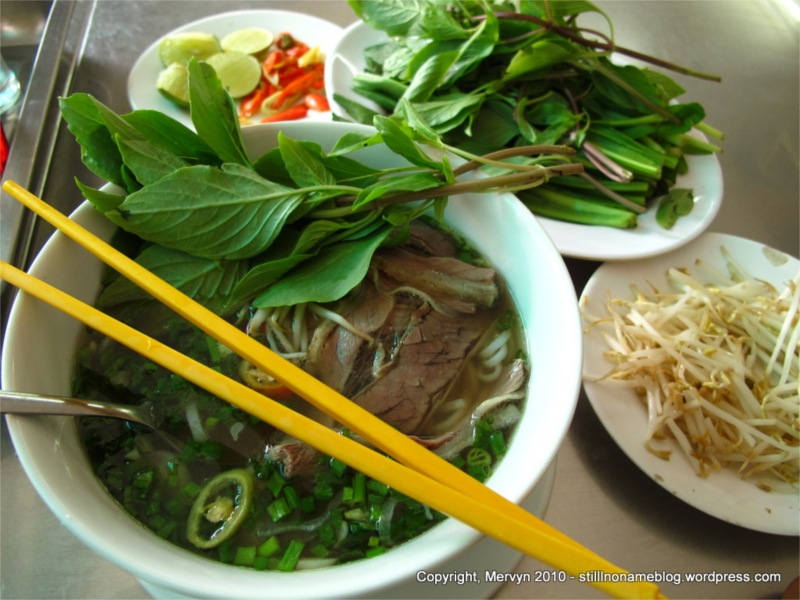
Sure enough, I got a bowl of pho with compressed meats of various shapes and colors. I was starving and wolfed it down, occasionally pausing to toss in mint leaves and bean sprouts. It was good. Very good. I sipped on a 7UP and munched happily.
When I got up to pay, the guy asked for 40,000 dong. I think I yelped. I couldn’t remember what the exchange rate was and I was trying to do math while pulling out my cash.
“How much?” I asked, trying to figure out if I was getting ripped off.
“40,000,” he said.
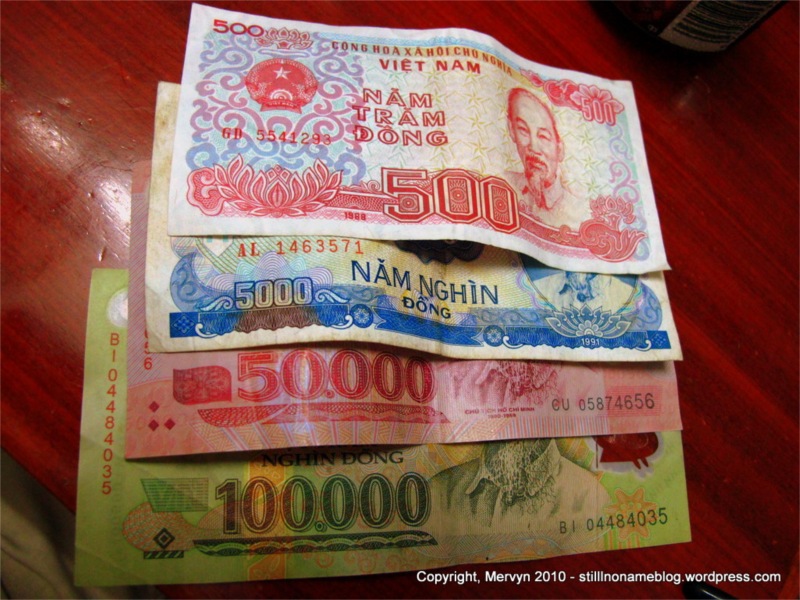
While I fumbled with the cash, he pulled a 100,000 note from my hand and gave me back 60,000. That’s when my brain came to. He just asked me for about two bucks. He wasn’t trying to rip me off. He was being straight–helpful even. I’m just slow.
The amounts still blow my mind. I think they should drop a couple zeros. Make life easier for us non-number people. It’d keep me from embarrassing myself while fumbling with my dong in front of others.
Low hanging fruit, baby.
Day 60 – Asian TV
Dateline: Phnom Penh, Cambodia – Sunday, May 2, 2010
I’m not in Ho Chi Minh. I’m not in Vietnam. I’m in Phnom Penh. Today was all about fixing my problem. Lots of editing boot.ini files and tracking down sys programs. Boring, tedious, frustrating as hell. I’ll spare you the details and skip to the part where I’ve ironed everything out with a little help from my editor. But it took all day.
Not surprisingly, I decided not to take any pictures of me sitting in the internet café cursing at myself while swapping a USB drive in and out of mine and the café’s machine. That would have been a little too real for the purposes of this travel writing project. I have my dignified image to maintain after all.
I’m not, however, at a loss for words. That’s because between bouts with my machine I took breaks by watching local TV. And I learned something.
The world watches a lot of soccer and motorsports. Not “more than the U.S” a lot. A lot as in “more than any interesting human being should ever be allowed to ingest” a lot. The quantity is not relatively large, it’s absolutely large.
I knew about the world’s fascination with soccer. I was not as aware of the world’s fascination with motorsport. This is a sampling of motorsports aired today: one moto GP (125cc) race, one other moto GP (some larger cc), two touring car races, one open wheel race, and even one go kart race. Seriously. Go karts. Little mini-cars racing around one of those tracks you see next to the mini-golf spots by the side of the freeway. It’s like if ESPN decided to show pee wee football in the U.S. Is this kind of programming necessary? Is it even legal? No wonder Top Gear is one of the most watched TV programs in the world. Watching TV here it felt like almost everything was petrol related.
That and soccer were about the only things they were showing on the sports channels. They actually showed each game or race over and over again. Once live, then at least one re-air, sometimes two.
I actually had to flip away and watch parts of old movies like Dirty Rotten Scoundrels (decent despite its age and the presence of a weak female lead) and You Don’t Mess with the Zohan (awful, despite the presence of Emmanuelle Chriqui’s everything).
In other TV news, the channels here also show a lot of crappy American TV. Stuff like Grey’s Anatomy, the CSIs, The King of Queens, and old episodes of cancelled U.S. shows (is Trauma even still on the air?). There were ads for Glee and The Amazing Race, which are the opposite of crappy so I guess the world’s impression of American entertainment doesn’t totally suck.
One thing they don’t show is NBA playoff basketball. I should know. I stayed up until 3 a.m. writing with the TV on hoping to find Game 1 of the Lakers-Jazz series. Even though I’d seen ads for the NBA playoffs on ESPN, I had no luck. Instead, I suffered through the end of a Yankees blowout of the White Sox, a rebroadcast of a motorcycle race, and X Games Asia (speed rock climbing, won by a Russian). There’s a perfectly good basketball game going on live and ESPN Asia decides that speed rock climbing is a better programming call. Gaw. I don’t care what the NBA says—basketball is not as worldwide as it claims to be.
Tomorrow, no more television. The writing machine is back up. That means I leave on another early bus (6:45 a.m.) for Ho Chi Minh. Vietnam, here I come.
Dateline: Sihanoukville and Phnom Penh, Cambodia – Saturday, May 1, 2010
I trudged my way through floodwater and God knows what else. My shoes and socks in one hand. My pants rolled as high as I could get them. My passport, cell phone, and mp3 player jammed as high in my pocket as I could manage. The water was mid-thigh and threatened to get deeper– I was walking on the raised sidewalk, after all, and would at some point have to step off it to cross the street. Garbage, food remnants, and unidentified sludge floated past in the thinly falling rain. This is not how I planned on spending my last night in Phnom Penh.
This morning, I got up early and boarded a bus from Sihanoukville to Phnom Penh. It was pretty much the same as the bus ride to Sihanoukville. No karaoke blaring on the TV though. For some reason most buses insist on this “entertainment.” I was happy to do without.
I slept my way through much of the trip. When we disembarked, I had the moto driver take me to a centrally located guesthouse instead of the one on the lake that I’d stayed at before. It was a bit pricier ($7 v. $3) but then I wouldn’t have to rent a motorbike to get to food or to find an internet café that I trust.
I planned to spend the day writing in my room. There was even a desk and chair with an outlet nearby; a genuine find, really. Most places I feel lucky if I have a sink.
When I went to boot my netbook, though, I couldn’t get it to work. Of all the rotten luck. The perfect spot to write and a lot of time on my hands and I can’t get my writing machine to boot.
I spent the afternoon researching my problem, trying to get it to work. I walked back and forth the few blocks between the guesthouse and internet café trying out different solutions. Nothing.
Now, it may seem silly to walk blocks away to an internet café when there were a few in my neighborhood, but finding a place that I know is virus free is actually kind of tough. Sticking a USB drive into infected computers is just begging for trouble. I should know, since I caught a bug a couple weeks back and spent two days purging it from my machine. I would gladly walk for a non-infected machine.
I must have walked back and forth between the café a million times. As darkness fell, I resigned myself to my fate: my device was a brick.
I decided to skip out on Ho Chi Minh for one day. Instead of leaving tomorrow, I decided to spend an extra night in Phnom Penh to try and fix the thing. I know this place pretty well. I know my way around to the guesthouse and the safe internet cafes. No sense in stressing myself out in a new city while trying to find a fix for my comp.
Settled on my new reality, I sat down for dinner at a local joint for the cheapest meal in the area. The noodles were adequate. Much improved, though, by the vinegar sauce the helpful server girl plopped in front of me and gestured that I should use with my dish. The drink, on the other hand, was great.
I’m not sure why I waited so long to try sugar cane juice, but I wish I hadn’t. I’d seen it made on the street. Sugar cane fed through two rollers that squeezed the juice out into a trough that led to a customer’s cup. When the juice was squeezed out, the proprietor would fold the cane in half and feed it through again. He or she would repeat this process until the cane was dry.
The juice looks like cloudy yellow water. Dirty. Like there might be algae or worse in it. It tastes like heaven though. It’s not that sweet even though it’s made of sugar and has a bit of sour to it. It goes down smooth without a hint of viscosity or sediment. It’s very refreshing when served over ice. I can see why it’s a local favorite. And it only cost 1000 riel (25 cents). One of the best ways to spend a quarter. If I come across it again, I’ll be having another glass, maybe two.
As I sat eating my meal, it started to drizzle. By the time I was through, it was raining. I decided to sit it out. I figured it was your typical tropical storm and that it would blow through in 45 minutes or so. No point in walking the three blocks to my place and getting soaked.
I figured correctly. It stormed and rained, then finally stopped. What I didn’t figure was the flood. During the torrent the water in the street rose. Unlike the rain, it never receded. Motorbikes stalled in the water. Cars got flooded as they tried to plow through the waist deep street river. The only things that consistently made it through were pedi-cabs and lifted trucks, two vehicles at the extremes of the transportation technology spectrum. When a lifted truck plowed through the street it would cause a wave to barrel towards the shop door. It was making a mess of the place, washing trash and debris to the restaurant’s door step.
When the rain stopped, there was nowhere to go but through the water. I pulled off my shoes and socks, rolled up my pants, and waded through. Barefoot in Phnom Penh. Barefoot in Phnom Penh in a flood. Barefoot in Phnom Penh floodwaters in a questionable sewage situation. I was pretty sure I didn’t have any open wounds on my feet. Guess I’d find out soon enough.
I immediately turned off my brain to cope. I ignored the trash. I ignored the fact that I wouldn’t have walked barefooted through the streets just two hours before. I ignored the idea of sewer water. I ignored everything but one foot in front of the other.
I did allow myself to notice the little kids splashing through the water and the other stranded citizens trying to slosh their way home. If they could do it, so could I.
I picked my way over the uneven sidewalk. I tripped over curbs. I stumbled around stranded tuk tuks. I felt my way through gutters. I just wanted to get home and get a shower.
I made it. I don’t think I got tetanus. Nothing seemed infected. My computer, though, was still a brick. Ah, life on the road. If it ain’t one thing, it’s another.
Day 58 – No Rush
Dateline: Sihanoukville, Cambodia – Friday, April 30, 2010
Just another lazy day on the coast. No pictures or sightseeing. I haven’t even bothered to visit the beach even though this is supposedly a beach town.
For me, it was just heat and writing. I sat in my $5 room and pounded on the keyboard trying to put together the Similan dive entries. The format that I’ve decided to use is way more challenging than I first anticipated. It’s taking me way too long to get through. I’m half tempted to scrap it and start over, but I’m a bit over halfway done so I’m pretty much committed. I’m trapped in a device of my own making. A device that, despite my efforts, just might suck. Ah the perils of being a writer. You put your work out there and just hope you don’t hear your readers scream. If you are within earshot, then you console yourself with the happy fact that you actually have readers.
This job doesn’t pay me enough.
I was productive in other ways, though. I picked up my passport from the travel agent that arranged my Vietnam visa. I also bought a bus ticket to Phnom Penh for a bus that departs at 6:45 a.m. tomorrow. I thought about buying one straight through to Ho Chi Minh, Vietnam (formerly Saigon), but decided against it. The journey would have been 10 hours, at least. By stopping in Phnom Penh I get to split the trip into two legs. I also get to spend another day hanging out in the city. No rush.
To that end, I have nothing to add. Consider this a placeholder entry. I get at least a couple of those, don’t I?
Day 57 – Old v. New. . .New Wins (Cambodia Dive 2)
Dateline: Koh Tang off the coast near Sihanoukville, Cambodia – Thursday, April 29, 2010
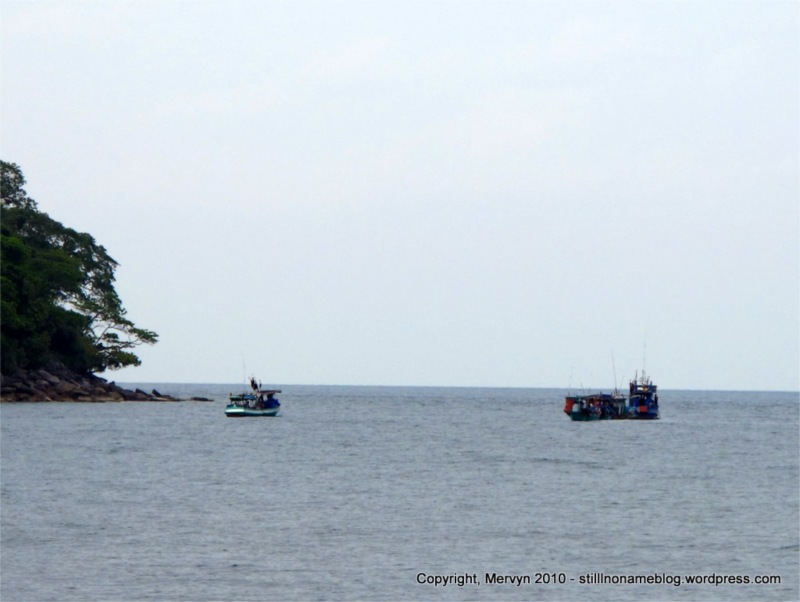
On our first dive I discovered a source of the damage to Koh Tang’s reef. Dynamite fishing.
Explosions underwater sound different than on land. Sound travels much better through liquid than through thinner air. The explosion makes a “doing” sound followed by a concussive blow. The French guide Fab, David, and I were swimming along a reef when we heard it. It didn’t echo. It sounded like it was all around us, then it was gone.
Fab immediately turned around and asked if we’re okay. We signaled that we were, then continued out swim.
When we hit the surface, Fab said the explosion was probably 1 km away. We looked around and but couldn’t see a fishing boat. We heard it, though.
Dynamite and cyanide fishing are a symptom of a larger problem. In much of the world, technology has developer faster than the culture that surrounds it. Dynamite and cyanide are powerful substances that, if misused, can have incredibly damaging effects. Here, people trying to making a living off the sea have found an easy, efficient way to catch fish. They drop a stick into the water and when it detonates the fish come to them. They’re living the life they’ve always led, fishing the sea for food and for sale. The difference is they have a tool that’s outpaced that simpler way of life.
I’ve seen the same thing happen with plastic, that innocuous everyday piece of tech. Back in the day, trash was mostly organic. Toss a mango peel or some bones out your window and it would just recycle itself back into the earth. Everything else was more permanent. Spoons, forks, chopsticks, plates, and cloth bags were all washed and reused. Anything that wasn’t permanent you could actually throw on the ground and know that it was going to the best place possible, back into the earth from whence it came.
We experienced this on the boat. We tossed our organic garbage into the ocean once we were over the deep. There it sank to the bottom or was consumed by the wildlife. No big deal. Bananas fall in the ocean all the time and don’t kill the environment so what’s another peel or two.
The high tech disposable culture, however, has found its way into this more natural way of life. The disposable culture relies on cheaply made, highly sophisticated pieces of technology. Plastic bags and Styrofoam are today’s banana leaf wrappers and cloth bags. They are the containers that hold food and produce. They are cheap and do a better job of protecting what they hold than their organic counterparts. They are also nearly indestructible.
The problem is, these fabulous substances aren’t built for a culture that still has a rural, agrarian mindset. A mindset that throws its organic garbage into the wildlife. Now, when someone throws a plastic bag out a window, it stays around forever. It doesn’t disappear into the ground. It isn’t broken down and eaten by insects and wildlife. It is litter.
Evidence of the clash of technology and culture was front and center when we hit the pier after our scuba trip. Underneath the stilt houses were piles of trash. Plastic bags and plastic wrappers, mostly. The residents just threw them out the windows when they were finished with them. Unlike their food refuse, though, the plastic was there to stay.
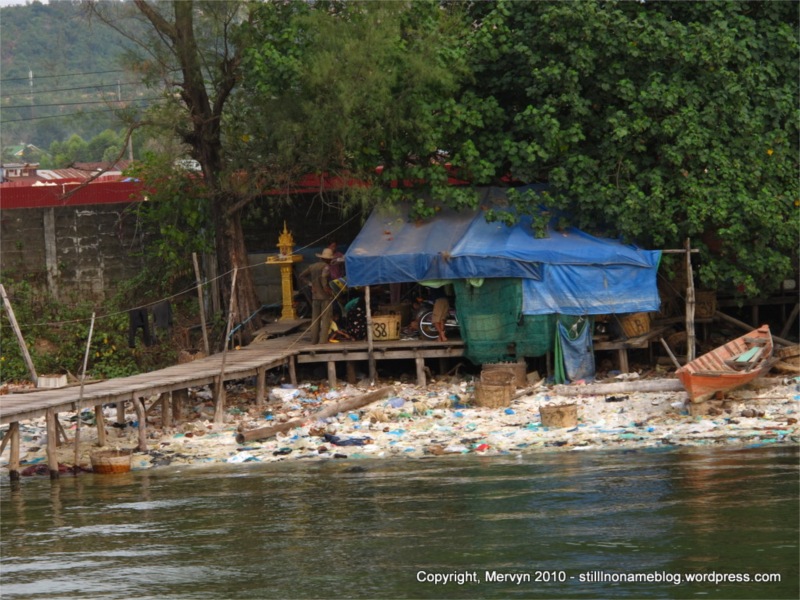
As we motored into the harbor, we passed fishing boats heading out to sea. It was near dusk and time for the fishermen to make their living. Diesel motors powered their boats out to sea. Some carried nets. Others more than likely carried dynamite. A mix of old and new.
If you want to save the environment, forget chasing down whale ships or sabotaging tree cutters. Just come up with a biodegradable substance that can be used in place of plastic. That or try to explain to the poor of the world with a straight face that they need to start picking up their litter otherwise they’re hurting the planet—you know the same planet where they don’t have potable water and make less in a month than you make in one hour. I think the time’s better spent in a lab.
Day 56 – Clobbered Cambodian Coral (Cambodia Dive 1)
Dateline: Koh Tang off the coast near Sihanoukville, Cambodia – Wednesday, April 28, 2010
It’s like swimming through a battlefield. The Koh Tang reef off Cambodia’s coast is damaged. Very damaged. There seem to be more sea urchins than living coral. There aren’t a lot of crown-of-thorns starfish, but it’s clear something is killing this ecosystem.
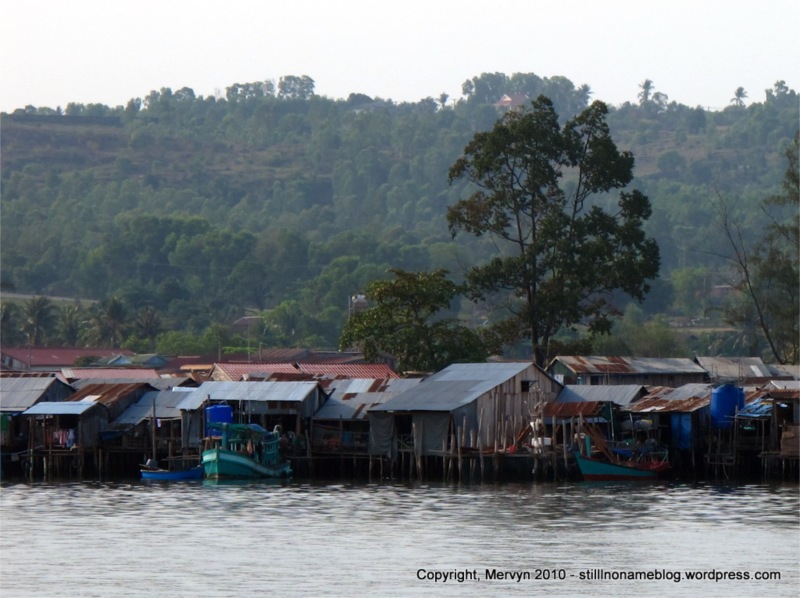
I started the morning by boarding a small wooden boat off a dilapidated pier. To get to the boat we had to walk through shacks and stilt houses. It was an odd sight, us rich divers marching through a poor Cambodian waterfront community off on our expensive dive holiday.
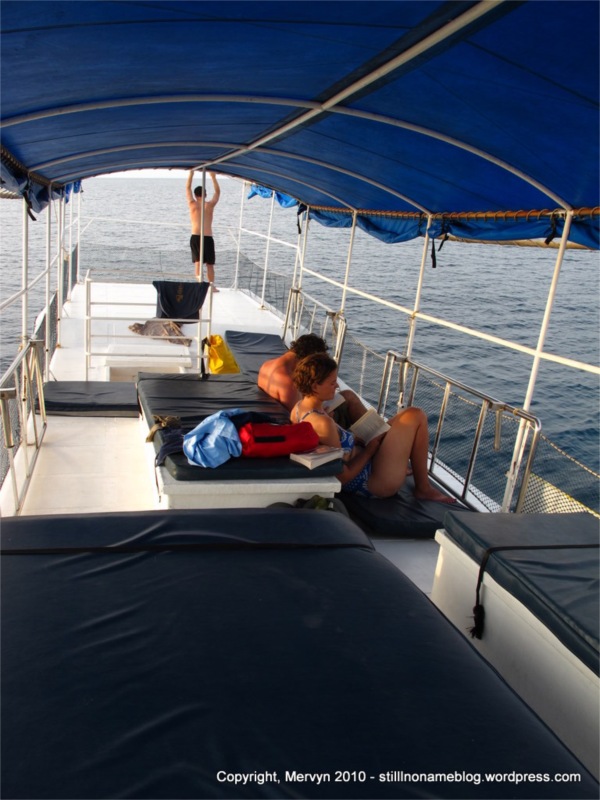
The double-decker that awaited us is to be my home for the night and the next day.
I am joined by two scuba guides: a mad scientist-looking Frenchman and a young Scot. The divers are an Aussie couple, a young French guy just out of university, and a middle-aged Scotsman who’s brought along his younger Venezuelan girlfriend, the kind of girl that talks and laughs loudly like she’s cuter than she actually is. She’s lived in London for some time so she provides the oddity of saying “cheers” and “reckon” in a Venezuelan accent. Her boyfriend doesn’t say much.
I decided to indulge in a scuba dive trip while in Cambodia. It’s a luxury, but one I thought I needed. I was sick a couple days back. My travel spirit needed a bit of a recharge.
Now that I’m here, I’m not so sure. It’s not been as lovely as I’d hoped. I realized today that I’d been pampered by the Similans in Thailand. That had been an epic dive trip. A first class boat in a first class location with first class food.
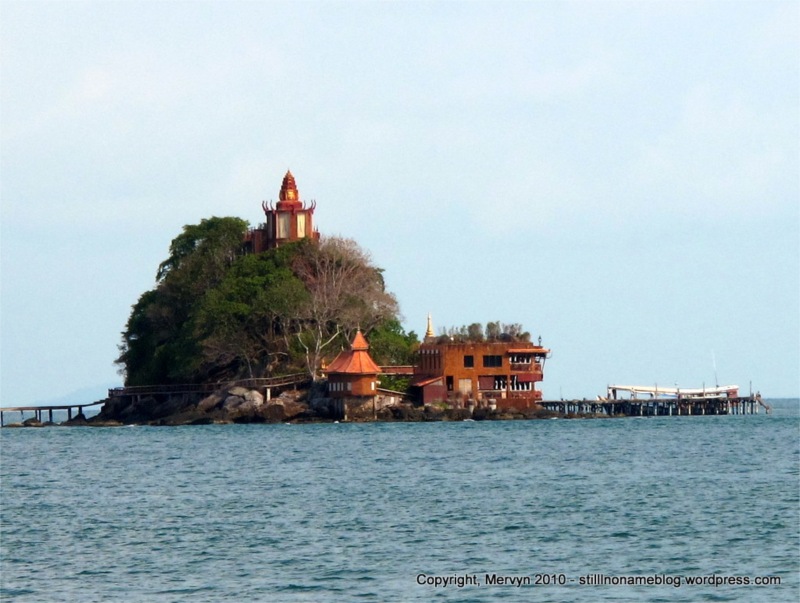
The boat that I’m now on is a bit rougher as is the crew. The food is more basic. Here, I have no cabin. We’ll basically sleep outdoors on cots. The dive locations are equally rough. Cambodia, it’s clear, has not made it as high a priority to keep its reefs. Where the Similans were colorful and vibrant, the reefs here are sad and hurting. The fish seem to be more timid, at least those that are left. The sandy bottom is littered with dead pieces of coral. It’s a sharp contrast to all my previous dives. It helps me appreciate just how precious a good reef is. This reef is in tough shape.
On my second dive of the day, I discover why. Embedded in the reef is fishing net after fishing net. The fishermen just cut them loose after they got caught on the reef. Some have been there a while, some look newer. People are still fishing here.
It’s sad really. This reef is the home of smaller fish. Those fish feed the big fish that serve as food for humans. The fishermen are slowly killing the source of their livelihood. They probably don’t even know it.
Despite the damage, I did see remnants of the reef’s former glory. There are crevices protected from nets where sea fans still flourish. There’s an eel here and there. Bluespotted ribbontail rays peer out from under the reef.
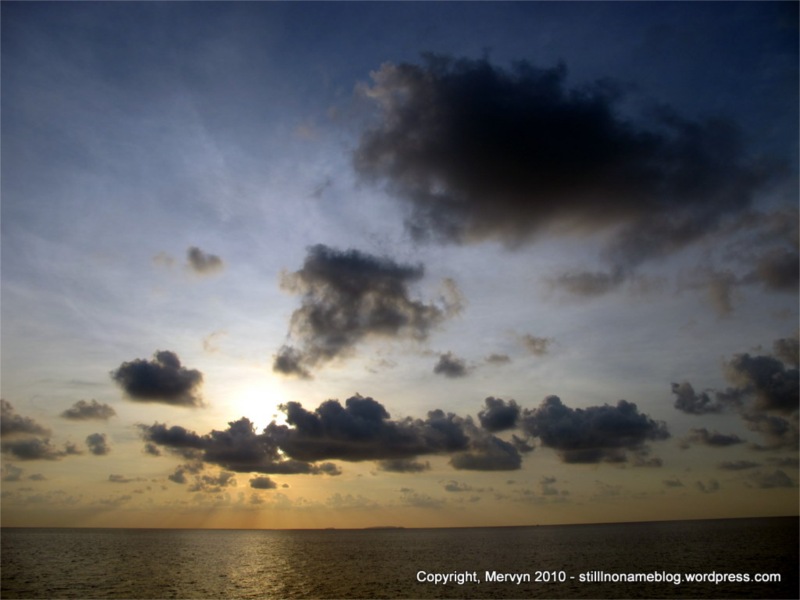
The state of the reef seems to reflect the state of Cambodia itself. The reefs, like the nation, are hurting. They’ve suffered a tremendous amount of damage to the point where it seems hopeless. If you look closely though, you can find signs of hope. The crevices of the reef, like Angkor Wat, hint at a glorious past that could perhaps be reclaimed. A little sign of hope that the tragic thing that is might still recapture its beauty. If only it’s not too late.
Day 55 – Searing in Sihanoukville
Dateline: Phnom Penh and Sihanoukville, Cambodia – Tuesday, April 27, 2010
It feels hotter here. I can’t tell if it’s my imagination or if it’s real. I haven’t seen a thermometer. Even if I did, I’d be hard-pressed to ascribe the number any meaning—everything here is in Centigrade.
I do know that when I sat down at the internet café to run through some work e-mail, I was soaked. All I’d done was walk down the street.
Sihanoukville is Cambodia’s largest beach destination. It took $4.50 and four and one half hours to get here. It seemed like the bus spent one hour of that getting out of Phnom Penh. Maneuvering city streets is a lot harder when you’re the size of a small whale. Much better to be one of the swarm of motorbikes. As we rolled out, I realized this was only the second time I’d gone through the streets in an enclosed vehicle. I miss the motorbike already.
When you’re in an enclosed vehicle like this, A/C seems like a necessity. Without it, you’re in a giant moving greenhouse. A human powered sauna. You’re steeping in each other’s essence.
On a motorbike, the world is your air conditioner. If you’re sweating, you’ll dry off fast enough once you get moving. It’s like you’re standing in front of a powerful electric fan. I don’t give wind chill much thought. Usually when it’s provided in the weather report it’s in the context of, “It’s cold today. And because of the wind, it’s going to feel even colder!”
Here in the tropics, I’ve meditated on its wondrous properties. The difference between sitting in a hot, still room and a hot room with a fan is the difference between sitting on a bonfire and taking a dip in an icy lake. The difference between sanity and Courtney Love.
I bore the heat long enough to give my passport to a travel agency to process my Vietnam visa. A few dollars service charge saved me the pain of trucking myself down to the local Vietnamese consulate and sitting in line. Being a rich Westerner occasionally has its privileges.
With that, I melted back to my room to write and sit under the electric fan. I still wasn’t right on the inside. Oddly enough, I’d narrowed down the suspects to two of the most Western restaurants I’d eaten at the day before I fell ill. Life isn’t without its ironies, is it? I’d have been better off eating street food.
Early tomorrow I hop on a boat for an overnight scuba dive trip in the Thailand Gulf. I expect it to be less spectacular than the diving in the Andaman Sea. It will be fun, regardless. There are few things in life I’ve felt that I’ve been meant to do–diving is one of them (the others are reading, writing, eating, and playing a shitload of video games; diving is by far the most interesting).
That means a two-day break. Expect my return to be with a vengeance. My photo trigger finger hasn’t been used in days.
Day 54 – The Price of Marriage in Cambodia
Dateline: Phnom Penh, Cambodia – Monday, April 26, 2010
Another day with no pics. Again, I claim exemption due to illness. (My editor is lovin’ this. Pics lengthen his work process, even more than sickness induced typos.) While I was not feverish, I was far from well. The Battle of Antietam had settled into a firefight between my immune system and the evil sickness’s evil forces. While that’s a mighty step down from formal engagement, my body was still taking casualties, many in the form of brain injuries that force me to draw out tortured analogies to combat. All’s fair in love and digestive war.
While I couldn’t be bothered to take the time to photograph anything today between internal chants of, “Keep it together. Keep it together,” that didn’t make my day free of interesting encounters.
In the wake of my illness I finally got around to visiting Seeing Hands Massage. As the name implies, all the masseuses are blind. It’s a great way for them to earn good money. It’s an awesome way to help me recover. At $6 for an hour, it was also cheaper than a doctor’s visit or any medication that might be prescribed.
Not sure if it was because I was still a little ill or that the masseuse was male or that he was blind or that he was doing shiatsu massage but I am sure that I was flinching a lot more than I normally do. He couldn’t see me flinch (see: blindness), but I know he felt me flinch. Every time I’d involuntarily tense, he’d ease up on the pressure. At one point he said, “Relax.” Oh, buddy, I was trying, it just wasn’t working.
When he was through, I was kicking myself for not trying out the place earlier. I highly recommend it. Also, after you’ve paid your blind masseuse for doing some damn fine work, you’ll feel less guilty when you wave off the legless guy in the wheelchair who’s selling books.
I returned the motorbike today, too, in anticipation of leaving for the south coast of Cambodia the next day. Sihounakville is a 4.5 hour bus ride away and I wanted to get an early start. That meant giving up my wheels in the evening while the rental place was still open.
The young tout who brought me to the shop followed me there to return the bike. The shop was temporarily closed because the cute girl that ran the place was at an English class. When she arrived, I paid my $30 for 5 days. The lady that took my money (the cute girl’s sister), almost reached over the desk and gave me a hug she was so happy. She kept saying, “Thank you.” I don’t think people normally rent bikes from her that long or probably for that much. She’s lucky that men do stupid things of no consequence just because they are in the presence of an attractive woman. Men are idiots. I’m just lucky my idiocy only cost me $5. How can you not love Southeast Asia?
The young tout, Sung Mune–don’t ask me how to spell or say it, I almost just made his name up—made me promise to drink with him later that night. Queasy stomach and all, I agreed. One never hurt.
I sat around the Floating Island lounge reading. When Sung Mune arrived after his English class (75 cents an hour) he sat down with me for a chat. I tried to choke down solid food (fried onion and beef) and we sipped beer. Every few minutes we’d raise our cans and say, “chueng mooi,” which means “Cheers” in Cambodian.
I got through a third of the meal before I had to stop. I couldn’t eat any more. Sung Mune’s friends arrived with food and more drink and we joined them at a larger table. A large platter of barbecued chicken entrails and chicken heads. I so wanted to give them a try. I couldn’t—I’d already abandoned almost a full meal of food. I could only watch as everyone dug in with their fingers. “Chueng mooi!” Beer over ice. It was like New Year’s all over again.
When I’d talked to the young tuk tuk driver two days before he’d told me about how expensive an education was for him. He’d also mentioned that women didn’t want to talk to you if you didn’t have money. I figured this was just the worldwide phenomenon of “no money, no honey.”
Talking with Sung Mune and his friends as they feasted on chicken parts, I realized it was something much more elemental. They told me that you couldn’t get married unless you could give her parents $1,000 or $2,000 dollars. The dowry lives on.
That may not sound like much, but Sung Mune says he earns $40 – $50 a month. That’s Jacob money right there. Seven years of labor, at least. Sung Mune apparently is interested in the cute girl who rented me the motorbike. He said he likes her but every time he tries to woo her, she says, “Talk to my parents.” It’s not that she’s necessarily a gold digga, but her fam ain’t messin’ with no. . .well, you know.
Just another complication in a complicated country. Nothing’s cheap for people here. Everything is, for me. Just a little perspective. It’s one thing to know that some people live on a dollar a day; it’s another to see someone try to get by before your eyes.
Tomorrow I head south for a two-day dive trip. Perhaps I’ll have the wherewithal to take some pictures by then. For now, I rely on my words.
I agree with you—I like pictures better.
Day 53 – Let’s Make A Deal (Cambodian Police Edition)
Dateline: Phnom Penh, Cambodia – Sunday, April 25, 2010
In the past three days I’ve broken more traffic laws than I had previously in my entire life, all aided and abetted by the local Khmer drivers. I’ve run red lights, gone the wrong way down one-way streets, made left turns on red, ridden through stop signs, crossed double-yellow lines, and gone into the left lane into oncoming traffic. So it’s ironic that it’s the one traffic law that I DON’T break that gets me into trouble.
Today, I was sick as a dog. Without going into details, let’s just say my tummy and whatever was inside decided they didn’t like each other and decided to hold a reenactment of the Battle of Antietam except with the spilling of more bodily fluids. It was not pretty. Between salvos, I was able to drag myself out to get some medicine and e-mail the latest entries to my editor.
On the way home I was making a right onto a busy road when a cop jumped out in front of me waving his hands. Like a damn fool American, I stopped and followed his cues to park. Then the games began.
“You have license?” another cop said in English, not even bothering with Khmer.
MISTAKE: “Yes,” I said, and I handed him my license.
I should not have given him my license. If you ever get pulled over in Cambodia, pretend you don’t have your license. Say you left it in your room. Pretend like your English is not so good. Whatever you do, do not give them your license.
“Where you from?” he said.
MISTAKE: “California,” I replied. For the love of GAWD do not let them know you are from the land of the Golden Mountain that is America. Do not put dollar signs in their eyes. Do not, under any circumstances, give them the impression that you have money.
“Ah, U.S.A.” he said. “You must Cambodian license. You Cambodia. You have Cambodia license. Go to police office, pay $50.”
Now, everyone I’d talked to had said that cops usually were only looking for $1 or $2 and they’d let you go. You have to, however, play the game. You have to dance. You have to put a little tease into it, shake your hips, bare your shoulder a little, then give it up. They won’t respect you otherwise.
“I don’t want to go to the police office. I want to work with you. You seem like a nice man. What is the fine if I pay you? One dollar?”
He laughed. MISTAKE: I’d played it too quick. I was feverish and just wanted to lie down and sleep. I’d gone from a wink and a smile straight to taking my top off. Mr. Officer wanted to play it out a bit more.
“No no no.” He pulled out a rule book written in all Khmer and pointed to a subsection that had, written next to it in the margin, $50. “Fifty dollars,” he insisted.
“I don’t have $50. I can’t afford that,” I said. I wanted to make him a participant in my Civil War recreation. I wanted to puke on his shoes.
“Five dollars,” I said in desperation. I really needed to lie down. I really needed my health back. This ass wanted to play games.
He pushed. I pulled. He pretended to go to his pad. He pointed at pedestrians who’d been roped in by another officer and said, “$20, everyone, $20.”
“Fine,” I said, getting desperate. “$10.” I was sweating now and not because of the heat. I needed an electric fan. I needed to recline. I needed this punk police to get off my case and just let me go.”
Still no. He proposed $15.
I said, “That’s all the money I have! I need to buy medicine. I’m sick. I need medicine. If you want $15, I’ll have to go to ATM. You and I don’t want to do that.” I think I was getting whiny. It was becoming undignified.
He looked at another cop. They conversed. The other cop nodded.
“Okay. $10.”
I forked over the money. As I got back on the bike and put on my helmet, the other cop walked up to me, smiled, and shook my hand. I think I just made their day. Shit, with that $10, I may have made their week.
At that moment, a larger, fat cop jumped out into the street in front of a motorbike that had just run a red light. The motorbike slammed on its breaks, nearly hitting the officer. The officer danced side to side, trying to block the biker’s path. The rider, swung his wheel hard to the ride, made a U-turn, and raced off. No ticket. No bride. No chase. No. Freakin’. Way.
MISTAKE: I stopped for the cop. NEVER stop for a Cambodian cop unless they have their guns drawn and are six deep on a roadblock. Run. U-turn. Dodge. Play stupid. The one rule you can’t afford to follow is the one your law abiding butt is going to have the hardest time overcoming. Trust me on this.
Also, it helps if you’re clearheaded and healthy. I will pretend that this would have all come out differently if I’d been less engaged.
____________________
No pictures today. One of the unspoken rules of travel writing is that when you don’t eat solid foods for over 36 hours you’re allowed to skip picture taking duties. If you’re lucky, I’ll feel better tomorrow and I’ll be back to my 5,000 word, 100 picture self. Till then.
Contact Mervyn
You may now attempt to call Mervyn in Cambodia. The Contact Mervyn page, available here or through the top menu, has been updated with the new pertinent information.
Day 52 – The Streets of Phnom Penh (On Driving in Cambodia)
Dateline: Phnom Penh, Cambodia – Saturday, April 24, 2010
A few more thoughts on driving in Cambodia.
Observation #1: No one will ever complain that you’re going too slow. Corollary: You can’t complain that anyone else is going too slow.
It’s not like people are going fast to begin with. Top reasonable speed in the city is 40 km/h or 25 mph. Most of the time you’re at around 30 km/h or 19 mph. That’s for good reason.
Again, no one stops. If you’re driving down a main road, people will fly into you from the right and left without even glancing over their shoulders. You have to be prepared to stop quickly. If you’re at a four-way intersection, no one is going to stop, so you have to be prepared to slow down quickly. That means going slow.
People also drive slowly because other, non-motorized things are on the road. Bicycles, for instance, are common despite the heat. Pedestrians will also inch their way across the road so you must be vigilant for them. Pedi-cabs are rare, but do make their appearance–they take up a whole lot of room and move very slowly.
I one time even saw a woman push a hotdog stand contraption through a busy intersection, making a sweeping left turn along with the rest of the traffic. No one even bothered to honk. She never glanced around to see if she was going to die. She just wheeled that thing along like she belonged. The best part is, she did.
Observation #2: A outstretched left arm means: “I want to turn left.” It also serves the practical purpose of being a mini-road block.
Just like in the U.S., when you hold your hand out to the left, it tells everyone behind you that you intend to turn left. Here, it also blocks motorbikes from zipping past on your left as you slide left to make your turn. If they were to go by, they’d get clotheslined and violate the most important Cambodian driving rule: Don’t hit or get hit.
Observation #3: You cannot let your mind wander unless you want to be impaled by a chicken.
Not just chickens, but metal poles, loads of sugar cane, and oncoming traffic. Ostensibly, Cambodia drives on the right-hand side of the road. In reality, you drive wherever there’s not people. If you need to make a left, for example, and there’s cross traffic coming from the left, you just duck into the left side of oncoming traffic and cruise slowly until there’s a gap so you can zip to the right lane.
Because of this, if you’re driving on the right lane, you have to be aware of people coming right at you. You also have to watch out for pedestrians stopped in the middle of the road as they play Frogger through the streets. You have to make sure you don’t plow into the back of a slow-moving bicyclist.
Bottom line is, the second you start to daydream, you’ll inevitably almost hit something. I have a rich inner-life, so this can be a challenge. I’m forced to constantly scan and look around and try to be entertained by the outside world.
Observation #4: The most dangerous things on the road are all driven by young men.
Young men are idiots. I was a young man once so I should know. Hell, I’m not so young and I’m still a damn fool.
The reason I bring this up is that the most dangerous thing on the road in Cambodia are fast drivers. They zip through traffic in cars or bikes going much faster than would allow them to stop quickly. Fast drivers are, I’m quite sure, the biggest reason for fatalities. Otherwise, how could anyone die if they were only doing 15 mph or less if they braked?
The fast drivers have, in my experience, all been young men with invincibility complexes. If I wind up dead on the side of a Cambodian road someday, you’ll know why. Some damn fool youngin’ plowed into me head-on going the wrong way down a one-way street.
Or I was day dreaming and got impaled on a chicken. One of the two.
Today, I got a haircut. A bad one, which is remarkable since I only had my head shaved. The dude didn’t make it all even. There are tiny spots where the hair isn’t down to the guard, so it looks like tufts of back grass have sprung up on certain parts of my head. Can’t complain too much though. Only cost $1.
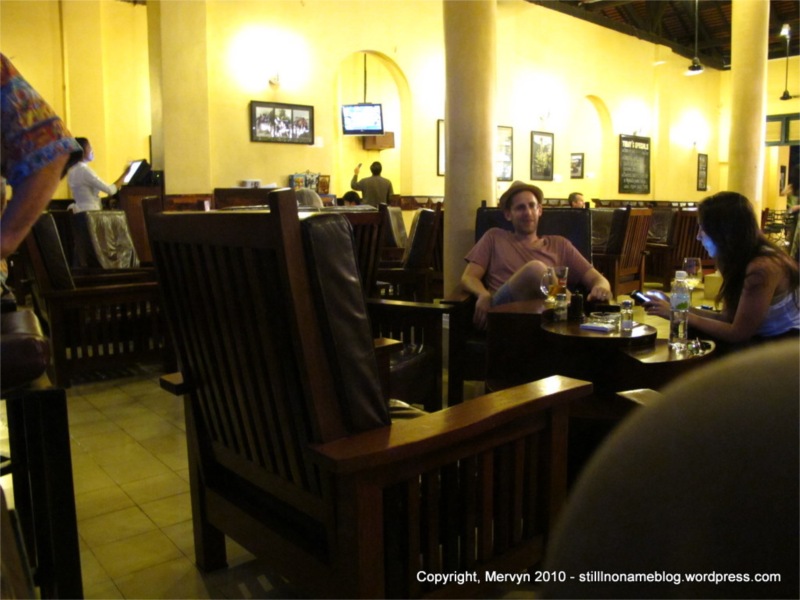
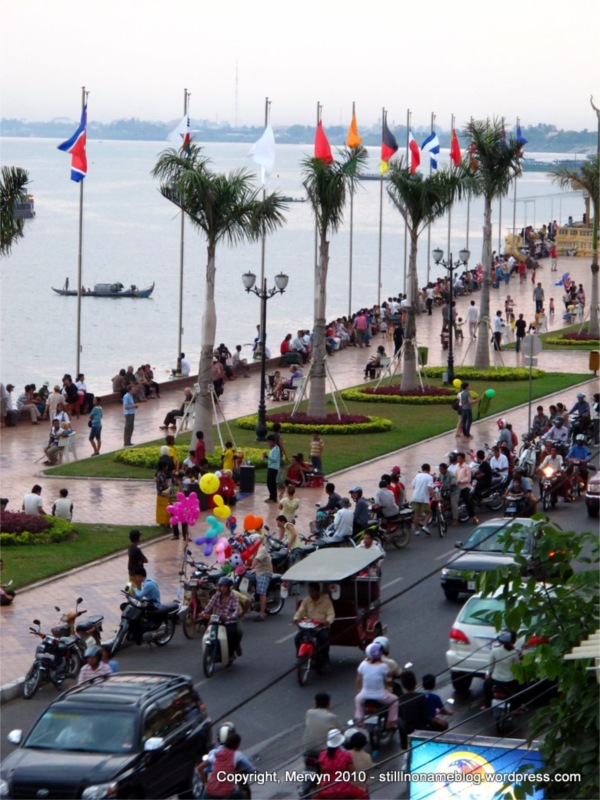
Afterwards, I chilled at the Foreign Correspondents Club, a Phnom Penh institution. It was also prominently featured on the Amazing Race a season or two ago, so that’s why I’m here. It’s like you’d imagine. There are cushy leather seats. The food’s overpriced. Happily the drink is cheap between 5-7pm.
I joined the tourist crowd and took a seat by the balcony overlooking the riverside street. As night fell, traffic got thicker as did the crowd lounging by the riverbank. The outdoor food culture here is strong. People brought packed dinners and ate with their friends by the river. A group of people danced to music on one side.
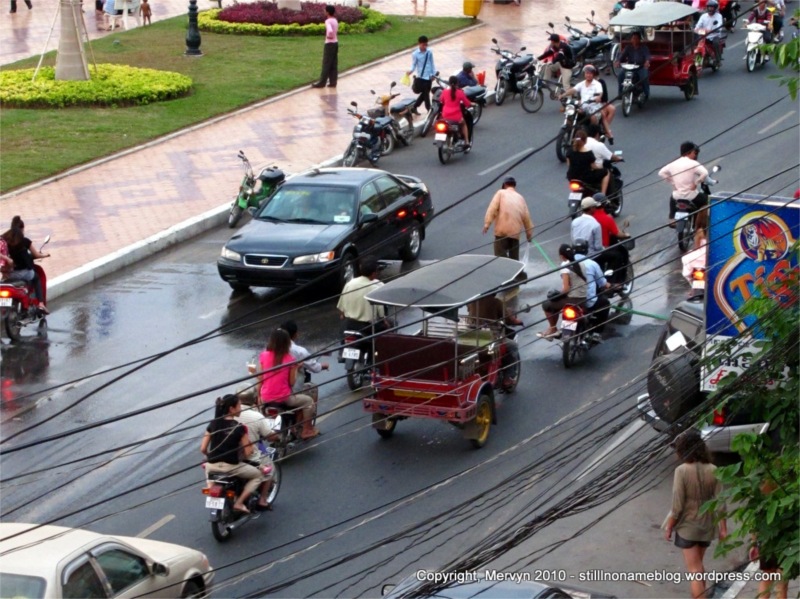
As I stared out into the street, I saw a man walking back and forth through traffic dragging a garden hose. He was spraying mud off the asphalt. No one even bothered to honk at him.
I indulged in a fine Cuban and sipped my drink. I felt imperialistic despite my $3 fan-room lodgings. Here I was, in a Western institution looking down on the locals in the street below spending more on food than most people made in two days.
A motorbike whizzed passed. The driver was standing on his pegs. His passenger, a little person, had his arms out like Leo in Titanic. They were both laughing hysterically.
I doused what was left of the cigar, pulled on my pack, and headed downstairs. The street looked like a lot more fun.
 The Overpacker