Dateline: Phnom Penh, Cambodia – Friday, April 23, 2010
After Tuol Sleng yesterday, I jetted out to try and find the Killing Fields. It was supposed to be 15 km southwest of Phnom Penh and—as Lonely Planet put it—“clearly marked.” Because it was supposed to be easy, I immediately got lost. One wrong turn an hour later, I found the right road. It was a race against the clock. It was 4:30 p.m. and the unfortunately titled Choeung Ek Genocidal Museum closed at 5:30 p.m.
I never found it. I committed to coming back early the next morning to beat the heat. And so, I did.
Again, though, I missed the correct road. I drove around Phnom Penh looking for my street. Then I spotted two White people in a tuk tuk. They seemed to be headed in the general direction of Choeung Ek so, following my rule of thumb, I followed the tourists. After a couple turns, I was on the main road. This stuff works even when you’re on a bike! I zipped past and silently thanked them for their service.
I started to count down the kilometers. Right at 15 km, I saw a large sign on the left side of the road. The kind you can’t miss unless you’re me.
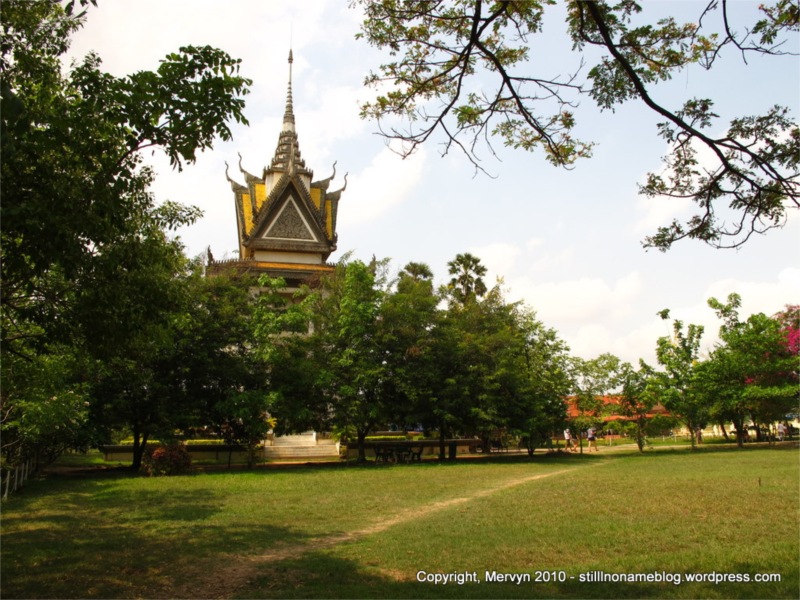
Down a small side road I found the old Chinese cemetery that the Khmer Rouge used to kill upwards of 20,000 people. I was one of only a couple people there. After viewing an awkwardly translated movie about the site, I walked the grounds.
Just like Tuol Sleng the day before, I was struck by how small the place was. Looking at one depression in the ground, I couldn’t believe they’d fit over 400 people in the mass grave. The signs filled me on the details. At its height the Khmer Rouge were killing 300 people a day here. So many that they had to construct a holding cell because of the backlog.
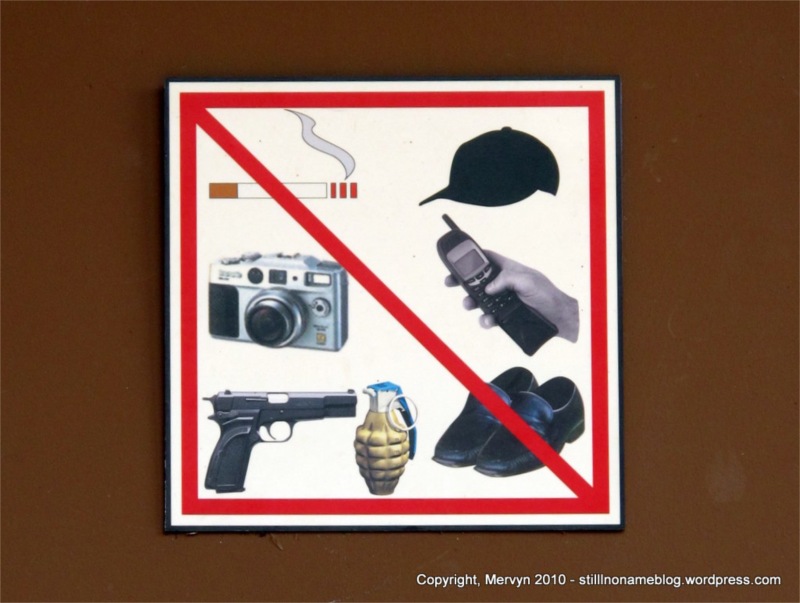
They would use whatever was handy to do their dirty work: shovels, axes, picks, scythes, knives. They’d dump the bodies into the pits and sprinkle them with DDT. They used the chemical to cover the smell from the surrounding farmers and to finish off anyone who might be still alive.
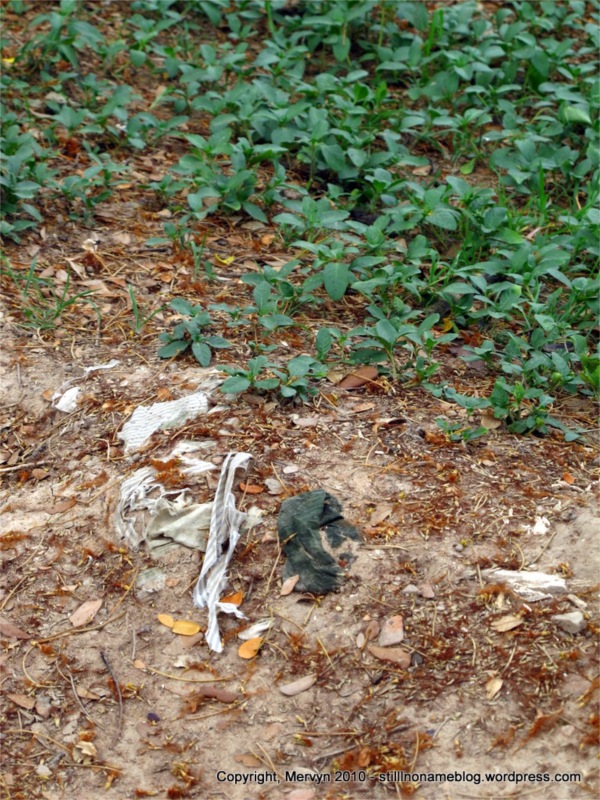
I walked the paths between the graves. The archeologists decided not to excavate every grave. Perhaps it would have been too much work. Perhaps it would have disturbed the site too much. Regardless that meant there were still teeth and bone fragments coming out of the ground. Pieces of clothing poked up through the vegetation.
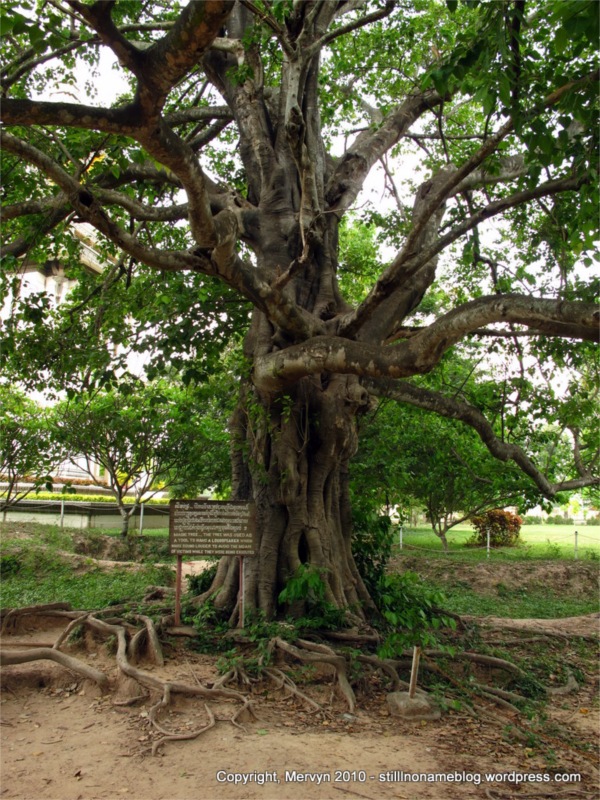
There was a large tree on the site, just like the one at Ta Prohm. Its roots twisted around themselves and stretched out over the ground. The Khmer Rouge hung speakers from this “magic tree” and played music to drown out the sounds of their work.
Under a wooden covering next to a large tree sat one of the most chilling graves. This grave held the bodies of 100 women and children. The Khmer Rouge chose to kill whole families to prevent the revenge blowback. That meant killing babies and their mothers. They forced the mothers to sit on a tree root and watch as they disposed of the kids.
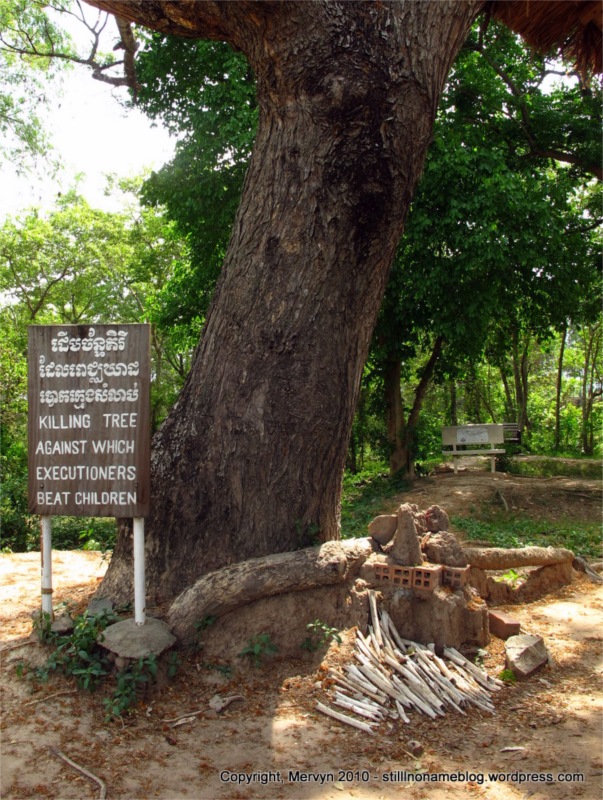
The cruelty here was something I couldn’t believe. The executioners had lost all humanity, compassion, and pity. They would play with the kids, sometimes even getting them to laugh. Then they’d make bets on who could hit their impromptu clay pigeon. Sometimes they’d miss. Sometimes they didn’t. Eventually, the results were always the same. If they got bored with that, they beat the babies against the trees. The guide claimed that many mothers died of heart attacks. I have no reason to disbelieve him.
I’ve been to Holocaust sites before. I’ve seen the evil that man can do. For some reason, this felt different. I’m not sure if it was because the people were Brown. I don’t know whether it’s because this wasn’t Germans on Jews but Khmer on Khmer. I’m not sure if it was because there felt like there was more tangible evidence, what with the bones and clothing still fighting their way to the surface. It could be that this feels more real because it happened in my lifetime, not long long ago in a World War far away. I’m not sure why, but it felt different. Eerie. I had a harder time distancing myself from what happened. It felt very real.
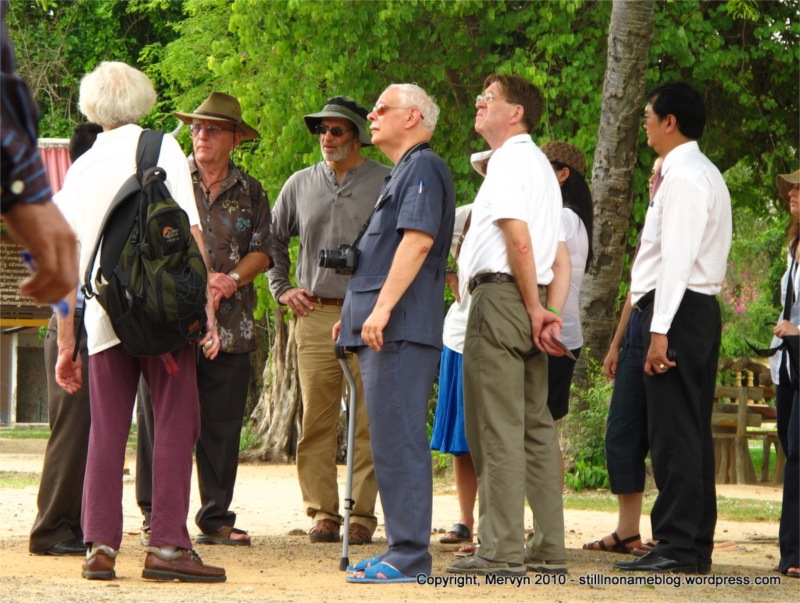
As I left, a group of old White guys trailed by frantic video and still camera men entered the complex. I asked a younger guy what the big deal was. He said these were old war correspondents in Cambodia for a reunion. They’d been here during the war. The younger guy scribbled notes on a pad. I asked if he was a journalist. He said, “Yes.”
Journalists covering journalists. Quite postmodern.
I headed back to Phnom Penh. I sat at a street side food hawker stand sipping on water, trying not to sweat, waiting for the Royal Palace to open at 2:30. At 2:45 I walked towards what I thought was the entrance.
A young tuk tuk driver asked me if I needed a ride. I said I didn’t. He then asked the standard, “Where you from?” I humored him as I walked and said, “Philippines.” Sometimes it’s just easier than trying to explain why I’m brown and American. Turned out he just wanted to talk. We chatted about women, getting an education, Cambodia, and travel. He was very friendly. He said he’d like to go to school but he couldn’t afford the $600 a year tuition. I played sympathetic, but it was depressing to know that what stood between this man and a better life was what I used to make for the firm in a little over an hour.
The tuk tuk driver pointed me the correct entrance. We said our goodbyes and I headed back where I came.
That’s when I played a thief. I accidentally walked in through the exit and found myself in the palace. I did not do this on purpose. Somehow, though, I was in for free. To atone for my sin I donated heavily to Buddha.
The palace stood in stark contrast to what I’d seen at the Killing Fields and what I’d discussed with the tuk tuk driver. The gardens were immaculate. The halls and temples were impressive. The king had been reinstalled some time after the Khmer Rouge fell. The palace felt like it was new. You could almost see the fresh coat of paint.
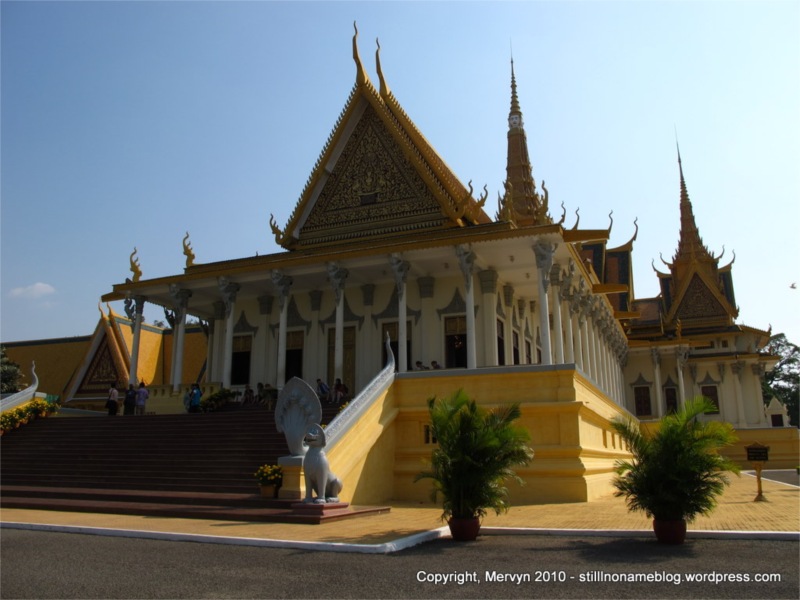
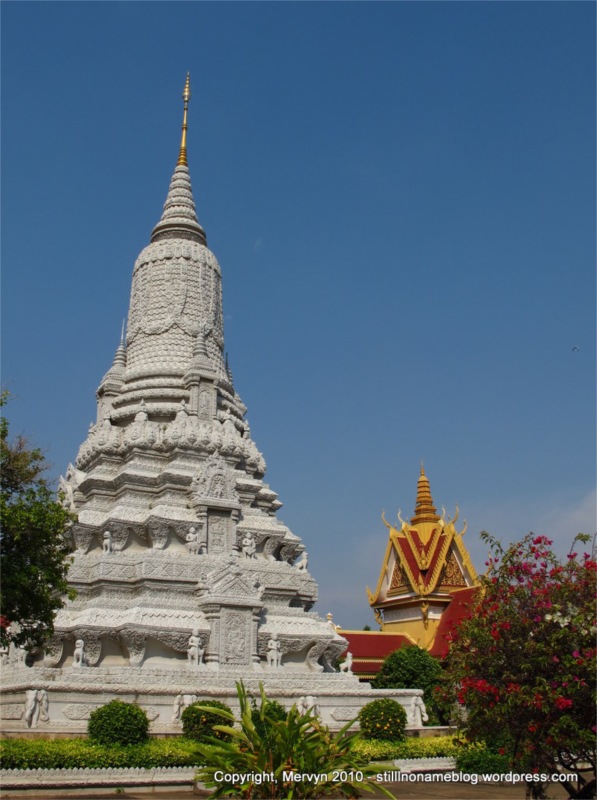
They even had their own emerald Buddha. I could get a lot closer to this one, but, like the one at Wat Phra Karew, I wasn’t allowed to take pictures. The floor of the emerald Buddha temple had tiles of pure silver weighing in at a total of 50 tons. Most were covered with rugs for protection. Some were exposed. For some reason it looked like a few were duct taped down. Fifty tons of silver and they couldn’t find something more ornate than duct tape? Strange.
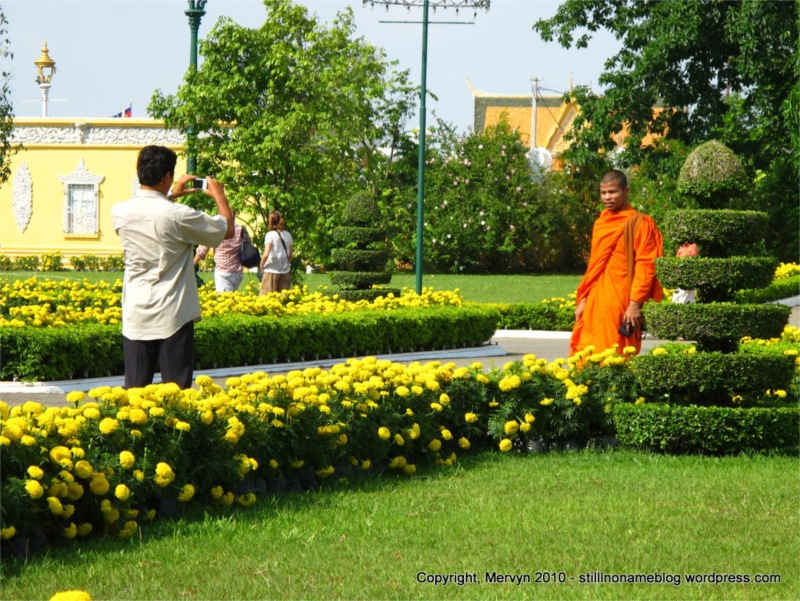
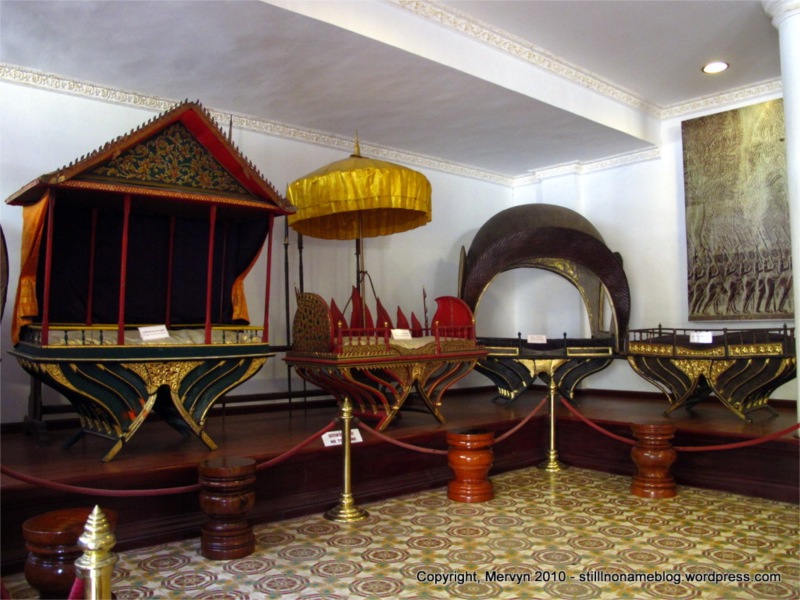
I hung out on the riverbank watching the sunset. This really is a country of contradictions and of nuance. There are things here churning under the surface. Khmer killing Khmer in the name of Communism just a few decades ago. Now the country tries to move on. The population is mostly poor, but they have reinstalled a king who lives in a lavish palace. The streets are clean, but the tuk tuk driver says that this is what the government wants me to see. If I go to the provinces, it won’t be like this. The traffic is chaotic, but even that has an underlying order. People seem to be running game but, at the same time, seem genuinely friendly.
I still don’t know what to make of this place.
Day 50 – Tuol Sleng Tuol Sleng (A Former Teacher’s Lament)
Dateline: Phnom Penh, Cambodia – Thursday, April 22, 2010
Today I rented a motorbike. No tuk tuk drivers for me. Just freedom of the open road. The moto came courtesy of a Cambodian girl (paid a bit too much because she was cute). The bike looked fine. As they say, though, looks can be deceiving–except of course for cute girls. They never lie.
I pulled away from the girl’s storefront. She went back to sleeping on the floor with two pantsless babies while I left to discover I had problems.
I got 10 feet when I discovered the first. For some reason, in Cambodia it is against the law to drive with your headlights on during the day. Two friendly Cambodians pointed this out to me as I lurched past by opening and closing their fingers. I stopped, or more accurately stalled, and spent 30 seconds flipping the high beam off and on before I found the light switch. I restarted the engine and lunged forward.
For fun, let’s count down my problems from least difficult to most.
Problem #5: Bike had no gas.
I had to find a gas station pronto or I wasn’t going anywhere no matter how crappy the bike (note literary device: foreshadowing).
Solution #5: Got gas.
As I humped my way to the main road, I saw a gas station kitty-corner to my position. I dodged traffic, pulled up to the pump, and, under the gaze of the gas attendant, stalled and nearly pitched myself over the handle bars.
I held up one finger, asking for one dollar of gas. He asked which grade, I looked confused, then shrugged and smiled. I think he gave me the cheapest one.
Problem #4: Bike had horrible engine idle.
The engine seemed to be idling too low. I had to throttle the thing to keep it going. It was tiring and annoying. It also made it more difficult when I stopped because I also couldn’t find neutral (see below).
Solution #4: Remembered that I am an idiot.
When I’d started the bike I’d flipped a bunch of things off and on to see what they did. I’d accidentally engaged the choke. Once I released it the engine idled fine. It’s disturbing to me how often my problems are my own creation. I bet this happens to everyone.
It better happen to everyone.
Problem #3: I couldn’t find neutral.
I expected it to be between first and second like on a motorcycle. I kept shifting between first and second, trying to find the middle setting. No dice.
Solution #3: Got lucky.
When I was messing around with the gears, I inadvertently shifted below first and found neutral. Getting lucky really works. Try it some time.
Problem #2: Shifting gears.
The gear shift sucked. I almost had to push my toes into the back of my calf to shift up. To shift down I had to rise out of my seat and stand on my heel. Easy it was not.
Also, even though it was a manual, it had no clutch. That meant I had to learn the proper speed to shift gears without lurching. I couldn’t use the clutch to disengage if I got it wrong. At the start, I kept lunging the bike around as I toed and heeled mightily between gears. I looked like I had a combination of Tourette’s, epilepsy, Parkinson’s, and Elaine dance.
Solution #2: Discovered that in Cambodia “four” sometimes means “two.”
This bike lists four gears. For all practical purposes, there are only two.
Where I come from (Earth), when you ride a bike you start in neutral and work your way up through all four gears.
Not so here. Here you start the bike in neutral, then go straight to third then fourth. That’s because the bike is geared so that in third you can be at a standstill and not stall. You don’t have to go below third until you stop the bike for good. Also, I could only stay in first gear until I hit 1 km/h and I had to shift out of second to third when I hit 3 km/h.
I also wanted to shift as little as possible because of the crappy gearbox (stand, calf cramp, stand, calf cramp). That meant sticking to third and fourth. Two gears, not four. I’d sit at traffic lights idling comfortably in third. I’d start smoothly off the line with my horde of fellow motorbikers in third. I suspect they were all doing the same thing. If I’d try to do it in first, I’d have had to shift three times in the first 2 seconds of starting off. No one else seemed to be doing this.
So why did the manufacturer set the gearbox so low? I mean, why have so much power in first and second that you can’t use either gear for more than half a second?
Easy. Because of chickens. Live chickens. And stacks of corrugated metal, 100 pound bags of rice, six family members, car transmissions, and six foot square sheets of glass. These are all things I’ve seen on a single motorbike (though not necessarily all at the same time). If you’re going to haul around that much on a little 100cc engine, you have to gear it low if you have any hope of getting it rolling. Here, a motorbike isn’t just for human transport it’s your pickup truck, four-door sedan, baby carriage and minibus. It’s got to be able to handle all situations.
I was just carrying me, so first gear was way too much for my little 160 pound frame. Perhaps the solution is to drag around 200 pounds of lead in the bike’s basket. Or, I could just stick to third and fourth gear.
With most of my problems solved I attacked the biggest one.
Problem #1: Phnom Penh traffic is insane.
Compared to Phnom Penh traffic, Bangkok’s is like your first “Dick and Jane” book–simple, easy to understand and no one will kill you if you read it slow. Phnom Penh traffic, by comparison, is like a linear algebra textbook clenched in the teeth of a rabid honey badger. Nearly impossible to comprehend and, if you don’t read it right, it might just rip your testicles off.
Phnom Penh doesn’t seem to be as jammed up as Bangkok, but that’s probably because nobody stops for anything. Like in Siem Reap, stop signs are meaningless. Unlike Siem Reap where traffic lights actually make people stop, Phnom Penh traffic lights act as strong suggestions.
Basically, they’re only helpful if you suffer from traffic blindness but not color blindness–if you can’t see that hundreds of cars are streaming across your field of vision and therefore you should stop, you can glance up at the red traffic light to confirm that if you want to live you should not move forward. Think of a traffic light as someone telling you not to stick your hand in the river while you’re staring at a school of piranhas devour a whole cow two feet away—traffic lights are helpful but only sort of.
The traffic movement seems chaotic. Until you figure it out.
Solution #1 (ongoing): Accept Jesus as your lord and savior and put your trust in Him OR Realize that to preserve your life you must not fear losing it.
The key to surviving Phnom Penh traffic is to hurl yourself into it.
Need to make a right turn into a busy street? No problem. Whatever you do, don’t stop otherwise someone might plow into the back of you. Just slow down a bit, then roll into the right edge of the lane. You don’t even really have to look left to check if anyone’s coming. No one else does.
Is there a pedestrian slowly crossing the street in front of you in the middle of hundreds of motorbikes? No problem, just ease off the throttle a bit and hold your line. But be prepared to dodge just in case.
Coming to a four-way intersection with no stop signs? No problem. Note whether your street controls the intersection or whether the cross traffic has fortified its position. If the traffic going with and against you is moving, follow suit, but keep an eye out for cross traffic that tries to squeeze in the gaps. Be prepared to slam on your brakes and dodge.
If the cross traffic is moving and yours is down to a crawl, follow suit and ease your way into the intersection. With the help of the travelers headed your way, you will either seize the intersection through force of numbers or you will dodge your way across to the other side.
Need to cross a busy six-lane street full of cars, trucks, pedal bikes, and swarms of motos? No problem, just keep easing your bike out slowly into traffic and trust that no one else wants to die or, in the case of the bigger stuff, scratch their vehicle. Everyone will dodge you until they can’t, then they’ll stop. Then you can deal with the traffic going in the other direction. This technique works best if you can pair up with a car, a group of bikers, or a large truck.
The basic premise is to let go of all that you’ve learned about driving. Release your fear. Trust that everyone else wants to live just as much as you. Know that traffic moves slow enough that they can stop if necessary. Know that everyone in your lane isn’t necessarily going the same direction you are. When in doubt, go slow and let others see you. Since I’m writing this, it’s obviously worked for me.
A few things I noticed while riding. First, almost no one wears short sleeves while on a bike. If it’s a choice between cooking under the heat lamp of the sun or steaming yourself to death inside a long sleeve shirt, everyone chooses to go the way of the steamed dumpling. I concur and always wear a jacket when I ride.
Also, almost no one wears shorts or light colored pants. I discovered why when I got home. My khaki cargos were filthy from dust, soot, and sweat. I can only imagine what my lungs look like. Tomorrow, I’ll be in dark pants, just like everyone else. Not sure what to do about my lungs.
With most problems solved, I headed off to Tuol Sleng Museum to see the most famous Khmer Rouge prison. I’ll be damned if that thing wasn’t hard to find. Phnom Penh is pretty much a grid. I figured it’d be easy since I knew the street number and the main streets to get there.
Nope. There were no street signs in that part of town or any signs pointing to the prison, so far as I could see. I wandered for 30 minutes going back and forth through neighborhood roads looking for the place. It’s like they were trying to hide it.
When I finally found it, I learned partially why it’s not easy to find. It’s tiny. The complex is maybe only 125 yards long and 70 yards deep. The prison is situated in the middle of a neighborhood in some nondescript three story buildings.
When I rolled in and parked the bike, I discovered the reason for its anonymous, residential location. Tuol Sleng prison used to be Tuol Svay Prey High School.
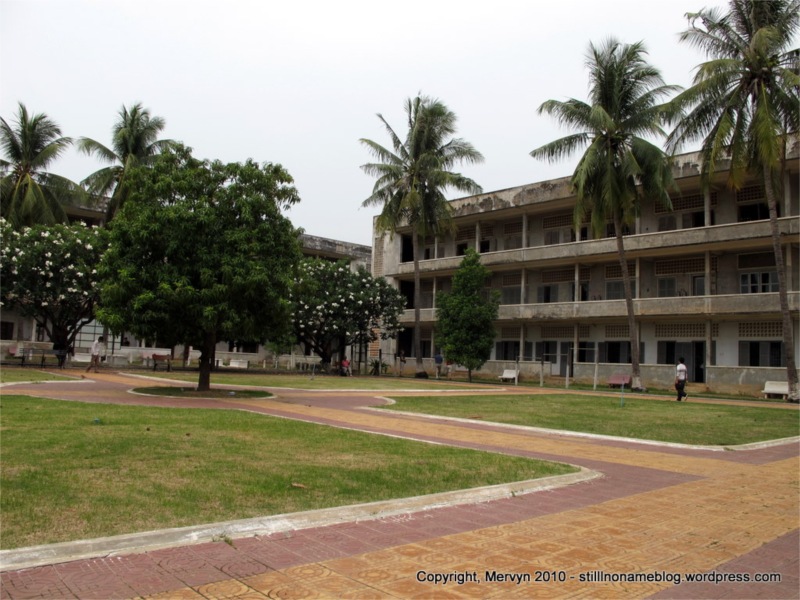
I’ve been to my dad’s high school in the Philippines. I’ve visited my Filipino cousins while they were in school there. I taught college for a year in the hills near Manila. The buildings at Tuol Sleng were buildings I’d seen before. They were quintessential Southeast Asia education architecture. Concrete and brick, open windows with shutters and bars but no glass, bare floors, windows to class rooms on one side of the three story building and open hallways between stairs and rooms to the other.
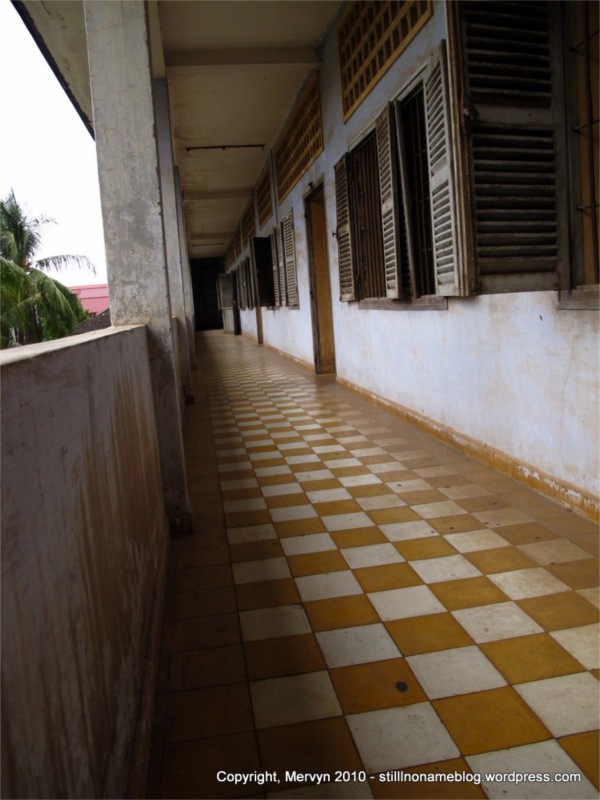
I loved my time as a teacher in the Philippines. If I want, I can hear the sounds of students clambering into the class, footsteps and voices reverberating off the polished concrete walls and floors. I can remember the feel of the chalk scratching the wooden greenboard I used to write notes to the class. I can see the looks on students’ faces when they learned something surprising. Mostly, I just enjoyed the feeling of people ready to learn. There was an energy there. A good one.
There’s also a nobility to teaching. You’re helping people reach their goal of becoming a nurse, accountant, businessperson, or whatever. If you’re lucky, you might even lead them to being a better human being.
Tuol Sleng was the opposite. The Khmer Rouge used this place for evil. They made people less than they were when they started. They destroyed lives. This place of joy and learning had been corrupted. My happy memories collided with the atrocities committed here.
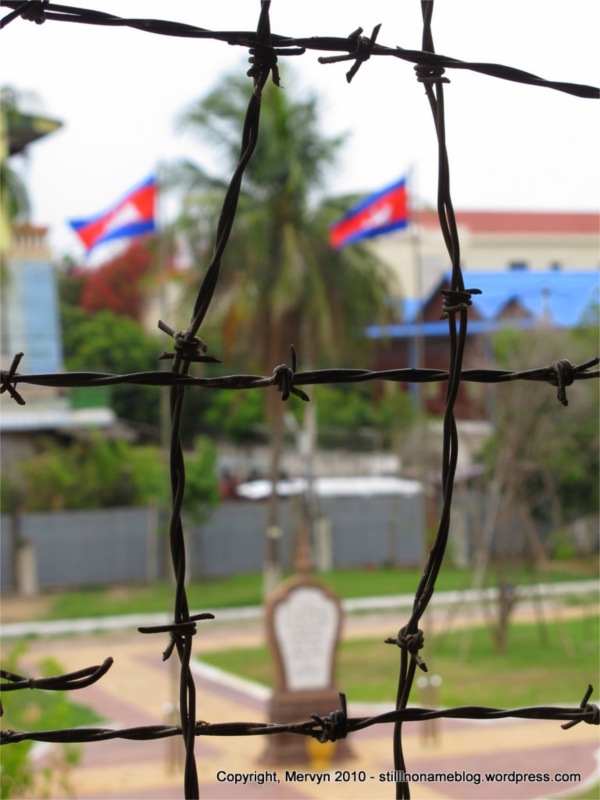
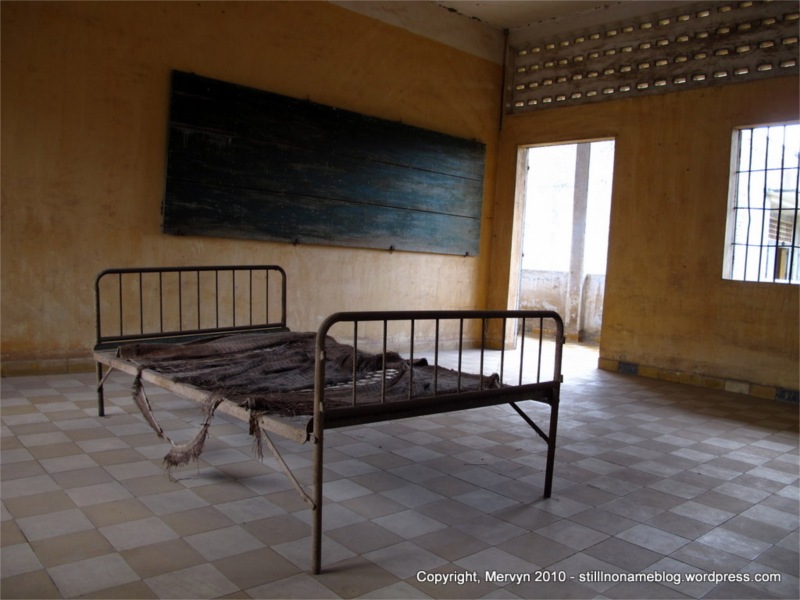
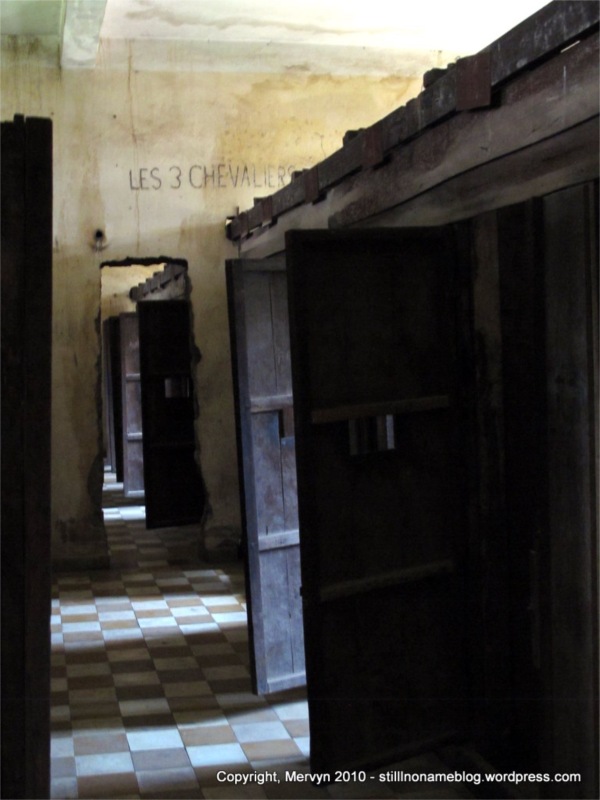
In the middle of a classroom much like mine sat a bed with chains attached. In another the Khmer Rouge had constructed cramped, makeshift cellblocks by knocking holes in walls and slapping together brick. On the wall of one of these holding blocks there were the words “Les 3 Chevaliers” carved into the wall. I imagine it was done by a teacher to inspire his class to learn or that the musketeers were the school’s mascots (Cambodia was formerly a French colony). Barbwire curtained the open hallways in front of the former classrooms to prevent desperate prisoners from hurling themselves over the side and killing themselves.
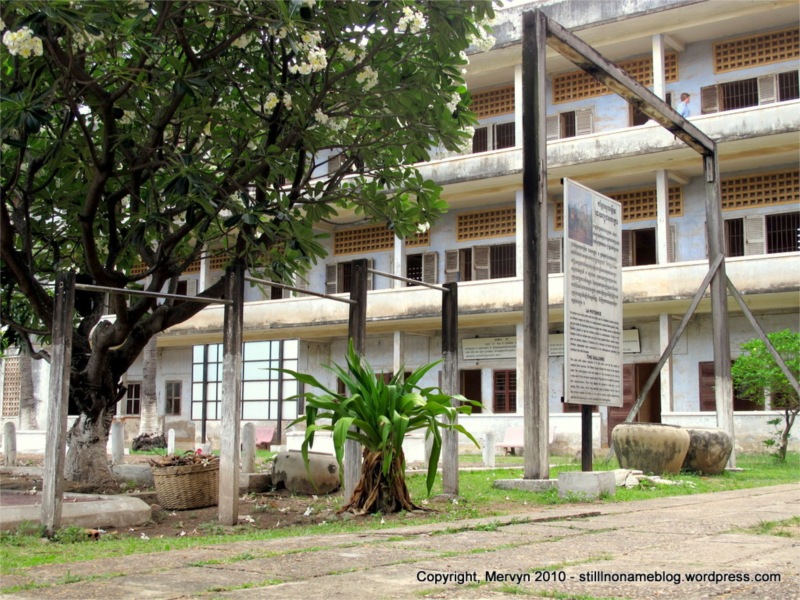
Innocent looking gym equipment had been twisted into something sinister. In the courtyard, pull up bars and rigs were set up; you could imagine kids climbing up outdoor ropes for gym class. A little sign next to the bars said that the Khmer Rouge tied prisoners arms behind their backs and strung them up from the impromptu gallows until they passed out. You could still see large clay jars underneath, which the torturers filled with dirty water. They’d dunk the heads of the unconscious in the jars until they revived so they could string them up again.
In my mind, the sounds of kids chatting and running between classes collided with screams of the people who suffered here. Where students had come eager to learn, people were dragged into cells to await their fate in fear. Human beings like me had taken this sacred place and defiled it. They’d turned the world upside down.
I wandered around the buildings, climbing concrete stairs, going in and out of familiar places that now made me sad. In one building, the curators had posted rows of pictures of the victims. The Khmer Rouge had been meticulous in their documentation, writing biographies of each prisoner and taking headshots. The pictures captured an array of emotions: sleepy, confused, fearful, defiant, angry, and even an occasional smile, as if the prisoner hoped his or her optimism and cheerfulness would convince their captors that they were harmless. That they were no threat to the communist revolution. That they were friends.
All to no avail. The people who survived this place were fewer than the fingers on one hand.
The Khmer Rouge sought to free the poor of Cambodia from the oppression of the elite. To that end, they sought out doctors, teachers, lawyers, priests, government officials, people who owned land, entrepreneurs, secretaries, janitors, nurses, railway conductors—anyone educated, enterprising, or marginally influential under the old regime.
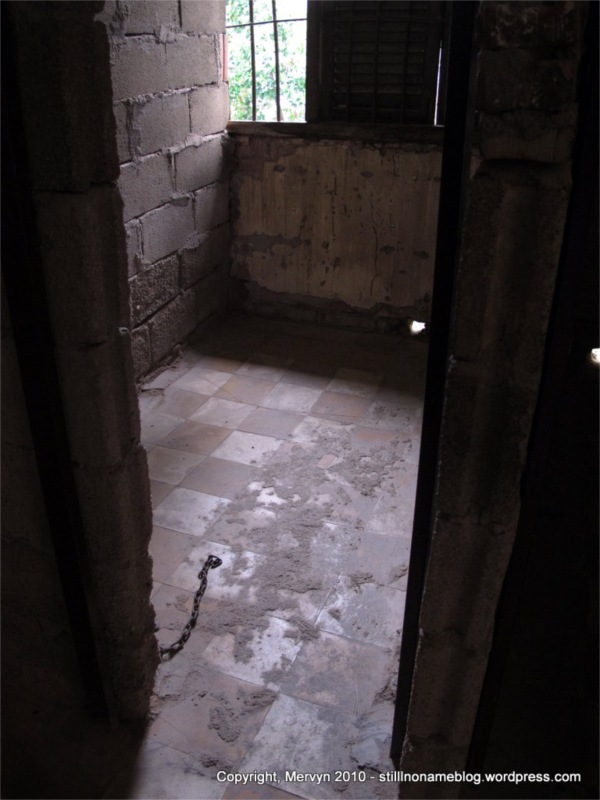
Then they looked for anyone with any ambition at all. They hunted people from the countryside who’d come to the city in the past year to escape the civil war and find jobs. These “April 17” people (April 17 being the day the Khmer Rouge “liberated” Phnom Penh) were not “pure” like their brethren in the provinces. The Khmer trusted no one in the cities.
Within days of their arrival, Phnom Penh was a ghost town. Only 40,000 remained including Khmer Rouge. The Khmer Rouge had evacuated everyone else. There would be no urban centers under the regime, only peasant farmers working for the collective good. There would be no religion either, just faith in the party.
Even if people escaped capture, many died because of Khmer Rouge policies. Policies that caused famine, gutted medical care, and destroyed livelihoods. (A brief list: only rice farming permitted and all crops collected and, in theory, redistributed or exported for money by the government; no currency allowed; all doctors, nurses and medical professionals killed.)
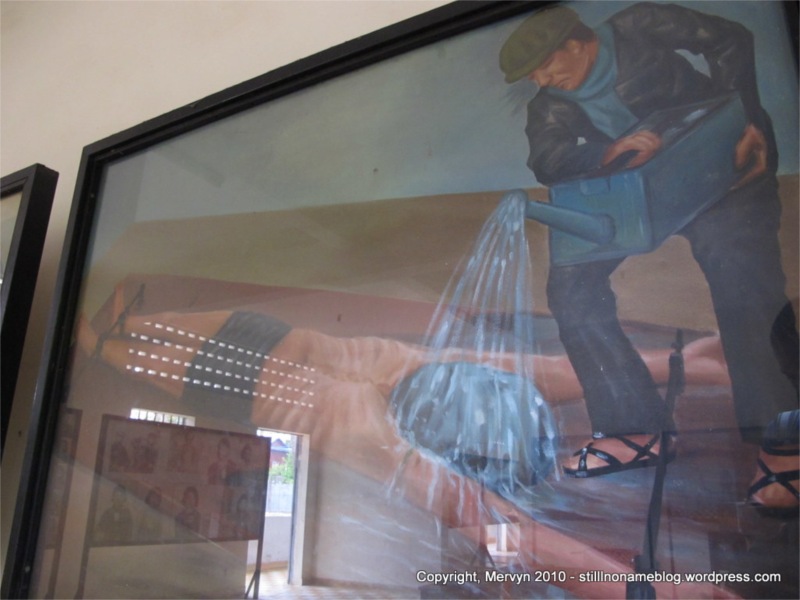
In the span of four years the regime wiped out 2 million out of a population of 8 million. Amongst the dead were nearly all those who’d exhibited any ambition in life. It’s unimaginable. It’d be the equivalent of clearing out all the cities in the U.S. and wiping out anyone with a high school diploma, then forcing everyone to raise corn and soybeans. When the Vietnamese toppled the regime in 1979, it must have been like trying to rebuild Cambodia with just folk from the Ozarks. God love ‘em, they might be good people, but to try to rebuild a nation. . .it’s like trying to rebuild a car with 50 feet of rope and a toothpick.
And all that doesn’t account for the emotional scars. I mean, this shit happened when I was alive. People here know people who died in the Killing Fields. Everything felt so familiar to me partly because the world hasn’t changed much since then. A classroom is still a classroom. A high school is still a high school. Gym class is gym class and everyone learns about the Three Musketeers.
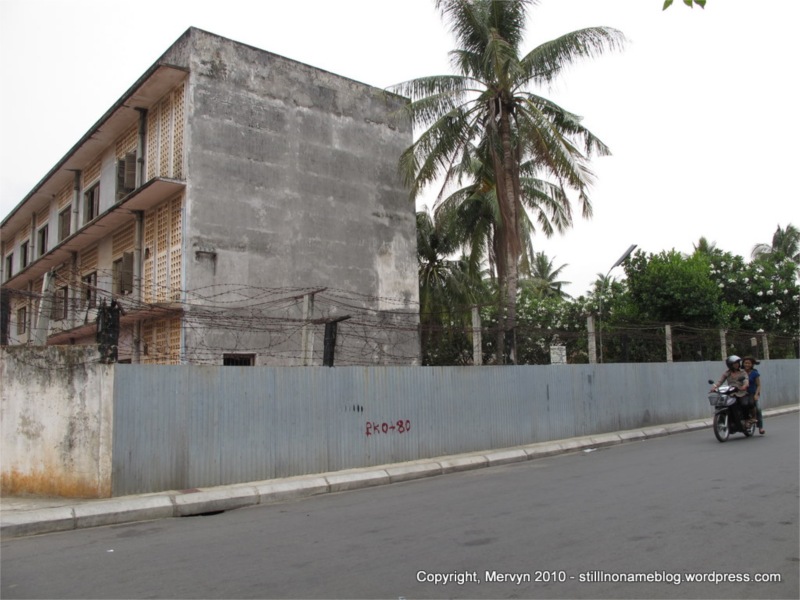
As I hopped back on my motorbike and prepared to leave, I realized that there must be a terrible tension about this place. Tuol Sleng is no doubt something tourists want and need to see when they come to Phnom Penh. But it’s probably not a place Khmer people want to celebrate. At the same time, it’s not a place they ever want to forget. In the end, it lives between the conscious and unconscious. There are no signs leading you to its gates, but the buildings still stand. It’s hard to find, yet it’s not hidden. It’s there, but it isn’t.
I started the engine, motored out of the neighborhood to the main road, and merged back into busy Phnom Penh traffic.
Dateline: Siem Reap and Phnom Penh, Cambodia (and roads in between) – Wednesday, April 21, 2010
It’s gotten to the point where I have to check the calendar for the day. Not the “date” but the “day” as in “Sun,” “Mon,” Tues”—those days. Today (Wednesday) I made the journey from Siem Reap and headed down to Phnom Penh, Cambodia’s capital city.
It was not exciting. That means today you get to rest your eyeballs. Take a break from the words words words of this current (former?) lawyer. It’ll be short. It has to be.
A minibus picked me up from Angkor Western Lodge, my home for the past four days. I, along with a mix of Khmer and foreigners, got dropped off at the Siem Reap bus station where we all boarded a large bus bound for a six-hour trip to Phnom Penh. The bus had air conditioning (not a given). Cost of the trip: $5. I have a hard time with math, but it’s hard to believe they’re making a profit carrying the 25 or so passengers.
That five bucks also confirmed to me that the guys at the Green Banana/Western Lodge in Siem Reap were taking me for a ride. When I asked how much a bus ticket would cost through them they said it would be $8. That’s a pretty high mark up. I feel much less bad about stiffing my driver his tip. I’m ready to give my dirty look now.
The bus was mostly comfortable. The seats reclined but if you went back all the way you got to know the person behind you in ways usually reserved for kids and Santa Claus. I know because I checked before I leaned my chair back. I also know because the Korean lady did not check.
Her seat was broken and would pop up instead of staying leaned back. That meant every time she decided to recline, she’d whip her chair backwards just barely missing my kneecaps. I had just enough room so I didn’t complain. The Khmer girl next to me, however, thought it was hilarious. She’d laugh, I’d shrug. Then it’d happen all over again.
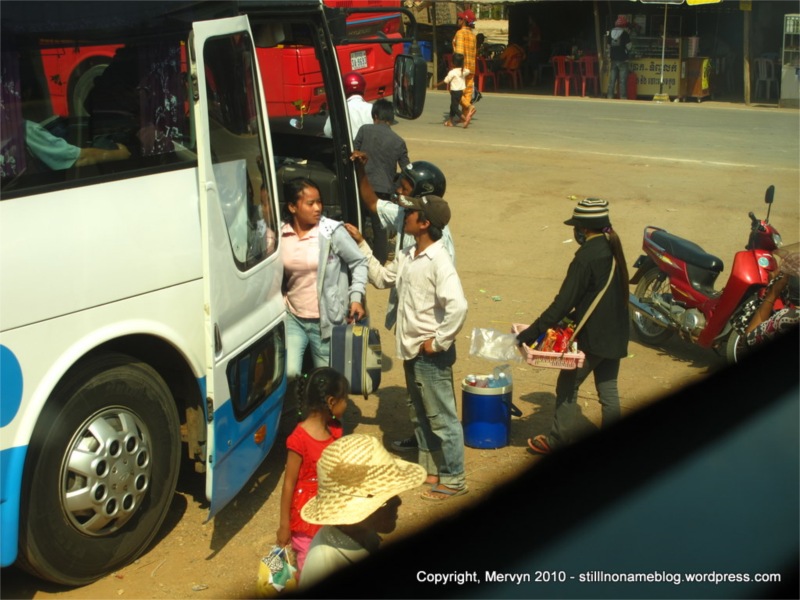
I did see one thing on the trip that made me feel a little better about Siem Reap and the oppressive salesmanship. While waiting at the bus station waiting to leave, another bus pulled in for a pit stop and to drop of a few passengers. The riders, all Khmer, piled out and headed to the bathrooms and to grab a bite to eat.
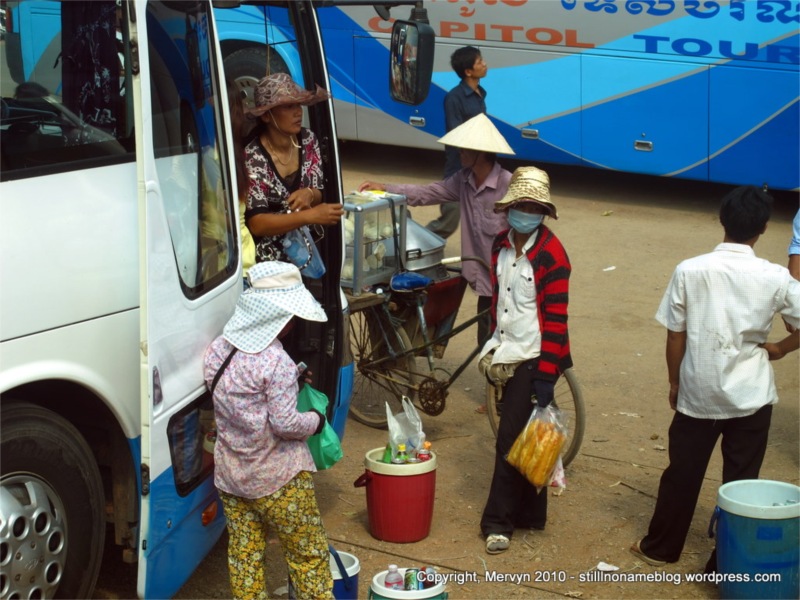
Like locusts, the locals descended on the bus door. They waved at people who were still at the top of the steps, asking if they needed a ride somewhere. Ladies in those round, pointy hats ran up and shoved snacks and fruit into the faces of riders who wanted to go to the bathroom. A guy on a bike with an attached portable steam pot, complete with coals and stoker, rolled up to sell dumplings.
The Khmer passengers had to adopt the same dour, apathetic faces I’d seen on many a tourist. They’d wave and try to move past. They’d ignore the sellers. One or two would buy something, but most just walked past.
The sales pitch was a bit different. Less persistent, with no kids, just adult on adult action. You could tell, though, where the kids got their sales style. It was nice to know that they treated their fellow countrymen with the same earnestness and eagerness that they did tourists.
When I rolled into Phnom Penh a tuk tuk driver said he’d take me to any hostel for $2. “Good price,” he said.
I laughed and said, “Good price FOR YOU.”
He looked hurt and said, “No.”
He ended up taking me for one dollar.
As I hit the hostel I realized I’d probably overpaid. Ah well, another lesson learned. I am getting better at this, though.
How’d I pick my accommodations? It was the first name I remembered from the guidebook when the driver asked where I wanted to go. Just another day on the road.
Day 48 – Blog Post of the Leper King (Temples in Review)
Dateline: Siem Riep and outer temples of Angkor, Cambodia – Tuesday, April 20, 2010
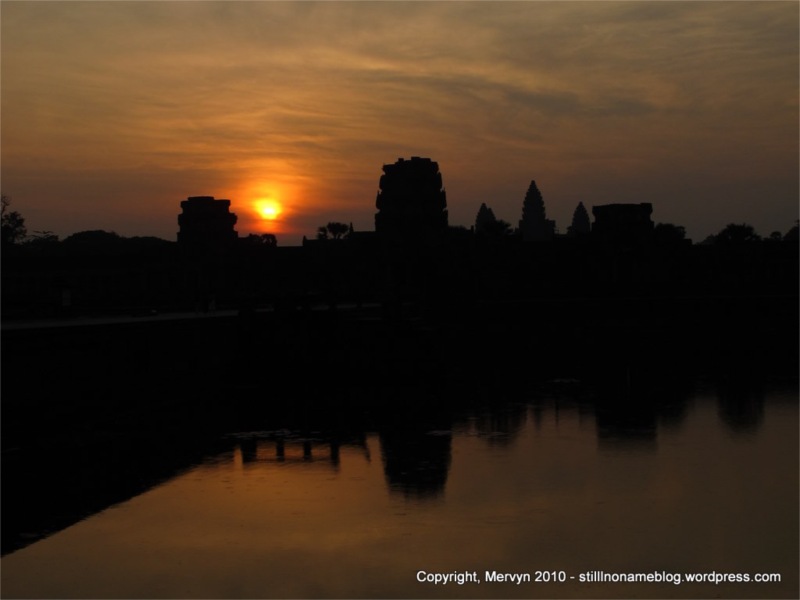
Today I’m going to let the pictures do most of the talking. I got up at 4:30 a.m. and hopped on the back of my driver’s motorbike to see Angkor Wat at dawn.
Angkor Wat at dawn was much more appealing than when I first saw it four days ago. I got my peaceful, spiritual experience. Though I didn’t wander into the complex itself, the sight of the sun cresting over the temple was something special. Or, I’m just resolving some major cognitive dissonance since my ass was up before the roosters. Whatever. I liked it.
Then my driver and I headed off to revisit Bayon (Temple with Many Faces) and the Terrace of the Leper King. I wanted a second shot at seeing the place since the first time had been near noon, therefore (1) it was hotter than a stolen Maserati in Vegas in July and (2) the sun was high in the sky making for some terrible picture taking.
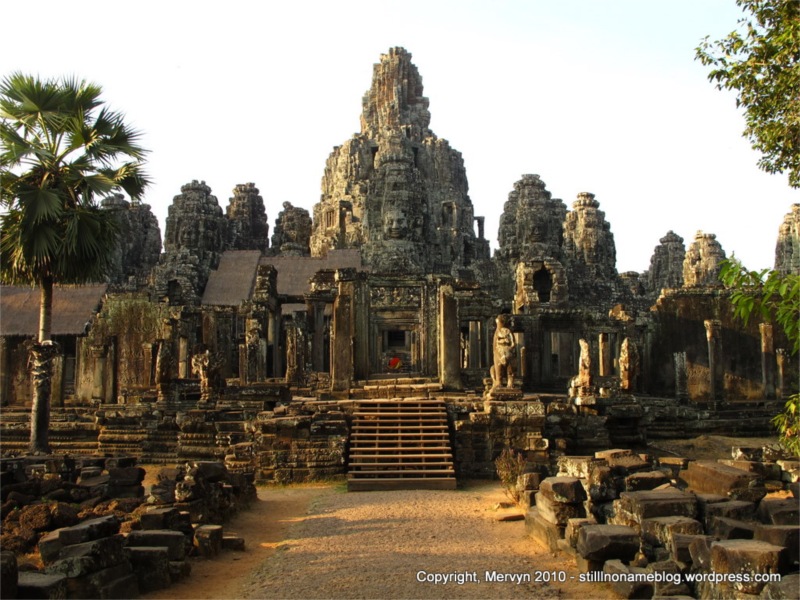
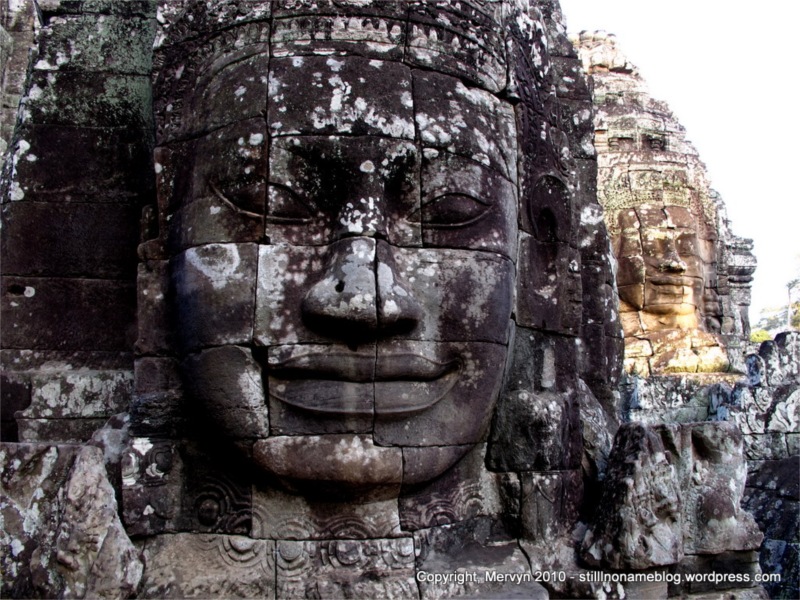
Apparently I wasn’t alone on the latter. I thought I’d seen photodorks before but it was nothing compared to this morning. They were working in teams. Two Chinese guys with tripods, multiple cameras, and a suitcase of gear were shooting the easterly view of Bayon. When I hit the upper terrace, I saw my first female photographer. She was set up under one of the faces with a tripod taking pictures of the morning light falling across its face. Further along, I found a younger German with an oversized camera shooting away while his girlfriend/wife wandered after with her tiny point and shoot. Mind you it was 6 a.m. That’s true love, baby.
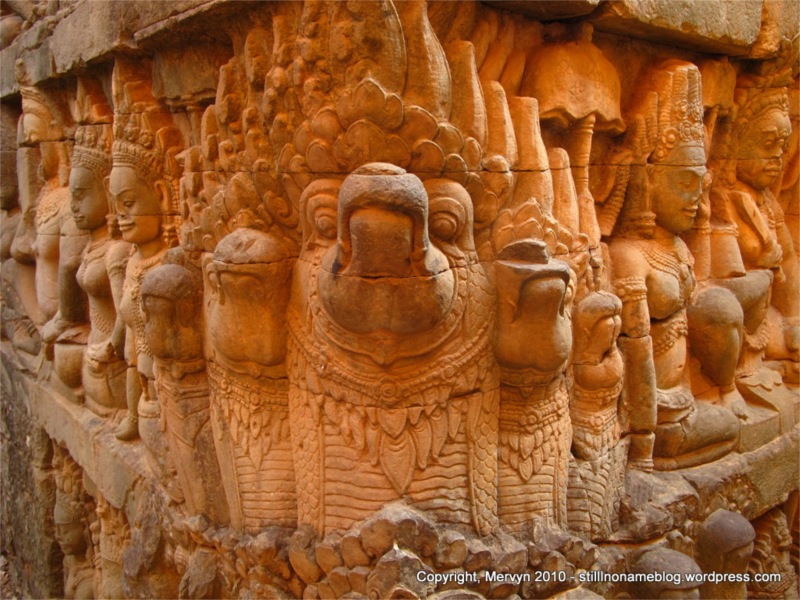
If I had to do this part of the trip over, I’d try to see the temples near Siem Riep at dawn then at around 9:30 a.m. head back into town to avoid the heat and nap. At around 3 p.m., I’d head back into the complex to see a second set of temples just as the day cooled. Sounds crazy, but trust me, it’d be better. I found my enjoyment of places was greatly affected by how much shade there was and how hot it happened to be. I even have statistical proof: I took more pictures of places I saw during the early morning and afternoon than those I saw in the hottest parts of the day.
I got my own photo fix along with my fellow hobbyists and we headed to the outer temples.
We’re not on a tuk tuk today. Instead of being dragged around in a cart attached to a motorbike, I was on the motorbike itself. That’s because taking the tuk tuk would have been much slower. The temples are 35 km out of town, which doesn’t sound like much until you remember that the tuk tuk tops out at 25 km/h while the motorbike without attachments can hit a whopping 40km/h. It’s the difference between one hour and twenty minutes in the sun and just under an hour. No small thing when there isn’t a cloud in the sky.
First stop was Kbal Spean, a holy place that’s situated along the banks of a river and waterfall. Or so they tell me. It’s dry season so there’s almost no water. Looking at the carvings though, I can imagine that this place would be pretty cool (both literally and figuratively) when there’s water.
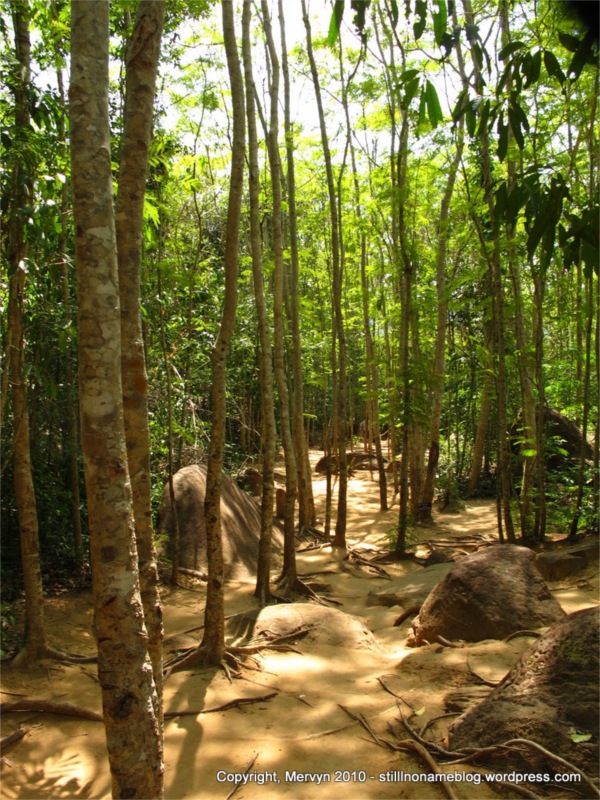
It’s a 1.5 kilometer hike up through the jungle. The oldest reliefs carved into the rocks in and around the river date back to the 11th Century. It looks like they were carved in the dry season, then best experienced when the river fills up in the wet.
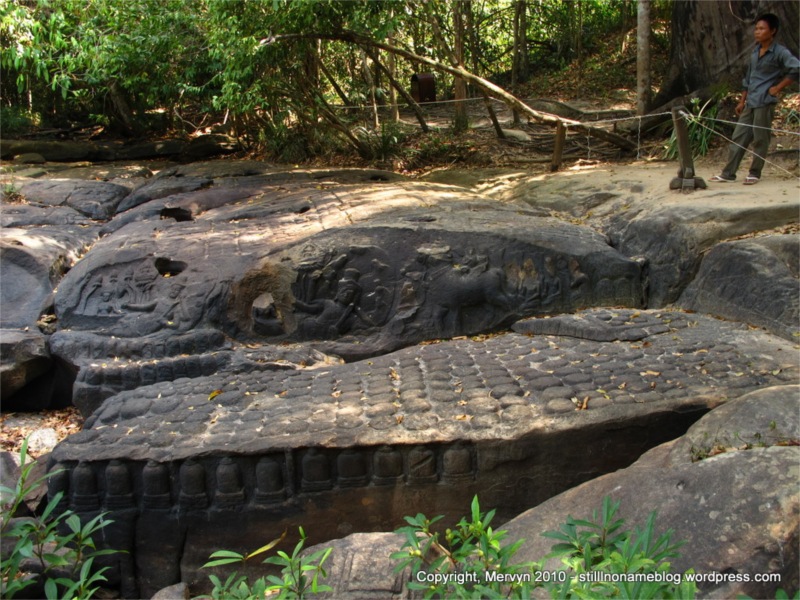
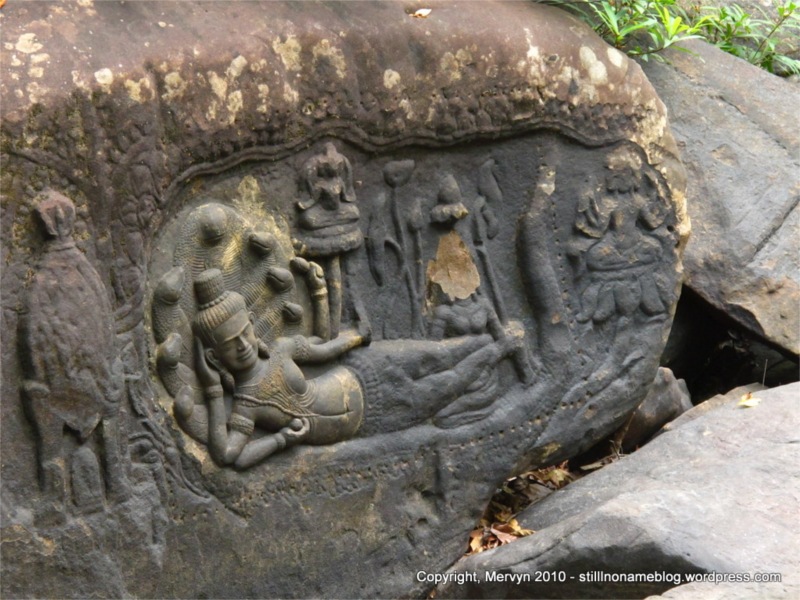
I haven’t talked about this much, but scattered throughout the temples of Angkor are linga and yoni. Linga are phallic symbols and yoni are the female equivalent. There’s a picture of a yoni in yesterday’s photoset. I bring it up here because today my impromptu guide at Kbal Spean pointed at a linga about two feet in diameter and said, “Need big yoni.” Since I’m juvenile, I thought this was funny.
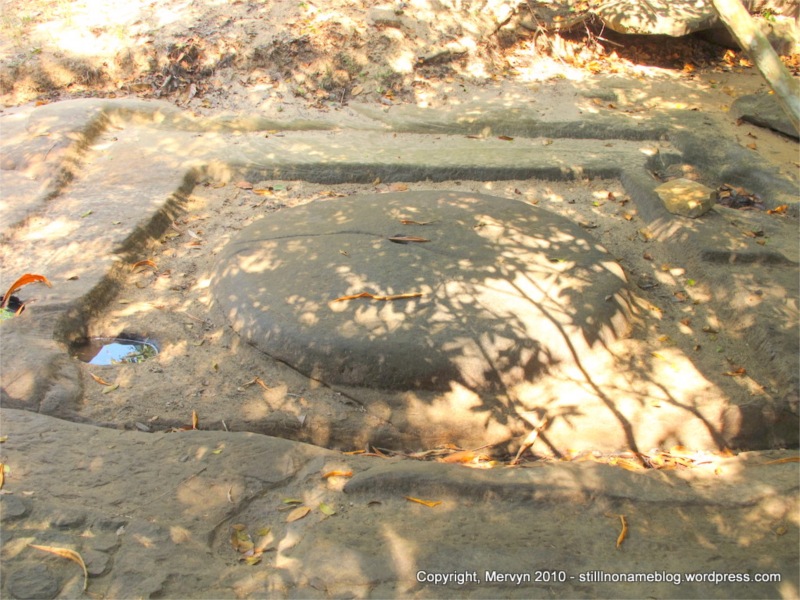
The floor of the riverbed is mostly rock. The ancients carved these up, too. I’d think it has a neat effect when there’s water running over it.
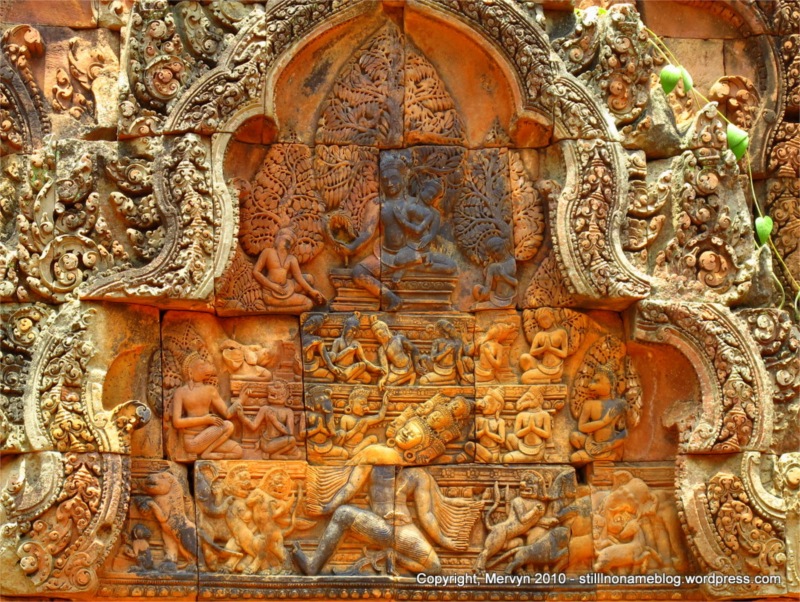
Next up was Banteay Srei, one of the best examples of Khmer art in the Angkor area. The amount of detail carved into this temple is amazing. They also used warm colored and porous rocks so there are some neat lighting effects. It looks like the whole place is charred black by fire. A series of monkey statues used to guard the temple. Because of a combination of looting and attempts to preserve the artifacts, there are no longer any originals on-site. The ones you see in the pictures are recreations.
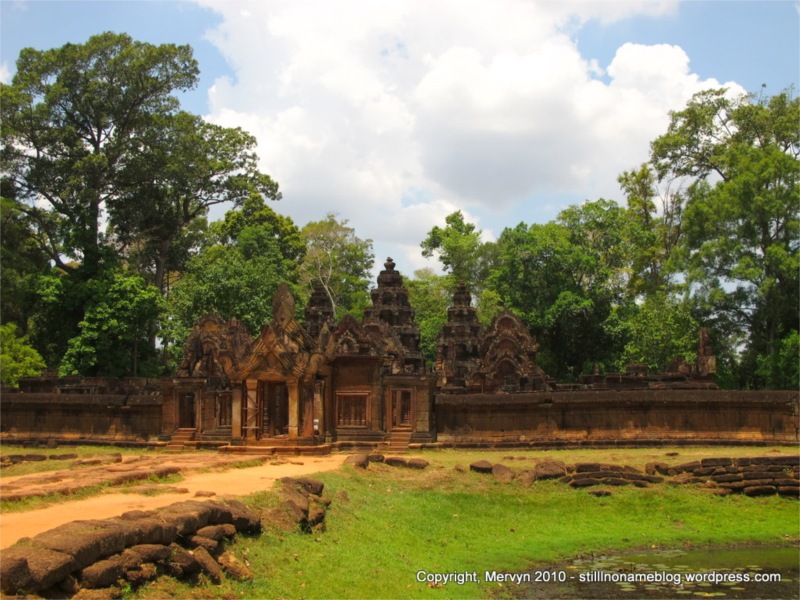
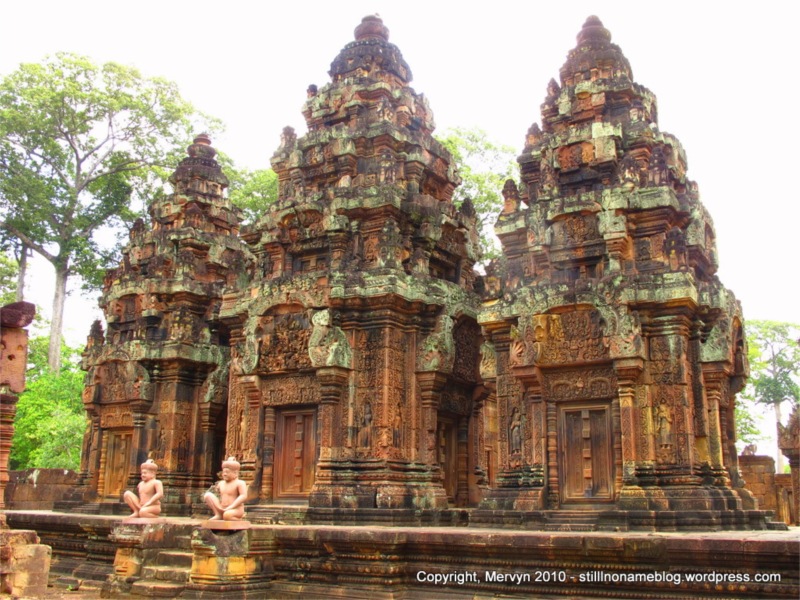
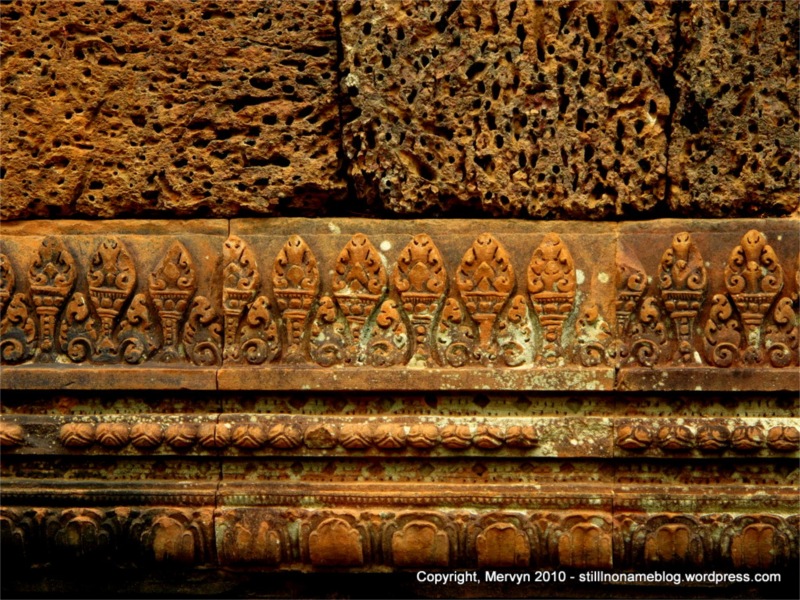
When we got back to the hostel and I’d had a nap, I decided to settle up my bill for the tuk tuk driver. The hostel guy at the front desk said I could pay him. He quoted me a price that was 10 bucks more than I expected. I started to get the feeling I was getting played. Lai had first quoted me $15 a day, but settled on $9 a day because I’d told him, thanks to Darrel (the Chinese climber I bunked with in Railay) I had a number for a guy who’d charge me $10. I’d later agreed to pay $25 bucks for the long trip out to the outer temples. That put my bill at $43. They wanted $50. I rang up Lai and he said the charge would be $10 for the first day, $15 for the Grand Circuit day, and $25 as agreed.
Now, I’m usually pretty laid back, but after days and days of having people try to squeeze money out of me, I was a little pissed. I argued that he hadn’t told me that the price had changed. He was adamant: Small Circuit was $10, but the Big Circuit cost $15. Something about gas and making a profit, which is total bullshit since gas only costs $1 for a full tank and we only ever filled up once. No dice.
I had to spend one more night in this place, so I decided to go peaceably. No sense in riling up the locals and getting my stuff stolen. I paid the $50, but didn’t give a tip. The front desk dude noted this. I told him that no one had told me about the changing prices.
Not tipping may not seem like a big deal, but for me it’s a sign that Cambodia’s “hardening” me to sob stories. I’m adopting the attitude of my British traveling companions: everyone’s playing games, looking for ways to get at your money. I’m starting to get the feeling that if I accidentally handed someone a $100 bill instead of a ten, they’d walk away without correcting my mistake.
I am a generous tipper. If someone has done good work, I consider it no big thing to toss in a few extra dollars to show my appreciation. I consider it good karma. Also, I don’t give money to bums on the street so I make up for this by giving a little extra to people who I know are doing good work. The driver himself, Mr. Poley, was good, but I felt cheated. No tip.
It’s silly. I’m sure a more confrontational person would have yelled and stomped their feet and threatened to do this or that (I’ve seen people do this before), but that’s not my style. For now, I’ll resort to these baby steps. Maybe tomorrow I’ll give someone a dirty look. Regardless, I need to start steeling up because I’ve heard that Vietnam is twenty times shadier than Cambodia.
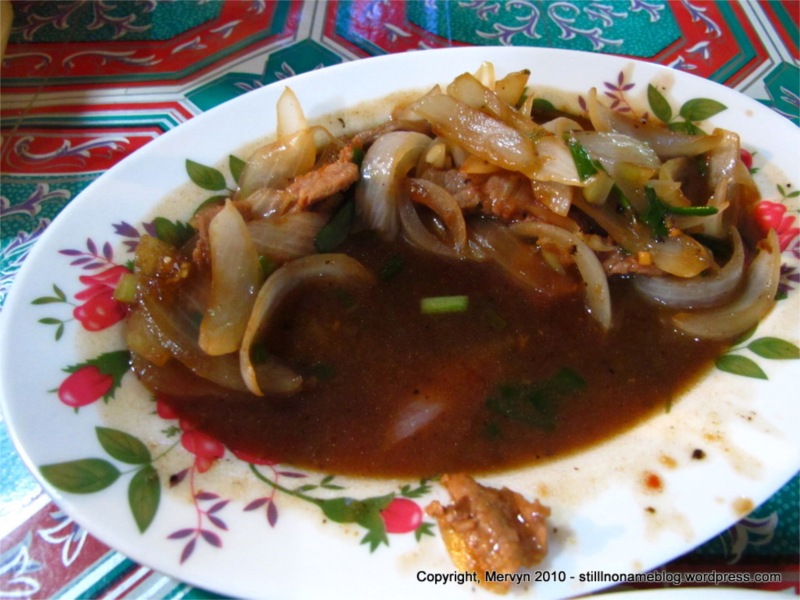
After the yin of the tuk tuk bill, the world offered me a little yang to balance it all out. I found a Khmer dish that I really liked: friend onion with pork. You read that right, the onion is the main ingredient. The cook takes a large, white onion, chops it up, stir fries it so the onion’s still crunchy, then adds whatever meat you order. It had a nice bite to the flavor and I enjoyed the crispness of the onion. It also had me thinking that Thailand still’s messed me up—the only flavor that I enjoy is that of a nearly raw onion? My taste buds have truly been desensitized.
I had my onion at a gritty little street side restaurant. The dish cost one dollar and included rice. I celebrated with a 75 cent lagan shake. Best tasting meal so far in Cambodia.
Tomorrow I ditch the tourist flytrap that is Siem Riep and head for Phnom Pehn. I’ve heard there’s a bit less hustle in the capital, if nothing else because it’s more than just a tourist destination. I hope so. Much as I hate to admit it, it’s wearing me a bit thin.
Dateline: Siem Riep and Grand Circuit of Angkor temple complex, Cambodia – Monday, April 19, 2010
A series of temples along the Grand Circuit. A series of random thoughts.
Temple: Prasat Preah Khan (“The Sacred Sword”)
Completed: 1191
Random Facts:
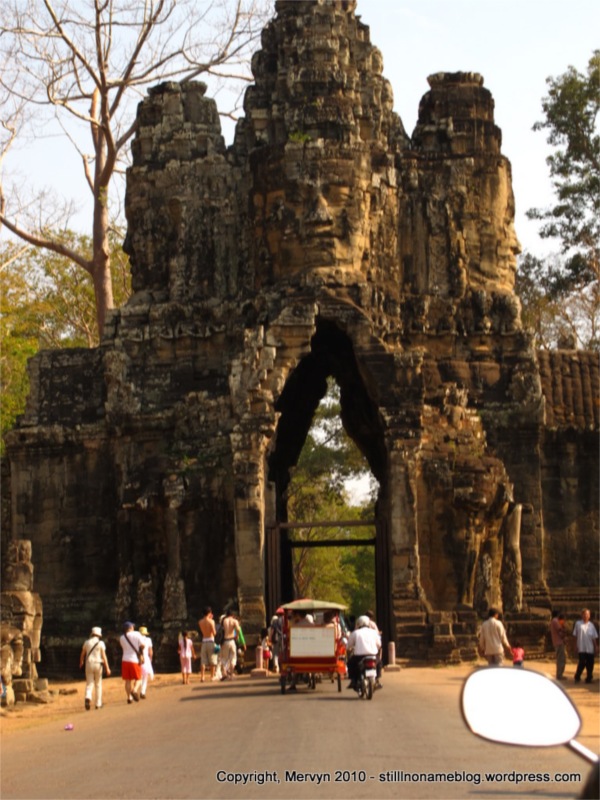
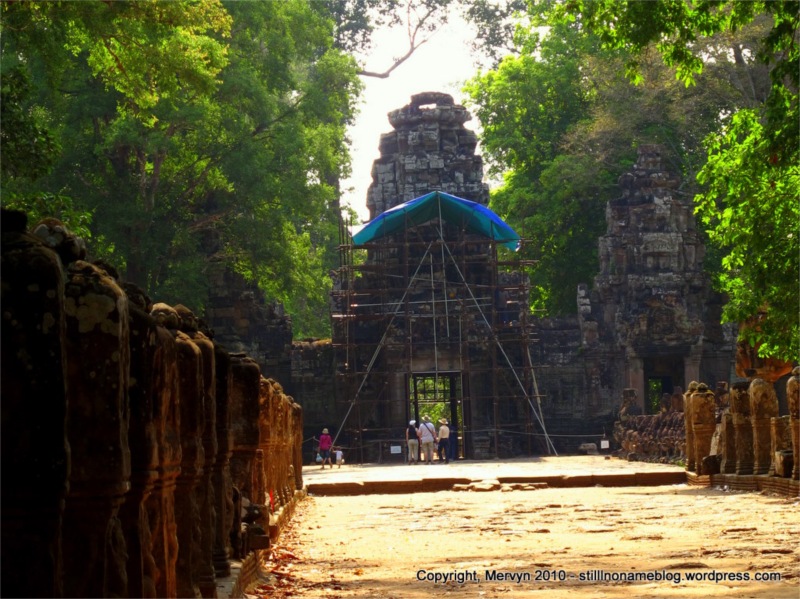
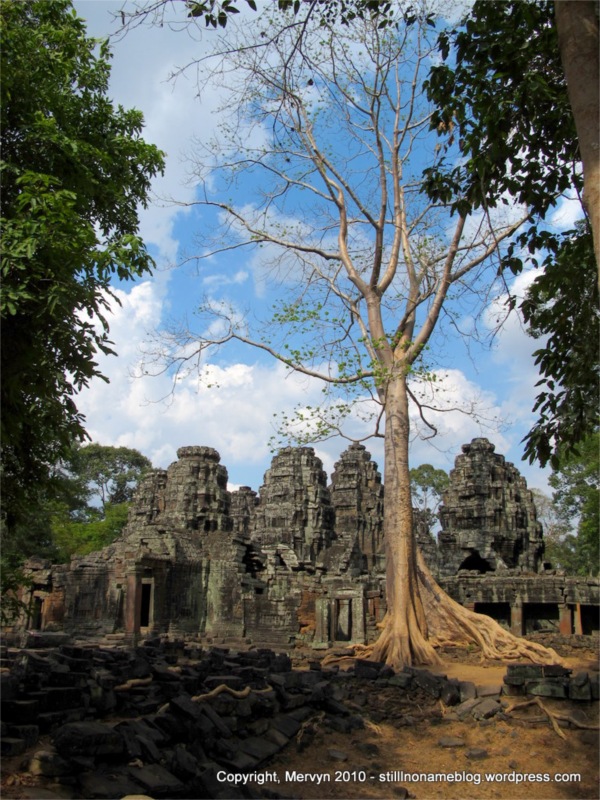
There is a long grand avenue at the east and west entrances lined with giants carrying giant naga (serpents). Like many other temples, there have been numerous additions and alterations throughout the centuries as evidenced by an odd mix of a Buddhist monastery and Brahmanic iconography. Built by the same king who constructed Bayon—it has the same towers with four faces scattered throughout the complex. Tall trees have overrun parts of temple, much like Ta Prohm.
I didn’t notice any swords. I also didn’t see any pandas, monster trucks, or little people. I admit, I wasn’t really looking.
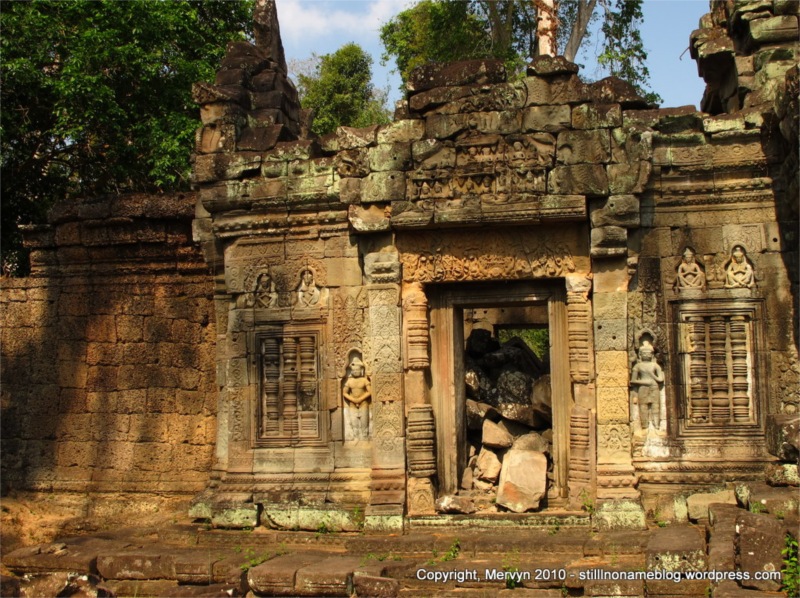
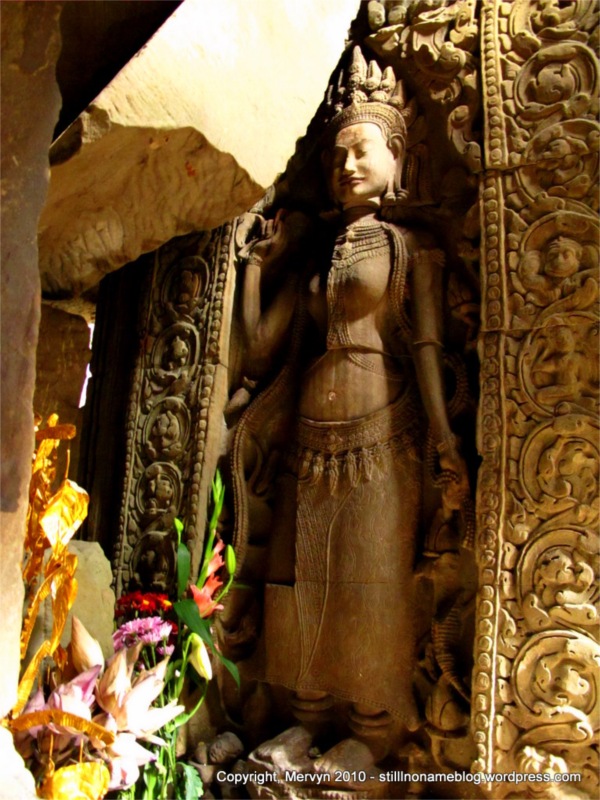
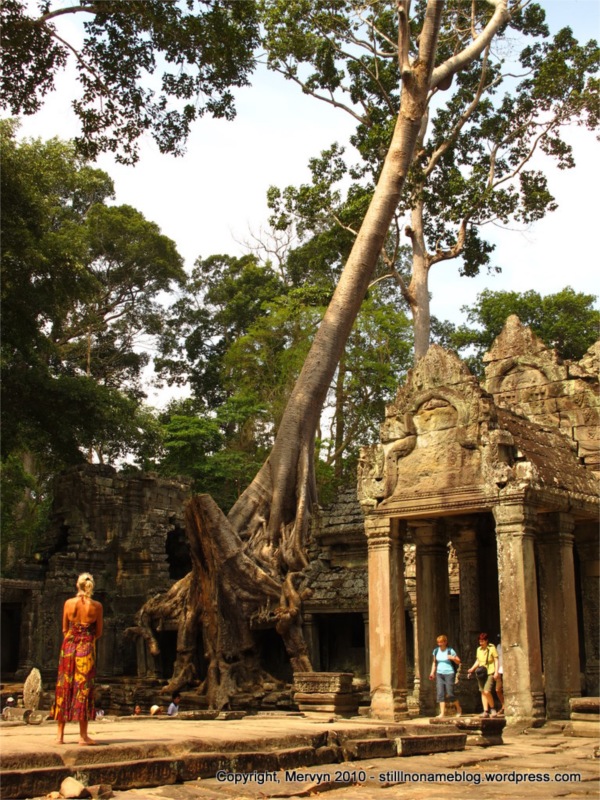
I know why Angelina Jolie has a thing for Cambodia. The American movie star first came to the country to film portions of Tomb Raider at the Ta Prohm temple and has been actively involved with the country ever since. At the beef and beer feast a few days ago, a Khmer noted two Americans that had done a lot to help Cambodia: Hilary Clinton and Angelina. She’s taken up the cause of clearing the country’s land mines, donated money for education, and even bought land in the northern provinces. She’s even adopted a Cambodian child. For her, Cambodia is no passing fancy, and I can understand.
Angelina has a reputation for being a wild child and Cambodia is a wild country. This is the woman that used to carry around a vial of her husband’s blood around her neck. She famously made out with her own brother. She’s a bisexual. She helped wreck the marriage of one of Hollywood’s hottest couples, but now is playing wife and mother to a large family. She barely speaks to her famous actor father. She had her first child in Africa. She has more tattoos than a Russian mobster. Her reputation is of a rebellious renegade, but she’s a humanitarian ambassador for the U.N., as establishment of an establishment as they come. She once ate a piece of her producer boyfriend’s flesh so that “they could be as one.”
Okay, I made that last one up, but you wouldn’t be surprised, would you?
To me, Cambodia is the Angelina Jolie of countries. It too has a rocky past and is politely referred to as “complex.” The temples of Angkor evidence a glorious history. The past few decades, though, have not been kind. It was a secondary battleground in America’s war against Communism in Southeast Asia (i.e. the Vietnam War). The populace was ravaged by the Khmer Rouge, which, through its policies, killed over 2 million Cambodians in a country that currently has a population of 15 million. The last remnants of the Khmer Rouge only surrendered in 1998. The jungles are still littered with landmines from all the previous conflicts.
And yet, this country continues to carry on with a palpable intensity. Like the vendors in Angkor, it feels like it won’t take no for an answer. In the face of a horrifying recent past, you can feel the country trying to right itself. The people seem friendly and laidback, but beneath the surface you can feel that they’ve got the hustle—like they’re taking in the situation and figuring out how they can use it to make it through the day. There’s an energy here, that’s hard to place. I feel like I could stay here a long time and still not understand it.
For a woman as contradictory as Ms. Jolie, it’s no surprise she’s taken a shine to the place. I have a feeling she sympathizes with its complex history; a history that often means that it’s misunderstood.
All that, and Cambodian kids are some of the cutest kids in the world. Makes you just wanna get one or two of your own.
Temple: Neak Pean (“The Entwined Naga”}
Completed: End of the 12th Century
Random Facts:
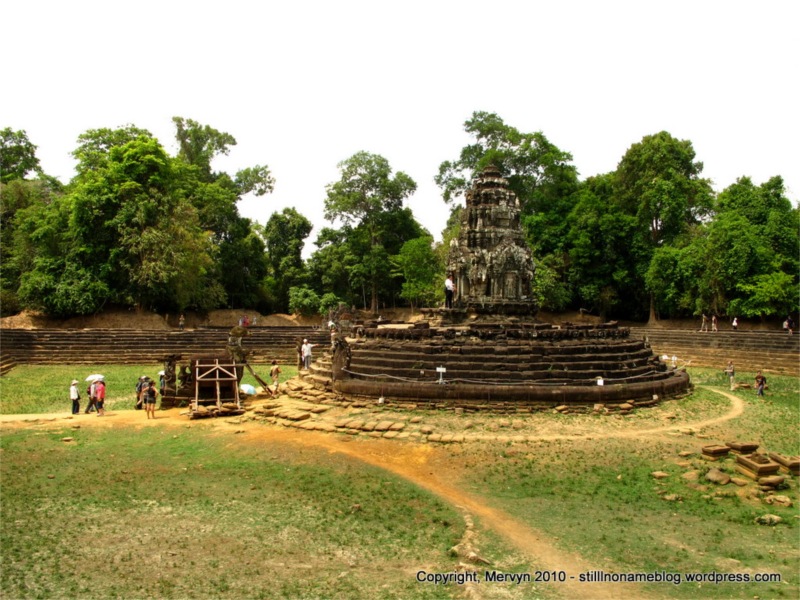
This is a shrine depicting the marriage of two serpents. The shrine sits in the middle of an island and is surrounded by four now dry pools. The tails of the two naga are intertwined with one serpent surrounding each side of the island. There is a gap between the heads of the serpent where one can ascend steps to the top of the shrine.
In the rainy season the pools fill with water creating an enchanting atmosphere. Or so writes another writer. I wouldn’t know. I visited during the dry season. There was no shade. It felt like me and the busload of Chinese tourists were sitting under the gods’ heat lamp. I wouldn’t have been surprised if a giant hand had reach out of the sky, snatched up a bunch of us, and put us in a “to go” box.
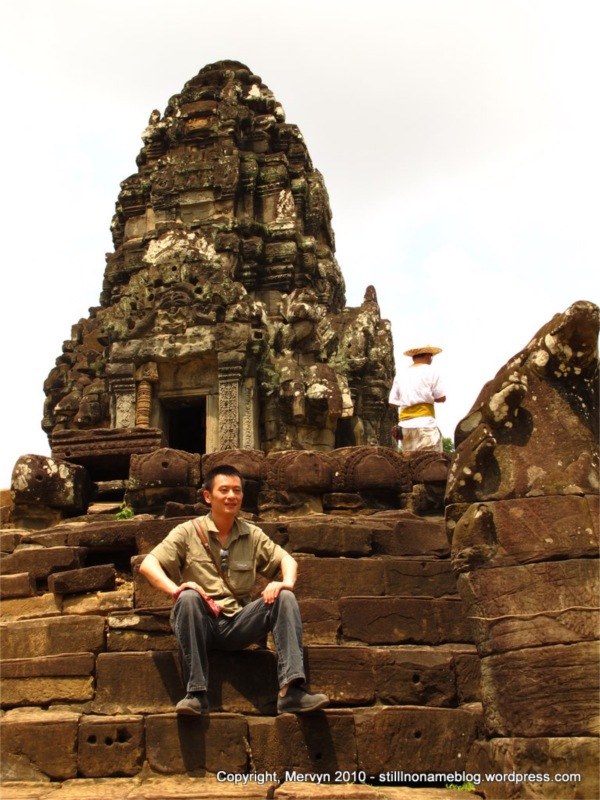
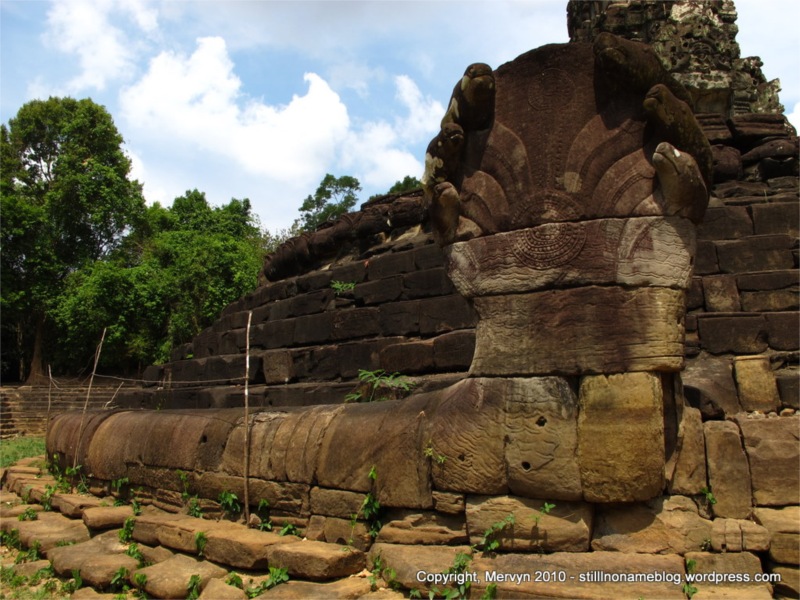
You’ll notice that, since arriving in Cambodia, I haven’t talked much about the food. That’s for a good reason. I think Thailand broke me. I haven’t come across anything I’ve totally loved when it comes to Khmer cuisine. It seems to have less flavor to me. I think it’s because I spent over a month eating Thai food, which has a myriad of spices and chilies. Even the food in Penang, Malaysia had more kick. Much of it was rooted in Indian flavors, which aren’t exactly subtle.
Even the Khmer beer and beef feast from a few nights ago was more about the circumstances than the food itself. The beef was just semi-raw strips of flesh cooked over a flame. The sauce was a little spicy, but the flavor wasn’t anything to write home about (literally).
It could also be that I’m just missing something. I will continue to explore random foods and see if I can come up with something interesting.
Temple: Ta Som
Completed: Late 12th Century
Random Facts:
A smaller monument. A giant tree has taken root over the eastern entrance, just in front of a tower with Lokesvara’s four faces.
This temple felt like a cross between Bayon and Ta Prohm. You had the giant Lara Croft trees combined with the four-faced towers. It also felt like this other temple that had stones and vegetation. I think it was in Angkor too. There was this other temple too that was old and falling apart as well. I’m pretty sure I visited this temple. I’m confused. I see ancient ruins.
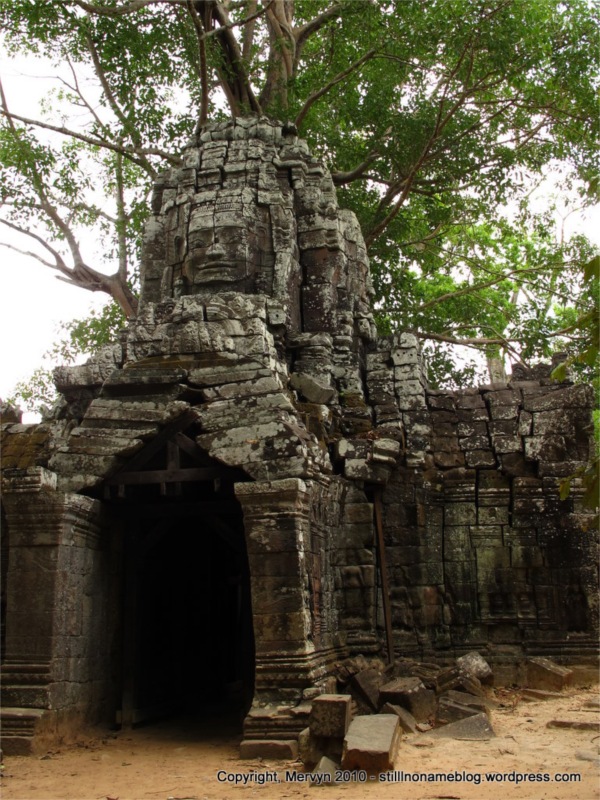
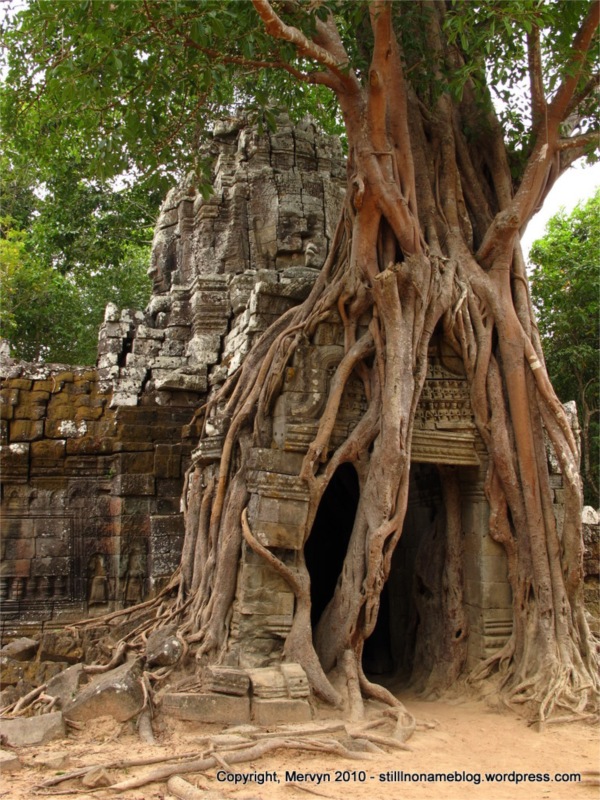
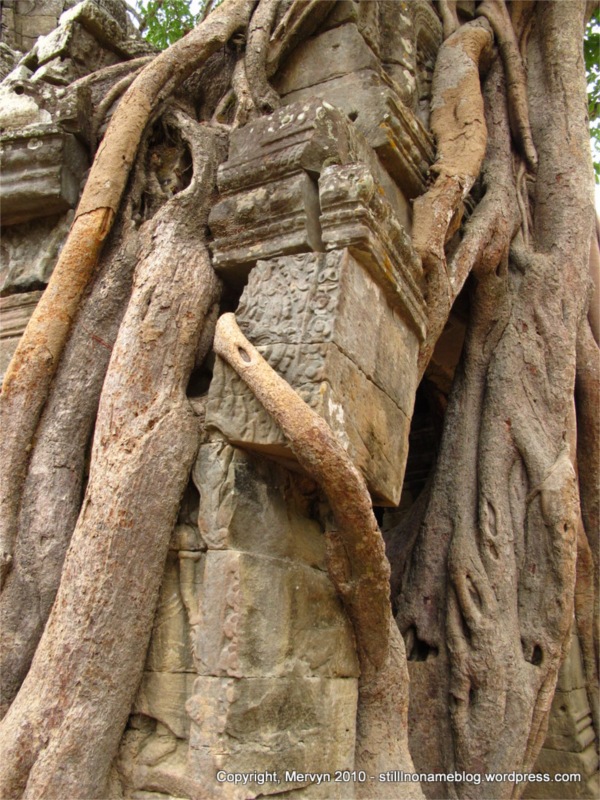
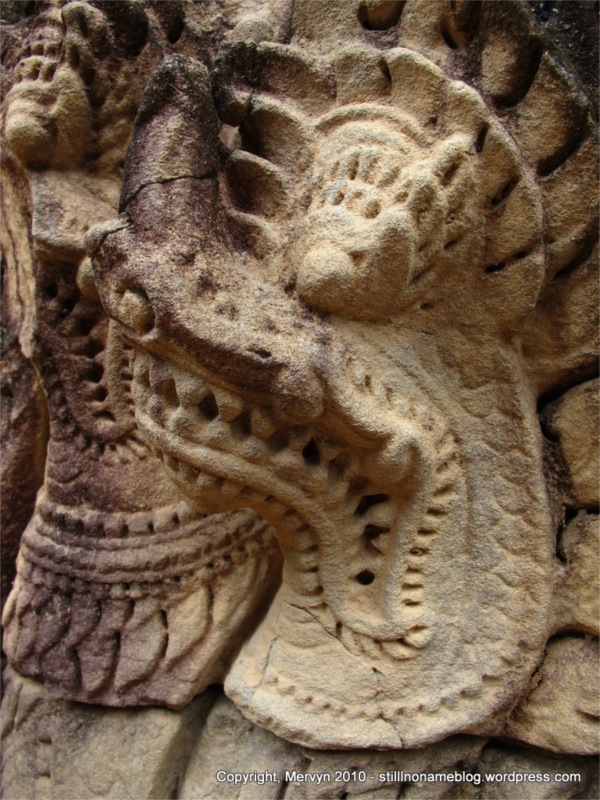
I’m getting better at taking pictures of buildings. Compared to my struggles in Penang, Malaysia I think my pictures these days are much better. That’s especially true for temples. I’ve learned that patience is a photographer’s best friend, especially here where the sites are crawling with tourists. To get a nice shot, it sometimes means sitting in the shade waiting for the busload of Koreans to roll out.
Looking at the first day at Angkor and today, I can see that I’m improving. I even went back to Ta Prohm (the Tomb Raider temple) today to reshoot some stuff. I even got a pic of the giant tree over a doorway without a chesty blonde walking in.
I’ve also noticed that I’m not the only photo-dork out here. There are guys (haven’t seen any women photograph-philes) with elaborate set ups. Backpacks with multiple lenses and hoods. Vests loaded with photo gear. One guy had a camera on a tripod, another around his neck, and a bag full of accessories.
I don’t know how these guys lug all that crap around. Today, it was so hot I struggled to not sweat on my little handheld with my fingertips.
Temple: East Mebon
Completed: 952
Random Facts:
This is a Brahmanic structure built in the “mountain” style. This temple is part of a series of temples erected in honor of deified parents. I just plan on putting mine in the best rest home money can buy.
A Chinese chronicler who visited Angkor in 1296 said that the “inhabitants are coarse people, ugly and deeply sunburned.” This is day three of wandering the temples. I don’t see coarse, ugly people.
I do sympathize with the “burned by the sun” description. That’s because I now have a spectacular shirt tan. All those days in the Thai islands gave me a nice even color. No longer. There are now three shades of me. The only time I look darker than one of those shades is when you turn out all the lights on a moonless night.
No skin cancer though, assuming that this “Ultra Sweat Proof” sunscreen can stand up to my sweat gland onslaught. There’s some serious doubt to that, too. I drank a liter and a half of water today while doing the temple circuit and didn’t feel the urge to pee once. I think I’m urinating through my skin.
That reminds me, maybe I should do laundry tonight.
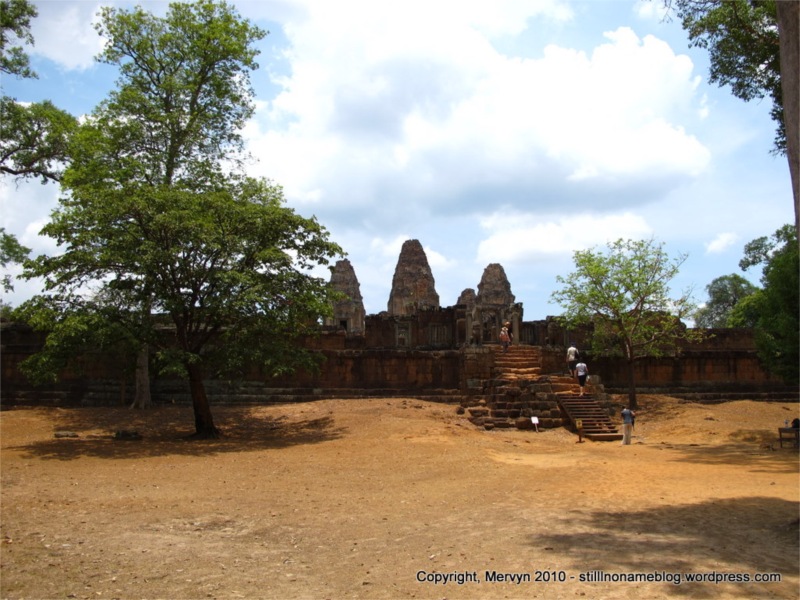
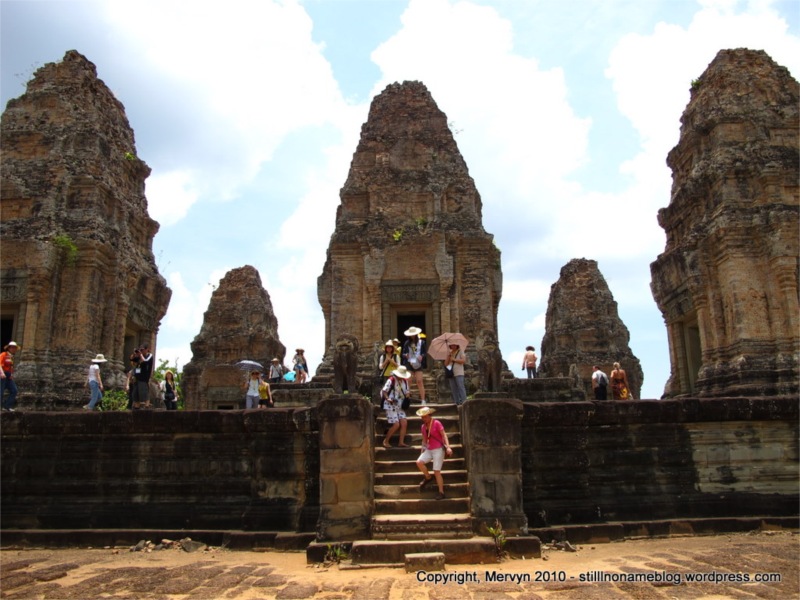
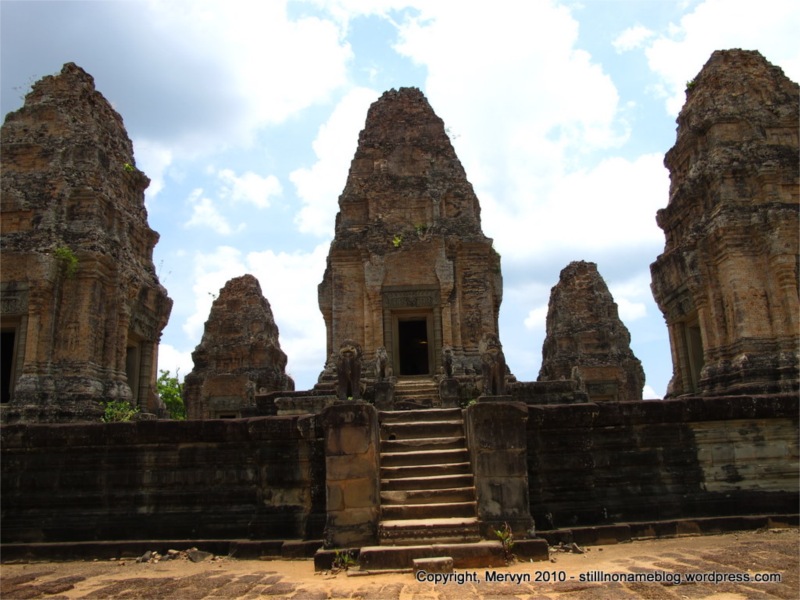
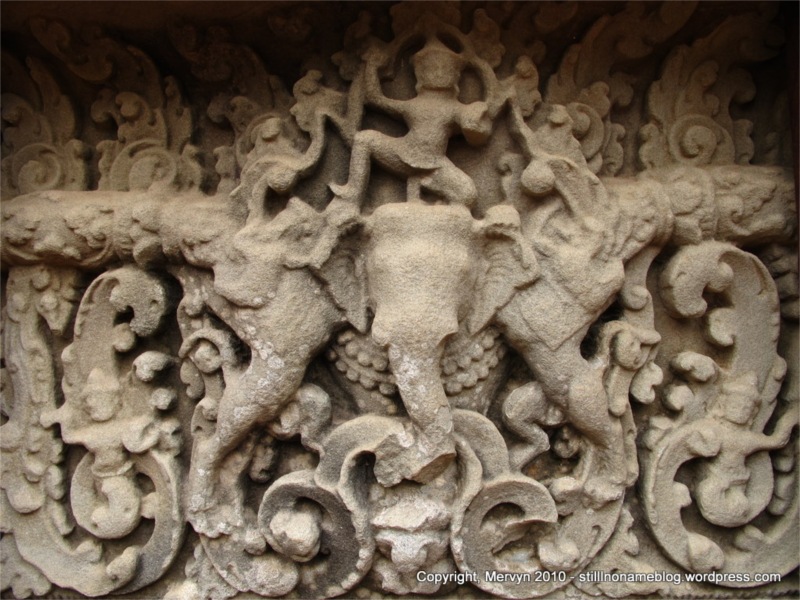
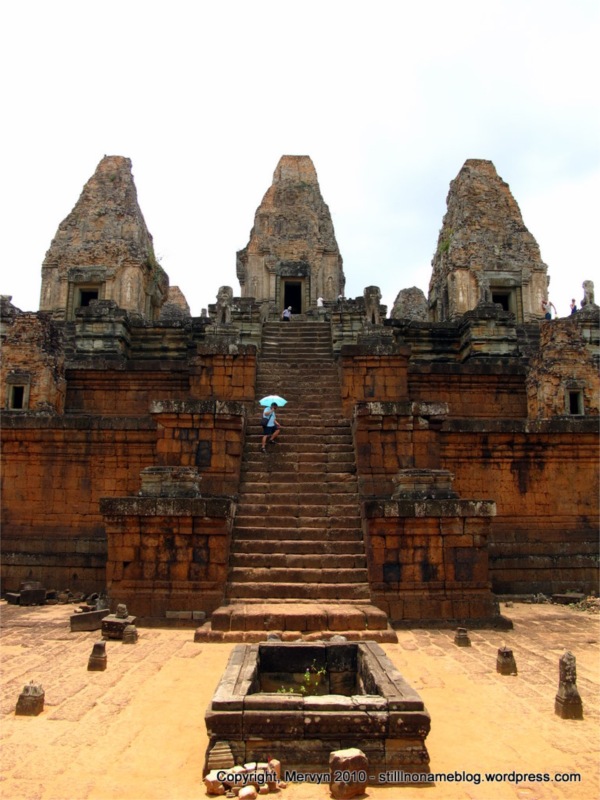
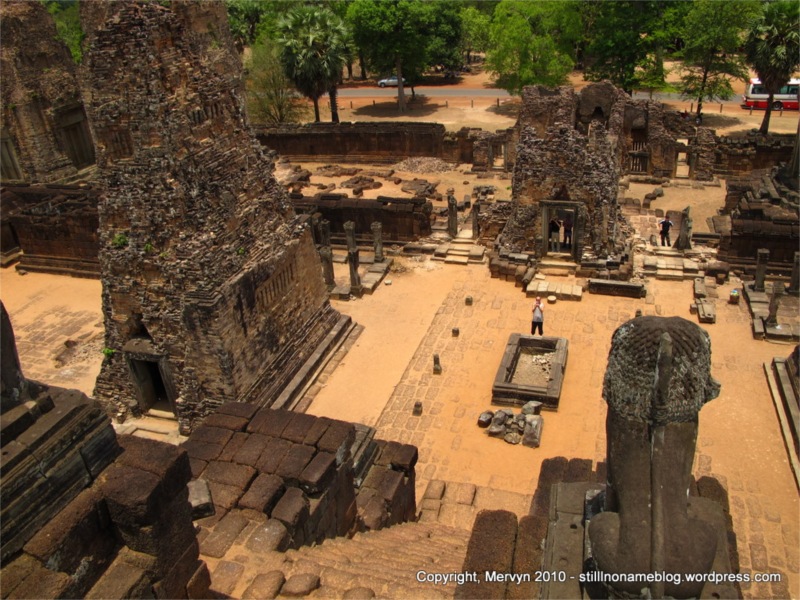
Temple: Pre Rup (“Turn the Body”)
Completed: 961
Random Facts:
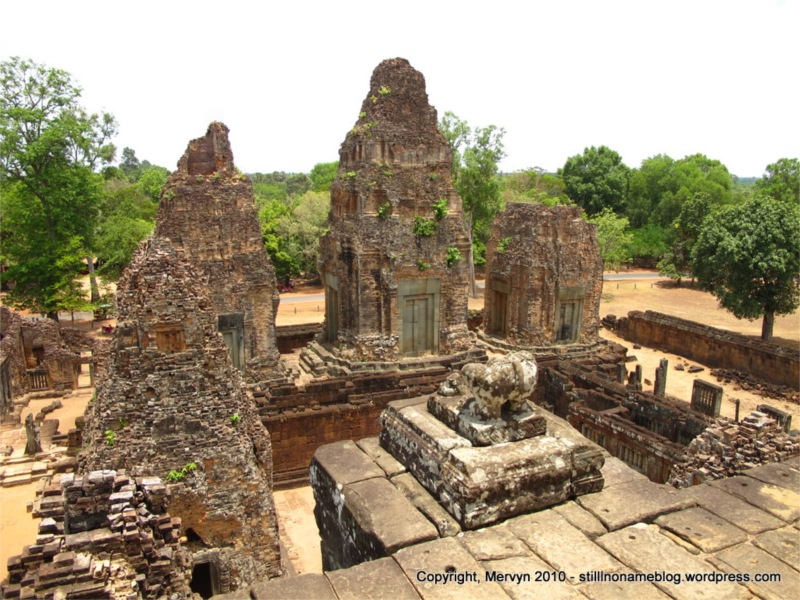
Made primarily out of warmer colored materials (laterite and brick) this temple has some fine colors. Built in the style of the “temple mountain” this Brahmanic structure is a three tiered pyramid topped with five towers. The walls used to be covered in limestone plaster. Legend has it that the site was used in cremation rites. “Turn the Body” refers to turning the corpse in the funeral pyre.
Presumably, if they’d mummified bodies here they’d have called it “Canned Preserve the Body.”
Other than at two stoplights in town, nobody here stops at intersections. Not trucks or motorbikes or cars. They slow down then just slowly not crash into each other. My tuk tuk driver, for instance, came to a “T” intersection this morning. The cross traffic was thick and moving briskly for Cambodia. He slowed down a bit, rolled through the cross traffic, and crossed to the far lane as he made his left turn. Everything seemed to go all Matrix–all the cross traffic slowed around him and he didn’t really break stride.
I think this only works because everyone understands that when you come to a cross street, you have to keep an eye out for merging traffic. Also, no one really goes much faster than 40 km/h in the city. It could be too that no one cares if they live or die. Since I’ll be in Cambodia for at least another week, I’m going to pretend that that one’s not true.
Maybe all Khmer are telepathic and telekinetic—they can communicate their driving intentions to all around them and, if need be, move objects out of their path with their minds. Yeah. . .I like that one. I feel much better now.
Temple: Banteay Kdei
Completed: Beginning of 13th Century
Random Facts:
A low-lying temple that, at its highest point, is three stories tall. It’s a mix of Buddhist and Hindu iconography. Hindu images have been drawn over Buddhist ones. There used to be statues of Buddhas attached to the walls but they’ve been removed.
A lot of the artifacts were looted by the Khmer Rouge and sold on the black market. Part of their eradication of all religion or something. Much of the temple was destroyed by the Khmer Rouge. Apparently they used it for target practice.
I can see why. It’s not like there was anything else to shoot at like jungle, trees, or dissidents.
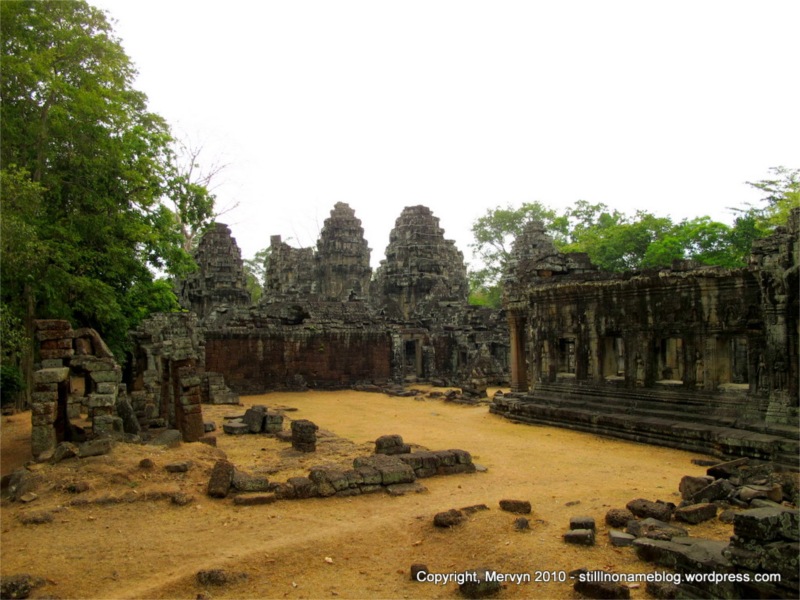
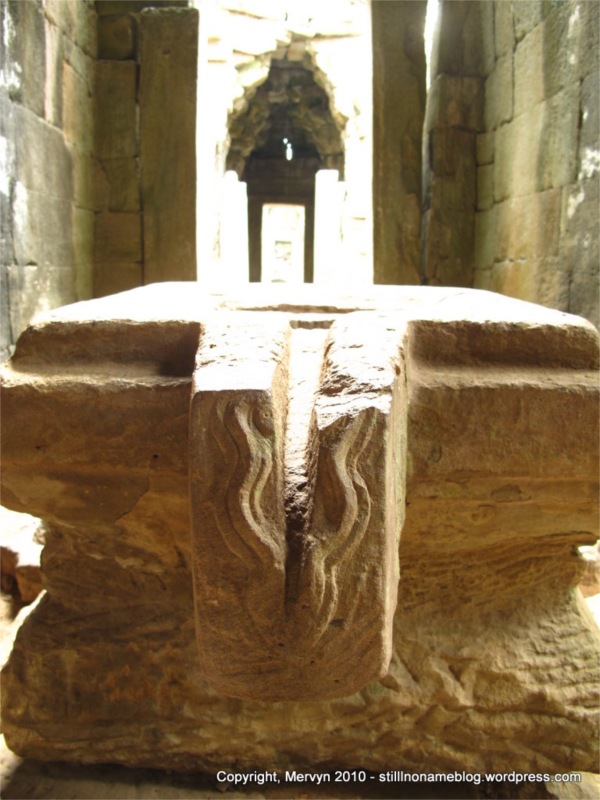
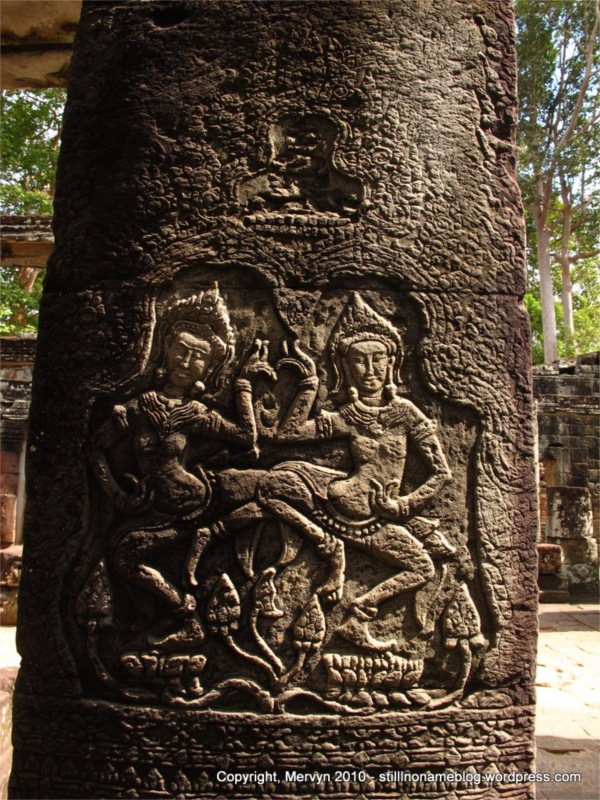
It’s all kind of blending together. I don’t have “temple fatigue” but I am having a hard time distinguishing between them. For instance, I was going through the pictures for today’s entry and I got confused about what temples I’d visited. Usually, I try to take pictures of signs so I can know what I was just photographing. For two temples I didn’t. All I know is that they were both on the Grand Circuit. I had to read the guide three times to figure out which temple was which (came down to the height of the pedestals and the schematic overheads, which were less helpful than you’d think since most temples have similar layouts).
It’s possible that I still got them wrong and I could suffer great humiliation at the hands of a temple geek.
I’m counting on reader apathy.
Click here for pictures. Including new pictures of Ta Prohm, the Tomb Raider Temple.
Day 46 – Teach The Children (More AngkorTemples)
Dateline: Siem Riep and Rolus Group Temples of Angkor, Cambodia – Sunday, April 18, 2010
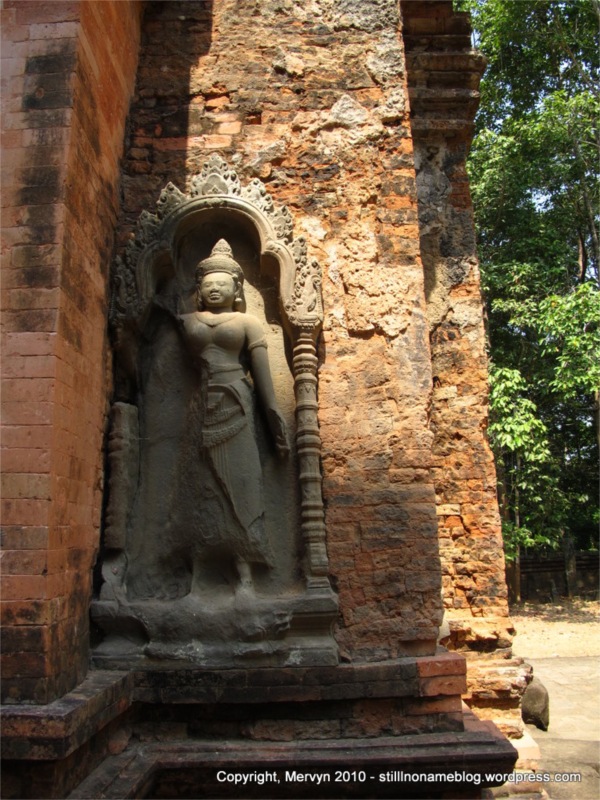
Temple: Preah Ko
Completed: 879
Location: Roulus Group, 15 km southeast of main Angkor temples
Random facts:
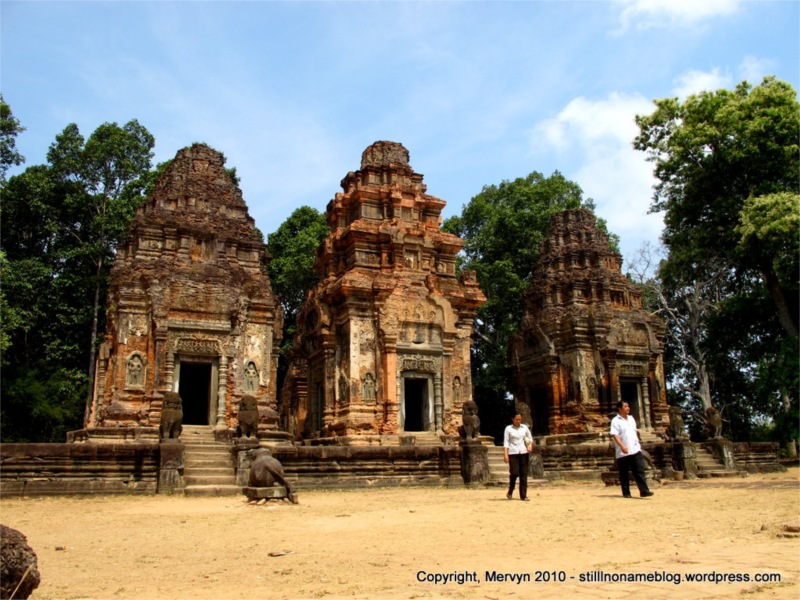
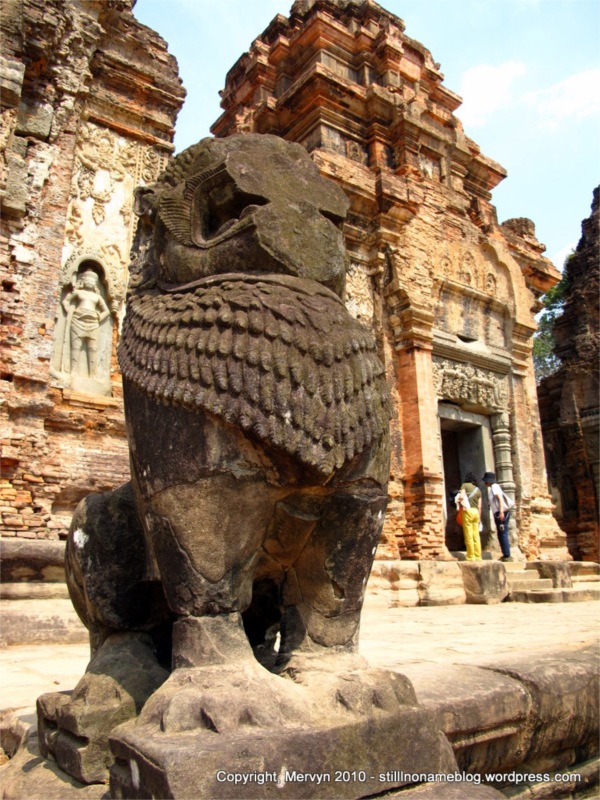
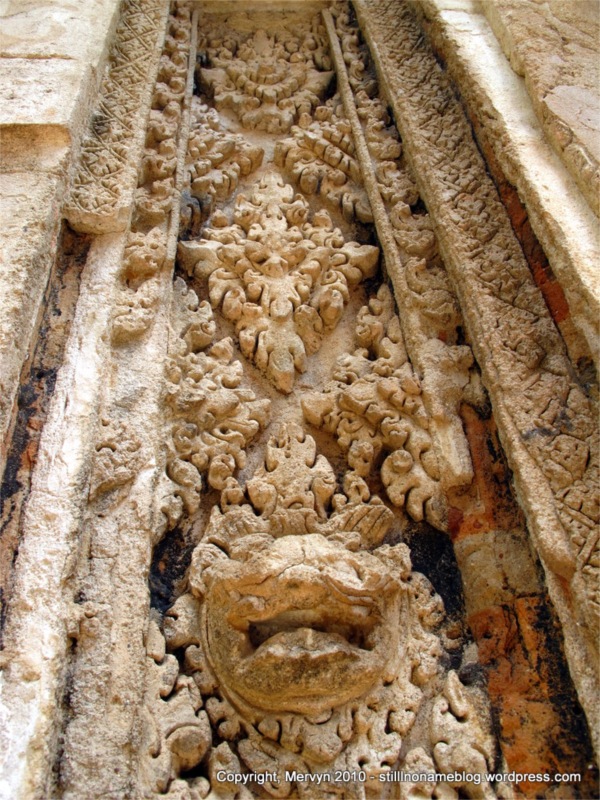
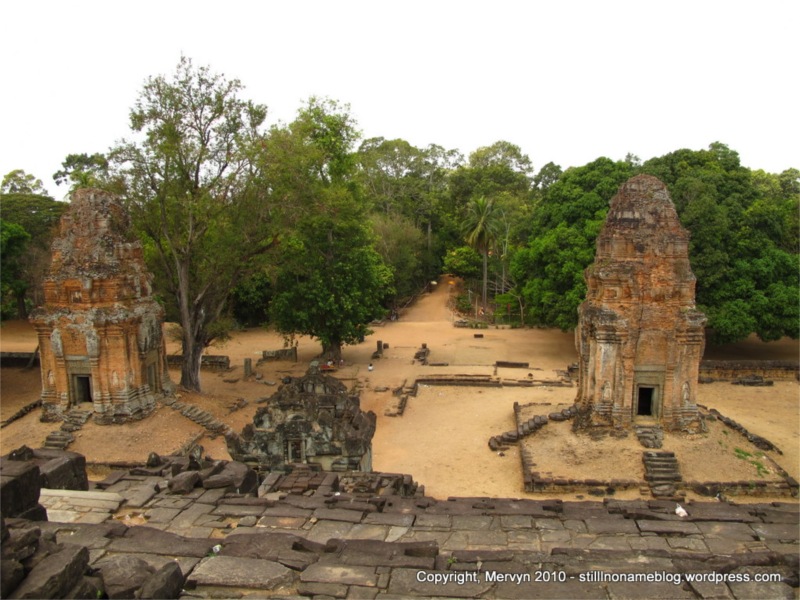
First major temple built from Angkor period. The “Sacred Bull” temple. Made of brick, unlike later temple.
Built to honor the king’s family. Has six towers, two representing the king’s parents, two for the king’s grandparents, the center two for the king who founded the Khmer empire and that king’s wife.
The three towers in front represent the men, the three behind, their wives, exhibiting the universe as it should be, except the back three temples really should be bar foot, pregnant, and in the kitchen makin’ some pies. Guess they couldn’t get it to work architecturally.
It’s the same every time:
“Mista, you like cold drink?”
“Buy ten postcard, only one dollar. Send to your friend or girlfriend.”
“Ten bracelet, only one dollar.”
“You like to buy fruit? Have mango, pineapple, banana.”
“What your name?”
“You want something to eat?”
“Business no good today. You buy from me.”
“You buy guide book. It tell you story. Must learn story.”
“Where you from? If I tell you the capital of California, governor, the president of America, population then you buy from me.”
Sometimes it would be a horde of little girls carrying baskets of knickknacks. Sometimes it would be ladies calling out from their roadside food stands. Sometimes it would be a lone man standing near an entrance holding guide books. The order of the phrases change. The words vary a bit. But after the 500th time, it all sounds the same. These are the perils of visiting Angkor.
Some people hate this kind of crap. They despise the hard sell. They don’t like it when the kids don’t take no for an answer, trailing around after you even though you’ve waved them off and said you don’t need more Angkor Wat fridge magnets because you bought 1,000 yesterday for all your girlfriends. It drives them absolutely mad.
I can’t blame them.
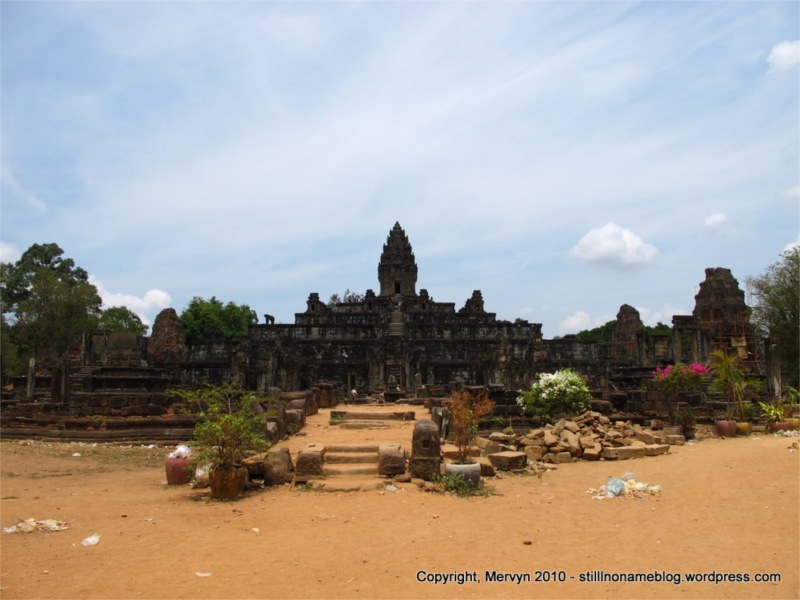
Temple: Bakong
Completed: 881
Location: Roulus Group, in center of the first Angkorian capital
Random Facts:
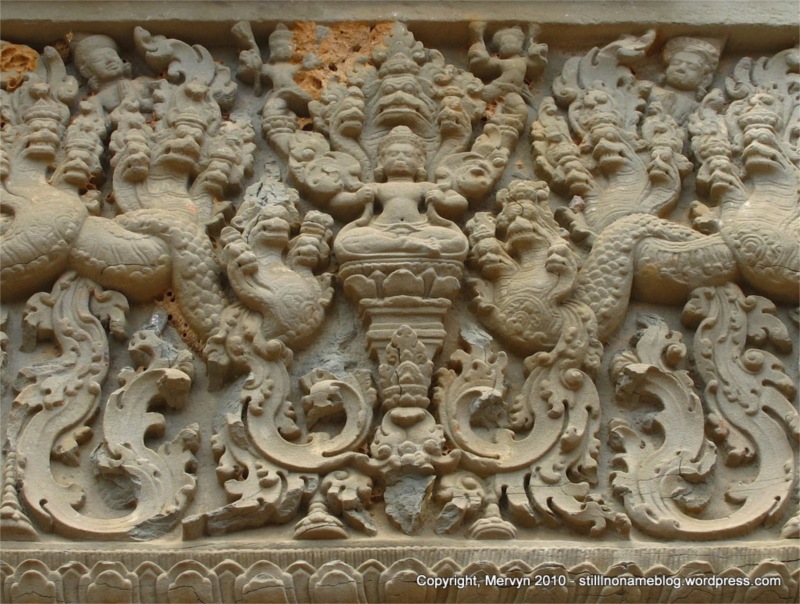
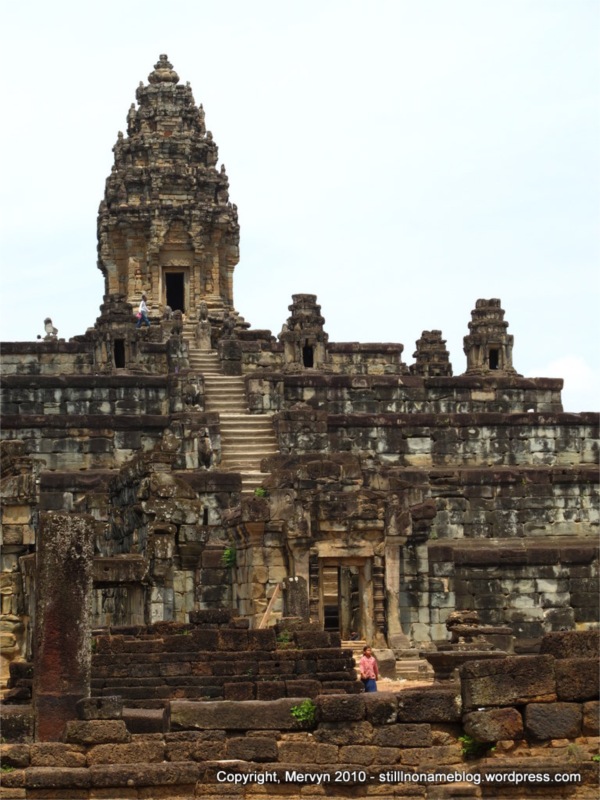
Built in the “mountain style” with five tiers. Made of sandstone, not brick. Originally dedicated to the Hindu god Shiva. Has two moats and is surrounded by brick towers similar to those at Preah Ko. Subsequent kings added and expanded the original temple. This is a running theme in the Angkor temples. A site will start out Hindu, then a later king will remodel, expand, or destroy bits to make it Buddhist. Then another king changes it back.
The philosophy seems to follow that of certain late 20th century car buyers—find something previously owned, then pimp it to your own eccentricities. When you lose it in a pink slip drag race, don’t be surprised if the new owner guts it for parts, strips your old paint job, or uses it to curry favor with Vin Diesel in a surprisingly virulent virus of a movie franchise. What were we talking about again?
Don’t get me wrong. I got sick of them too and I think I have a high tolerance for this kind of thing . It’s day three of temple hopping and I felt like every walk up to the site was the same. It started off innocently enough with Collin and Haley two days ago. We sat down for a late breakfast at a food stand near Bayon. A group of kids rushed us and tried to sell us woven jewelry, Angkor trinkets, postcards, and toys. When we insisted we didn’t need anything, one girl just stood at our table with her basket of stuff propped on the edge. She didn’t say anything for a long time. She watched us get our food. She sat in on our conversation. Only occasionally would she shuffle.
I’m talking dedication to her vocation. Did I mention she was probably only 8 years old?
Whereas we were polite about our refusal, the American lady at the next table was much more brusque.
“No. Leave. I don’t want anything. No. Go away. Put that back in your basket, I don’t want it. Stop.”
I didn’t know whether she or the kids were more annoyed.
I’ve heard some people hate Cambodia because of the people. If they only visited Angkor and Siem Riep, I can see why. Here, no question is ever innocent.
Someone wants to know your name? They’re running game.
Someone wants to know where you’re from? They’re going to use it to try to impress you with knowledge of your home country so they can sell you something.
Someone offer to show you something in a temple? They’re going to put their hand out for a tip.
It’s always a best price. It’s always please. It’s never just because. Under the onslaught, it’s very easy to become cynical about every Khmer you meet.
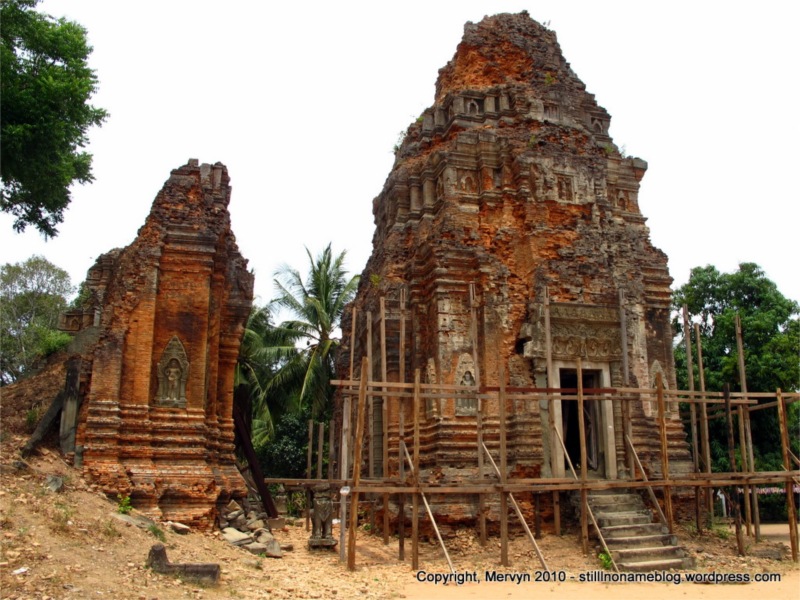
Temple: Lolei
Completed: 893
Location: Roulus Group, on an island of a now dry lake bed
Random Facts:
Last major temple built before the capital moved to the Angkor area. Four brick towers built on a platform. Dedicated to Shiva and the royal family. It’s the smallest of the major Roulus Group temples. Now the site of an active monastery. Monks dressed in orange go about their monk duties while you wander the temple grounds. This site has never played host to a Super Bowl.
Even though I was weary of the constant sales pitches, my attitude started to change. It went through the classic comedy arc. A short story, to illustrate.
When I lived in the Philippines, I attended a male beauty pageant in which my cousin was a contestant. (Man pageants are normal in the Philippines. Think football but with more outfit changes and less putting your hands between another guy’s legs.) In the talent section, one guy chose to play a guitar and sing a song he’d written himself.
When he started it was clear this was a disaster, as in the only way you could tell he wasn’t chewing on the tail of a live cat was because you could see his mouth wasn’t full.
Everyone in the audience was trying to hold back their laughter, you know, to be polite and all. You could hear a titter running up and down the audience. When he got to verse two, though, some people were openly laughing. They couldn’t hold it in.
That is, until he got to verses three and four. At this point, everyone started to feel sorry for him. He was humiliating himself and didn’t seem to know it. Someone had told him he was good when he clearly wasn’t. A murmur of shared embarrassment rippled through the crowd. It was sad to watch.
BUT when the contestant decided the audience hadn’t had enough of his self-written piece and plowed right into verse five? Everyone lost it. People were practically rolling in the aisles. All sympathy was gone. The guy was doing it to himself.
The situation had started comedic, turned tragic, then–after the tragedy had cried itself out—become comedy once again. After all, sometimes when things are going bad, all you can do is laugh.
I went through the same progression with the aggressive sales pitches. At first I thought it was amusing. These kids are so clever and cute, coming up with ways to get people to buy.
Then I started feeling annoyed and sorry for myself. What the heck? Can’t these people see that I just want to experience the peace of an ancient temple? I’ve said “no” a thousand times to every other seller out there. Nothing you can say will make me want to buy a small, brass version of Angkor Wat. What am I going to do with a wooden flute? Leave me alone!
After a while, though it became high comedy. I’d try to guess which line the kid was going to use. I’d laugh when I’d say “no” the first time, every kid immediately asked, “Where you from?” I started to think of these people as the opening and closing credits to the temples. Most times I’d want to skip them, but after a while they became part of the main event—a catchy, familiar tune that I’d hum along to as I walked into each site.
These people live in a poor country and are trying to eke out a living whatever way they can. They’re certainly not doing it to get rich. They’re not rude and they don’t yell; they’re just insistent. They’ve learned English, Chinese, French, German, Spanish, Italian, Japanese, Korean, maybe only a little bit but enough to get their point across. Furthermore, these are the descendents of the people who built these temples.
The least I can do is turn them down politely. Maybe I’ll even teach one how to say, “California. So if I tell you state budget deficit, you buy from me.”
Day 45 – Angkor Wat Is Overrated
Dateline: Siem Riep, Cambodia and surrounding Angkor temples – Saturday, April 17, 2010
Angkor Wat is overrated. Yeah, I said it.
Everyone I’ve talked to has said that it will be a spiritual experience. That it’s awe inspiring. That it’s mesmerizing. That it’s the eighth wonder of the world. I had no reason to think otherwise. A million visitors a year can’t be wrong.
Well they are. It may be one of the most revered sites in the world, but not by me. Before you dismiss me as a crank, hear me out.
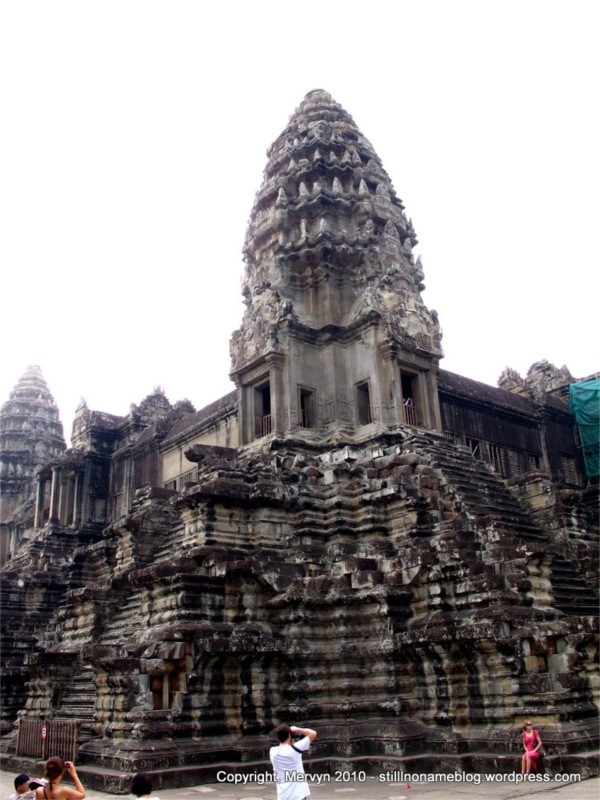
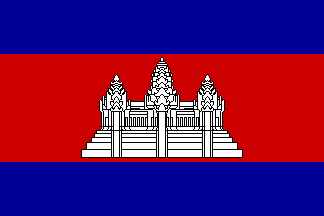
Angkor Wat is the largest of a host of temples located near Siem Riep, Cambodia. It appears on the Cambodian flag. Built in the early 12th century, it is the best preserved temple of the Angkor era of Cambodia. It first served as a Hindu center, then shifted to Buddhist with the whims of the reigning king. It exemplifies Khmer architecture.
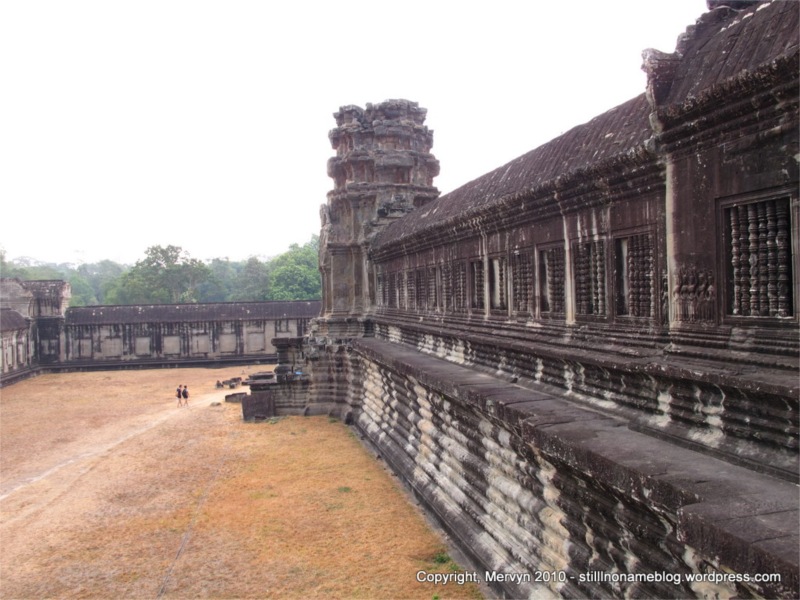
None of this matters to me. I acknowledge that it is an impressive structure. It is amazing to think that people hacked down a section of jungle and constructed one of the biggest preindustrial structures in the world. It didn’t move me, though.
Bigness does not impress me. In fact, I think its reputation for being large works against it. It’s large but not stunningly large. It’s large for what it is, but like most celebrities, it feels smaller in person. It doesn’t help that it’s crawling with tourists.
I’ve said before that I don’t hate on hordes of tourists coming to popular places . I still believe that. Why hate on people for wanting to see the beautiful thing that you’re also visiting.
The horde, however, does take away from what could be a more meditative experience. It’s not like they’re in a cathedral, either. No priests are running around shushing people. Here, the tourists are outdoors, talking loud, posing for pictures, listening to their guides, queuing up to climb stairs, and everything else that you’d expect people to do when visiting a famous landmark, not a sacred shrine.
I think it was all expectation for me. I wanted more than an old, big building—I wanted a religious experience. I wanted to stand in awe of the past. I wanted to see Buddha and Vishnu. I wanted to feel small and insignificant in the face of one of the best temples in the world. The crowds, however, had conquered the complex and made it just another old building. The whole time I kept thinking the place needed to be bigger so I could find some peace–I felt like one of the herd, shuffling around grazing on the past.
That doesn’t mean I didn’t like it. It just isn’t what it’s hyped to be. I’m going back for the sunrise. I wouldn’t mind spending more time at the bas reliefs. Next time, I’d focus on finding secluded pockets of temple where I can feel the history. Places that feel expansive instead of cramped.
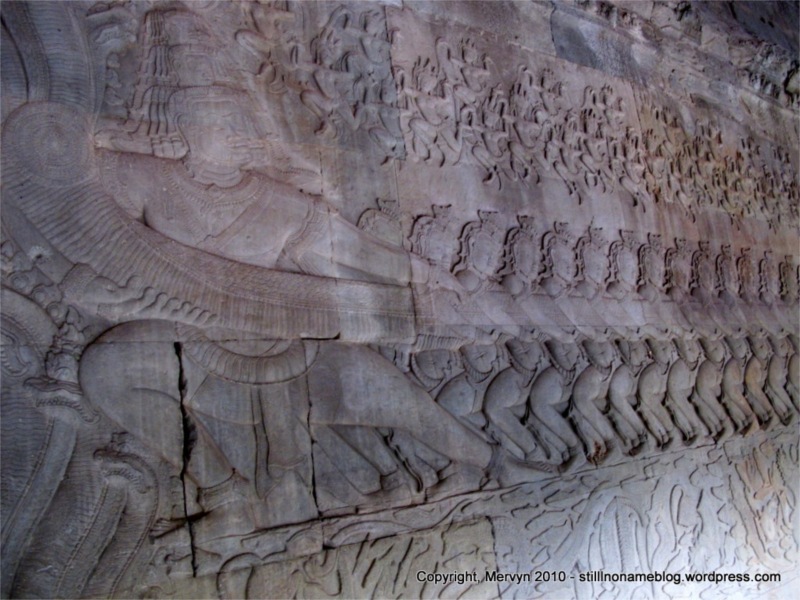
If you get a chance, you should go. Go there before it gets even more crowded. It only started really being touristed in 1998 upon the defeat of the remnants of the Khmer Rouge movement. The number of visitors has been climbing every year. Get in there before they have to shut it down to preserve it.
Now, I’ve been a little sneaky. Those steeped in all that’s Angkor will have noticed that I only talked about Angkor Wat, not the Angkor temples themselves. Yes, there are others. Hundreds of others.
After Angkor Wat, Collin, Haley, and I visited Bayon, The Terrace of Elephants, The Terrace of the Leper King, Ta Keo, and Ta Phrom (i.e. the “Tomb Raider Temple). Collin and Haley were trying to cram in the highlights of the Angkor Temples into one day. I’d given myself four days to explore the temples.
I don’t want to give you temple fatigue. You’re going to hear a lot about temples for the next few days. I’ll keep it brief and let the pictures do most of the talking. I’ve read that after a day or two everything starts to blend together. I’ll do my best to not let that happen here. With that in mind, I’ll stick to the highlights.
Bayon
This temple is really a ruin. From far away it looks like rubble, a haphazard stack of dark rock. As we got closer we realized what we were looking it. This is the temple with all the faces. You know it even if you don’t realize it. The towers throughout the structure have a face carved into each of the four sides. There are supposed to be over 250 faces in the complex. I’d believe it.
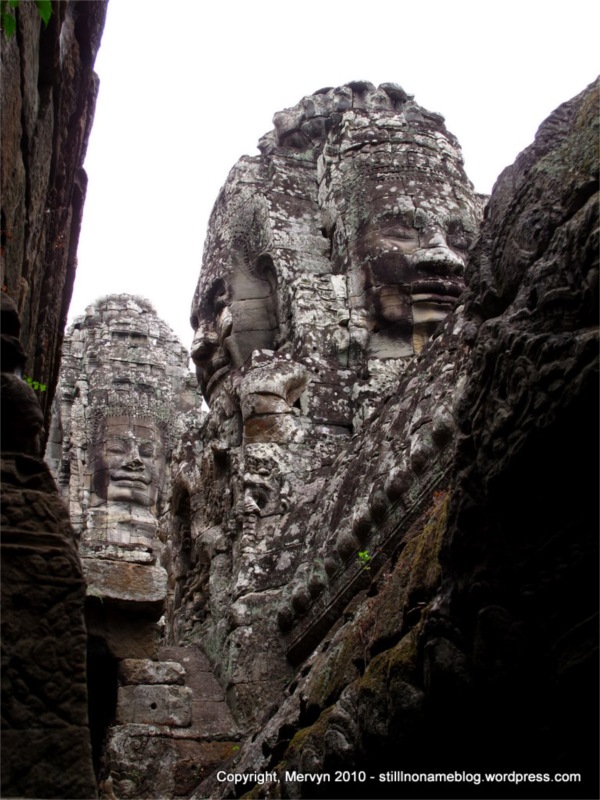
Collin, Haley, and I all agreed we liked this better than Angkor Wat. Evidence: We took way more pictures here than at Angkor Wat. The place was just plain cool. There were tons of little details carved into the walls and around doorways.
A Cambodian guy approached me and started telling me about the temple. He showed me a well, bats hanging in a tower, some details on the wall where Buddha figurines used to hang. He’s one of the illegal guides I’d heard about that hang around the temples. They work for tips.
He sent me off upstairs to meet Collin and Haley and asked if I could pay him. I gave him two dollars. He said he preferred baht. I gave him 100 baht instead which is about $3. He asked for 500 baht “for his schooling.” I laughed in his face. An official guide with an AC cab costs $25—he was asking for almost $17. He said something about bribing guards. This sounded plausible and I like the guy. I dropped him 40 more baht, against my better judgment. I think I got hustled. I chalked it up as a learning experience.
Terrace of Elephants
Way too hot to appreciate this adequately. There was no shade because it’s a 300 meter long parade stand. It had elephants on it.
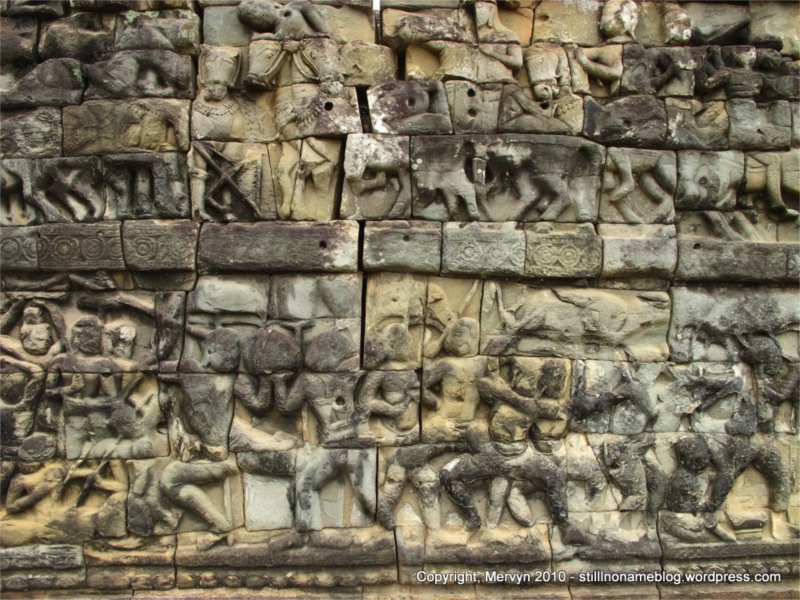
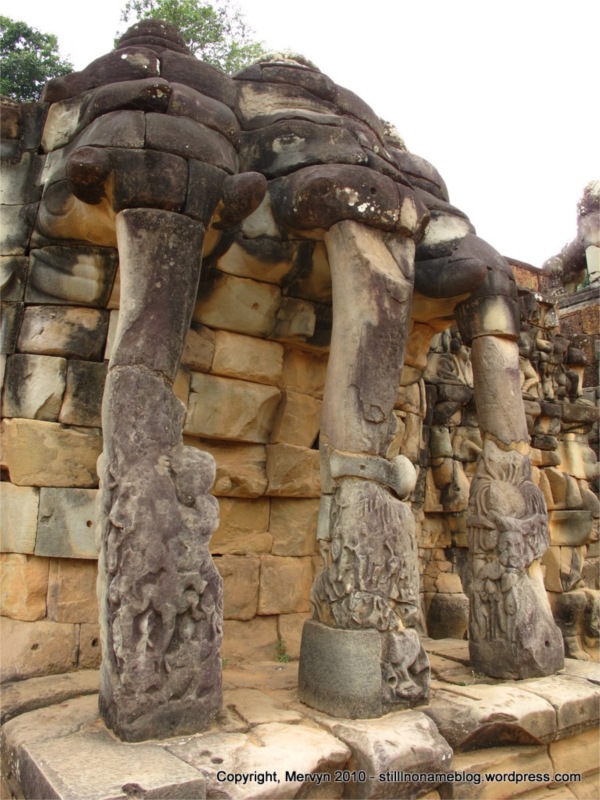
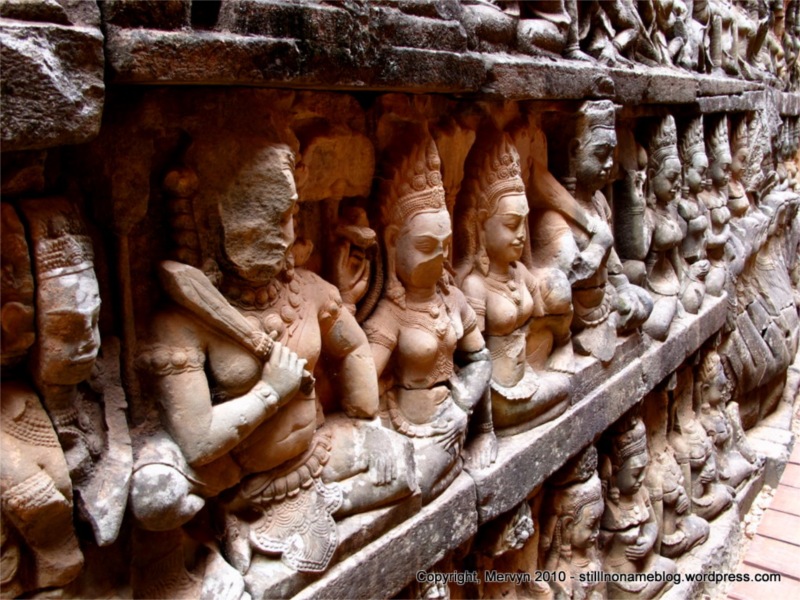
Terrace of the Leper King
This is a 6-meter tall stand probably used as a crematorium. On it is a statue that is either of a legendary Khmer leper king or of a Hindu god. The one there now is a replica. The real one is in a museum. The highlight is the inner wall around the base which as all sorts of well-preserved carvings along the wall.
I liked this one because, between the inner and outer wall, there was shade.
Ta Keo
This is a tall temple that was never completed. Our tuk-tuk driver said it was because lightning stuck the temple and the king took it as a sign that the site was unlucky.
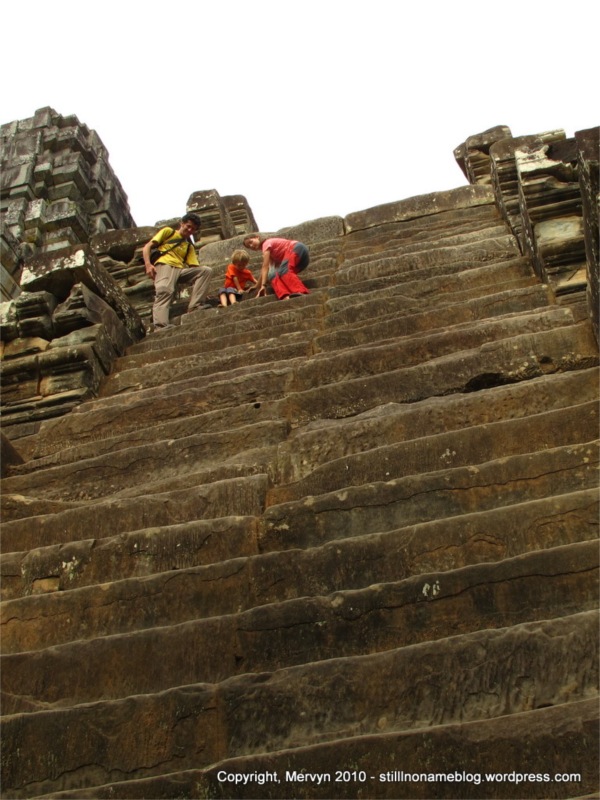
Maybe the gods struck this temple down because the king who built it was an arrogant prick. The thing has some of the steepest steps I’ve ever climbed. The steps were as thin as the width of my foot and each one was almost knee high. The proud king basically made you “crawl” up the steps to get to the top of his shrine. I think the gods went out of their way to humble him.
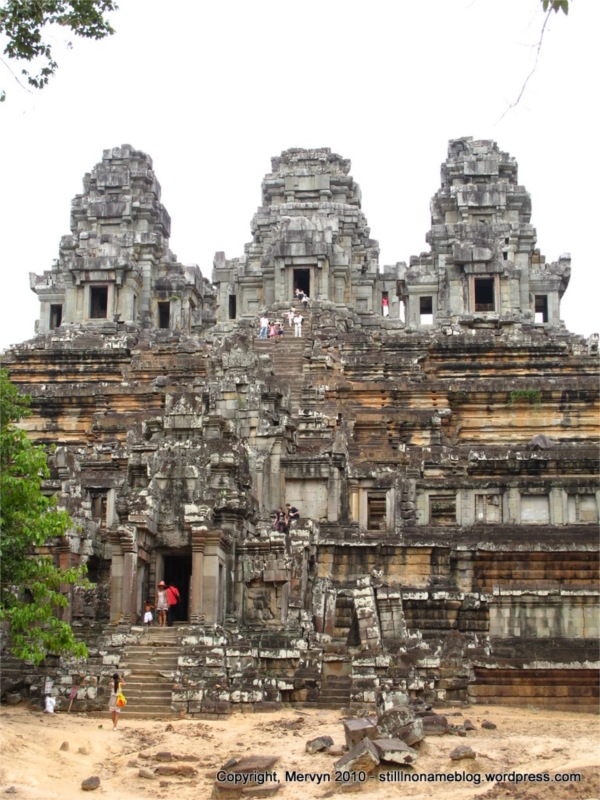
Haley passed on the steps. Collin and I laddered our way to the top. We both wondered out loud how we’d get down. At the top I ran into a French family with two small kids. There was a 3-year old and a 7-year old girl. I wondered how they’d get down.
We ended up finding some wider steps on the opposite side of the tower and decided to climb down from there. A Cambodian guide told us that a few months ago a Japanese girl in her twenties had died going down the opposite steps. Guess we were lucky to find the easier ones.
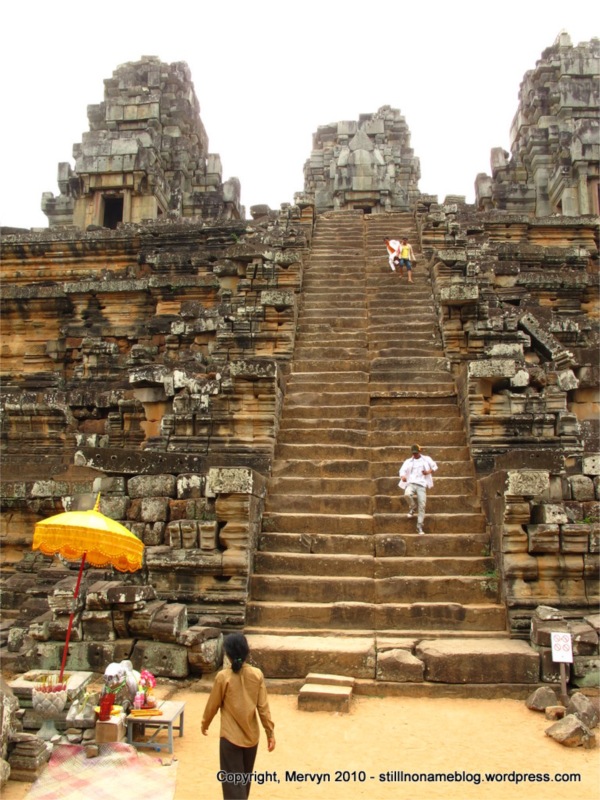
When I walked back around the base of the tower towards the exit, I saw the French family descending the Stairs of Death. Actually, I saw the dad and kids coming down. Mom was at the bottom taking pictures of the descent. Dad wasn’t even holding his son’s hand. This confirms that French parents are the most awesome parents in the world.
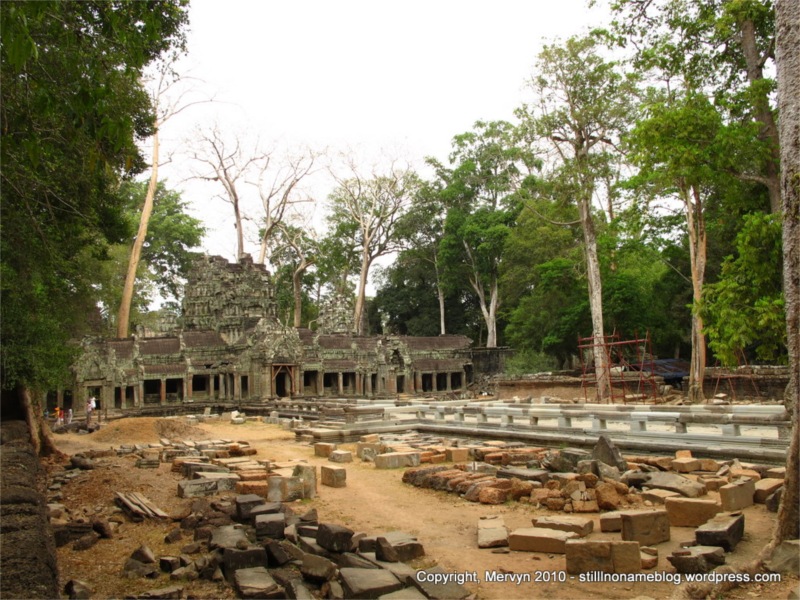
This temple is the reason Angelina Jolie loves Cambodia. She had to come to this temple to film parts of Tomb Raider. Every Cambodian refers to it as such. The Tomb Raider temple is ridiculous. If I drugged you and dragged you here, told you that I’d constructed this place as the movie set for an upcoming adventure movie and that I wanted your honest opinion, you’d tell me that I’d gone too over the top and to tone it down. Really. It looks fake.
You know on the Indiana Jones ride in Disneyland, where they have those roots and trees growing out of rock? You touch the roots and they feel like cement, confirming that you’re in the real world and not in an Indy movie. Well here, the roots are real and the trees are bigger.
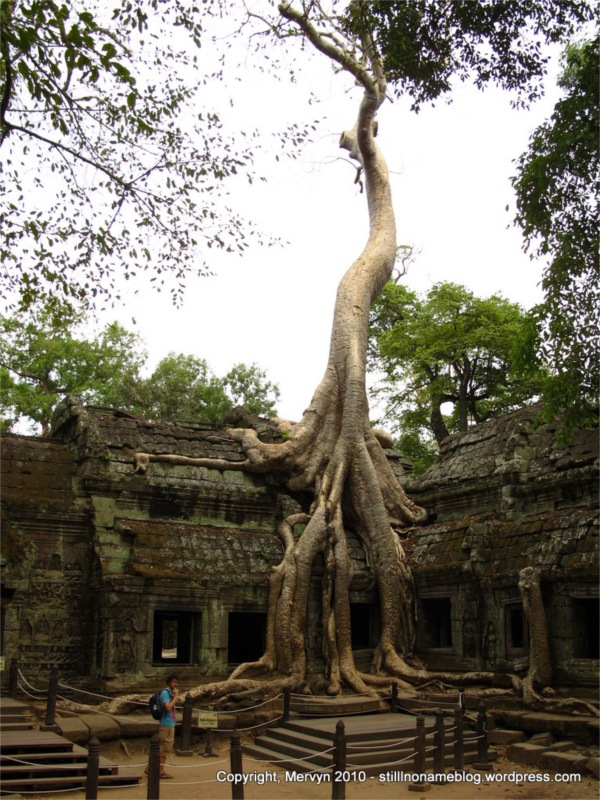
I could have spent all day here. Even the mass of tourists didn’t take away from the atmosphere. Well, almost. I sat around waiting for a gap in the tour groups so I could take a clean picture of a tree that’s draped its roots over a doorway (aka, the Tomb Raider tree). I was shooting pics up close when I realized everyone behind me was gone. I sprinted to the back of the plaza, whirled around, centered the shot, and clicked just as a blond with big boobs walked out a side door. Turns out that there is a situation where a chesty blonde doesn’t make it better.
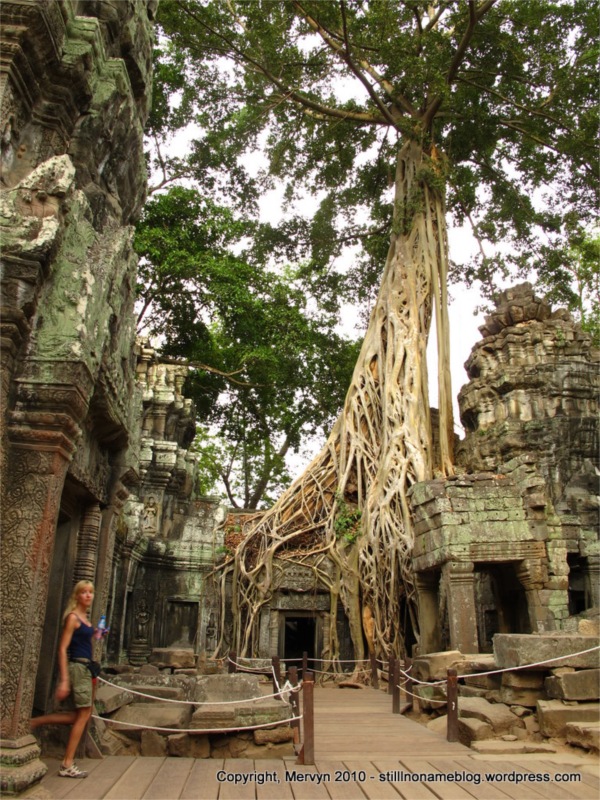
We ended the day with Ta Prohm. Collin, Haley, and I had dinner at a French-owned Khmer and pizza restaurant, a place geared towards tourists. They let me tag along on their honeymoon, so who was I to argue.
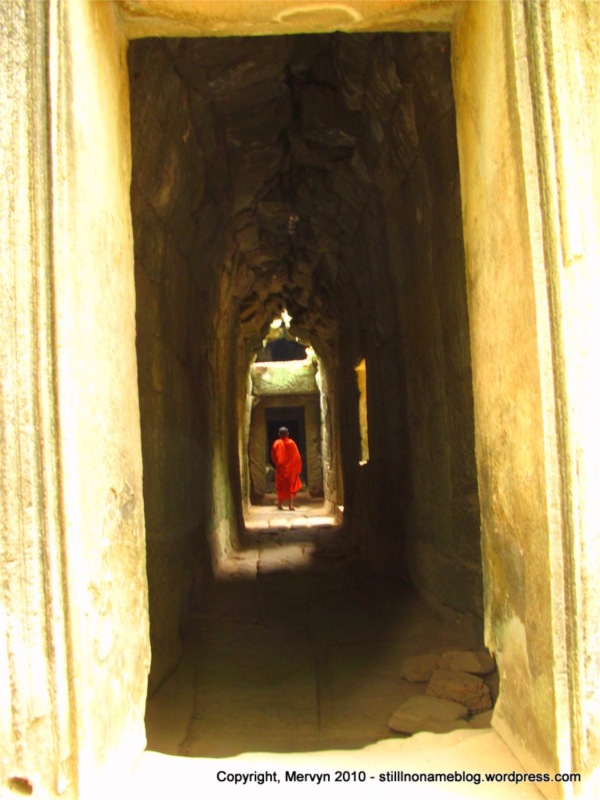
After a visit to the night market, we headed back to the hostel. They head out tomorrow. Me, I’ll be hitting up more temples, trying to find ways to not make it all blend together. Guaranteed, though, that none of them will be overrated, if nothing else because I know nothing about them.
Click here for Day 45 in pictures that you may not have seen!
Dateline: Bangkok, Thailand to Siem Riep, Cambodia – Friday, April 16, 2010
“In Cambodia, we cheers to make closer friendship,” said a local Khmer. I looked at my half empty glass and the Khmer people dancing, talking, and yelling around me . If toasts make closer friends, then my twenty closest friends are all Cambodian.
It’s the last day of the Khmer new year or Chaul Chnam Thmey, a three day celebration of the end of the harvest. Like the Thai new year, it has its roots in Buddhism. Here, though, the emphasis doesn’t seem to be water but on beer. If this first day in Cambodia is any indication, the country is absolutely mad—and I love it.
The day technically started at midnight. I was awake packing, writing, and reading about crossing the overland border between Thailand and Cambodia. Before I knew it, it was 3 a.m. The bus station opened at 3:30 a.m. If I wanted, I could just stay up and catch an early bus to Aranyaprathet, the Thai town on the Cambodian border. I took a short nap then prepared all the documents and other paraphernalia I’d need to make the journey.
You might think a bus terminal at 5 a.m. the day after Thailand’s biggest holiday would be pretty quiet. You might think wrong. Mo Chit bus terminal, Bangkok’s northern bus station, was packed with people departing for remote parts of the country or arriving on long haul buses. People stood on the large street in front trying to hail cabs or local buses into the city. My cab driver negotiated the traffic and dropped me off across from the station on a busy road saying I could take the footbridge over on my own. People were already climbing into the cab before I could get out.
I crossed the footbridge to the bus station. I found the ticket window, accidentally overpaid by 8 baht (220 instead of 212, since I misunderstood the lady), and boarded the 5:30 a.m. bus. I was one of 8 passengers, none looked farang. I slept intermittently. When we neared the Thai border, a Thai soldier hopped on and checked passports. He scrutinized those of two older Filipinos. When he saw the blue jacket of my U.S. passport he just waved at me.
The bus dropped us off at a market at 9:30 a.m. As I stepped off, my glasses immediately fogged up because of the heat and humidity. I searched for a tuk-tuk driver to drive me the remaining 16 km to the border. Whenever I asked a driver to take me to the border, they waved me off towards the main road. I’d move on and ask another driver closer to the road for a ride to the border. Same response. I began to wonder if I was missing something. Where could I find drivers willing to go to the border?
I turned left on the main road and ran smack into the immigration checkpoint. No wonder the tuk tuk drivers looked at me funny. Turns out the website I consulted is a little out of date. The bus from Bangkok no longer drops you off a few miles from the border. Instead it takes you all the way.
I marched through Thai immigration and started to look for the Cambodian immigration office to purchase a visa. Before I could even start looking, a Cambodian man asked me if I needed a taxi to Siem Riep. Mind you, I was still technically in Thailand.
I waved him off and marched on. He followed me, repeatedly asking me what I was willing to pay. I insisted that I’d find something once I crossed the border. He gave up and pointed me to a quarantine office to fill out a Cambodian medical form.
I half expected a scam, since I’d read that on overland crossings, Cambodian immigration officials sometimes try to get you to pay them money in order to get past a health screening. No issue this time, though; after filling out a form, the officers let me through.
Sleepless, hot, and pouring sweat from hauling around my bag, I walked further down the main road looking for the visa office. Hungry, I stopped for a bite at an outdoor restaurant. I sat down and watched a cast of shady characters mosey in and out for a bite to eat. They looked like the sort of people that’d you’d expect to skulk around Poipet, the shithole of a gambling town on the Cambodian side of the border. Muscled Korean guys with tats, skinny hunched Asian men, a chatty White guy in a Hawaiian shirt. I opted to put on my contacts because my glasses kept slipping down my sweaty nose. Something told me I might need better than 20/5,000 vision to make it through to the other side.
After scarfing down rice and chicken, I pulled on my pack and continued my search. I walked back and forth down the road, looking for what my research suggested was a large white building. I asked guards where I needed to go and they pointed back where I’d come. That’s when I spotted the White people. Following Rule [INSERT RULE NUMBER] I headed towards the group and discovered that the visa office is right next to the quarantine office in the same small white building. It’s like I was trying to get myself lost.
I paid the $20 visa fee, plus 100 baht in grease money the guard asked for. I was more hot and tired than I was principled so I didn’t put up a fight about the bribe. While waiting for my visa, I overheard a tall Czech girl talking to a British couple about finding a bus to Siem Riep. I interrupted and asked if they wanted to share a taxi.
A slim Cambodian tout with long finger nails joined me in intruding on conversations and offered his services. After a bit of haggling, he said he’d get us a cab for ten bucks apiece for a non-association cab to Siem Riep. I thought this was a pretty good deal because I’d heard that association cabs cost considerably more. He even offered to let us check with the association office to see if his price was better. After considerable debate, the others finally agreed to share the cab.
There was some confusion about changing money, but I insisted that I cover the cost of the cab in dollars and that the others could pay me once we hit Siem Riep. We finally trudged off to the Cambodian immigration intake office. We sweated our way through line then met our tout on the other side.
As we rode the free shuttle to the bus and taxi station, he briefed us on the plan. We’d get off the bus, then go up to the association taxi window and ask about the price. We’d tell the ticket people that it was too expensive and walk out of the station. The tout would discreetly follow us out of the terminal and join up with us a block away. Guess, the cab association that holds a monopoly on cab business doesn’t look kindly on people using non-cartel cabs.
All went according to plan. I asked about the taxi prices and the association told me it was $15 per person. I pretended to consult with my new traveling buddies then we walked out of the station.
The tout walked out after us, then caught up to me and said, “Pretend to argue with me about price.”
I laughed and said loudly, “Too expensive.”
He smiled and said, “How much you pay?”
“1 million dollars,” I replied.
He said, “That’s good. Okay, pretend to argue.”
I waved my hands. He kept asking about price. I kept saying too expensive. Then he stopped, pointed at a Toyota Camry, and said that this was our taxi.
As we waited for the Czech and Brits to catch up, he looked over my shoulder and said, “Wait. There is police. You must pretend to pay $20.”
“But I will only pay $10, right?”
“No problem. Just pretend.”
The police man, the tout, and the driver then had a lively discussion. The tout called back to me, “How much you pay?”
I played along and said my line. The others caught up and were thoroughly confused. I said that they should just play along. The tout asked where we were from, we answered, and the cop wrote down something on his hand. We loaded our bags into the trunk then piled in.
The Cambodians continued to talk outside. At least in the car we had air conditioning. The cop left and driver got in. He was about to leave when the tout poked his head in and they had another animated discussion. The driver then gave the tout some money.
The tout leaned in and said, “I had to pay the driver $80 in front of the police. Now I have to take the money back.” He laughed maniacally. No wonder the cab driver looked so confused.
With that, we were off. The road to Siem Riep used to be a muddy mess. Now it’s a sealed, paved road. Other than the signs in Khmer, I wouldn’t have known I’d left Thailand. The road blasted straight through the flat country side. We passed groups of kids walking down the road–where they were walking to and from I couldn’t tell. There were no buildings ao far as I could see, just open fields and plains.
When we hit Siem Riep, the driver stopped and said we had to switch cars. The others were already on edge from the whole border experience. I wasn’t that worried since I hadn’t paid the driver. If they wanted to run game on us, I’d just knock something off the price of the cab.
A Cambodian named Lai told us he’d drive us into town. He said he’d already paid the driver and that we could pay him when he dropped us off at wherever we wanted. When we asked why he’d drive us into town for free, he said, “I want to get work from you.” I liked the honesty. The others were a bit more cynical. I have a feeling I should adopt their attitude.
He shuttled us between a couple guesthouses we’d read about and took the others to an ATM. I took him up on an offer to check out his friend’s place—A/C room with free internet and wifi, private shower, all for $8. I liked the room and decided to crash there. The British couple also took a room. The Czech decided to go someplace else because “I don’t like air conditioner.”
I had lunch with Collin and Haley, the British couple. They’d just gotten married in Thailand after being together for 11 years. No family or friends had attended their beach wedding because the trip was too long; that suited them fine. They were on a month-long trip through Southeast Asia on their honeymoon. Honeymooners cruising through Asia on a backpacker’s budget. I liked them already.
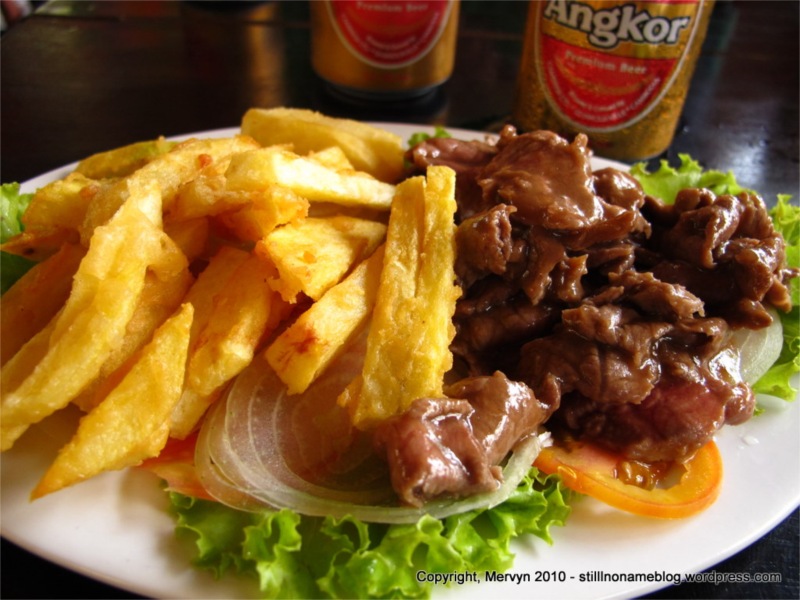
We headed to our rooms to crash. I slept the ugly sleep of someone who’d been traveling all day. When I came to, I could hear a party going on outside.
Earlier, Lai had said his friend had bought a cow to celebrate the last night of the Cambodian New Year. He said all hostel guests were invited to the party. I was starving and hadn’t had dinner so I wandered downstairs to see about the cow.
The proprietor had set up tables, chairs, and a sound system in the hostel’s dirt driveway. Candles were melted to the table tops for light. A few travelers were mixed in with the Khmer, but I didn’t see Collin or Haley.
Lai picked me out, offered me a chair and a glass. He filled it with ice then poured me a measure of stout. Lai, his friends, and I toasted. Then we feasted on barbequed sliced beef. We picked at the pile of meat with chopsticks, dipping the medium rare strips in a Khmer sauce of some kind. We used our hands to grab cut vegetables to dip in the sauce.
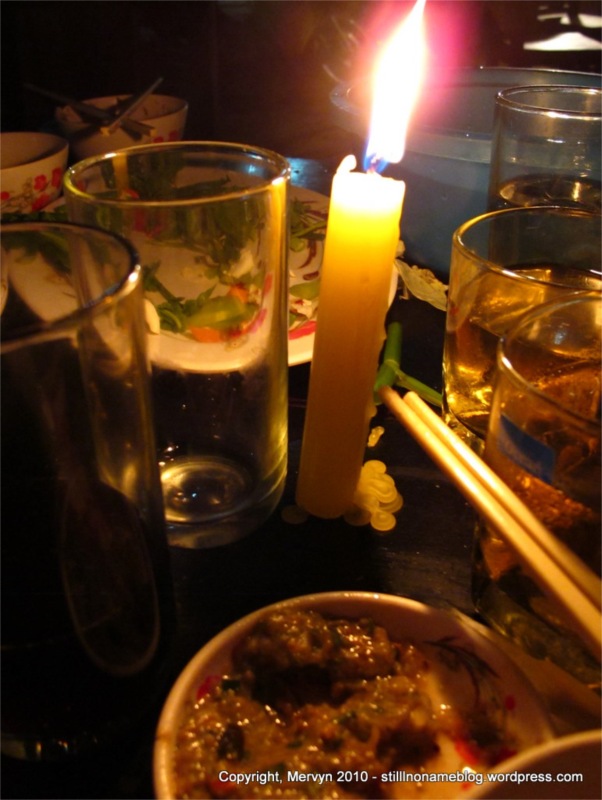
Anytime anyone came to the table, we toasted, drank, then refilled our glasses with beer and ice. Anytime anyone said something funny, we toasted, drank, and refilled. When more food arrived, we repeated the process. When someone made eye contact with someone else, glasses rose, and another round would ensue. One time, I put my glass down to eat and, when I picked it back up, everyone took it as a sign to toast and drink. I swear to you, I participated in more toasts that night than I have in my entire life. We were making some seriously close friendship.
Other than a handful of tourists, it was nearly all Khmer men. A mix of Western and Khmer music blasted through a sound system. Guys kept dragging me out to dance. Some shoved me towards other tourist women. Everyone carried a glass and raised it high and often.
Collin and Haley joined us as they returned from a trip to the night market. They were fascinated by the beer on ice. They joined in on the toasts, though Haley just raised her glass since she doesn’t do beer.
The party carried on as Collin and Haley headed to bed. The music shifted to heartbroken Khmer love songs, which some of the men belted out at the top of their lungs.
One of the guys smashed a glass into his head and cut himself. Lai leaned over to me and said, “He’s a tough guy,” snickered, then went back to singing.
Just 24 hours ago, I was in big city Bangkok leaving a Red Shirt rally to get a massage. In that time, I’d crossed over into another world. A crazy, mad world. A world where everyone’s running game. A world of long nailed hustlers and never take “no” for an answer touts. A world where men drink, feast, dance, and sing love songs.
I love it already.
Day 43 – Goodbye, Thailand (One Last Taste)
Dateline: Bangkok, Thailand – Thursday April 15, 2010
So far, traveling has been sort of manic depressive. I’m not talking about my mental state, I’m talking about the state of the trip. Some days, like the chicken factory are full of activity. When I sit down to write about it, I don’t know where to start I have so much content. That’s manic.
Some days, like yesterday, are slow. I think of them as a recovery period from intense activity. Sort of like I how I like to exercise. I prefer intense periods of activity followed by periods of leisure. The dull, painful monotony of jogging isn’t for me.* Same goes for travel. Regimented, steady movement from site to site seems boring. There’s no variation. I prefer intense amounts of activity followed by a few days relaxing and settling in to a place.
I bring all this up because today was a sprint day. That’s because yesterday, I was a lazy traveler and I needed to make up for it. Also, today was my last day in Bangkok.
I love Thailand. There’s no getting around it. To me, it’s what the Philippines could be if it gave up the diesel, got its tourism act together, and fixed its political system. (Wait a minute. . . scratch that last bit about politics.)
Anyway, today I tried to cram everything I find fascinating about Thailand into one day. I thought I’d break this up into categories, that way you can see what aspects of this country intrigue me.
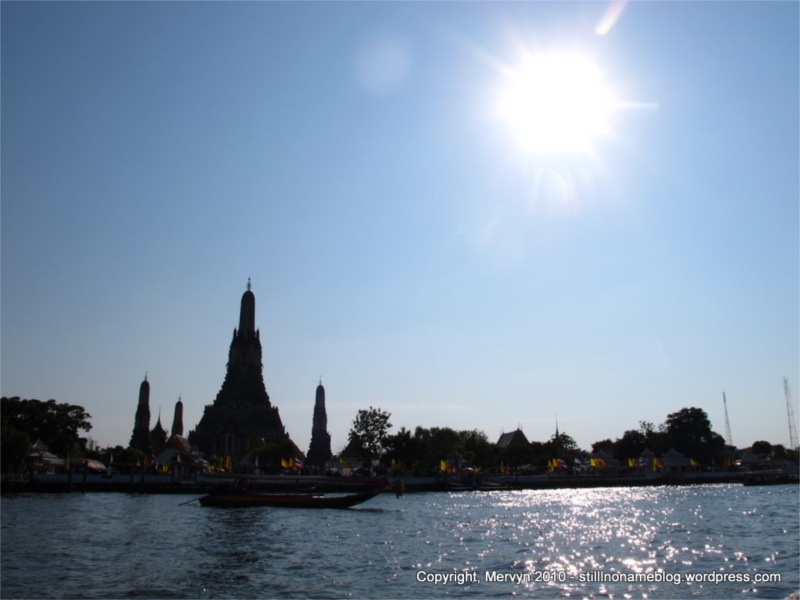
The Spiritual
Today was the last day of songkran, Thailand’s three-day celebration of the new year. The holiday occurs during the hottest time of the year and involves a lot of water. Most Westerners know it as Thailand’s water festival. It’s a time of waging water war–where people hurl, shoot, and hose water at strangers and friends in the streets. It’s nearly impossible to get from one place to another without getting soaked.
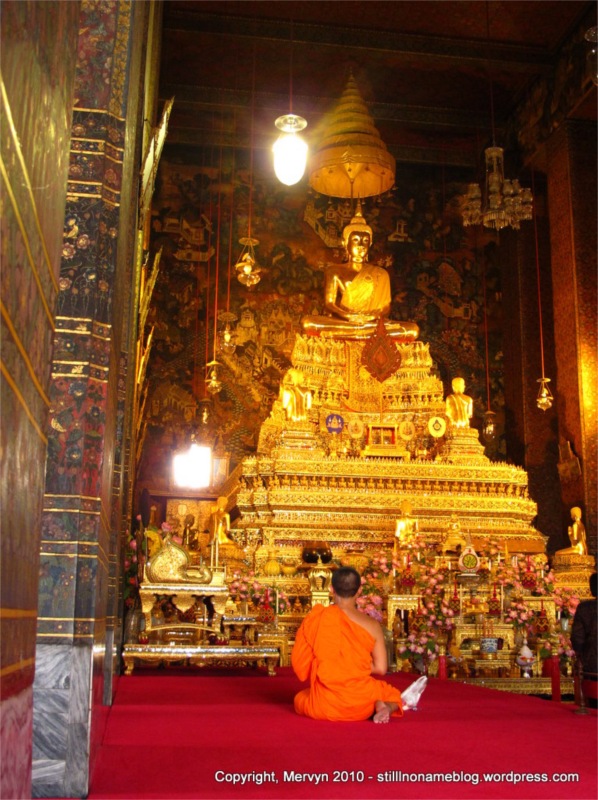
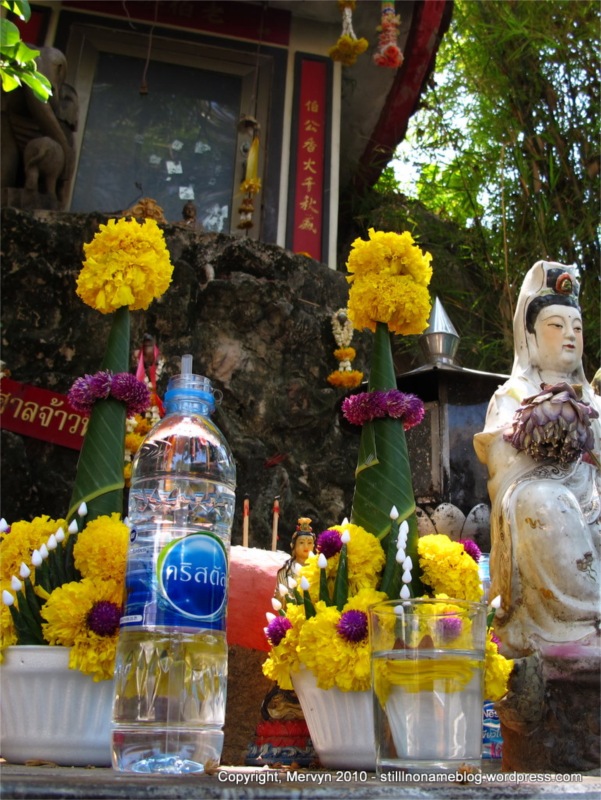
There’s a quieter, more meditative side to the holiday, though. People go to temples and pay homage to Buddha. They give donations and pouring scented water over the temple figurines to cleanse them.
For my songkran, I stopped at Wat Pho. As I did before, I played myself as a Thai and walked in without bothering with the ticket counter. (And, again, I made up for this by donating generously to the temple.) I joined people in line washing a row of Buddhas. I dropped coins in a line of copper vases behind the Reclining Buddha. I sat meditating in the coronation room, observing Buddhists as they came to pay their respects.
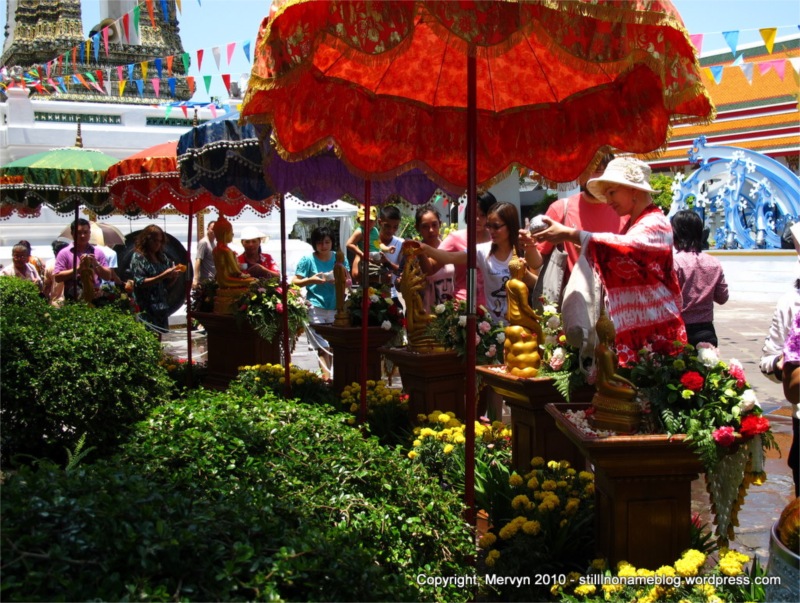
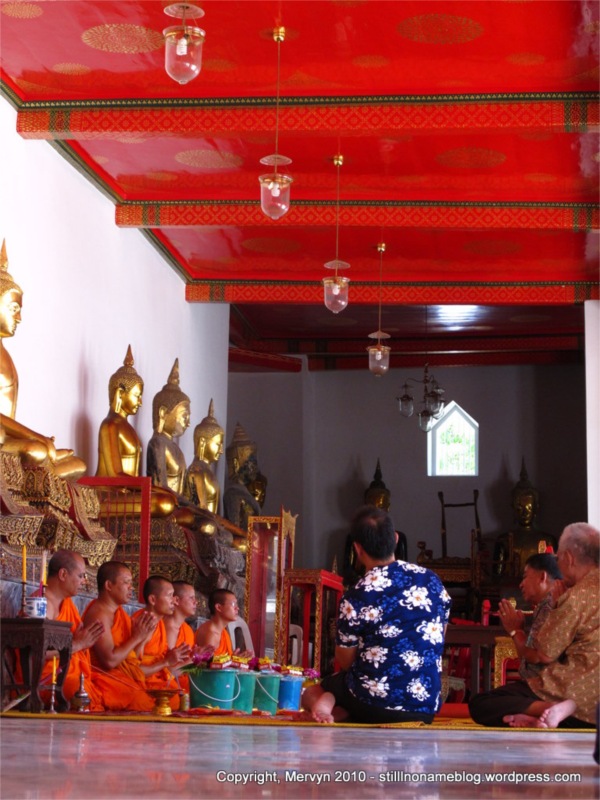
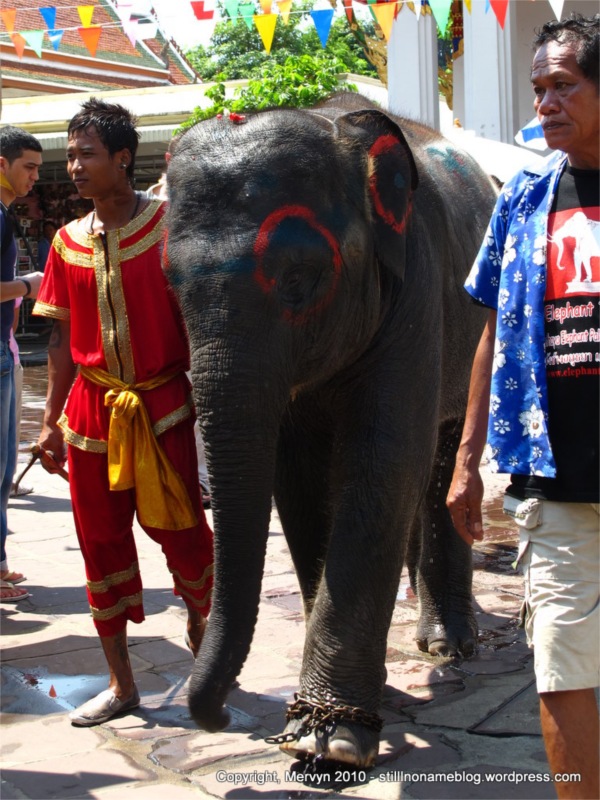
But there’s no shelter from the water, even at a temple. A monk sitting in an elevated chair flung water onto bowing visitors. There was also a mini-parade where kids danced and sprayed water on the spectators. The star douser, though, was a baby elephant that followed the kids around. It used its trunk to spray visitors. Forget a pony, if a birthday kid’s smart he’ll ask for a baby elephant.
In all, I got what I wanted. A peaceful, soulful afternoon at one of my favorite temples.
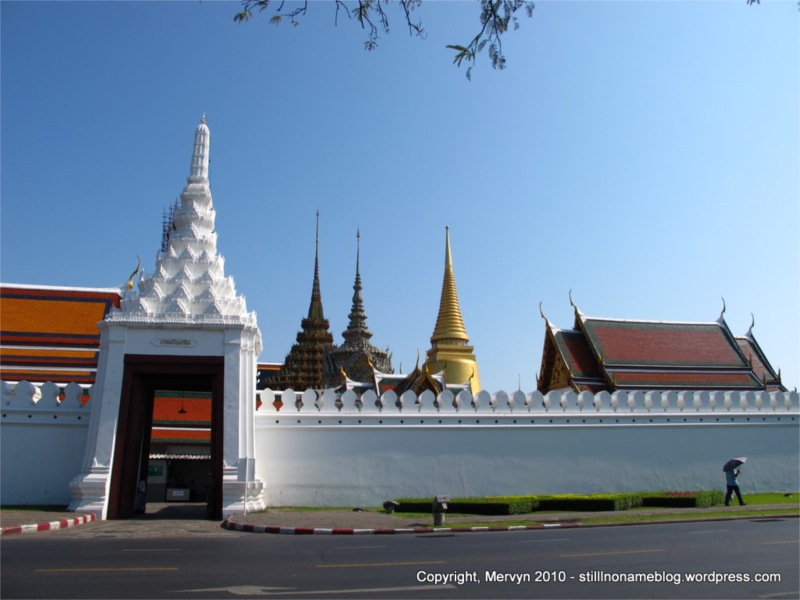
The Royal
On a lark, I went to Wat Phra Kaew and the Grand Palace to see the Emerald Buddha. I couldn’t pull the stunt I’d wanted to with the tickets because military men had closed the main entrance. That’s when I remembered that the Emerald Buddha changes outfits during songkran—the guards were probably there because a royal was there to change the garb.
I walked around looking for another entrance and eventually found my way in on the east side. I found loads of people, farang and Thai, kneeling at the bottom of the steps leading up to the Emerald Buddha’s temple. It was packed and a guard was kicking out anyone not sitting. Most of the people seated were hiding under umbrellas. I did not have one. I also did not know how long I’d have to wait. It was way too hot and bright, so instead of trying to find a spot, I bailed out.
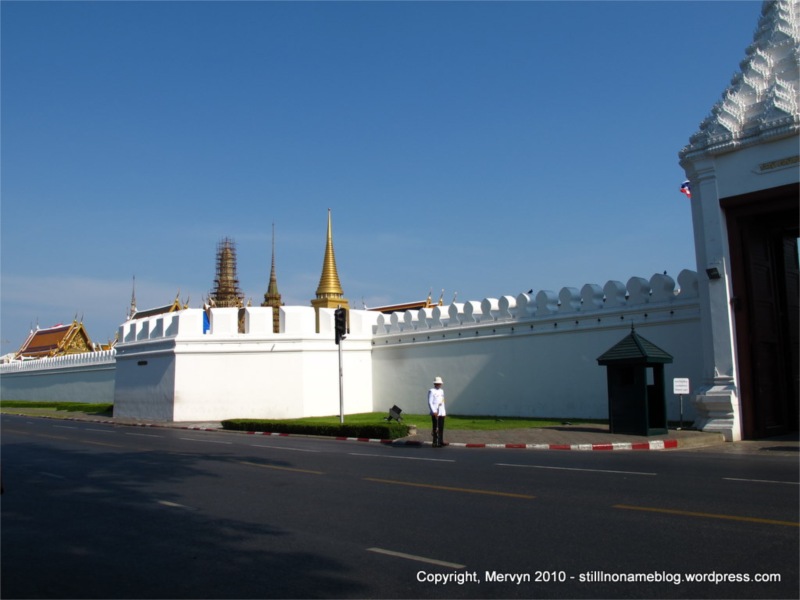
I walked around to the main entrance, on my way to catch a boat back to the BTS station. That’s when I saw a bunch of guards blocking off the road. I got whiff that the prince would be exiting shortly, presumably after finishing his royal duties with the Emerald Buddha.
Slowly, more police and guards showed up, blocking traffic in all directions. Then they started telling people to take off their hats and to turn off their cameras. Usually I’d put up a fight, but they had guns and I’m less bulletproof than I’d prefer. It was the quietest I’ve ever heard a main Bangkok street.
Then, trumpets sounded (really) and a black BMW rolled out. It was followed by a Rolls Royce with three people in white uniforms crammed into the back. Then red BMW after red BMW poured out of the complex and sped after the two lead cars. I kept waiting for a stately car to slowly roll past, but it never came. Guess one of the people in the back of the Rolls was a prince.
I wonder if they made him sit bitch.
The Food
I headed back to grab food at MBK food court. I felt like some rice, so I ordered shrimp fried rice. It reminded me of a friend who only orders shrimp fried rice every time we eat Thai. It’s boring, I know, but it’s what I was in the mood for.
I chased that with a Thai iced tea then topped it off with red beans and sticky rice with coconut milk. Unless it’s a meal from Becca’s mom or one with friends, I can’t imagine a meal that better exemplifies this trip. Cheap, yummy, and at a food court.
I will miss you food court. I will miss your strange no cash only coupon/card system. I will miss the ladies that treat me like I’m their disappointing son when I ask to change my coupon/card to cash. I will miss your tasty, cheap, delightful eats. Food court, don’t tell anyone, but Del Taco ain’t got nothin’ on you.
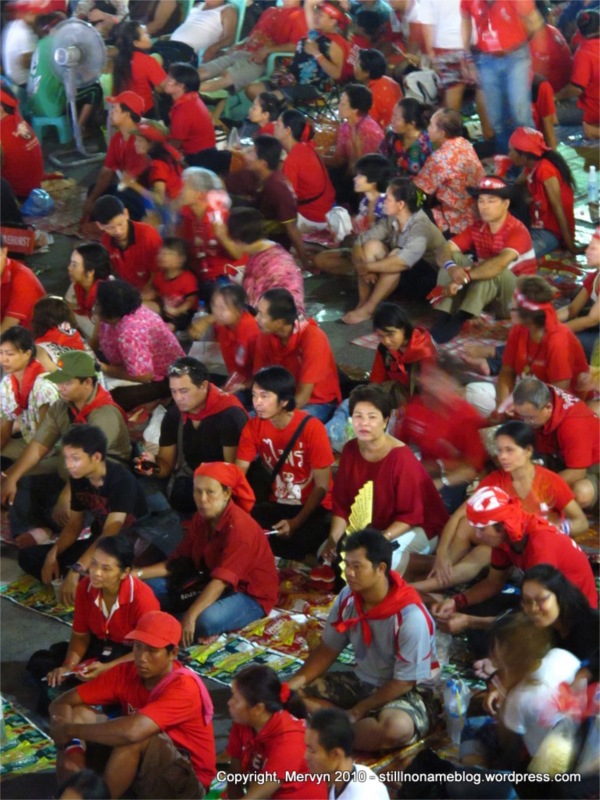
The Politics
On the BTS today, I overheard an older Aussie talking to an older American. The American asked if Siam Paragon shopping center was open because he wanted to see a movie. The Aussie said that it was closed because the Reds had consolidated their protest sites to Ratchaprasong, which is near Paragon. He added that he wouldn’t go anywhere near there because the Reds had automatic weapons and grenades and that there were snipers all around (he didn’t specify which side). The American asked if MBK was open. The Aussie said he wouldn’t go there either and directed the American to Emporium, which is a bit further away. “Gosh,” said the American. “I’m glad I ran into you.”
Really? There are a lot of good reasons not to go near the protest site, but snipers and automatic weapons are probably the dumbest. Seriously. Let’s break it down.
First, and most important, the American was not going NEAR the protest site. He asked about MBK for his movie, which is about a kilometer away from Ratchaprasong. There are some powerful sniper rifles, but I don’t know any that can shoot half a mile through multiple buildings, at least not any earthling rifles. So, the idea that MBK was somehow dangerous was lame.
Second, if there were ever a time that the Reds and the government wouldn’t be fighting, it would be now. The Reds are massed in a place where the government would have to literally wage urban war to extract them. The Ratchaprasong intersection is surrounded by large buildings and a maze of streets and alleys. The army would have to drive the Reds out then hold the area. All without damaging the shopping centers, offices, and tourist hotels that front the streets and without harming the kids and grandparents camped out in the streets or the tourists staying at the hotels. The army may be many things, but it’s not that stupid.
The Reds, meanwhile, would not be so foolish as to give up the moral high ground. They’re sympathetic as victims of either of an overzealous government or of some third party terrorist plot. Either way, mounting an offensive is not their goal. They just scored a victory with the election commission, so they have a political advantage. They hold a complex, naturally fortified part of the city, so they hold the tactical advantage. They also have the public relations advantage. For today, at least, they have no reason to go on the offensive. They’re not going anywhere until the government (or the terrorists) moves against their position, they run out of money, or the situation otherwise forces them to.
This isn’t all conjecture (just mostly). A week ago the government issued arrest warrants for about 13 Red leaders. Those leaders have been parading around Ratchaprasong, giving speeches, organizing Reds, and giving concert performances–it’s not as if the government doesn’t know where they are. In the whole time, the government has not even tried to get at the leaders at the protest site; it’d just be too complicated. I believe the Reds are confident they can hold the intersection indefinitely and don’t feel the need to go anywhere else.
Not even any would-be-terrorists would be dumb enough to try something. That’s because it’s so clear that the government and the Reds are in no position or mood to battle. If they tried something, both sides would throw their hands up and say, “See, it’s some evil person who wants to sabotage our negotiations because we wouldn’t be so stupid to try anything.” It would probably even unite the government and the Reds for at least short time.
Of course, I’m an ignorant bastard who’s just making this up (mostly) as he goes along. Watch. “The government will try to expel the Reds from Ratchaprasong just as the Reds mount a guerilla war.” Just because.
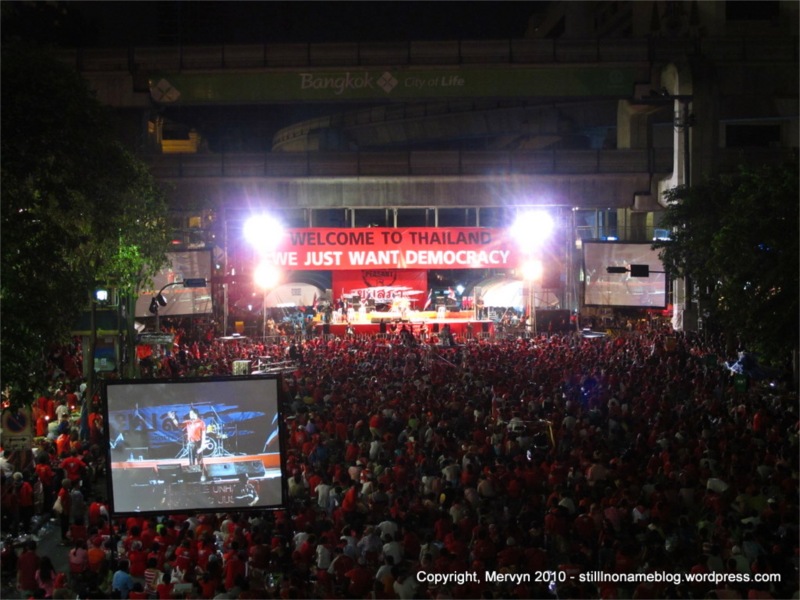
The bottom line is, though, the old white guys weren’t going to scare me from saying goodbye to my old protest pals.
When I got there, it was almost the same as before, except with three times as many people. It did seem like there were more cameras–the cam on the boom seemed especially active.
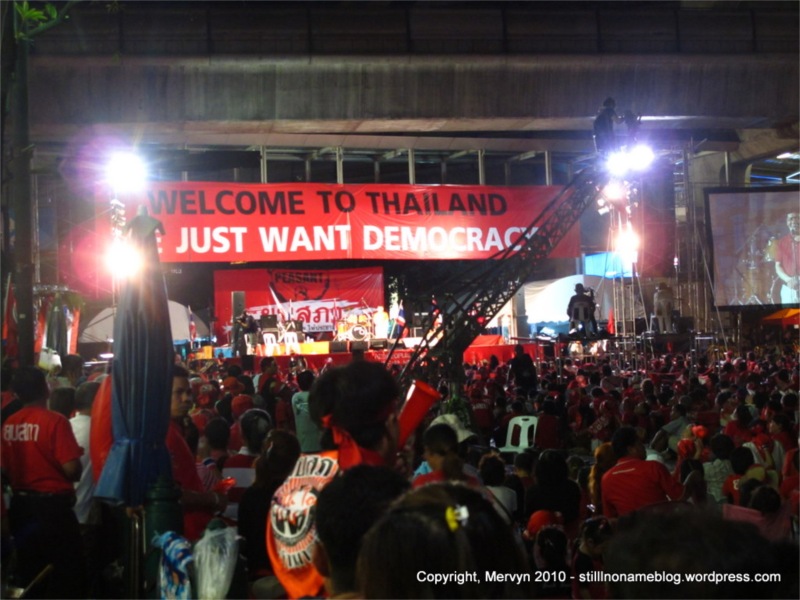
I walked through the crowd and noticed one key difference. There were now vendors showing and selling videos of Saturday’s violence. Some video was from camera phones, some from professional video cameras, some from TV news. Every vendor selling the videos had a crowd gathered around, watching the footage on monitors or TVs. To my eye, it looked like some video showed soldiers shooting into the crowd, whether rubber or real bullets or whether in response to being fired upon, I couldn’t say. No matter what, the fact that people believed the government might have killed their comrades had a sobering effect on the watchers. Sure, the massage ladies were still doing good business, so the street fair wasn’t off. The tone of the crowd, though, was a bit more serious.
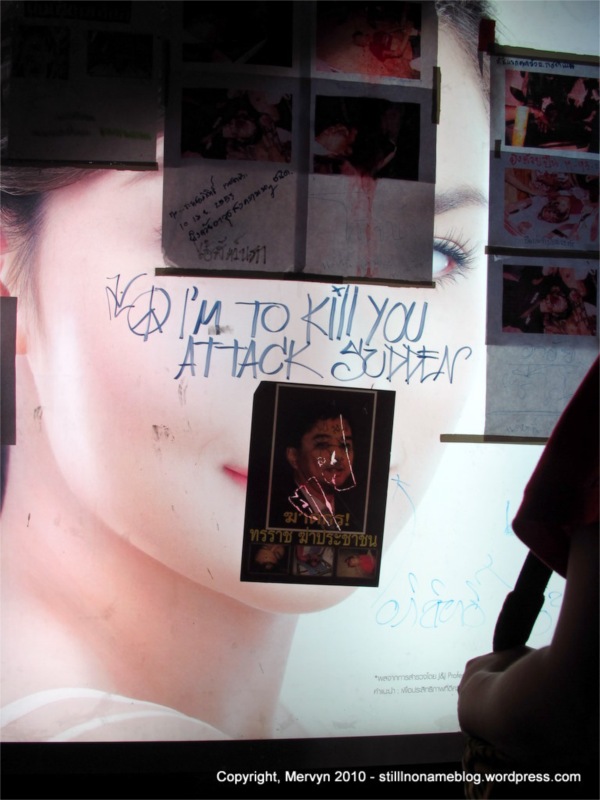
On a billboard advertising a beauty product, someone had posted graphic pictures of the dead protesters and a picture of the Prime Minister with blood coming out of his forehead and a Hitler mustache. Above the picture of the PM, someone had scrawled, “I’m To Kill You Attack Sudden.” Next to the text was a peace sign. I couldn’t tell whether it had been written by one person or two. The image seemed to be the perfect synopsis of the whole screwy situation.
Right then my camera battery died and I headed towards home.
Massage
If I couldn’t leave Bangkok without seeing the Reds, I sure couldn’t leave without a massage. On the way back I stopped at one of my favorites, Buanthip Massage.
I ended up with an older lady who absolutely destroyed me. I asked her to focus on my upper back and shoulders and she spent 30 minutes using her whole body weight to jam her elbow into various parts of my trapezius. It’s the only time I’ve actually had to tell a masseuse to stop while I tried to recover my breath. She laughed at me.
When I left, I felt like the Double Dragon twins had taken a lead pipe to my upper shoulders. It was great.
I headed back to Suk 11 to pack for my trip to Siem Riep, Cambodia. It’s been almost a month and a half since I arrived in Thailand. I’m sad to see it go. I’ve managed a manic, fitting good bye. The only thing that could have made it better is if I could have said good bye to all the people that made it special. Alas, the road calls and, because of my visa, I must answer.
Till Cambodia.
———————–
*Turns out I’m not totally insane. There’s research indicating that jogging is bad for you and that short intense exercise is better for your body. See this podcast, starting 35:21.
Day 42 – The Price of Convenience (A Day of Regret)
Dateline: Bangkok, Thailand – Wednesday, April 14, 2010
This morning I did not go to Amphawa, a town 60 km outside of Bangkok that’s known for its floating market. I did not catch a ride with Becca, Franck, Ananda, and Becca’s mom in their new car. I did not spend the first of two nights in a home share with a local family. I did not eat dinner handed up to me by a woman in a boat using a long pole.
I did none of these things because I’m cheap. Oh, don’t get me wrong–I’d have paid to go to Amphawa. I’m not cheap about experiencing new things (I’ve never been to a floating market and I so want to eat food from a lady on a long boat). I’m talking about me being cheap two weeks ago in Penang, Malaysia.
You see, in Penang, the local Thai consulate will issue you a 30-day tourist visa so long as you pay about $40 or so. If you do not, however, get a visa from the consulate and decide to get a visa at an overland Thai border station, the longest visa you can get is 15 days.
Stay with me. This is going to be tough, but we have to do a little math. I reentered Thailand on April 2. Counting April 2 as “Day 1” of my 15 day visa, I am permitted to stay in Thailand until April 16. Becca and Franck were willing to let me ride with them to and from Amphawa on their two day excursion. They would return on Bangkok on the afternoon of April 16. The problem is that’s not enough time for me to go overland to the Cambodian border on the 16th. I would have to overstay my visa by one day and leave Thailand on the 17th.
Bad bad bad. Back in Penang, I figured another 15 days in Thailand would be enough. Why pay the $40 for 15 extra days I wouldn’t use anyway?
Well, turns out I could’ve used one extra day. If I could go back and do it over again, I’d have paid the $40. Ah, the dangers of traveling with only a loose itinerary. The blessing and the curse.
Oh well.
Instead of joining Becca and Franck, I went over to their place for an early breakfast. I was out the door by 7 a.m. and at their place before 8. They fed me, humored me while they packed, then jetted off on their holiday, telling me I could hang out at their place as long as I wanted if I locked up when I left.
I took full advantage of this and promptly fell asleep on their couch for a few hours. Then I spent the afternoon alternating between sleep and reading every article I hadn’t read in the past month on the internet. By the time I left, it was late afternoon. I went to MBK food court for a quick meal (noodle soup with beef, $1.25) then headed home.
That’s when I realized I had nothing to write about. At least not anything interesting. (And yet, somehow this lawyer found a way to stretch “nothing” into 500 words. That’ll be $4,000; I’ll send you the bill at the end of the month.)
That’s when I remembered my old stand-by: snacks. I popped down to the 7-11 and created a little tasting menu. I grabbed three items that I thought deserved a chance. Here they are in no particular order.
First up, something called Yoghurt with Nata de Coco. From the label, I guessed it had something to do with young coconut. There were little cubes in the picture, so I was hopeful that it’d have little jelly things.
I was right. This yoghurt is delicious. The natural sourness of the yoghurt balances nicely with the subtle sweetness of young coconut. You also have the added benefit of a flavor burst and texture change every time you come across the jelly cubes. The cubes are firm, not flimsy like grass jelly. I will pretend it’s not because of a thousand preservatives. I’d call this snack a good dessert.
Next up is another yoghurt, this time with Cereal Beans and Lotus Nuts. I felt that the description was incomplete, since the side label had a picture of an ear of corn.
This yoghurt was not that good. I really liked the corn flavor and the corn kernels. They did the same thing as the young coconut did in the Nata de Coco, balancing the sour with some sweet. I did not, however, like the lotus nuts. They were more firm than the jelly cubes in the Nata de Coco flavor, but not crunchy. That meant they came off as either undercooked (too hard) or soggy (too soft). I wish it had been either crunchy or soft. Sadly, this would not have rescued the yoghurt. The lotus nut flavor did nothing for me. In fact, I think they made it too bitter.
You’ll notice that I didn’t really talk about cereal beans. That’s because I have no idea what they are and didn’t’ notice them as I ate. Taster party foul, I know. Too bad for you I’m not a chef.
Finally, we have something from Bento. At the top it said “Squid Seafood Snack.” From rubbing the packaging between my fingers, I guessed it was something like beef jerky, but with no beef and more ocean.
When I ripped open the foil and plastic container, I was not disappointed. The package said “squid” but I think it was being optimistic. This was much more like “seafood” which is a flavor the same way Miley Cyrus is an actor—just because you say it is one doesn’t it make so.
The jerky is gummy and doesn’t rip so much as ooze into two pieces, notwithstanding the deceiving score marks. Not bad tasting, but not good either. It just is. It’s not filling. It’s not particularly tasty. Perhaps if you ate it with rice, it’d be better. Of course, that could be said of about nearly every food, so that’s not saying much (See: spaghetti, which I grew up enjoying with the Asian staple).
So there you have it. One hit, one miss, and one “eh.” Next time you’re in Thailand, you’ll know to avoid the Yoghurt with Cereal Bean and Lotus Nut, grab the Nata de Coco instead, and bring some rice when you buy Squid Seafood Snack. Now, would you prefer I send the bill to your work or home address?
Day 41 – The Man amongst Men (Muay Thai)
Dateline: Lumpinee Stadium, Bangkok, Thailand – Tuesday, April 13, 2010
Muay thai is a man’s sport. It’s run by men. It’s watched by men. It’s gambled on by men. Its aesthetics are for men. There aren’t even ring girls because women aren’t allowed on stage—it says so on a big sign.
There are other manly sports. Boxing, mixed martial arts, and darts are geared primarily towards men. I’m talking something more ingrained, though. Something about the way muay thai is practiced and spectated.
Lumpinee Stadium is one of Thailand’s premiere venues for muay thai, Thailand’s homegrown martial art. The style emphasizes leg kicks with some punching and throwing. I know I know I know. There’s more to it than that. Some muay thai-ophile would jump all over me about the spiritual aspects of the art and the subtleties of leg sweeps, knees, elbows, blocking, striking, balance, grappling, and conditioning. “Oh my gosh golly gumdrops, describing muay thai as kicking with some punches and throws is like describing cooking as mostly fire and some ingredients,” they’d no doubt say.
Well, “they” are not here so I’ll give you what I saw, and I saw a lot of kicking (including knees and sweeps) with some punching and throws.
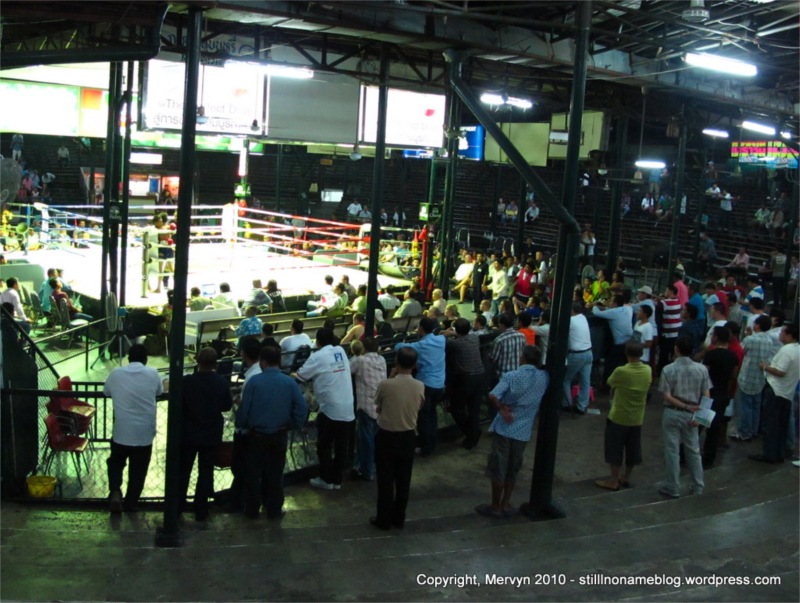
Boxing and mixed martial arts (e.g. UFC) are probably the most analogous sports in the West. Surprisingly, muay thai is a lot less bloody. That’s because in the U.S. analogues, people are often trying to hit each other in the face. Faces are delicate. A strike to the face is going to do more than leave a mark; it’ll likely change the topography. Mountains and valleys will form. Rivers and streams will burst forth.
Here’s the first reason why muay thai is a man’s sport. In muay thai, what the judges are looking for is “effect.” They want to see muay thai techniques performed in a way that shows that it has damaged the opponent.
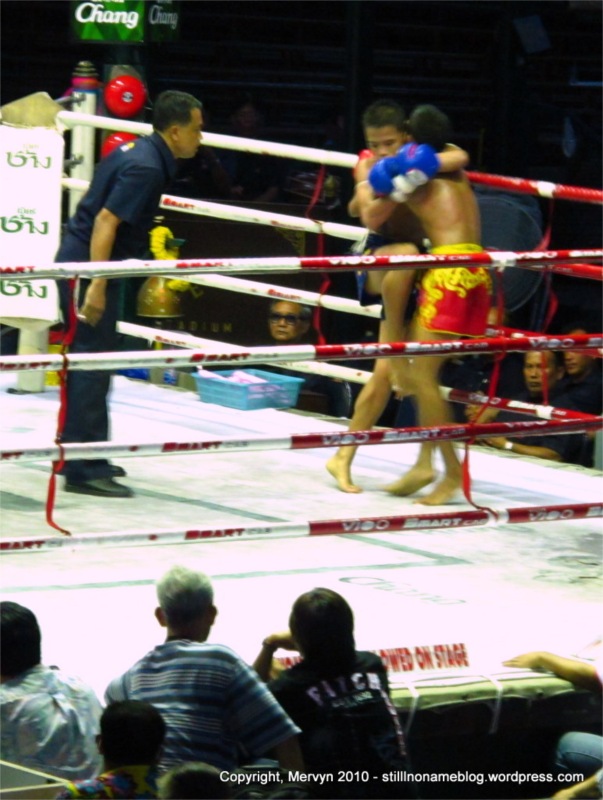
Judges want to see a fighter kick their opponent so hard that the opponent moves involuntarily. Knee him in the side and a judge will probably look to see if the victim grimaces. It’s not just that the guy got thrown, but whether the throw knocked the wind out of him. There’s little blood. That’s because muay thai emphasizes kicks, which means most strikes are to the legs and torso, the more sturdy parts of the body. The martial art, like the culture that spawned it, looks for something a bit more subtle. If there’s any bleeding to be done in muay thai, it’ll be done on the inside.
The sport, therefore, seeks to find the archetypal man. The tough who guy doesn’t show he’s hurting, even though he is. He wins by not giving anyone the satisfaction of knowing he’s hurt. Whether healthy or not, muay thai turns into sport what most guys do naturally: internalize their feelings. The winner isn’t the person who hits the most or hits the hardest. The winner is the man who can act like the blows rained down on him are just droplets from a nice, warm shower.
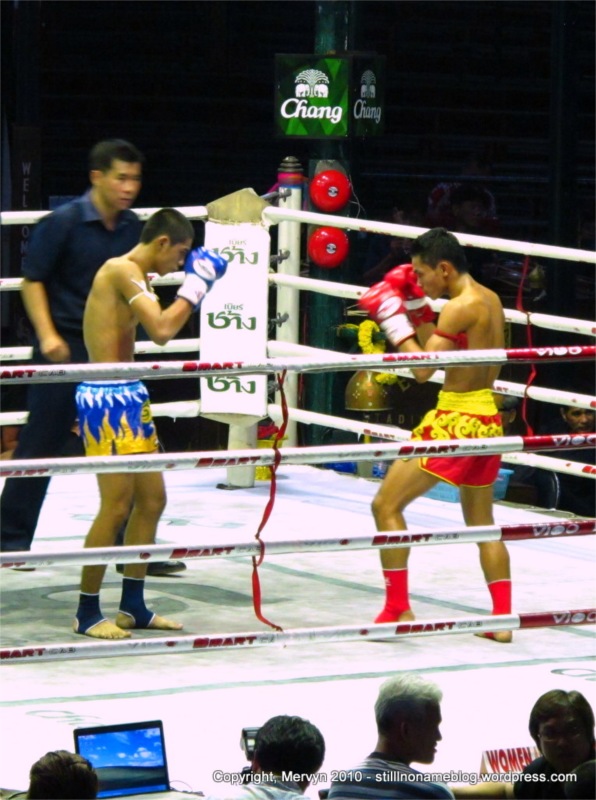
The venue itself exhibits a manly quality. Lumpinee Stadium is mostly open air concrete. There’s a roof over plain tiers of stone. Much of the arena has no seats. Most fans stand while they’re there, only occasionally resting on the cold slabs between fights. It’s as austere a sporting venue as I’ve seen and remember, this is one of Thailand’s two premiere muay thai venues. The place oozes grit. Sure, there are pretty boys who take their girls to sit ringside on folding chairs, but those are spectators not fanatics. Spectators sit and watch; the fans actively participate.
And boy to they participate.
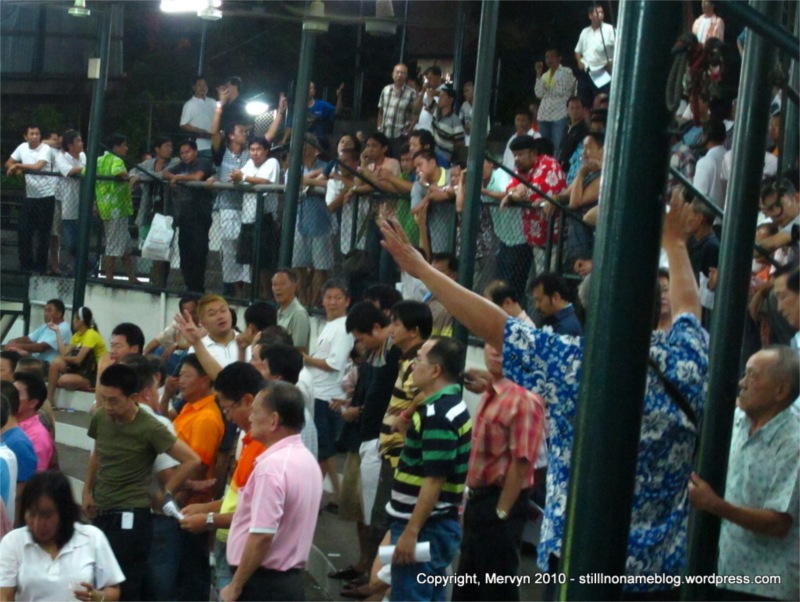
Lumpinee Stadium is one of the few places in Thailand where gambling is legal. Very legal. There are few, if any, bookies though. There is no betting window. Spectators gamble with other spectators by using hand signals to communicate how many baht they wanted to bet, who they wanted to bet on, and at what odds.
A gambler makes eye contact with another gambler in the crowd–often in a totally different section–who is giving a hand signal that corresponds to the opposite end of his bet. Then the pair yell stuff back and forth to each other while waiving fingers and pointing. From what I could tell this works, mostly.
The gamblers would bet while the fighters were kicking each other. They’d bet between rounds. They’d place multiple bets on one fighter. They’d hedge their bets by betting one fighter one round and the other fighter the next. It was like watching a futures market in action. It was intense. And, unlike the New York Stock Exchange, the betting floor here is all men. (I was going to say, “the floor is dominated by men” but I didn’t see a woman gambling and have decided to rely on my non-representative sample. If you have an issue with that, you can take it up with my scientific observation board of review. E-mail: sobreview@childplease.edu.)
The rhythm of the fight went something like this. The fighters entered the ring draped in flowers and wearing robes, headbands, and armbands. They ditched the robes and flowers then walked around the ring bowing to the four sides of the stadium. Next, the fighters kneeled and bowed then started to bounce around on one knee while stretching the other back behind them. They bounced and stretched, stood up and bounced and stretched some more. I’m sure this had some spiritual significance beyond limbering up. Sorta like sumo and the rice throwing or something. I do not know what that significance was.
Next, the fighters removed the headbands (but kept the armbands) and got warmed up by a trainer while standing in a wide, circular baking pan. Really, that’s what it looked like.
After that, the fight began. There’d be a couple of fans calling out bets, but there’d be few takers. Round would end. The fighter would extend his arms and his trainer would rub him from his chest to the bottom of his stomach with one hand and pull on the elastic band of the fighter’s shorts with the other. I do not know why the trainer had to expose the fighter’s man parts to the ceiling. Maybe the trainer was just to letting ‘em breathe and reduce the effect of swass and swalls.
The baking pans would come back out, this time with a wooden stool placed in the middle. The fighter would get instructions, get stretched and rubbed and watered. Then they’d go to the next round.
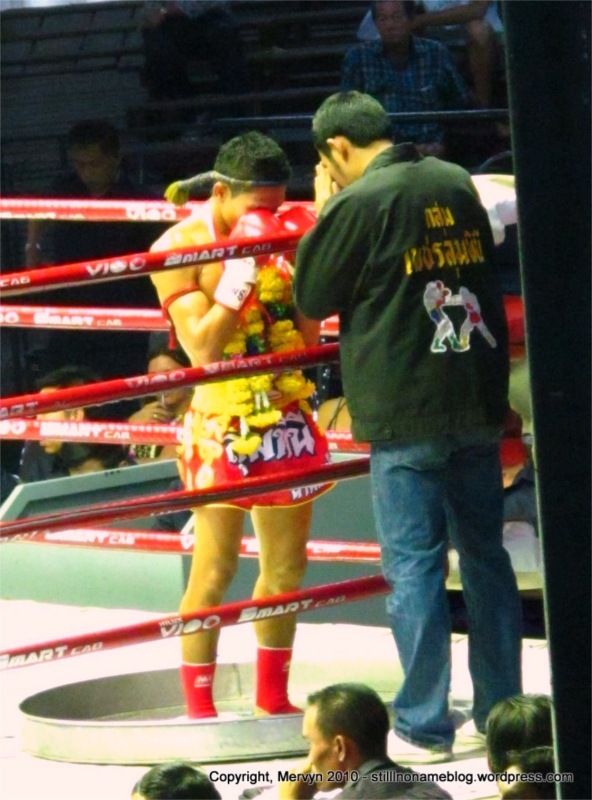
With each round, the crowd would get more into it. The gamblers would start to get a feel for the fight and begin to set their own odds. The gambling would get more and more frantic, plateauing at Round 4. By then the crowd was yelling with every hit and screaming numbers frenetically. Men waved different finger combinations like shadow puppet masters who wanted their charges to come alive. They’d scream and yell simultaneously trying to find matching gamblers and urging their fighter on.
We’ve already established that, in small doses, I like crowds. It’s partially because I like how they make me feel small. It’s also, though, because they make me feel like I’m a part of something larger than myself. When a crowd cheers as one, you can feel the power of the collective. They’re trying to will an outcome. Through their voices, hands, and feet they’re channeling focused energy to their favorite.
The fighters would grapple, exchange blows. Give a knee, take a knee, give a knee, take a knee. In unison, every time the crowd’s favored fighter gave a knee, they’d all say, “Aaaaaaay!” (as in “hay” without the “h”). Since half the crowd bet one fighter and the other half the other, the “Aaaays” would resound for every hit.
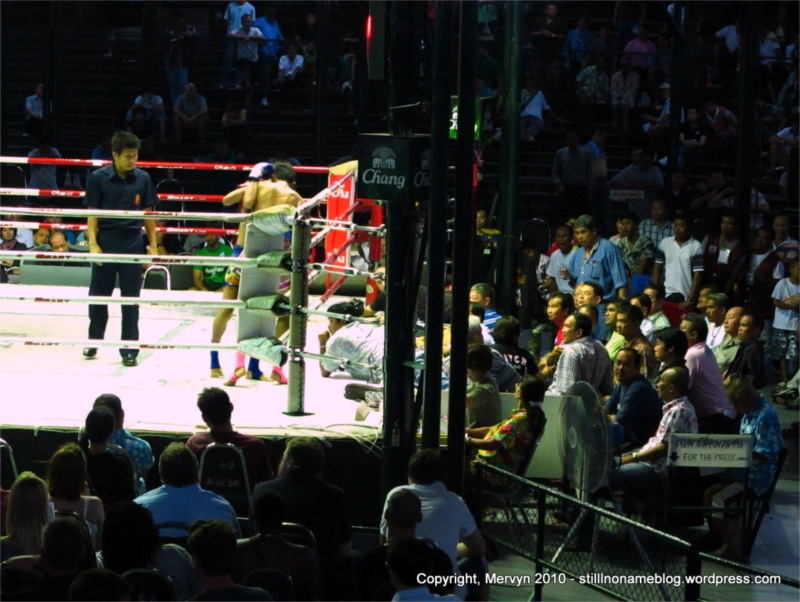
The “Aaaaaaaaays” would get louder and louder. Give a knee (“AAaay”), take a knee (“AAAAaaaay”), give a knee (“AAAAAAAAaaaaaaaay”), take a knee (“AAAAAAAAAAAAAAAAAaaaaaaaaaay”).
Then, when the winner was announced after the fifth round, the place would decrescendo to murmurs as the gamblers sorted out their winnings and their debts. Wads of thousands of baht, a month’s wages for many Thais, would flip hands. Here, the men imitated the fighters, receiving their winnings and relinquishing their losses stoically. (Why receive winning stoically, you ask? Well, would you want to place a bet with someone who you knew was going to taunt you if you lost?)
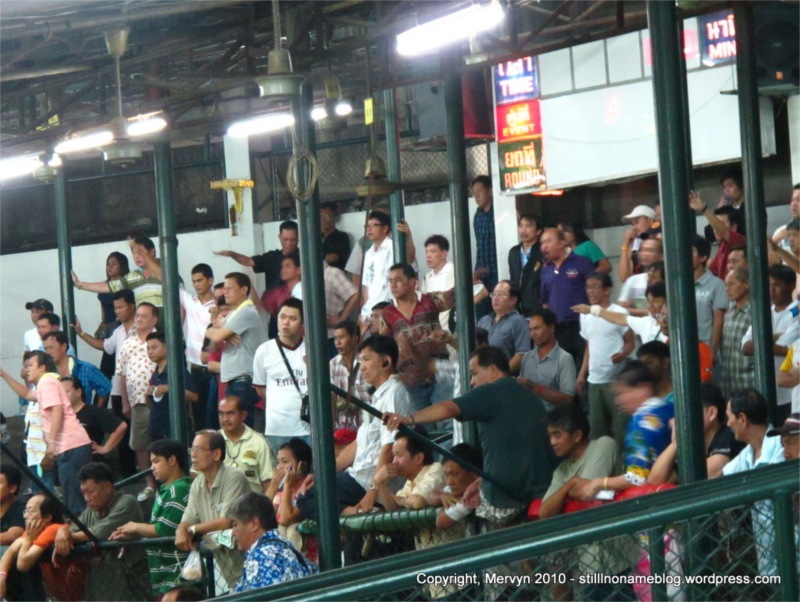
These men had increased the intensity of watching two men pummel each other not only by gambling on the outcome, but by adding the testosterone of a trading pit. It was like feeding an already hyperactive two-year old fistfuls of Snickers bars that’d been dipped in maple syrup and dusted with Pixie sticks and cocaine.
There were nine fights that night. I saw the middle five. The next to last one (#4 on the program) was the most competitive and the most heavily wagered. I could tell the crowd thinned afterward, but I stuck around for one more, just to see if anything else happened.
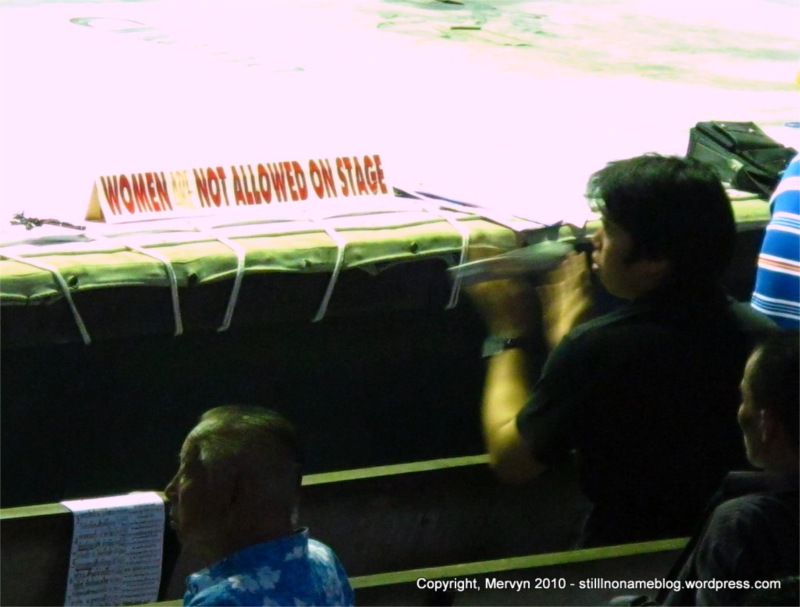
With the gambling dying down, the fanatics became less invested. The cheap seats started heading for the exits. Soon there were as many people ringside as in the stands. That’s when I decided to go.
I joined the men leaving the arena and drifted out to take the MRT. That’s when I realized that the one “man” thing I hadn’t seen all night, other than from the farang, was drinking. Really. If they were pounding booze, they were doing it out of sight. I hadn’t even seen anyone noticeably drunk.
Guess the sport’s not so manly after all.
____________________
Stupid Travel Tip of the Day: If you want to pay the cheapest price for your tickets, make sure you look Thai, and can speak and read the language. No, seriously. Thais pay about a fifth or less than what foreigners do for the same sections by using a special ticket window. If you show up looking farang, they’ll send you to an English window and charge you 1000 baht for a 220 baht cheap seat, 1500 for second class, and 2000 for ringside.
Not So Stupid Tip: If you want to pay the cheapest price for your tickets, make sure you look Thai. No, seriously. It worked for me.
When I got to Lumpinee, I sat on a pillar near the ticket window and pretended to check my phone for text messages, sorta like I was waiting for someone. I was really just watching how ticket purchasing worked.
When I thought I’d figured it out, I girded my loins, checked my phone one last time for effect, then walked up to the ticket window with a Thai sign above it. I shoved a 1000 baht note into the window, held up one finger, and put my hands into my pockets. The person behind the counter handed me a ticket and counted out 780 baht in change. I took my time at the window arranging the stack of bills so they went neatly into my pocket, just like I’d seen others do. Then I walked towards the entrance where the guy in front of me was headed.
An old man almost blew my cover when he gave me a program (written all in Thai) and tried to say something to me. I tried saying, “No, thank you,” in Thai. “Mai, krap.” He got more insistent, then pointed at the fourth fight listed on the program. I laughed, then walked quickly on. Later, I figured out that he was probably trying to tell me that the fourth fight was the best.
I walked up to the entrance, handed my ticket (written all in Thai) to the ticket collector, which he took without a word. Then I walked in.
Eight hundred baht saved. I’d have preferred to sit in the second best seats, but I couldn’t figure out how to buy those and, if I’d paid at the farang window, it would have cost me 1500 baht. The extra $45 just wasn’t worth it to me. I stuck with my $7 seats.
So there you have it. Good luck!
Day 40 – A Mighty Parade (Thai Protest 2010)
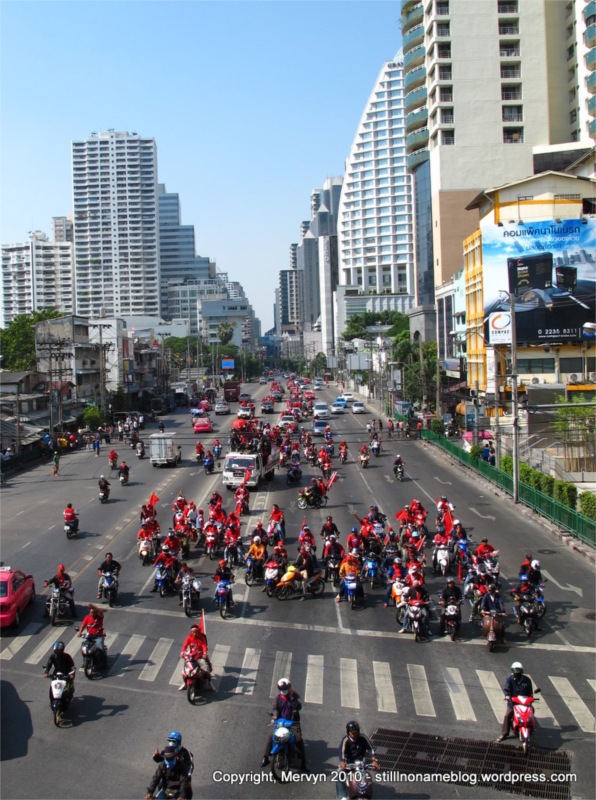
Dateline: Bangkok, Thailand – Monday, April 12, 2010
I was on the same bridge looking down on the same strip of Sukhumvit Road as yesterday. Things were different, though. The Red Shirts had seemingly moved past their street festival. They’d moved on from their pop concert. They were now cruising the streets in frat boy spring break mode.
The Red Shirts were on motorbikes, pickups, cars, taxis, and tuk tuks. Music blared from giant onboard speakers. People were using giant megaphones mounted to their vehicles to urge the crowds to do … something.
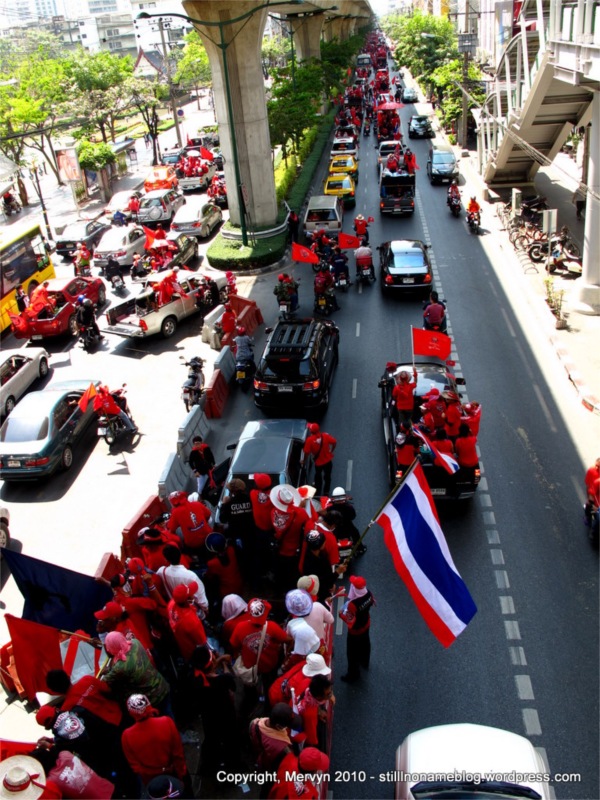
Just an hour earlier, I’d reached Emporium after walking the same route I’d used the day before. I was visiting travel agencies, looking for a cheap way to get from Bangkok to Siem Riep, Cambodia for the next leg of my journey. The walk had been, like yesterday, hot and uneventful. There’d been a couple Red Shirts at an intersection, smiling and waving flags at about 15 policemen who were behind yellow metal barriers guarding a local soi. I didn’t even pay it any mind.
Coming out of Emporium, though, was a different story. People were stopped on the pedestrian footbridge gawking at a Red Shirt parade. The onlookers had their camera phones out, snapping pictures. The Reds had commandeered all but one lane of traffic and were headed … somewhere.
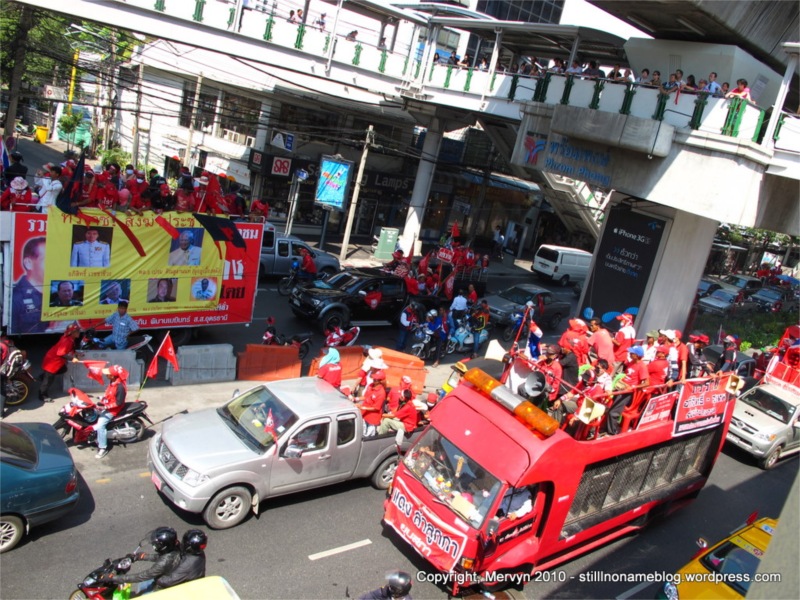
As I walked back towards my hostel, I discovered where: the Prime Minister’s residence. Now, admittedly, I don’t know this for sure. But I’m making an educated guess based on the following facts:
#1 – It’s the same intersection I’d been at earlier in the day where the police were standing behind metal barriers, chatting and smiling at the demonstrating Reds.
#2 – I know that a lot of government officials, including the PM, live in this area of Sukhumvit. In fact, I’d passed one on the way to meeting Franck and Becca for lunch a few weeks back. Soldiers had made me walk on the other side of the road.
#3 – I heard on the news later that the Reds had marched to the PM’s house in Sukhumvit. I walked Sukhumvit from Phrom Phong to Nana (i.e. the area of Sukhumvit closest to the Prime Minister’s house). The intersection I saw was the only one with any action.
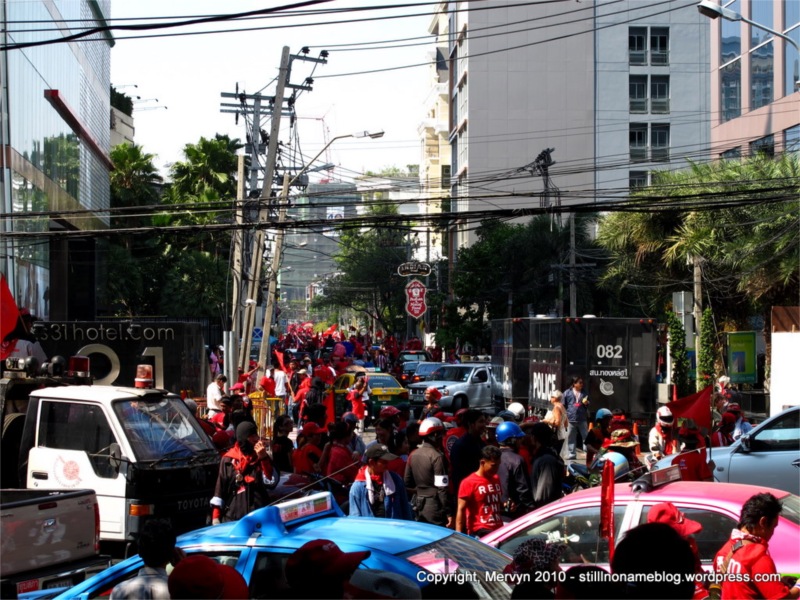
I’d bet money it was his place. Regardless, there was a lot of activity.
Red Shirts dressed in black directed traffic. Turns out these are the security forces or guards of the Red Shirt movement. I know this because a few of them had “Guard” written on the backs of their shirts. They seemed to command a lot of respect. People followed their orders.
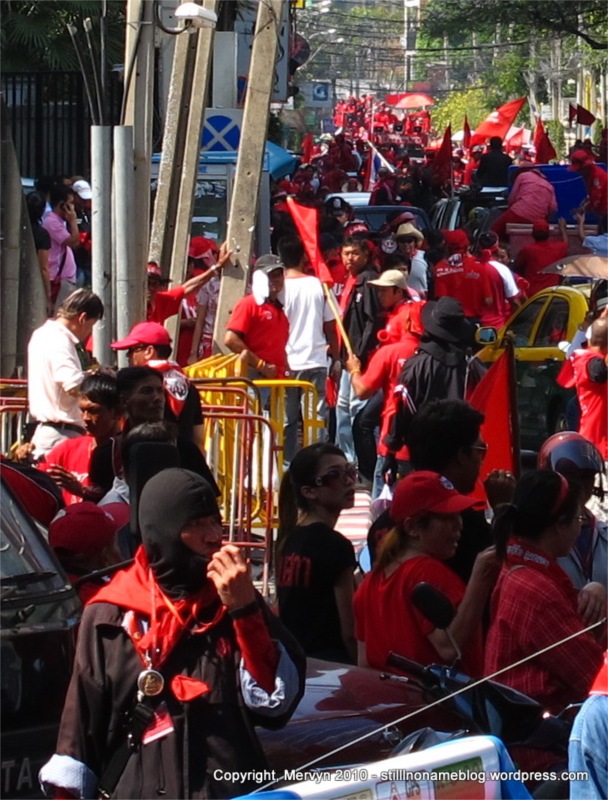
A person dressed like a policeman joined the black Reds. I say “dressed like” because he wasn’t doing what I’d expect a policeman to do in that situation, namely at least be a little upset that a bunch of people had overrun his position. There was even a guy in full army fatigues with a red sash around his neck. A black masked ninja, a policeman, a solider; it was like a gathering of the brown, militant wing of the Village People.
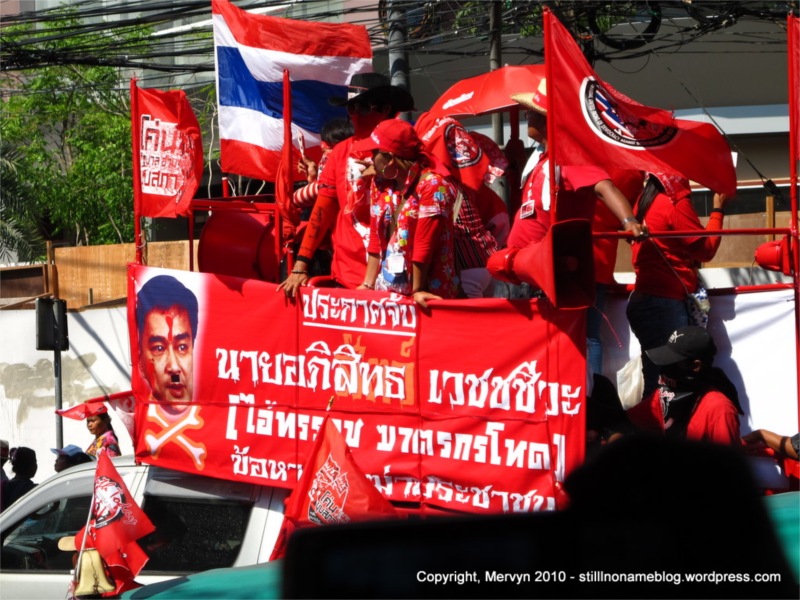
Other than the one, cooperative police-looking fellow on the radio, all the other cops were nowhere to be seen. All that remained were the yellow metal barriers pushed aside and two large S.W.A.T.-looking vehicles parked unattended on the side of the soi.
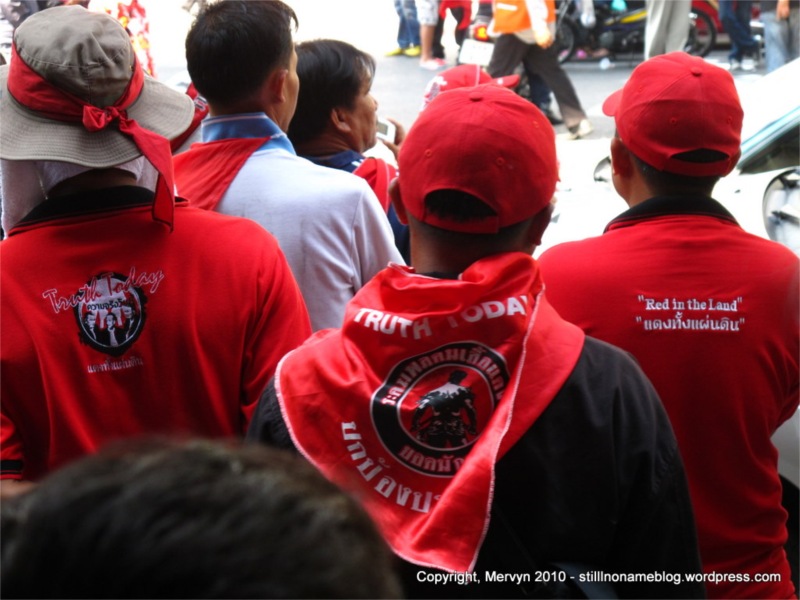
I was standing in a crowd of Red Shirts watching the scene play out. Vehicles would approach the intersection. The men in black would wave some vehicles through. If, however, the vehicles were large, loud, and filled to the brim with Reds, the men in black would send them down the soi.
Every time a particularly boisterous or rowdy truck of protesters went down the soi, the few hundred Reds gathered around the intersection would cheer and clap.
The vehicle that got the loudest reaction, however, only contained one man: a monk in a wheel chair mounted to the roof of a silver Nissan. He held a bundle of sticks which he waved at the crowd like a beauty queen’s scepter. The people ate it up and were even more delighted when, in the spirit of the Songkran water festival, he dipped the sticks into a pail of water and used it to fling water at the crowds. It’s no surprise that he got waved into the soi.
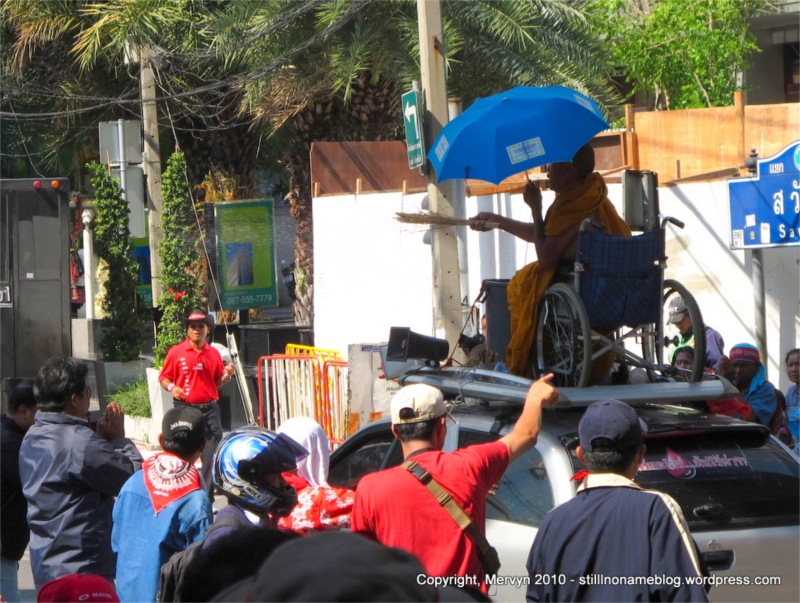
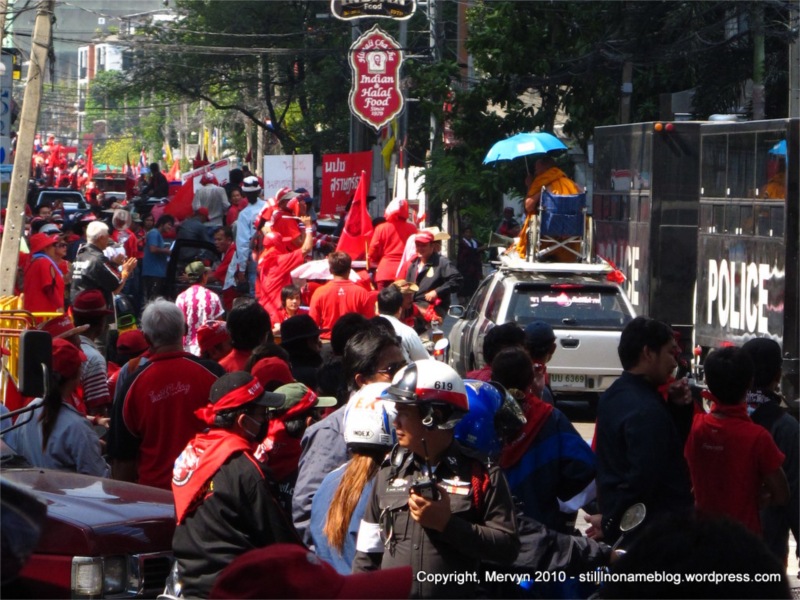
The whole thing didn’t feel dangerous. In some ways, it felt like a parade. It looked to me, though, that the Reds controlled the streets. They’d expanded beyond their demonstration stages with the lights, cameras, sound systems, and big screens. They were coming and going as they pleased. They were directing traffic and screening cars. In fact, they may have had the cooperation of some of the police. It’s hard to tell, though. Were the policemen cooperating or were they just doing what it took to stay alive in the face of thousands of protesters?
Despite the Reds in the street, things did seem more normal. The Skytrain was open at all stations. All the shopping centers were open except for those directly on the Ratchaprasong intersection (mainly, high-end Gaysorn). I spent the whole day looking for a decent way to get to Siem Riep and the temples of Angkor Wat all the while hopping from food court to food court gorging myself. To me, that’s perfectly normal.
I didn’t hear anyone fire real or rubber bullets. I never got my eyes stung from tear gas. I didn’t see people stripping army vehicles clean. I saw no blood other than the fake stuff on the “The PM is Hitler” poster. The greatest threat to my health was that all the good food I’d eaten might someday make me a heart attack prone fatty.
On the news front, it looks like an election commission has determined that the ruling party has taken unlawful campaign contributions and that they should suffer essentially the same fate as Thaksin’s party; the party must be dissolved and its members may not participate in politics for 5 years. It’s quite a victory for the Red Shirts because the determination calls into question the legitimacy of the current government. A court still has to review the election commission’s determination, but the Red Shirts must feel like they gave their opponents a good stab to the lung; the current government may not be dead, but it’s breathing heavy and its health is in serious question.
What I want to know is where the army is going to come out on this. They’re the major swing vote in this political environment. In this topsy-turvy democracy, they’re the vote that has the gun.
The next few days should be interesting.
____________________
Snack Food Break: I went down to the nearest 7-11 to get a writing snack. I grabbed a cup of yogurt, the healthiest writing chow I’ve had in weeks, and noticed something interesting: yogurt flavored soda. Or, to be absolutely precise: “Calpico Soda – Yoghurt Flavour.” I had to try it.
I braced my palate as I dipped my straw into the drink (in Thailand only savage farang drink straight out of a bottle or can). I prepared for a taste of sour, clotty yogurt mixed with feet.
It actually was quite good. Like cream soda, but with about three pounds less sugar. It also had a nice touch of sour in the finish. Quite refreshing in fact. If I see it again, I’ll buy another one and be glad I cannot read the calorie content because the whole thing (other than one of the two labels) is in Thai. Besides, I’m on vacation, so junk foods are like prostitutes; they don’t count.
Dateline: Bangkok, Thailand – Sunday, April 11, 2010
If you read the newspapers today, you might have caught a piece about the violent clashes between protesters and the army and police. I read one and it made me think the city was under siege. In some ways it is, in some ways it isn’t.
Being here, I get the feeling it’s sort of like how outsiders view California. When there’s an earthquake, out-of-staters might think it was felt from Los Angeles to San Francisco. When a wild fire ravages coastal communities, a person who only reads the paper gets the impression that my backyard is burning . It’s the same phenomenon that makes people think that every Californian owns a surfboard and lives near the beach. After all, the newspaper headlines say “California wildfires” and the TV only shows people who are pretty and live near the ocean. Both give the impression that California is less complicated than it actually is.
I’ve experienced a bit of the same here in Bangkok. Last night I watched the rally at the intersection near many of the major Bangkok malls. It was tense at moments, sure. They did parade the bodies of fallen comrades on the big screens. There were defiant cries to fight on.
More than that, though, it was surreal. A two pop song set from some old, long haired queen? Vendors selling food, clothing, and other merchandise, some totally unrelated to the Red Shirt movement? A sophisticated camera on a boom taking swooping video of the dancing, singing crowd? It’s all missing from the news stories.
Also missing is the stuff happening in Bangkok despite the unrest. Sure, major intersections have been shut down, some public transport’s been suspended, and major shopping centers have been closed. That’s all true. All of it has changed the regular hustle and bustle. Traffic going towards the demonstration sites is significantly lighter than traffic headed away. The streets are quieter and there seem to be fewer tourists. The city has even, to my dismay, cancelled the water festival activities associated with the Songkran holiday.
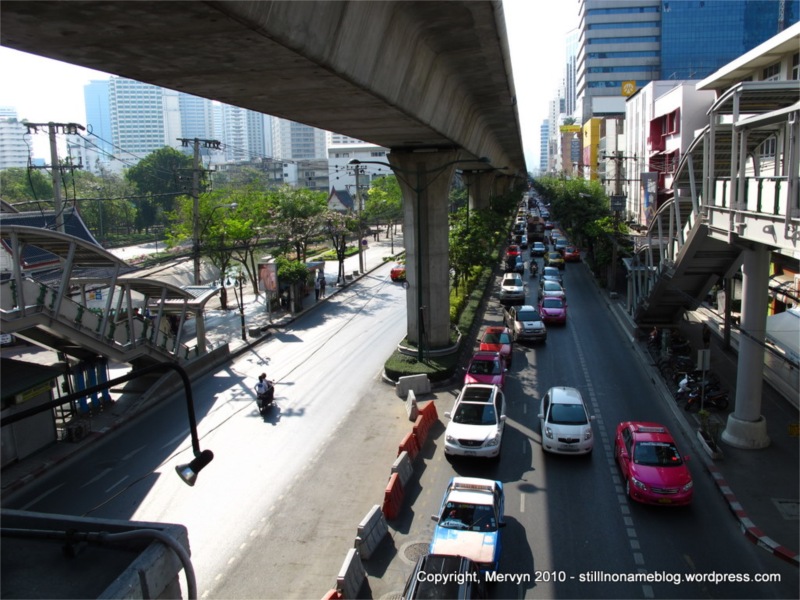
There are, however, significant pockets of normalcy. I took a walk along Sukhumvit road today, this time away from the area surrounding last night’s excursion. I did this mostly out of necessity since Skytrain service from the closest station had been suspended because of the unrest. I headed to Emporium, a shopping center 1.5 kilometers from my hostel. (Yes, I’m going metric, mostly because I’m lazy and the map I’m looking at only has it in meters.) It was hot out as it tends to be around lunchtime.
When I got to Emporium, it was less crowded than I’d expect for a weekend. However, the food court was packed. Locals sat around reading, having coffee, and chatting over their meals. I decided to have a “Japanese burger” at Mos Burger and inadvertently ordered sliced beef between two slabs of sushi rice. I ended up chasing French fries with bites of beef and rice. Odd, but flavorful. It was a bit unsatisfying, though, because it was small and not what I expected. Despite the chaos in the streets, I felt safe enough to snap a pic of the food.
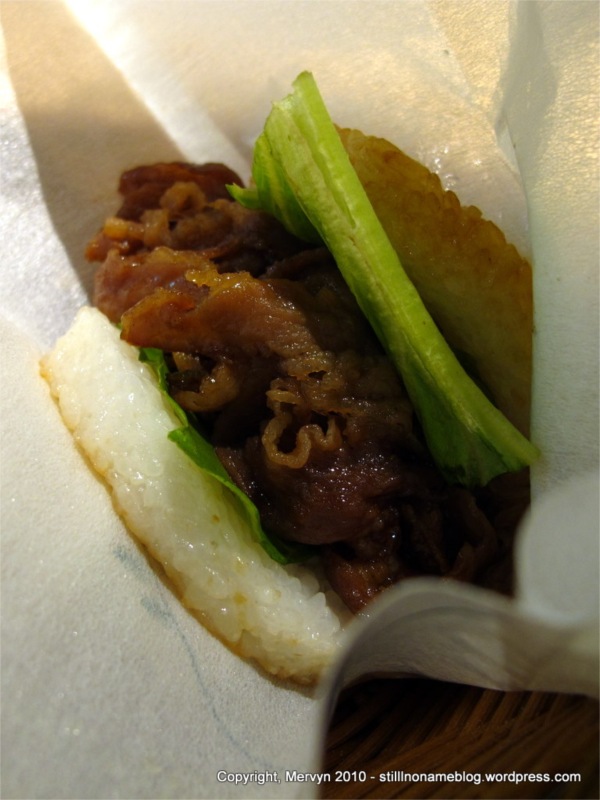
Walking through the mall, people were shopping like it was any other day. I did my usual and fended off clerks who tried to assist me in Thai. (Aside: What does it take to buy a t-shirt made of a cotton blend instead of just straight cotton? I’ve been looking every chance I get and everything’s either pure polyester or pure cotton. In country where you sweat like a bottle of ice water in the Mojave Desert, you’d think blends, which dry much faster than cotton but don’t pick up odors like polyester, would be the material of choice. Alas, this is not so. Or I suck at finding things. Also, I seem to know a disturbing amount about fabric. It’s like I took a sewing class in college or something.)
The mall seemed mostly insulated from the Bangkok portrayed in the news. I got the same feeling when I walked through the adjacent Benjasiri Park. People were lounging in the shade, chatting with friends on the grass and reading by the lakeside. There was a skateboard park busy with miscreant youths. There were two courts where guys were playing that volleyball game where you use your feet and head instead of your hands (joga?).
There was even a basketball court busy with a full-court pickup game. I sat down and watched for a while. There were the fast, short, young friends playing a step faster than everyone else. There was the savvy old guy who got a surprising number of rebounds and made all his shots. There was the insistent dribbler, who held the ball for way too long trying to get his shot. There was the lazy tall guy who couldn’t be bothered to run past the foul lines. There was the black hole, who’d find a way to shoot even if both hands were tied behind his back. There was even the cherry picker who almost never played D and thought he was better than he actually was just because he scored off long inbound passes. I hate that guy.
It was refreshing, though, discovering that the game’s the same around the world. That certain things stay familiar. That what’s normal in a California pickup game still feels normal in Bangkok, Thailand.
And really, that’s the thing. Outside of the transportation inconveniences and lighter crowds, the day felt normal. People were out with their families. Guys were arguing about the score. People were eating and reading on park benches. This, at a park that’s within walking distance of the protest site I’d been at the night before.
I’m not naïve, though. There’s civil unrest in Bangkok. People are dying. Demonstrators are staring down police and soldiers, a powder keg about to explode. People are fighting for a democracy they can believe in. Others are trying to deal with a movement that’s trying to reinstall an exiled convicted felon and that’s turned confrontational and violent.
That said, in the face of it all, life in Bangkok rolls on. That fact, more than the protests and the violence and the demonstrations, fascinates me.
Contact Mervyn
Mervyn misses you like the deserts miss the rain. You may call him using the information available at the “Contact Mervyn” link at the top of the page. The info will probably be updated as his location changes. Call while you can! Or don’t, if you don’t want to. Whatever.
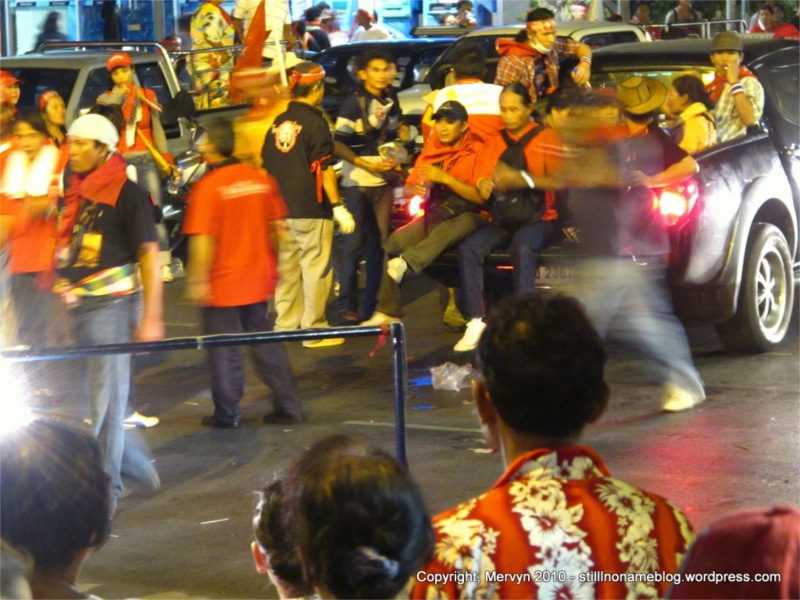
Dateline: Bangkok, Thailand – Saturday, April 10, 2010
It was like walking down an unexplored dark tunnel. I had no idea what’s on the other end. I was walking down dimly lit Sukhumvit Road towards the Ratchaprasong intersection, site of the largest Red Shirt rally. According to the spotty news coverage, the army and police had driven the Reds back from a couple of other protest sites including, for a short period, the Ratchaprasong intersection. The protesters, however, had somehow negotiated to keep Ratchaprasong as a meeting place and the army and police had withdrawn. Supposedly. You never know with the Thai English language press.
On my own, I’d discovered that the BTS Skytrain system had been shut down. I’d walked there from my hostel hoping to either go to the MBK shopping center for some serious internet time or to head to Lumpini Stadium to catch the Saturday night Muay Thai fights. No dice. Trains weren’t running at all and the cages were rolled down on the stations.
I had two choices. I could head away from the supposed Red Shirt gathering towards Emporium, grab dinner and internet there, or I could walk towards the Ratchaprasong intersection, the supposed heart of the Red Shirt demonstrations. Becca had just sent me a text that said, “Crackdown in progress; has turned violent; check news and avoid crowds.”
Me being me (mildly adventuresome, sometimes cocky, a decent swimmer), I headed into the supposed fray. What I didn’t know is that the police and army had clashed with the Reds at a different site earlier in the afternoon. Soldiers had fired rubber bullets into the air, helicopters dropped canisters of tear gas, and baton and shield wielding regulars had pushed back a Red advance towards a key bridge. Protesters had supposedly lit an incendiary device of some kind (a large natural gas canister?) and rolled it into police causing a number of casualties. Hundreds had been injured, 11 had been killed, and the Reds were trying to regroup.
Walking down Sukhumvit that evening, all I knew was that it was dark and unusually quiet for such a busy thoroughfare. Piles of trash lined the gutters. I passed abandoned cars parked in the middle of the typically busy street. I couldn’t be bothered to take a picture and actually put a little skip into my step, visions of car bombs running through my head. My active imagination puts a damper on my healthy bravado.
I was simultaneously comforted and discomforted by the fact that a farang or two walked nonchalantly from where I was headed. It was a good sign that they weren’t running; it was a bad sign that none seemed headed in my direction.
I finally hit an intersection with some activity. It was a welcome relief from the dark, ominous streets. At least there were lots of people. Some of were even White. It wasn’t clear to me what was going on, though. Red Shirts were directing traffic, chanting, honking horns, and waving flags. Behind them and further on from me, the streets seemed mostly deserted. It was strange. Occasionally the Reds would waive a pickup truck or motor bike loaded with their comrades through a makeshift barrier. In hindsight, I see that they were probably trying to rally supporters to the Ratchaprasong intersection.
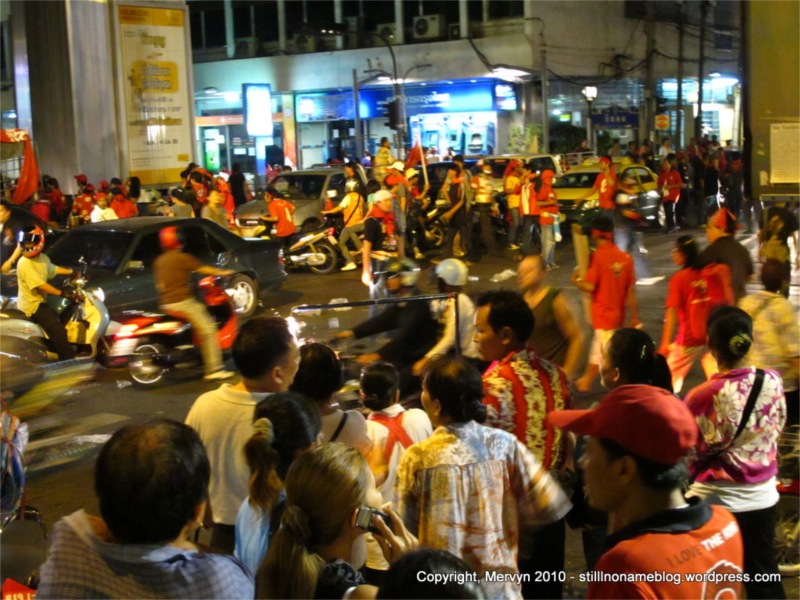
I walked towards the barrier, trying to appear as casual and non-threatening as possible. As I walked along the barrier towards a pedestrian opening, I saw two White guys talking to an old Thai guy in English. The man waved in the direction in the direction I was headed and I distinctly heard the words “tear gas.” The White boys turned around and headed elsewhere.
I, on the other hand, proceeded to violate Traveling Rule of Thumb #8 (“When in doubt, follow the White people”) and started to walk through the pedestrian opening. A young man, dressed in all black with a black mask and a red scarf hopped up, raised his hand, and said something in Thai. I assumed he was asking what I was doing. Quick wit that I am I said, “Just walking through?”and pointed down the street and smiled.
He laughed, I laughed, his black clad friends laughed, and he let me through. I guess it could have been worse.
I marched on past scattered groups of demonstrators, more abandoned cars, and a Visa ad that said, “Experience Thailand’s Legendary Hospitality Now.” That seemed optimistic.
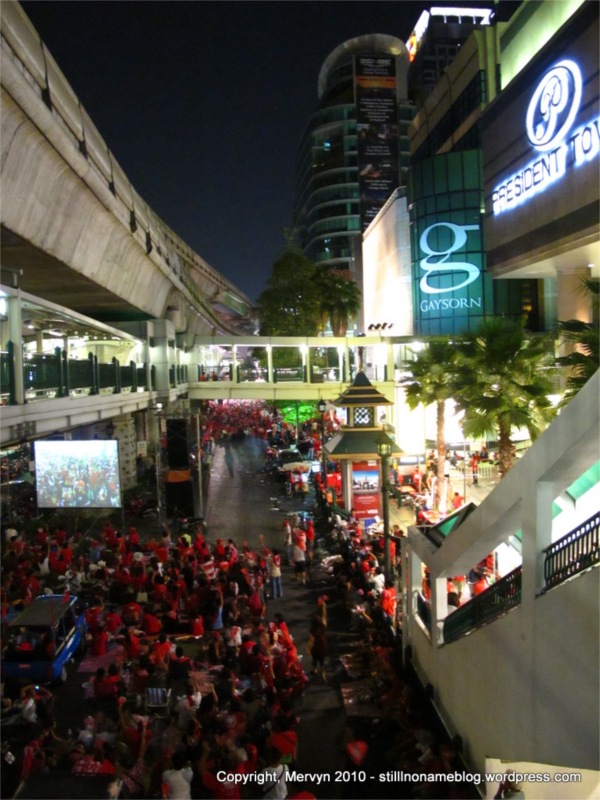
I finally hit Gaysorn shopping center where I’d been a couple nights before. Then, it’d felt like a street festival or concert whereas tonight it felt like I’d walked into an Orwell novel. There were still families, kids, and old people, but the big faces on the screen were angrier, more vehement. The crowd seemed to be more expressive and there was a lot more cheering and chanting.
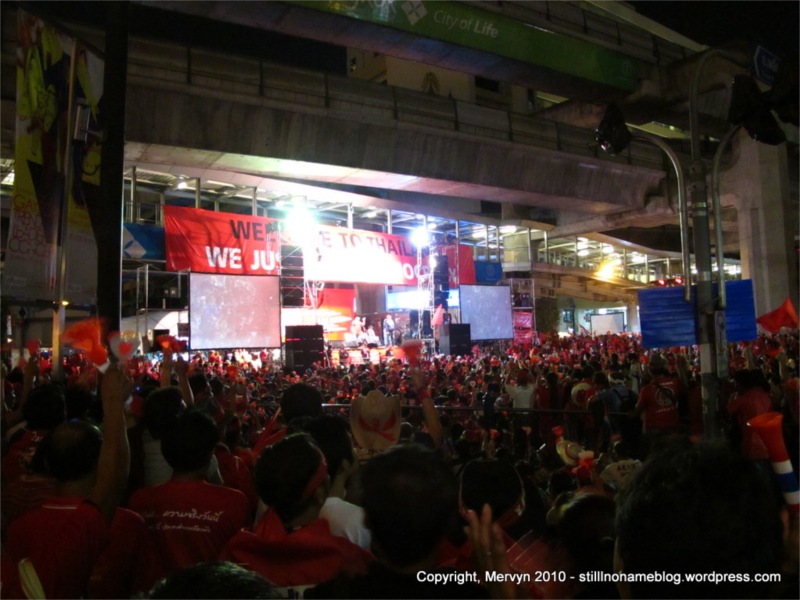
When I rounded the corner and could see the main stage, I finally saw the street vendors, food hawkers, and drink salesmen. The street fair wasn’t completely dead. Commerce was definitely thinner, though. I did see someone selling slippers with the faces of government leaders and guns on them. It’s the Thai equivalent of the George W. Bush novelty toilet paper I’d seen a few years back.
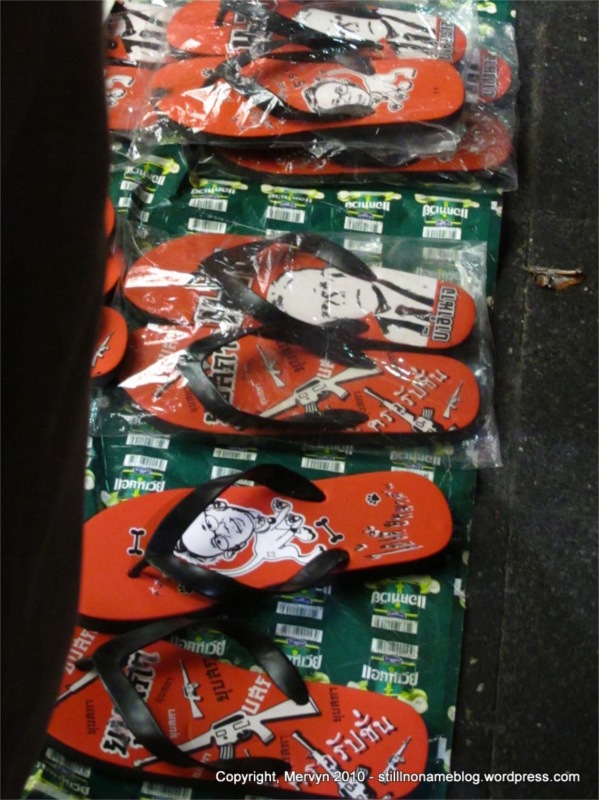
The crowd cheered wildly when a fiery, round-faced, shaved head guy appeared on screen. Round Face brought down the brimstone and hell fire. He was a Red leader I’d seen pictured at a negotiating table with the prime minister a few weeks back. No negotiating here, apparently, just stirring the coals.
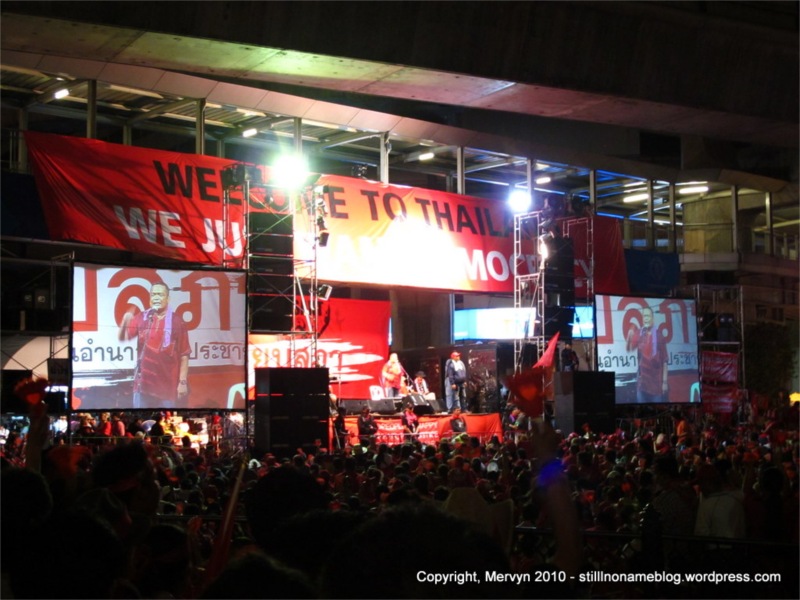
Then the crowd tittered with excitement when a man who looked like a cross between Jimmy Buffet, David Cassidy, and Johny Cash took the stage. I took it he was a celebrity of some kind. Judging from the shirt, probably a musician or singer.
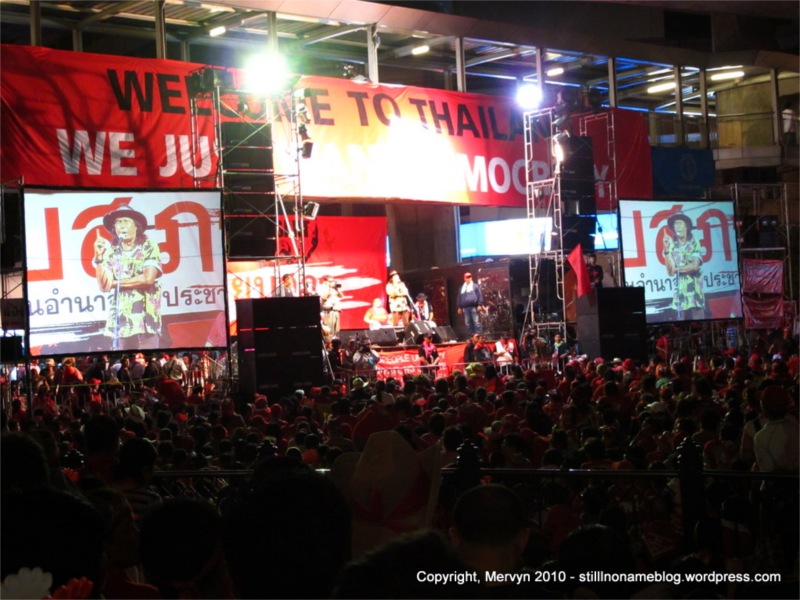
I walked to the back of the mass of people and discovered more vendors. I started to relax a bit when I saw that many had nothing to do with Red Shirt paraphernalia. A couple was selling little helicopter things with LEDs on them that they shot repeatedly into the air with rubber bands. They were next to a clothing stand that didn’t seem to be selling anything Red.
Don’t get me wrong. I kept my head on a swivel the whole time. I’d stop, take pictures, watch for a bit, then move quickly, but casually, to another spot. I’d turn around and see if anyone had followed me. I’d also pull out my notepad and scribble notes, hoping that any observer would assume I was a reporter. It’d at least help explain why I wasn’t wearing any red (white button down today, nothing blue). I’m sure it was all the equivalent of waving your mouse pointer at a stalled computer or not drinking red wine after vodka, but it did make me feel better.
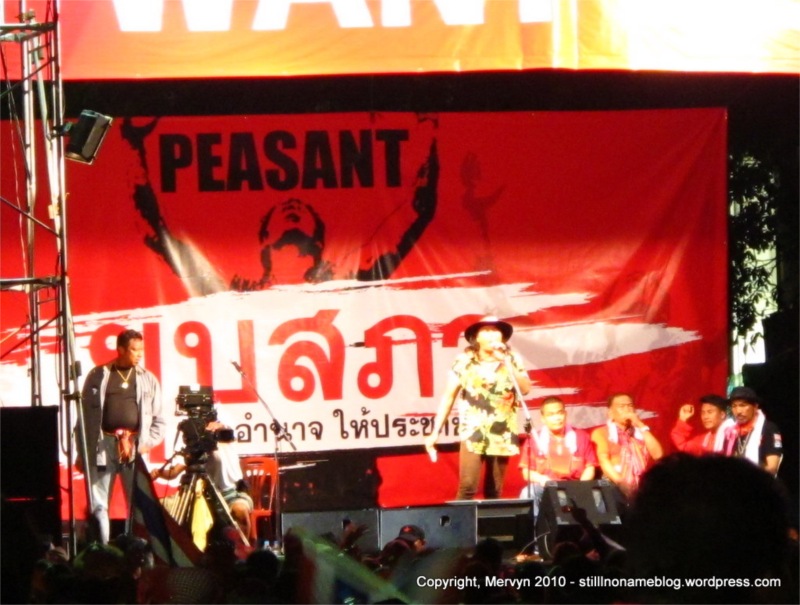
I headed back to the main crowd. That’s when I saw the bodies. On the big screens, they were projecting video of two people lying on their backs, draped in Thai flags. The audience murmured. The speaker seemed to ask for a moment of silence, which he mostly got.
Then Round Face got back up, shook his cell phone in the air, and proceeded to read a text message. I’m going to guess that he was reading a tweet from Thaksin, the not so shadowy figure watching over this rising red tide. The exiled former government leader hasn’t called for revolution so far as I can tell, but he’s been ambiguous enough to stoke the flames (Things like “The people must fight for their rights” and “The country needs me if it wants peace and prosperity.”). I say it was a tweet because I know Thaksin is a Twitter user and when Round Face started reading I immediately saw other Reds looking at their cell phones and reading, too. When he finished, the crowd went wild.
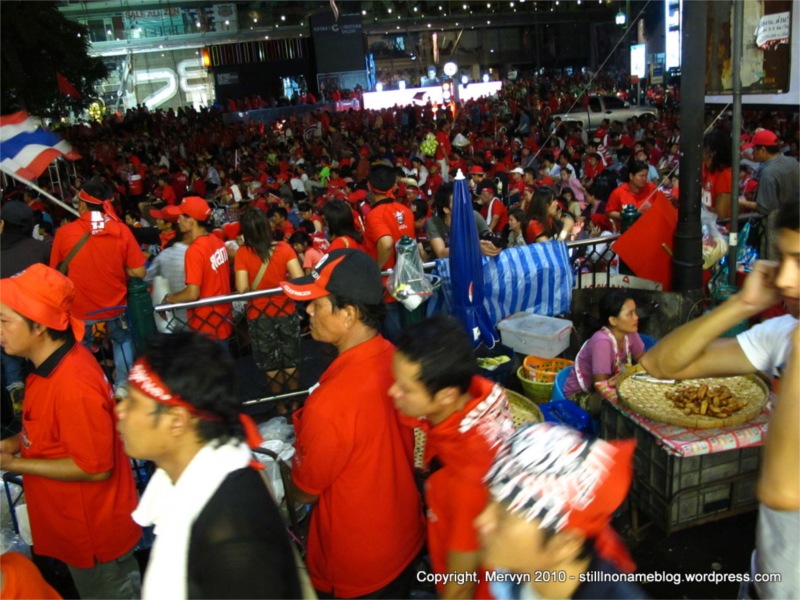
Then the long haired entertainer took the stage and the groupthink double plus ungood cult gathering turned into a concert. Really, an honest to God concert. The stacks of speakers blared pop music and the long haired, black hatted, Hawaiian shirt clad man belted out a swinging song. Then another. The camera man on the boom provided sweeping shots of the fans and of the concert stage. The crowd stood and danced and clapped and cheered. When prompted, they sang along. Everyone was smiling and laughing. Moments ago, Round Face had seemed to be crying for an uprising and the crowd matched his defiance. Now, they were singing and dancing to the Thai version of Margaritaville.
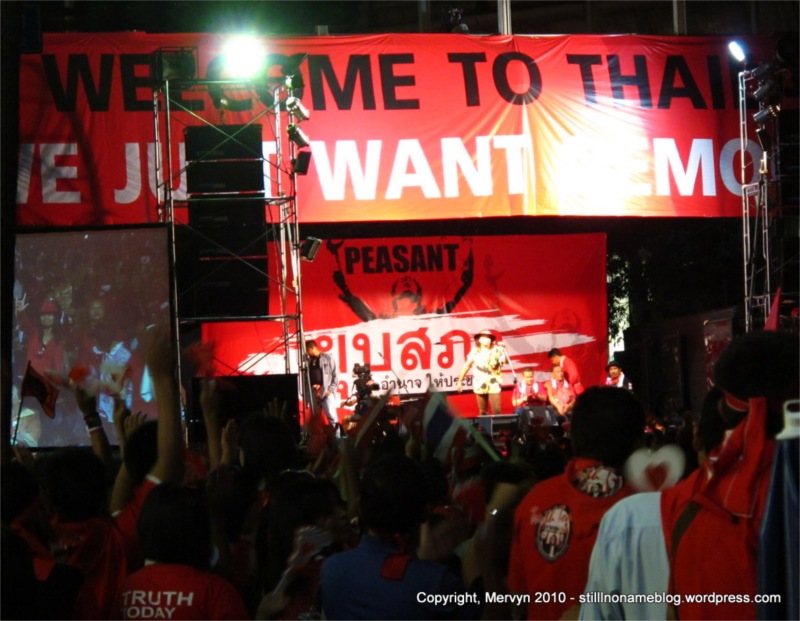
At that moment, Franck sent me a text that said, “People dead in streets of Bangkok better go home.” I looked back up at the partying crowd, then back down at my phone. The whole thing was absolutely surreal.
I lingered for a bit, but decided to head to the hostel. I was tired and the thought of the long walk made me more tired. The thought of taking the long walk later, around midnight, made me want to camp out in the streets for the night with the Reds. I left before it got to that.
As I tried to inconspicuously make my way through the dark streets, I passed truck loads of young male Red Shirts headed towards the rally. They were yelling, chanting, blaring their horns, and pumping loud, bass-heavy songs through their cars’ subwoofers. Many seemed to be holding beer cans.
I picked up the pace slightly. I passed back through the pedestrian hole in the street barrier. The black clad men seemed more prominent this time around. I kept looking over my shoulder to make sure I wasn’t followed.
In time, I returned to the tourist area. I passed a panoply of hookers worthy of the United Nations and their equally diverse prospective Johns. Well dressed farang and Thais walked to and from the surrounding night clubs. The lights from restaurants and bars burned bright. It was Saturday night, after all. It’s Bangkok business as usual.
 The Overpacker
