Day 94 – Beijing Is Gone and Dead
Dateline: Beijing, China – Saturday, June 5, 2010
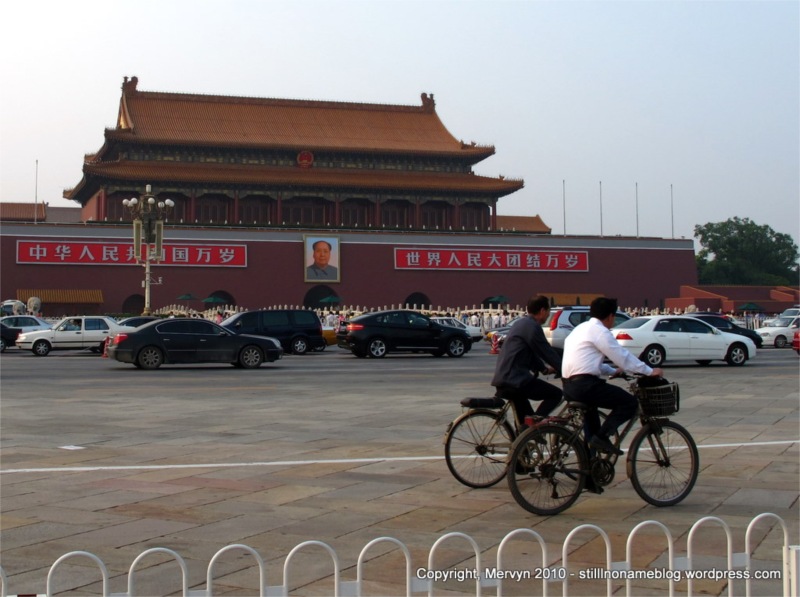
Beijing doesn’t exist anymore. I don’t mean that literally, of course. There’s a city in China named Beijing. It is the capital of the country. It still has a Forbidden City. It still has the same giant picture of Mao. It’s still the size of Belgium and it still is home to 15.2 million people. Its citizens will still clear their throats and spit at your feet and will elbow past you like you’re a stalk of wheat. That place is around.
No, the Beijing that I’m talking about is the one you have pictured in your head. Or at least, the one in my head. That Beijing had a hustle and bustle of bodies; of millions of people rising in the morning to do Tai Chi under the trees and open their shop doors. Street hawkers selling their wares, calling out to passersby telling you what’s for sale. There was a grit to the place; dust kicked in the air because not every road was paved. The old mixed uneasily with the new. Old world, dilapidated buildings sat next to gleaming modern structures. Millions of bicycles dominated the streets; a few cars here and there would plod their way through the pedaling humanity.
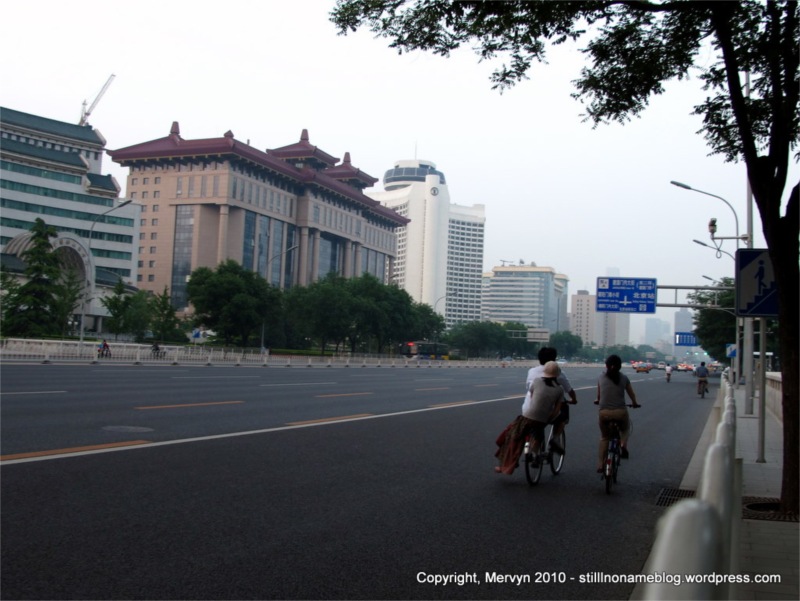
If that Beijing ever did exist, it’s long gone now. The streets are paved and six lanes wide in both directions. The old world buildings are gone, replaced by huge skyscrapers, hotels, office buildings, and malls. The blocks aren’t small and intimate, they’re huge and dominated by modern buildings which are set back 150 feet from the street with grass, concrete, and driveways in between them and the road. That separation makes the sidewalk feel impersonal and separate from the places where people work and shop. It’s as if the sidewalk is more part of the road than part of the buildings which they’re meant to connect.
You’ll still see an occasional bicycle. Stand by the roadside and after hundreds of cars have passed you’ll find a trailing bike. Most will be electric, silently whizzing along at a decent clip. After a brief silence, a lonely pedal bike or two will trundle past. The giant schools of metal, gears, spokes, and wheels are a thing of the past. In their place are fast moving packs of air conditioned automobiles.
I suspect a lot of this change came with the Olympics. China seemed desperate to show that it was a modern superpower. It did its best to clean up the city by paving roads, installing subways, building skyscrapers, hotels, and stadiums. For the games, they taught locals how to interact with Westerners. They shipped nearly all the migrant workers out of the city and back to the villages. In Sanlitun, the ex-pat bar area that I visited last night, they even shut down all the food hawkers. All this to put the awe of God into visitor.
I am awfully impressed. Much of the Olympic renovations are still around. Sure, the food hawkers are back in Sanlitun, but the streets are still paved, the hotels and offices still stand, and the subway runs fantastic. It’s quite a feat. So much is gleaming and new.
Sadly, I am not charmed. I can’t say I’ve fallen in love with the place just yet. It seems so impersonal. So. . .sterile. (Who would’ve imagined me saying that about anything in China?) I’ve never been to Dubai, but I get the sense Beijing is something like that—an impressive feat, but not the kind of place you have romantic thoughts about.
Beijing is like the pretty valedictorian who finished university in two years with straight A’s, plays the piano, cooks well, and makes your mother swoon. Beijing has accomplished so much in such a short time it’s hard not to be impressed. On paper, it’s everything you’d want out of a growing city.
Alas, I prefer my cities a little more like Angelina Jolie than Tracy Flick. Sure, my favorite cities have their smarts and accomplishments, but they’re also a little dirty and rough around the edges. What makes me swoon isn’t their resume and accomplishments, it’s the twinkle in their eye and the mischief in their smile.
Hanoi has that for me. So does Saigon. Bangkok has it, but hides the mischief under a more clean-cut veneer (at least until the whole bloodbath thing). Even Phnom Penh had a bit of it, even if most of the time it made you want to let it cry on your shoulder instead of take it home and make out.
Beijing, though, is much too earnest. Like Tracy Flick, it’s wants to show you so so badly that it’s succeeding. Its skyscrapers are the gleamingest. Its malls the upscaliest. Its boulevards are the boulevardiest you’ve ever seen. It’s like it read what all the other modern cities were doing and tried to apply all the best changes as quickly as possible. Beijing’s been trying to win for so long I’m not sure it knows how to charm, if it ever did.
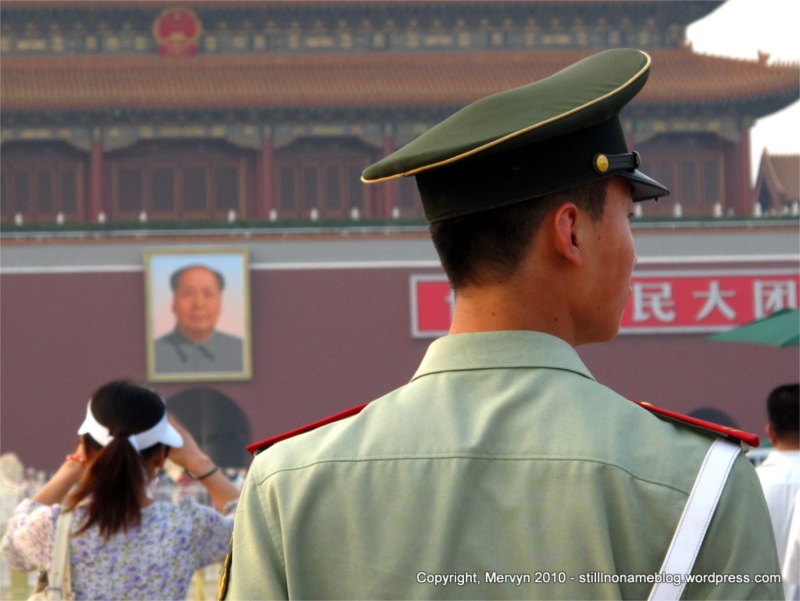
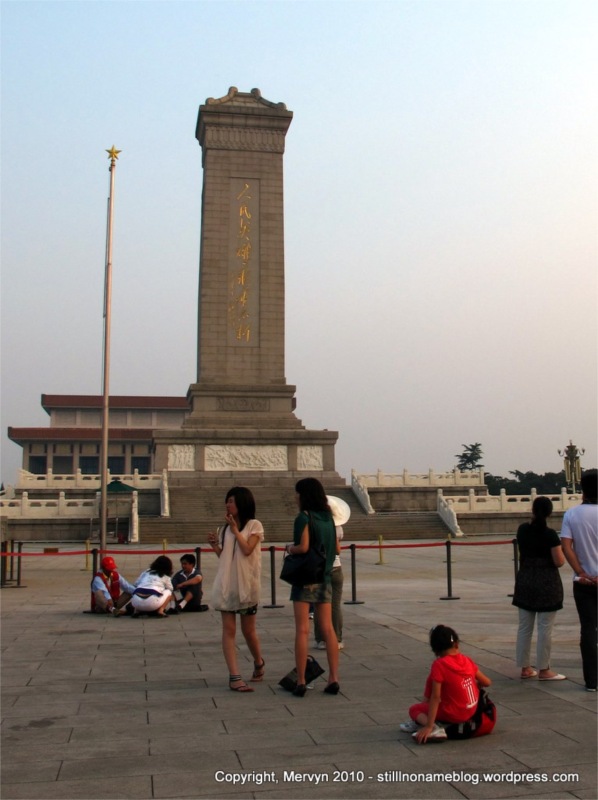
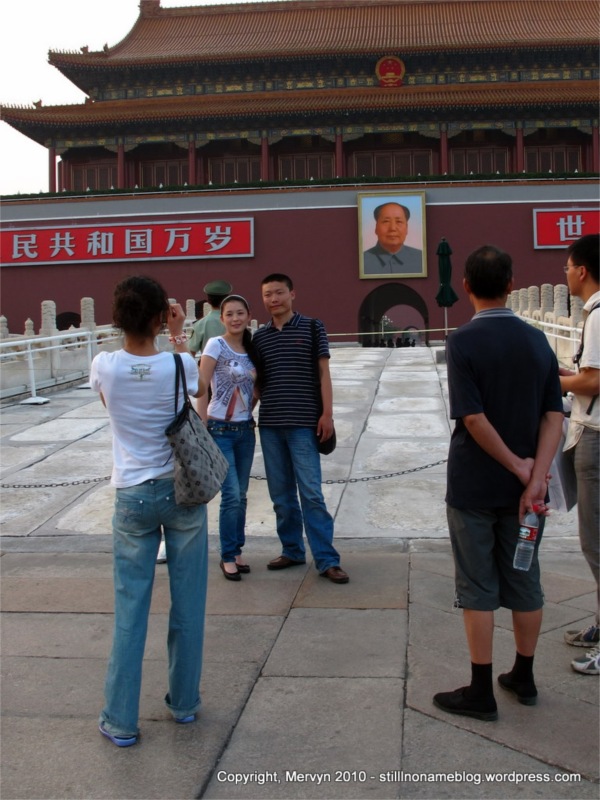
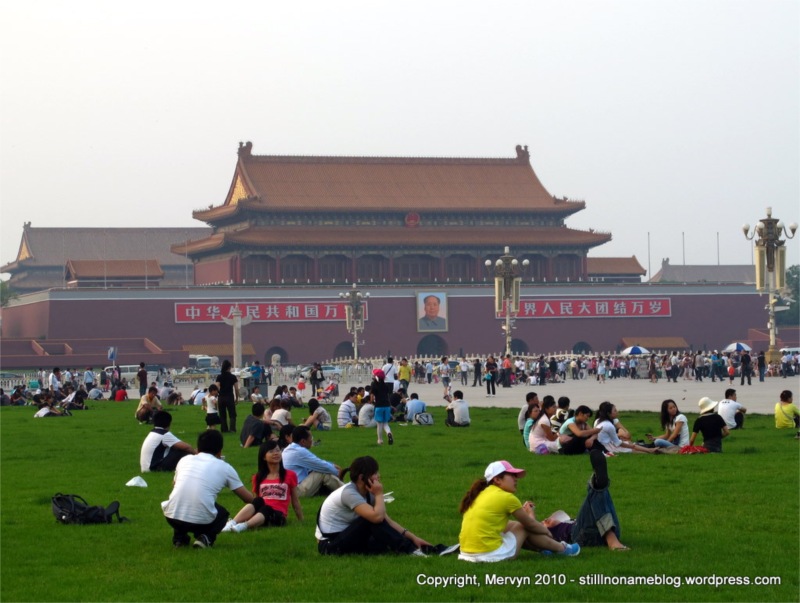
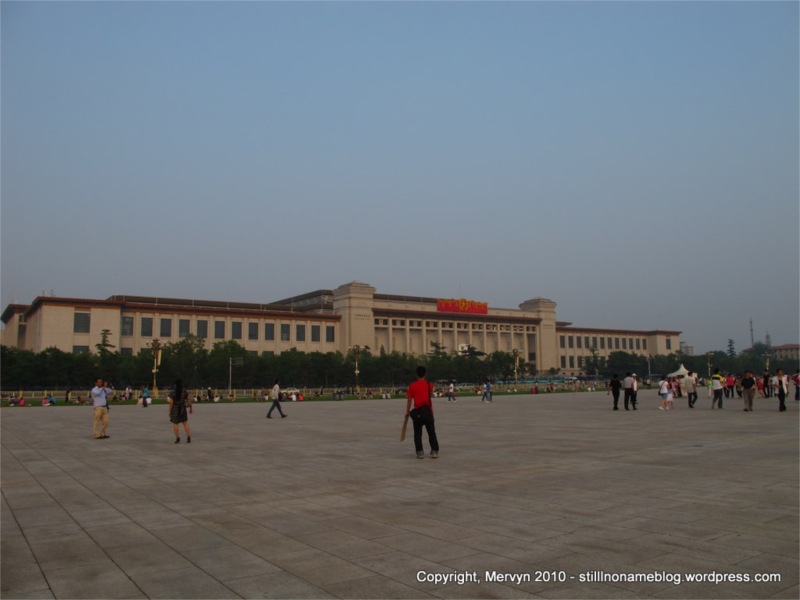
Again, I’m impressed. Today, I walked through Tiananmen Square and past the Gate of Heavenly Peace with the giant picture of Mao on it. You can’t help but be awed by the size of the place. It is immense. When Mao conceived and built the square, he achieved his goal of conveying the enormity of the communist movement. You can just imagine him reviewing millions of paraders during the Cultural Revolution.
I spent hours wandering around watching out-of-town Chinese tourists pose for pictures, hang out on the lawn, and wait for the guards to conduct a flag lowering ceremony. It struck me, as I walked around, that there were so few Western tourists. Almost all were Chinese (or Chinese looking).
In Tiananmen Square two giant light boards ran through the middle of the expanse and ran a loud video of all the beauty and wonders of China. The earnestness and desire to impress shone brighter than the screen itself. Ironically, it added a bit of unintended kitsch to what might have otherwise been a truly awe inspiring display: the quiet immensity of the empty square itself.
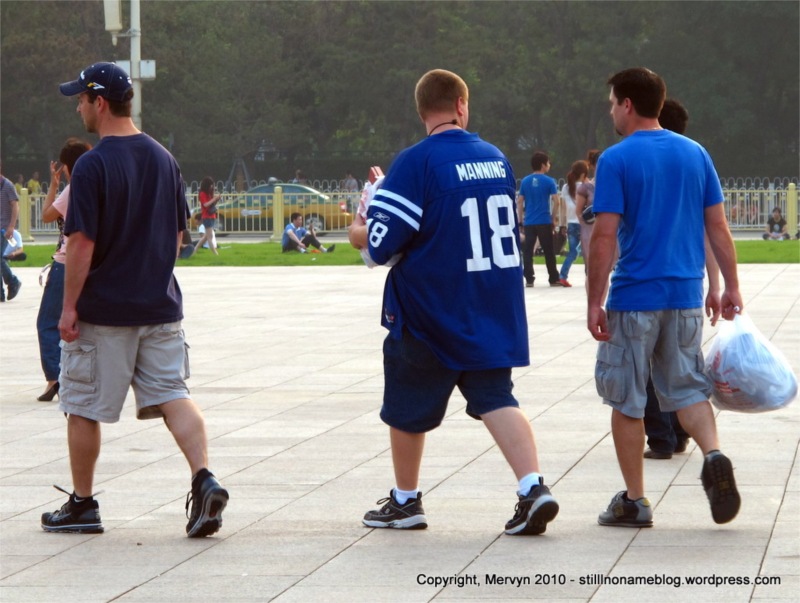
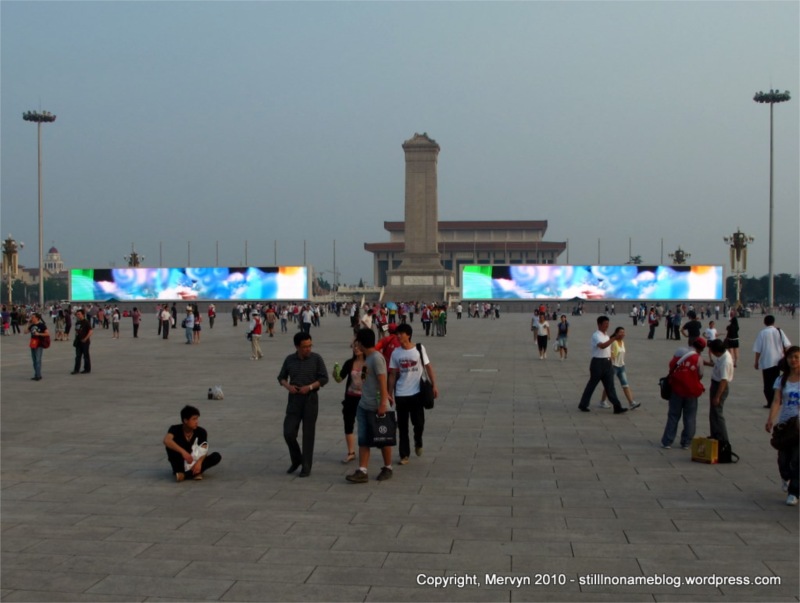
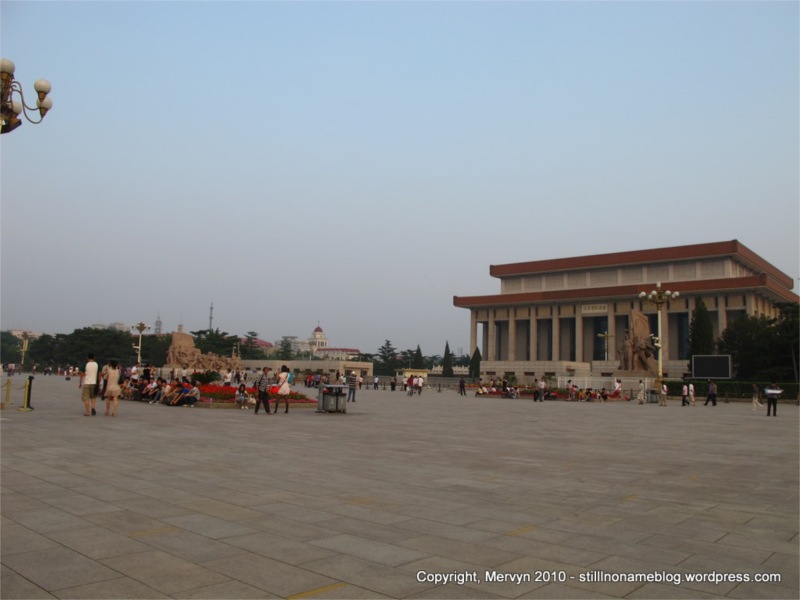
And there’s the rub. Beijing is truly a masterwork. It gleams. It’s a feat. It’s a wonder. Especially when you consider so much of this wasn’t here just five years ago.
But all that doesn’t make me want to sing love songs or write poetry. It humbles me, but it does not inspire me. It makes me stand back and wonder, but it does not make me swoon. Beijing knows how to impress, but I don’t think it knows how to be intimate–how to whisper in my ear and make me beg for more.
Hanoi, Saigon, Bangkok, and even my adopted hometown of San Francisco—they all make me swoon in their own special way. They tug at my heart strings. They make me want to come back.
There’s still time, Beijing. Perhaps somewhere, away from the touristy center, there lurks the charming city that I seek. Perhaps it will be a street market or back alley dive restaurant where I’ll find the personable grit. Maybe it’ll be a temple or a park where I’ll find the warmth and the whisper.
For now, though, I am impressed. I’m just not in love.
RANDOM NOTE: I spent most of the morning writing. By the time I got out it was early afternoon and I was starving. So starving, in fact, that I committed a couple of blunders, including leaving my usb stick stuck in the hostel computer (had to walk back to hostel to retrieve) and leaving the subway one stop earlier than I planned (walked rest of way). I was so hungry I stopped off at McDonald’s for a quick, easy lunch. Guess what I found. The chicken sandwiches at Chinese McDonald’s use only dark meat. That’s right. None of this white, tasteless breast meat crap. Dark, juicy meat was under the crisp, breaded exterior. Apparently, Chinese sensibility has converted the local versions of the world’s largest fast food joint. It’s brilliant. I was totally impressed, perhaps, ahem, even charmed a bit.
GALLERY: Click through to today’s gallery to see tons more pictures of pictures of Mao, McDonald’s and the magical dark meat chicken sandwich, Mervyn squinting into the camera in front of Mao, guards marching while trailed by marching guard wannabes, and Chinese S.W.A.T.
Dateline: Beijing, China – Friday, June 4, 2010
China is overwhelming. I’ve spent the last three months in Thailand, Malaysia, Cambodia, and Vietnam. They are all small, tidy, podunk places compared to Beijing. There are people everywhere. The streets are wide and full of cars. Just walking out of the Beijing West Train Station and to the Junshibowuguan subway station, I could tell this was a juggernaut of a city. I had to take sky walkways to cross the street. The blocks felt long and unending, the whole way full of shops and offices. Nothing looked familiar. There was a lot less honking and a lot more cars. And they were going fast.
I’d felt the same way when I visited Japan, but there, everything seemed a bit more compact. Streets were narrower and buildings felt closer together, so there was an intimacy to the place. It also helped that I had a good friend with me who knew her way around town. An emissary goes a long way to overcoming a place where you can barely read the street signs.
I started today with no one to bridge the cultural divide. Luckily, it seems the Olympics have gone a long way to helping Westerners make their way through the city. The signs have English names on them to go along with the Chinese.
I made my way the 1 km to the subway station, bought a ticket through a vending machine (yay, “In English” button!), and hopped a train to my destination, a youth hostel in the Chaoyang district. I wanted to check out the dorm rooms since single rooms were running upwards of $20, a total sticker shock after spending no more than $12 on private, luxurious rooms in Vietnam.
As usual, I wandered. I went up and down a long street with a name similar to the one I was supposed to be on. Turns out I needed to be in an alley parallel to a main road. Who knew?
Hot, sweaty, tired, and hungry I immediately agreed to a bed in a four-person dorm room after checking to make sure it had a floor, ceiling, and four walls. I didn’t care. I needed to sit down and orient myself.
I hopped on the internet, shot an e-mail out to a friend who was supposed to be in China and then called my local ambassador. Max has been living in China for three years building a gaming company. Even though he’s in the middle of a bit of a crunch, he agreed to meet me at a Starbucks at Oriental Plaza near Wangjujing station. Perfect.
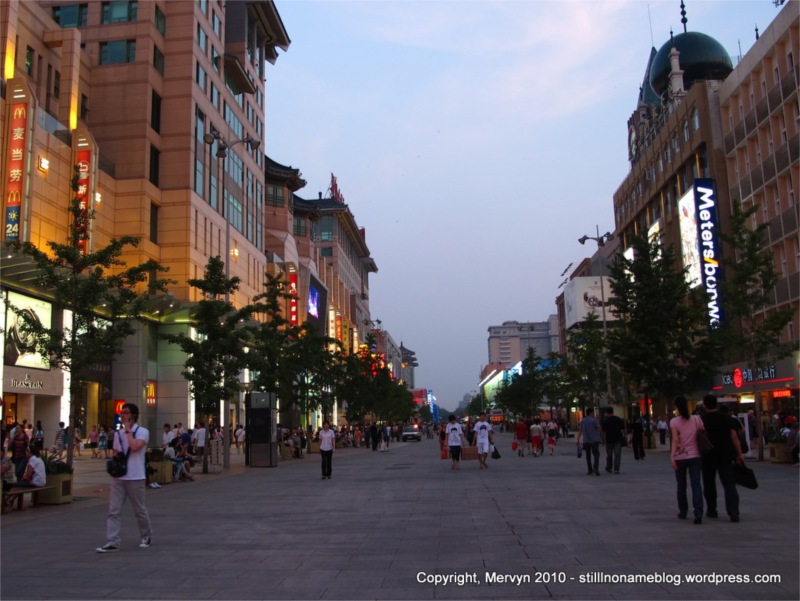
I settled in, took a shower, and headed out to meet him. Oriental Plaza is a high-end mall that would be just at home in Los Angeles as anywhere else. Haven’t seen one of these since I was in Thailand nearly two months ago. It’s a bit disorienting.
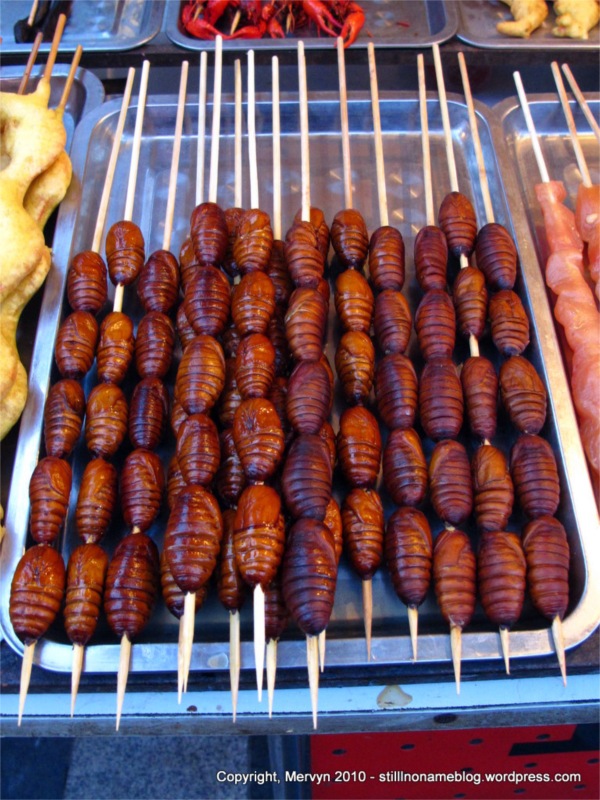
Max showed up after a stint at work and we ended up walking around Wangfujing, which, turns out, is a big tourist attraction. For Chinese people. I guess the shopping is renowned and the food alley nearby is an attraction itself. People from all around China were taking pictures of various skewered meats. Things like scorpions (alive!), sheep’s testicles, liver, grubs, and other things that I could not identify (Max had to tell me about the sheep’s balls).
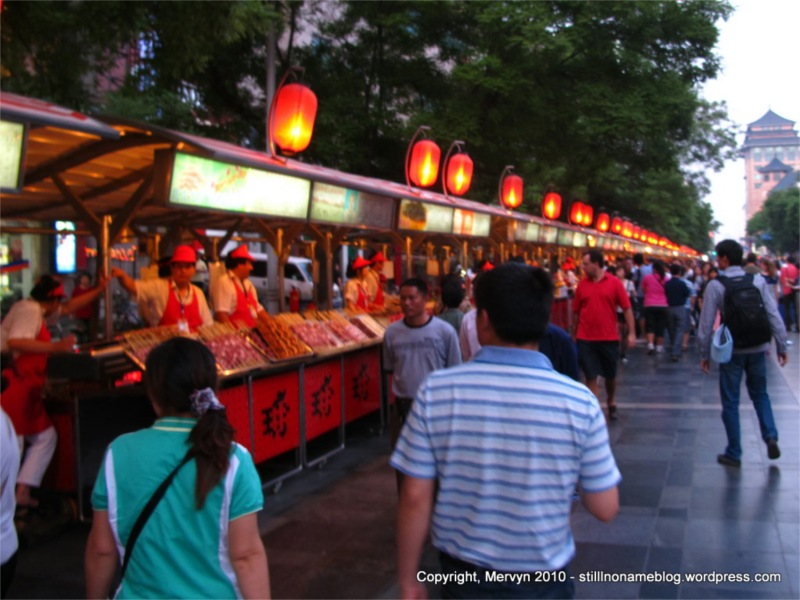
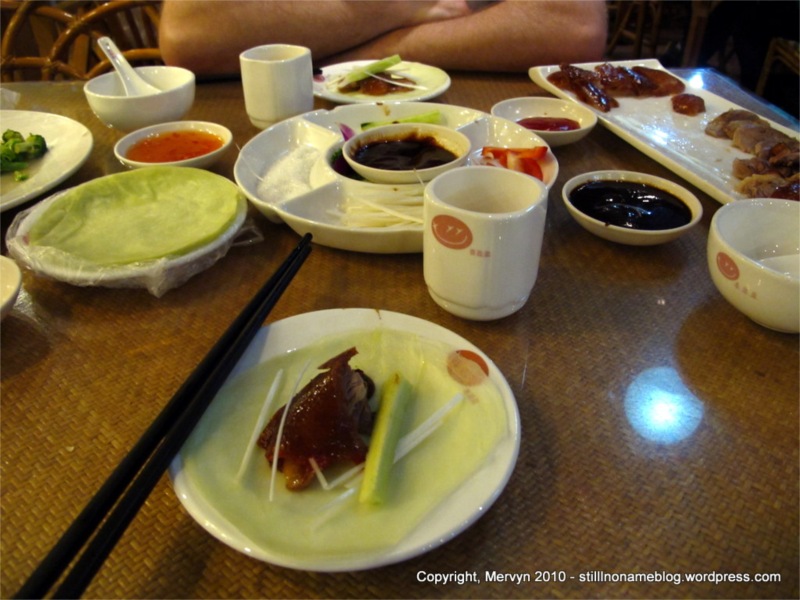
We visited his office, tried unsuccessfully to buy me a reasonably priced SIM card for my phone, and had dinner at a Peking duck restaurant. Peking duck in Peking. Love it.
Really, being in China is like being in a giant Chinese restaurant. If you want something, you have to yell at somebody to get it. Everywhere you go, things smell like Chinese food. People elbow, shout, and are Western rude. It’s awesome.
Max has been here long enough so that his Chinese is passable for day-to-day interactions. It was a trip to see my Canadian friend, who I hadn’t seen in years, exasperatedly negotiate with cell providers or yell at a waitress and place an order, all in the “shhhrrr wrrrr, nwrm nawh” of Mandarin. People kept turning to me, expecting me to carry the language load, and Max would have to get their attention and show who was the real local. I’d just end up sitting there like a deaf mute, then having to ask Max, “What did he say? How much was the SIM card?”
After dinner we met up with a few Max’s friends in the Sanlitun area, which has become the ex-pat bar hang out. The embassies are in this area, so a lot of foreign kids roamed the streets. There’s no drinking age, apparently, so we saw 12-year-old kids mixing it up with people our age. It was bizarre. When Max first visited China five years ago, the place was just some seedy bars with karaoke-quality bands serenading fat White men. Those bars are still there, but now there’s a much younger bar scene. People decked to the nines were strolling around, eating meat skewers from street vendors, playing drinking games at outdoor tables, dancing to music in small clubs, and generally cruising around doing what 20-something’s do: try to get laid.
It was intense. At one point, we were sitting there, chatting and drinking and a fight broke out in the bar next door. It was some big white guy and a Chinese dude. It lasted for over 10 minutes, which is the equivalent of a human running 5,000 miles without stopping. Usually, someone gets the upper hand within a few seconds, someone gets their ass kicked, and it’s over. Or, two people struggle until they both get tired and people break it up.
No doing here. They just kept coming back together after being pulled apart. That, despite the fact that both of them glassed each other within 1 minute of the onset and they were both bleeding profusely.
Chris and Max had seen a few fights, but they said this was the first with a racial component.
When the fight seemed over, a couple of Chinese guys would yell something and try to stir things up again. Not sure what the White guy was thinking. He’s a minority here. He’s going to lose one way or another. Short of pure preservation of one’s life, I see no reason to try to mix it up with a local. Shoot, the White guy probably couldn’t even explain “self-defense” to the cops.
Ah, the cops. They really were the best part of all this. They actually showed up mid-fight, but somehow the fracas kept going. They even seemed to disappear for a while. Chris said they don’t like to get involved. Too messy and complicated.
True to his word, the cops didn’t come in until everything had cleared out. A short, fat, donut-eating-looking guy conducted an “investigation,” walking the crime scene, staring at the ground, while his buddy cop stood around in surgical gloves trying to look CSI.
Two white guys adamantly kept trying to explain what happened to the fat cop. He just stared at them and didn’t even take any notes. I doubt he knew what they were saying.
An eventful introduction to Beijing, if I don’t say so myself. Apparently, bars don’t really close so the kids can stay out till the sun comes up. I hopped a cab back to my hostel and crashed out at 2 a.m. Can’t do it up like I could before. I’m an old man now, dawg.
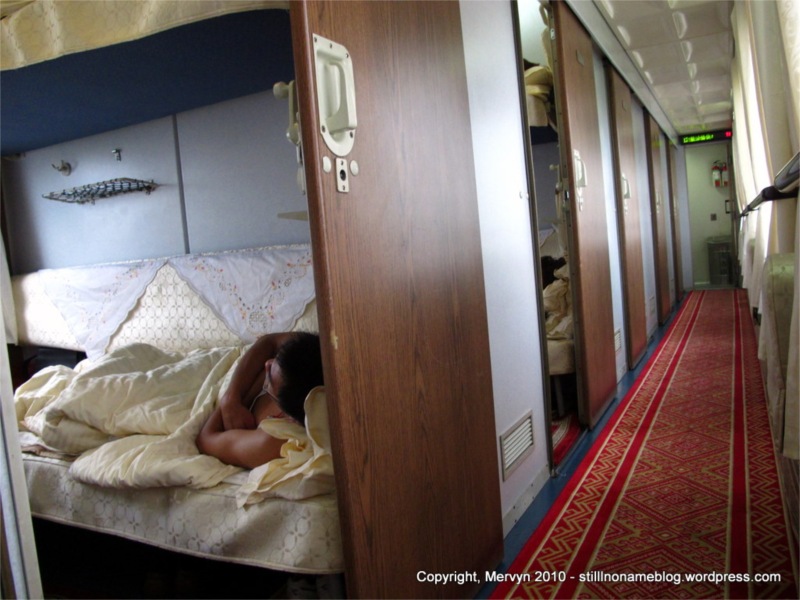
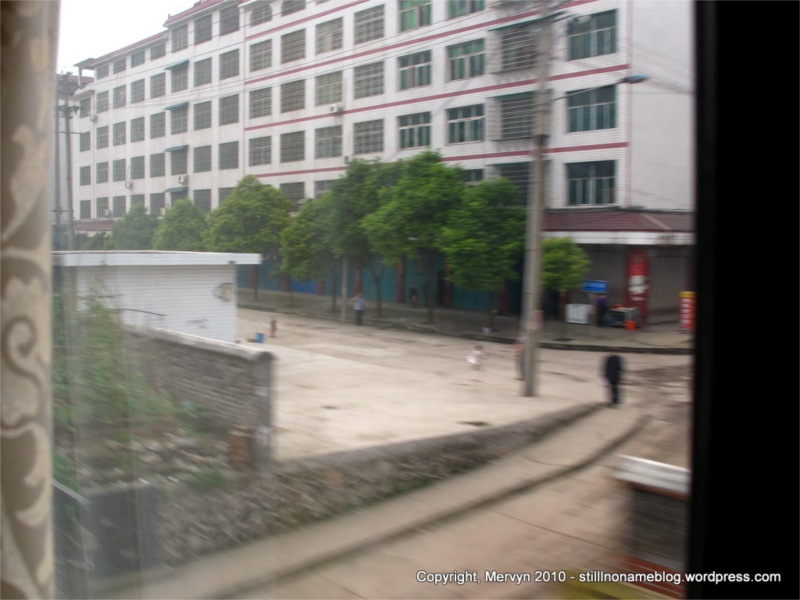
GALLERY: Click through to today’s gallery to see pictures of food, the changing scenery from the train, and a couple pics of a man who for some reason was sleeping on the floor of the posh dining car and to whom no staff seemed to pay any mind.
Dateline: Train between Nanning and Beijing, China – Thursday, June 3, 2010
I spent all day today on the train. I had a quick breakfast of instant noodles in a bowl. I stuffed two more bowls into my backpack for the train journey and hauled myself to the train station at 7:30 a.m.
I stood in line for security and immediately three Chinese people cut in line right in front of me. I girded my loins and adopted the local custom of shoving my way to the front. It’s taking more than I expected to overcome my Western desire to say excuse me and apologize for elbowing past people.
I ended up in a train car with an older guy and a middle-aged couple. All Chinese. None spoke English. I was on the top bunk and could not figure out where to sit. I ended up huddled against the wall at the foot of what was the middle-aged guy’s bed. After a while, I just crawled up to my bunk, settled my bag into the storage compartment above the door and slept through most of the morning and afternoon.
I can’t say much happened today. I sat on a fold-down chair in the sleeper car’s hallway and watched the world go by while listening to podcasts, but that’s about it. Nothing too exciting.
A few observations, though, from my second 24 hours in China:
• There are lots of block houses in China. Tall, concrete, formless, housing buildings which look like they could hold a small city. I haven’t seen this many since 11th grade when I went to former communist East Berlin or last year when I was in New York City.
• Everyone eats bowls of instant noodles on the train. There’s a dining car, but as far as I can see, few people use it. Everyone brings their own food. Much of that food is instant noodles. All the shops near the train station are heavily stocked with all varieties of the stuff. I picked mine out by color. Green and red. They were pretty. Everyone cooks their noodles using a spout at one end of the car that has hot water. I saw a train stewardess use the same spout to soak her mop. It’s supposed to be safe for drinking, though.
• People have no problem bumping into each other or knocking people’s heads with their elbows as they pass. I was sitting on the fold out chair in the hall and people would just barrel past me hitting me in the shoulder, clocking my head, or leaning into me a bit as they squeezed past. No one said excuse me. No one apologized. No one even bothered to make eye contact. It’s like I was a ghost. This happened to everyone, not just me. Guess they’ve disposed of that kind of thing otherwise, in a crowded country like this you’d be apologizing all the time. I just think it’s funny Chinese don’t seem to try to avoid contact. It’s like they welcome it. Bizarre.
• That night, our cabin traded out the middle-aged guy in the bunk below me for a mother and her daughter. She must have been three or four years old. I was sitting on a fold out in the hallway when I felt a hand run up my back. It was the little girl. She said something to me in Chinese and I smiled. She grabbed and hugged my leg and kept babbling. Then she ran off. Weird. But it got weirder. She returned and ran her hands up my thigh and rubbed my arm. I smiled and said, “Hello.” Since I’m a stranger in a strange land I had no idea if this was normal. It was creepy as hell, though. At one point she and her mother walked by and I found myself praying that she wouldn’t touch me, lest her mom think I was some kind of child molester. Can anyone confirm whether this is normal Chinese kid behavior? Please God I hope that it is otherwise there’s some scary stuff going on with that girl.
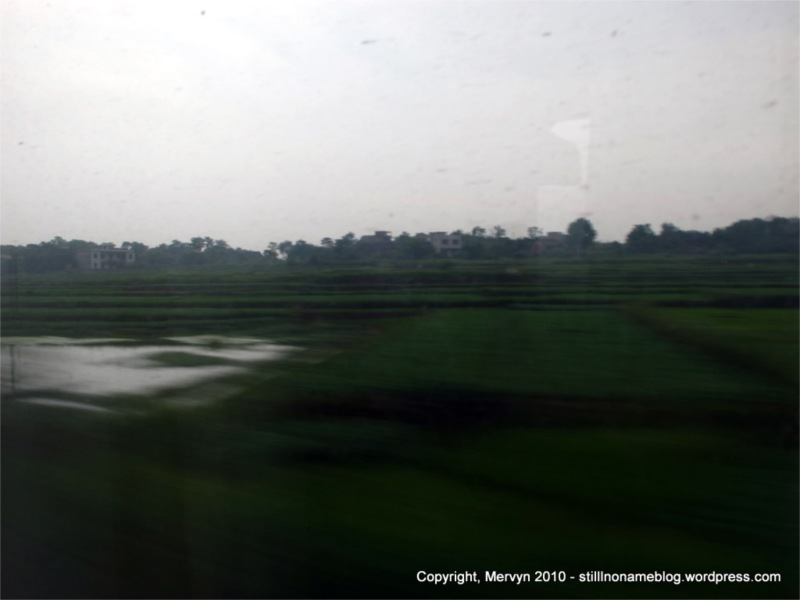
And that’s that. I slept a lot. A whole lot. There’s nothing else to do on a train other than stare out a window and watch the climate and scenery change. I love trains, though. They’re romantic in a way that buses just aren’t. You only stop every few hours or so to drop or pick up people from train stations so the trip flows almost seamlessly. You can move around, stand up, and watch actual scenery through the window, unlike an airplane. Since you can see things whiz past, you have a better sense of your progress. You can feel yourself traveling. The clickclackclickclack of the tracks gives the journey a rhythm section. A drummer providing a beat to your travels.
In the soft sleeper it was quite a luxurious trip. I’d consider this just about my favorite transport journey on my travels so far. Other than not speaking the language and the adult-molester child.
GALLERY: Click through to today’s gallery to see more block houses and a picture of a hallway.
Day 91 – I Miss Vietnam (China, Day 1)
Dateline: Nanning, China – Wednesday, June 2, 2010
Today I officially arrived in China. In reality, though, I entered China the moment I boarded last night’s train. Yesterday at 9:40 p.m., I got on sleeper train from Hanoi, Vietnam to Nanning, China. I negotiated a motorcycle taxi to Gia Lam train station which is just across the river northeast of Hanoi’s Old Quarter. I overpaid a bit, but I didn’t care. Sure I could’ve paid just a tad more and taken a proper car taxi, but I prefer the wind in the hair, unfiltered experience on the back of a motorbike to the a/c climate controlled car.
After making sure I was in the right waiting area, I took stock of my fellow travelers. They were all Chinese. I didn’t hear any Vietnamese. When I boarded the train, it was clear that all of the staff were Chinese and barely spoke English. My train ticket was in Chinese and Russian. No English in sight. For all intents and purposes I left Vietnam the moment I handed in my ticket and threw my bag onto the train.
I’d sprung $25 or so for a soft sleeper cabin which can hold up to four people. I ended up being the only person in mine. A pyrrhic victory if there ever was one because I barely ended up using the cabin.
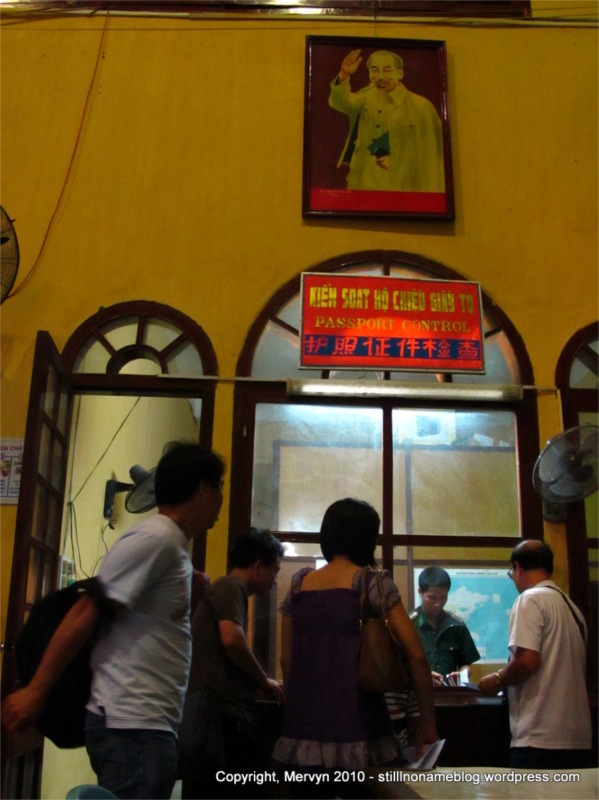
I chatted and texted on the cell phone for a bit, got cut off because of weather, and drifted off to sleep. Starting at 2 a.m. it was like a night-long fever dream. Clearing immigration on the Hanoi to Nanning train is a two and a half hour process. I remember handing in my passport to Vietnamese immigration, getting stamped out while Uncle Ho waved me goodbye out of Vietnam, getting woken up to fill out a customs form for China, getting woken up again to hand in my passport to China, dragging my luggage off to put it through an x-ray, meeting a Brit who was rock climbing his way through Asia, and being greeted by Mao into China and being told I was his favorite non-Catholic Filipino.
That last one may not have happened.
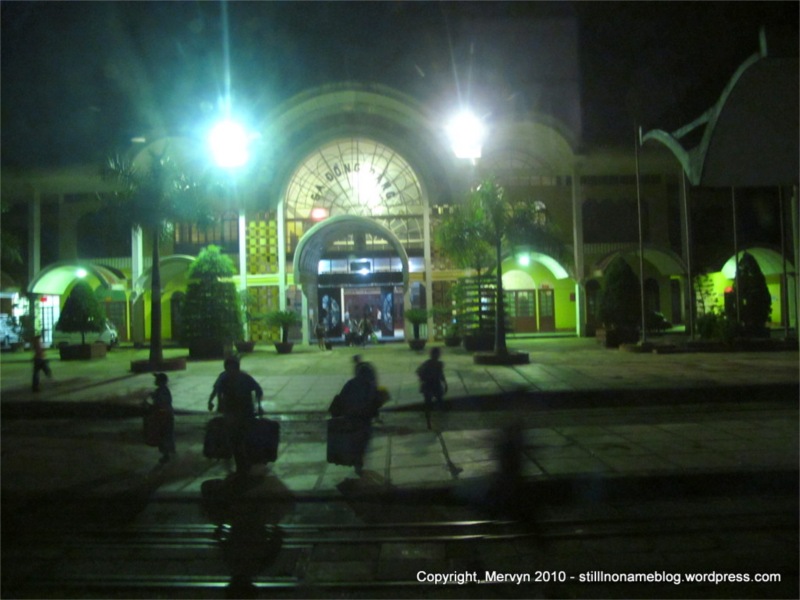
By the time 4:30 a.m. rolled around, I was doing the ugly traveler sleep face down in my soft sleeper compartment. If you plan on doing this trip yourself, consider saving a few bucks and just doing the hard sleeper. You’ll be so exhausted you’d probably fall asleep hanging upside down from the side of the train anyway.
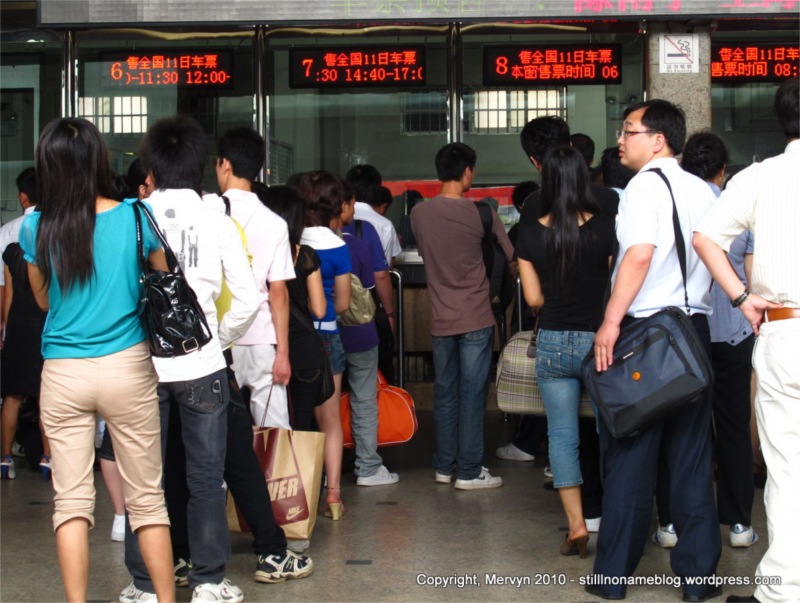
I disembarked at Nanning and ran to the ticket counter to try and get on a same-day train to Beijing. No luck. The train board was indecipherable. The only thing I recognized were the numbers and even then, it wasn’t clear whether they were times or prices. By the time I got to the front of the long line, the train was gone. The girl behind the counter looked terrified and bewildered when she used her English. “No ticket,” she confirmed, then pointed me to two prices for a sleeper and sitting car for the next day. I screwed up the local currency and mistakenly thought I didn’t have enough money—I told her I’d return. She nodded, wide-eyed.
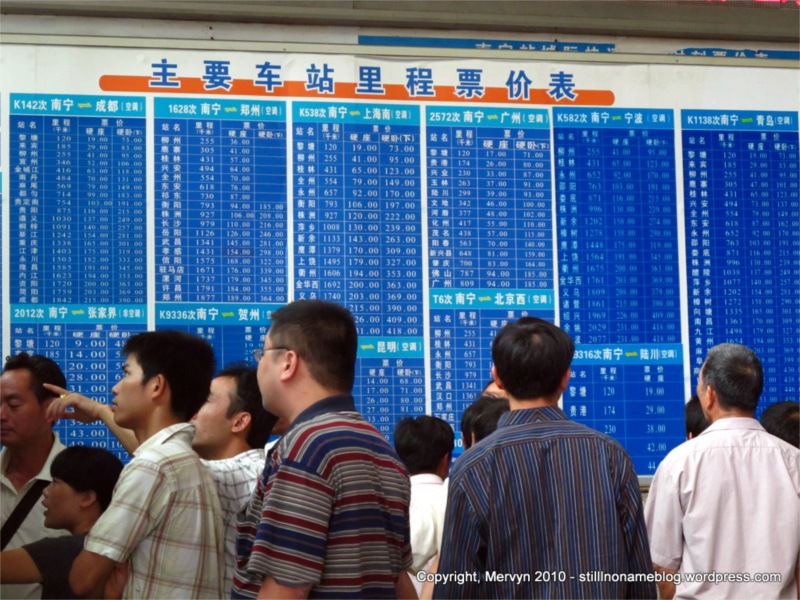
I walked outside the station and immediately noticed a few things. First off, the age distribution in China isn’t as skewed as in Vietnam. Less than 80% of the population here is under the age of thirty. It’s quite a dramatic difference after being around so many young people for my month in Vietnam.
Second, Chinese people don’t seem to wear slippers. Outside of a few women with open toed shoes, everyone was wearing shoes. This differs from Vietnam and Cambodia. It saddens me that I’ll have to wear socks for the majority of my time here. My toes need to breath.
Nanning isn’t on anyone’s radar outside of China, so far as I can tell. That despite the fact that it’s home to more than 2.5 million people (about 3 times the population of San Francisco). It’s quite modern, especially compared to Hanoi, at least around the train station. There are more cars and fewer motorbikes. Walking the main street from the train station, there seem to be fewer street hawkers and more actual shops than in Vietnam.
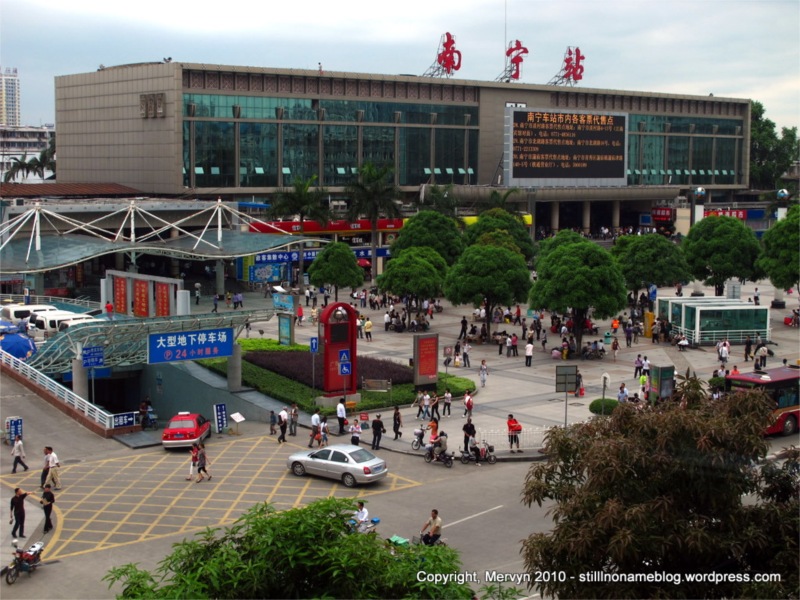
As far as the people go, they seem more serious. I’ve smiled at a few people—train station clerks, food lady at the place I had lunch, receptionists—and didn’t’ get much of a response. This is quite a change from Thailand, Cambodia, and Vietnam, where smiles seem to come more easily. If I smile, I usually get a response in kind. It’s my opener to soften people up to what is inevitably going to be an awkward interaction. If smiles have no effect, interactions are going to get a lot more uncomfortable.
I checked into my hotel and, as I walked up to my room, I passed two gruff-looking Chinese men in the hall. One cleared his throat and hawked a giant loogie onto the linoleum floor. Indoors. I’m not in Kansas anymore, Toto.
I got to my room and crashed, my body trying desperately to make up for the previous night’s non-sleep. For some reason, someone—perhaps from the hotel—kept calling my room every 30 minutes. They’d repeat something over and over again and I’d just lamely say, “I don’t know. I have no idea what you’re saying.” I wanted to bash the phone into the table and yell, “Lady, just because you say it over and over again, louder and more slowly, doesn’t mean I am going to understand you. Please, for the love of God, please stop calling me. I need sleep.” Instead, I just stopped answering the phone.
That wasn’t the only interruption, though. For some reason, people kept confusing my room for their own. This is remarkable because my room was the last one at the end of a long long hallway.
Twice, people tried repeatedly to use their keycards on my door. The first guy, I answered and he looked confused and embarrassed. The second, I just sat there and listened to them struggle. All of a sudden, the door swung open and I was staring at a whole Chinese family. The lead guy immediately apologized, (I think) and I got up and closed the door.
Unable to get any decent sleep, I headed back to the train station to buy a ticket to Beijing. I ended up talking to the same girl from the morning. When I asked for the sleeper she said, “No ticket, only sitting,” for tomorrow’s train. Thirty hours in a sitting car sounded like crap, but I desperately wanted out of Nanning. I plopped down the money. Then, on the off chance, I asked, “Is there a soft sleeper for tomorrow?”
“Soft sleep?” she asked, eyes bulging. I nodded, and she looked surprised. Guess she thought I couldn’t afford a soft sleeper. It ended up costing me $120 bucks, but I wouldn’t have to spend a day and a half hugging my backpack trying to fall asleep on a hard bench. Well worth it, I thought.
Finally, a few notes on Chinese TV. First, there is only one TV station in English and it appears to be government sponsored. One show spent half an hour with the Chinese host asking two vacuous Westerners why people kept pets when “there are starving people around the world.” The questioner appeared to be Chinese.
Proving once again that people on TV are mostly idiots, the German guy and the hapa American who’d grown up in China couldn’t give an easy to understand answer. “Companionship. . .teaches kids responsibility. . .pets are fun,” all floated around in various forms. The closest one which still left a lot of gaps was the lame “Pets makes people happy. . .”
My answer is this: The premise is flawed. Why do people do anything other than feed the poor and help the needy? Why got to a restaurant, buy a TV, wear nice clothes, put on makeup, or perhaps even have kids? Because it gives them something they need or enjoy. People have their time and their money and they choose to spend it how they will. For whatever reason, people determine that certain activities and possessions make their lives better in a way that helping poor people does not.
Harsh but realistic, I think.
Enough of that. Tomorrow I board a train for China. With lots of Chinese people. With questionable bathroom facilities.
Bring it.
GALLERY: Click through to see more pictures of Chinese people and Chinese signs, a view from the Hanoi-Nanning train, and another pic of the Nanning train station.
Day 90 – Cha Ca in My Maw (Old Town Hanoi)
Dateline: Hanoi, Vietnam – Tuesday, June 1, 2010
Today was my last day in Hanoi. That meant running a few more errands and cramming in a few things I hadn’t fit in before.
On the errands front, let me just say that it’s damn near impossible to find a place that sells contact solution. I’ve spent the last few days popping in and out of pharmacies, grocery stores, convenience stores, cosmetic shops, and anywhere else where I might find eye care products. Sometimes they have eye drops, but they’ve never had cleaning solution.
The only reason I found some is because I stumbled on a prescription eyeglasses store and popped my head in to ask if they knew where I could buy lens solution. The lady happened to have two bottles in stock and happily sold me one.
So kids, next time you’re in Vietnam and run across a bottle of solution, just buy it. Who knows when you’ll see the next one.
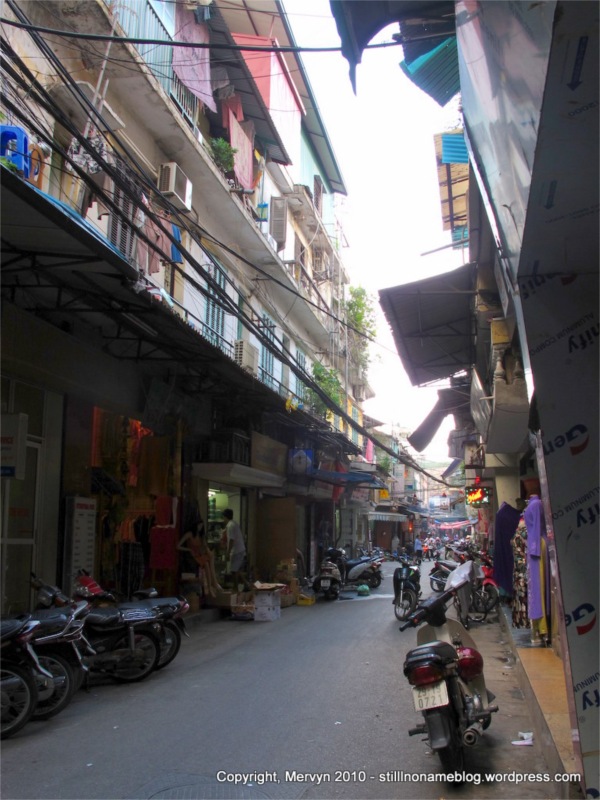
In other news, I did a more deliberate exploration of Hanoi’s Old Quarter. I’ve been staying here for a few days and have wandered, but I haven’t really done a self-guided tour. The area is known for having specific streets that sell specific items. For example, one street I came across sold paper lanterns and other red and gold regalia. Another sold gravestones. One near my hotel sells kids’ toys and another sells slippers and sandals. We’re talking random stuff here.
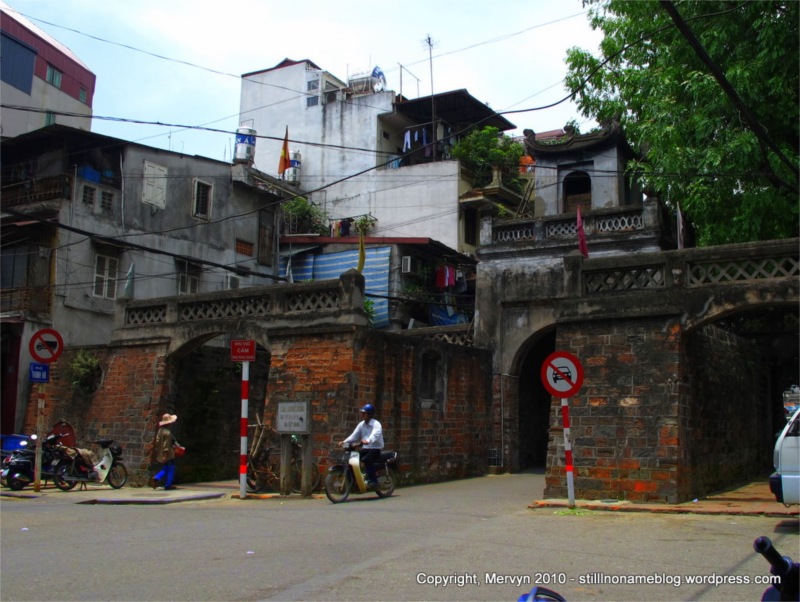
The beauty of these streets is that there’s always something interesting to see. You’ll be walking along and the street will collapse into a little alley then broaden out into a larger avenue, almost without rhyme or reason. At one point, I came across an old gate that had been part of the old city. It was just sitting there, like it was normal to have a parapet next to a few shops.
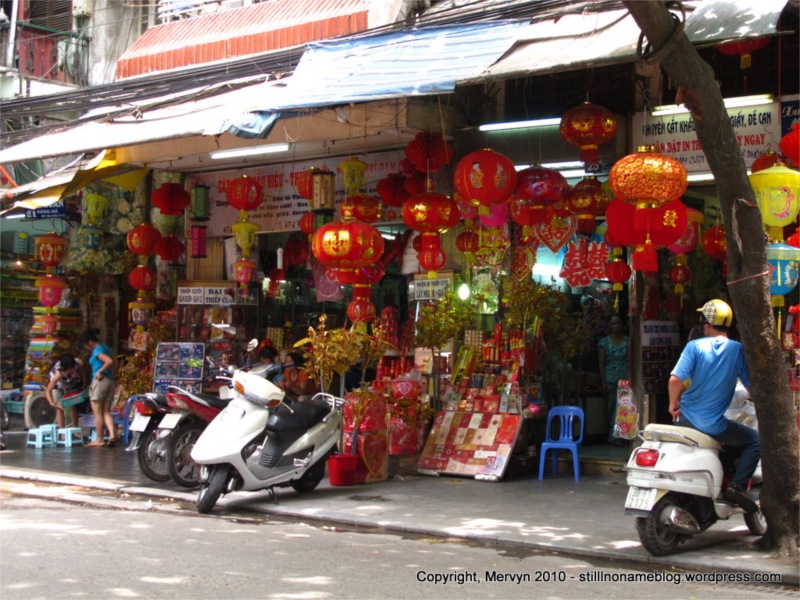
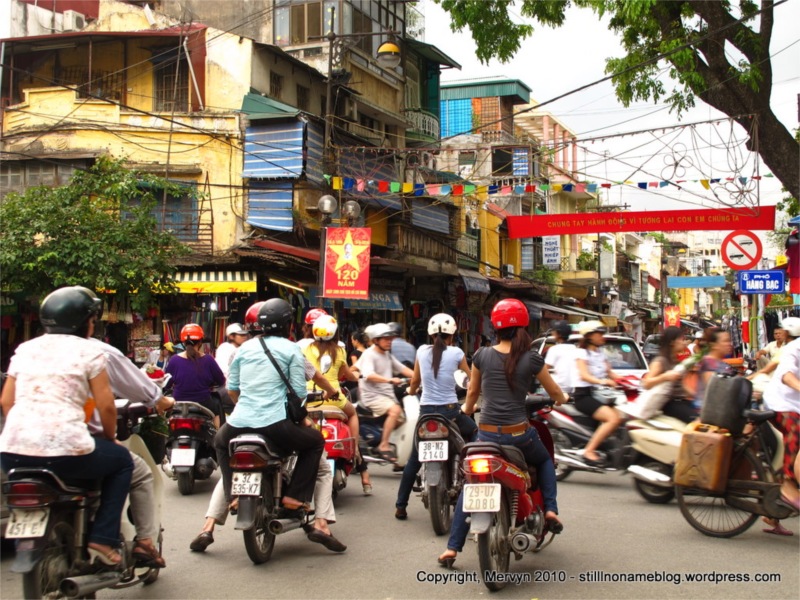
As you move through the streets, you’re reminded that this isn’t just a tourist attraction. People actually live and work here. The number of travel agencies and English-named restaurants thins and you’re suddenly in little warren streets that are clearly neighborhoods. It’s a nice change of pace.
I ended up eating lunch at Cha Ca Thang Long, a restaurant famous for its cha ca, which is filleted fish, grilled at your table, mixed with a mess of herbs and peanuts. This restaurant is the more casual sister to Cha Ca La Vong, which I’ve heard tends to draw bigger crowds. A friend pointed out that this made someone’s “1001 Things You Must Do Before You Die” list. That may be high praise, depending on whether you think 1001 things is a lot or not.
I barged into the air conditioned restaurant after a 1 hour walking tour of the Old Quarter. I must have looked like death sweated over. I asked for a table for one and immediately became a curiosity. Everyone was there in groups besides me. Not the first time.
Of course they thought I spoke Vietnamese, but when it became clear that I was a foreigner, they decided to give me some help. Cha ca is a self-assembled dish, so a young guy with an affect flatter than a two-day-old glass of Sprite wordlessly put together my first bowl. The drill: some rice noodles as a base, a heaping amount of raw herbs, the fish and the herbs from the grill, some peanuts, then a drizzle of sauce (with peppers, if you prefer).
I’d read a couple of reviews online and they ran the gamut of “overpriced, horrible” to “awesome, great value.” First off, I don’t think it’s overpriced. You’re paying less than $5 (80,000 dong) for a specialty. Cha ca is the only dish on the menu. I’m sure you can get it cheaper, but you’ll have to hunt it down.
Second, the food is good, so long as you like herbs and fish. I have a soft spot for fresh vegetables and herbs and meat, dating back to the first time I ever ate Vietnamese at a classmate’s house in high school. The crunch of raw veggies and the soft saltiness of the meat is one of life’s perfect combinations.
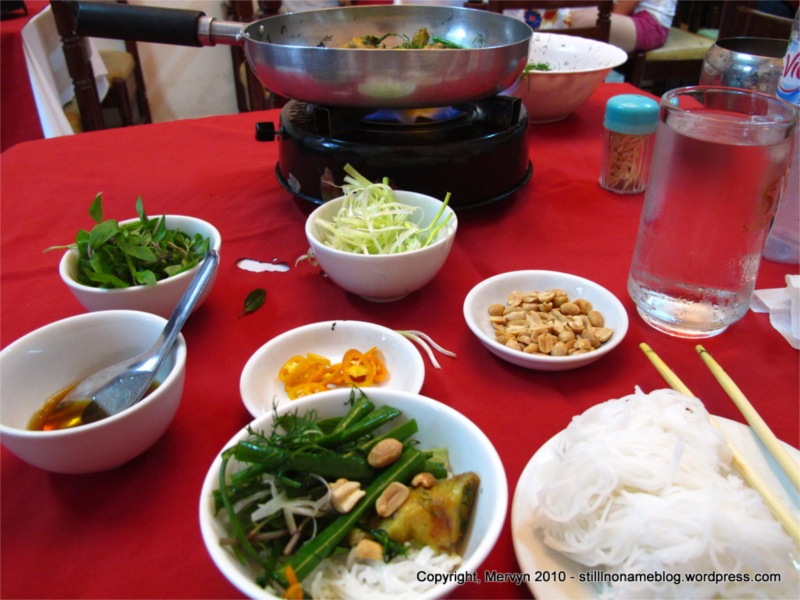
Cha ca has the added benefit of being a bit lighter because of the fish. The peanuts are key to the dish, because they add an extra crunch and a bit of nutty flavor (surprise!). The fish is cooked in oil, which I think is a bit spicy, so there’s some bite. The rice noodles add a softness to it and provide a silkier texture than plain steamed rice.
I liked it. I’d definitely eat there again. It’s definitely a group eating place, though. Like Korean barbecue or hot pot, it’s probably much better with a bunch of people grabbing and assembling their food while chatting and throwing back a few.
Not sure it would make my “1001” list, but it definitely would make my “Fun Things to Eat with Friends” list. If you’re in Hanoi, I say give it a shot. Just know what you’re getting yourself into.
I spent the rest of the day wandering the Old Quarter streets, trying to kill time before my 9:40 p.m. train. I’d checked out of my hotel before noon, so I had no place to go to just sit and relax without paying. I ended up going to a local burger joint and hanging out over dinner until the power went out on the block and the café turned into a dark hotbox.
Quick shower at the hotel, courtesy of the kind owner of Thuy Nga, a change of clothes, and that finished off my time in Hanoi. As I sat in the hotel lobby, I realized that one thing I’d miss about Vietnam was the food culture. Every street, almost no matter where you go, there are people grilling meat, selling halo-halo like drinks, dishing out bowls of pho, or chopping up dried squid. Locals will just plop down on little six-inch plastic stools, sometimes spilling onto the street so they can hang out and eat. It’s fantastic.
As I was thinking this, two girls sat down and ordered food at the street-side food shop, sat down on the side of the road at a table, and had a meal. I have a feeling I won’t see much of this in China. I get the feeling the six-inch stool is uniquely Vietnamese. It’s too bad, too. They’re more comfortable than you think. And they make you feel like a towering giant which, for a guy who didn’t break five feet until his sophomore year in high school, is just awesome.
Time ran out on Vietnam. I grabbed a motorcycle taxi and soon was on the train and off to China. Good times. I can only hope China’s half as good.
GALLERY: Click through to today’s gallery to see more pictures of the Old Quarter, cyclo taxi drivers waiting to snag tourists, and an extra pic of people eating food at kindergarten stools.
Day 89 – Errands and Desserts
Dateline: Hanoi, Vietnam – Monday, May 31, 2010
Today was a Errand Day, which meant I wandered around town looking for laundry detergent (easy success), contact solution (epic fail), an inexpensive China guidebook (success/fail), and writing and mailing postcards (success). Since I didn’t rent a motorbike, this took the whole day. I walked around and sweated a lot. I did nothing you want to hear about.
With that in mind, I took to writing a more abstract piece about my experience here in Vietnam. I got 1,500 words in and realized it wasn’t working. I’m exhausted now and can’t bring myself to either rewrite it or try my hand at something else. So, instead of something conceptual you’re going to get something incredibly concrete: what I had tonight for dessert.
For dinner I opted for a street hawker bowl of pho. Tasty, delicious, all while sitting at a low metal counter on what, in the U.S., would pass for a six-inch tall plastic foot rest. Food is partially context and the whole thing came together nicely. Tell me where, at home, I could have a meal like this and I’ll buy you lunch at Boulevard.
Afterwards, I decided to splurge. I dropped in on one of the pricier restaurants in town, Green Tangerine. I’d come in earlier in the evening to check out their menu but decided not to go for a full blown meal. It would have cost me a full $20 and I wasn’t in that spendy of a mood.
Instead, I swung by for dessert. Nothing on that list more than $6, so I could keep my wallet relatively safe.
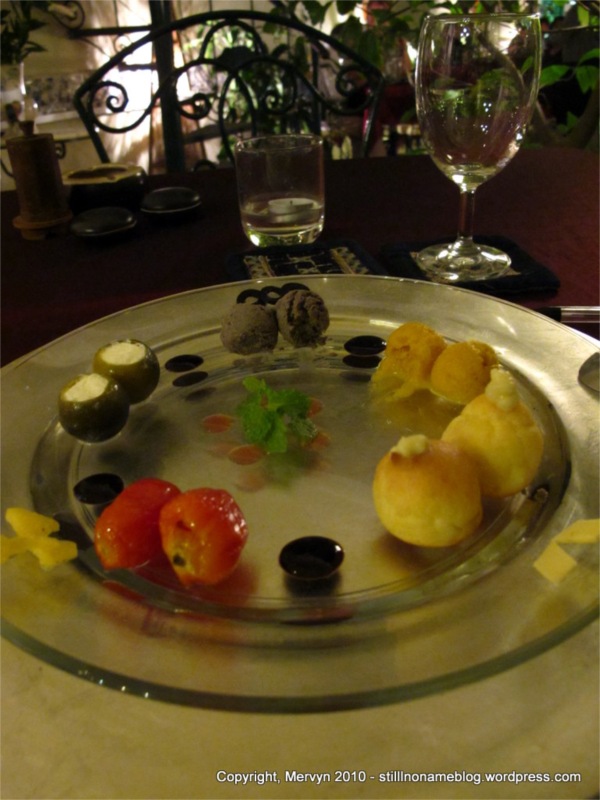
I skipped the dessert medley when the waitress told me it was a collection of standard faire (creme brulee, cake, etc.) and opted for the weirdest thing on the menu. Something called the “Eastern Necklace.”
Now, here’s the part where I wish I’d written down what the menu said I was getting instead of going from memory. What came out was nothing like I expected. Five pairs of little circular objects. I was so confused I asked my waitress if my order was correct. I’d thought I’d be getting some pineapple curry concoction. Nope, this was it. The pineapple things were two little yellow balls. So, let’s review what I got, keeping in mind this is partially from memory and partially what my faulty palate tasted.
Starting from the top of my plate: Two purple-looking balls that the menu said were honey sorbet. Two yellow balls of pineapple blended with curry. Two cream puffs paired with slices of ginger. Two cherry things paired with slices of pineapple. Two kumquats stuffed with ice cream.
I’m all for being daring, but, as a whole, the plate was a bit of a mess. The purple balls didn’t taste much like honey (why were they purple?). The cream puffs were a bit soggy. The pineapple curry things were tepid both in flavor and in temperature and they had the consistency of fibery rice paste. The kumquats were very close to being good, but were so sour, the ice cream stuffing couldn’t overcome the mouth searing finish. The two cherry-like things were the best, but that’s because it felt like little had been done to them, which isn’t good considering they were supposed to be soaked in cognac (I think). This was no Mango Rooms experience.
In the end, I spent five times what I spent on the bowl of pho. I did not get five times the value. In fact, I’d say the pho was five times more satisfying than my dessert.
Oh, well. This being Southeast Asia, I didn’t spend too much. Six bucks was a relatively minimal risk. I’ve paid more for worse stuff back home.
On the other hand, it’s about half of what I paid for my hotel room. Yikes. To make myself feel better I’m going to grab another bowl of pho.
GALLERY: Click through to see random pictures of Hanoi’s Old Quarter which Mervyn took while running errands.
Day 88 – How You Must View Ho Chi Minh’s Body
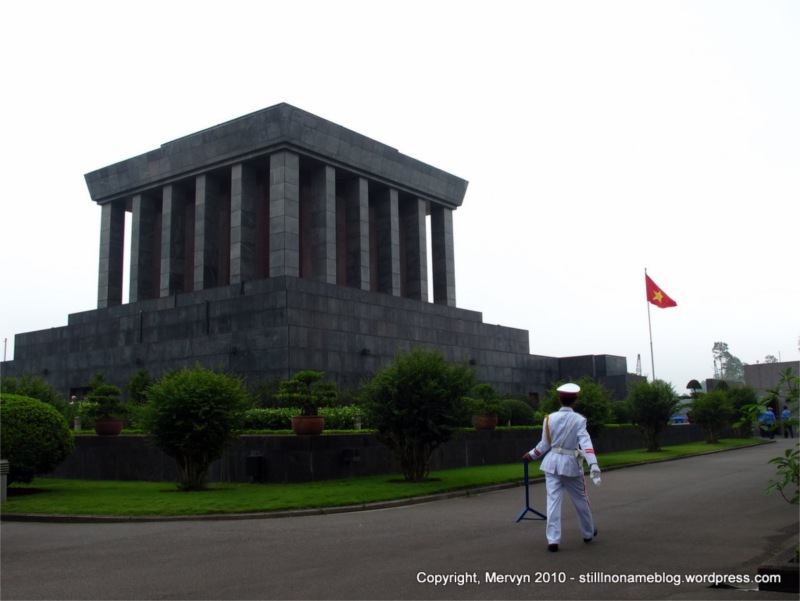
Dateline: Hanoi, Vietnam – Sunday, May 30, 2010
Somehow, today was my first day on a motorbike in Hanoi. As with my other motorbike experiences, I had a blast.
I hit up Uncle Ho first. Because of my misadventure at the mausoleum a few days back, I knew I had to get there early. I arrived promptly at 9 a.m. and parked the motorbike in a lot on the mausoleum complex. That’s when I realized that I should have tried to get there even earlier.
It being a Sunday, the Vietnamese tourists were out in force. I barely saw any Westerners in the throngs. The line was somehow even longer than when I’d been there with Michelle and Ruben.
It took an hour and a half to get to Ho Chi Minh’s body (or wax replica of his body, if you believe conspiracy theorists). That may seem like a long time, but that’s actually not bad considering how many people were in line. It gave me a lot of time to observe the Vietnamese tourists.
First thing I noticed is that many of the kids were dressed up, especially the girls. Three-year-olds were in satin or chiffon dresses. This, despite the stifling heat. I couldn’t tell if it was just because we were all visiting the corpse of Vietnam’s George Washington and Thomas Jefferson combined, but it was remarkable.
Second, Vietnamese people have less of a taboo about cutting in line. Guards tried to keep people orderly, but the locals kept sneaking in whenever they got the chance. When the line had to break because it crossed a drive or walkway, guards would have to yell at people and physically remove them because they’d tried to slip in.
Other people would just march up through the line like there was no one in front of them. No one seemed to pay them much mind. Kids kept walking up the sides of the line because their little bodies could fit in the small gaps. Inevitably, a parent would be a few seconds behind following the lead block of their child–wouldn’t want to separate child from parent, after all. Just let ‘em through!
Vietnamese people also seem to have no problem shoving you aside if they want through. I kept feeling people press their hands into my back with the back of their palms or their open hands. Most of the time there’d be no shove, just light pressure. Even more often, people would swim move past me using their elbows. Small children would stiff-arm their way past my hip as if they were LaDanian Tomlinson before the wheels came off.
It wasn’t just me. It was Viet on Viet, too. If I didn’t keep actively pressing forward, I’d get passed. At one point I was walked behind two older Aussie ladies until I realized they were falling back in the line because they weren’t actively pressing forward. I ditched their shadow and joined the flow of the rest of the line.
This is just a preview of China, I’m sure. I’ve heard queue etiquette there is even less existent.
So, how was Ho Chi Minh? Well, he looks good for his age, considering that his age is “dead.” I can see why some people think he’s wax. He almost looks too good.
A tip on viewing the body. You want to be on the left side as much as possible. The circuit around the body goes counterclockwise and the left is the inside track. The guards will put the kids on the left side in a special line so they can have an unobstructed view. You should try to mimic them to try and achieve the same effect.
There’s an added bonus to being on the inside: no shoving guards. That’s right. If you’re on the outside, you’ll be in reach of the guards who, in an effort to keep the line moving, will literally pull you along. Swim to the middle if you can to avoid men in dress whites grabbing at your arm. Unless you’re into that kind of thing.
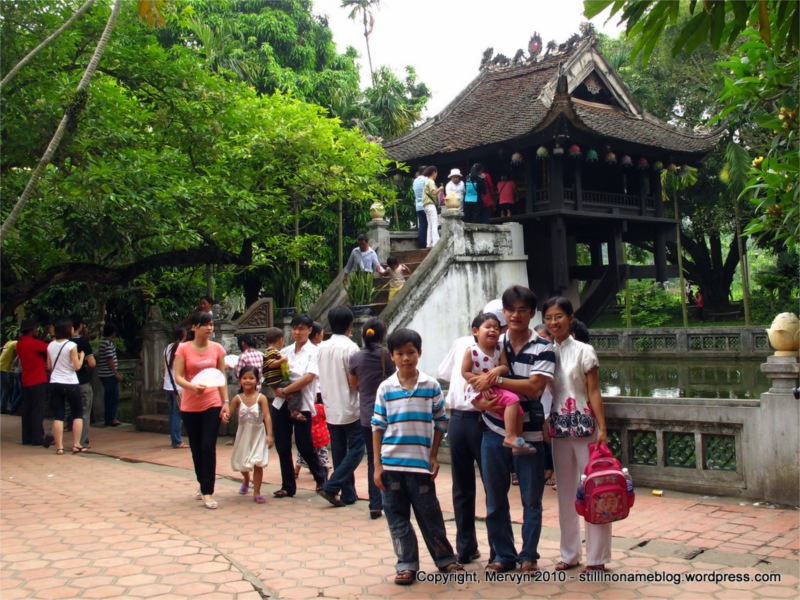
The Ho Chi Minh Mausoleum complex also contains the One Pillar Pagoda, the Ho Chi Minh Museum, and a stilt house that once served as his residence. The One Pillar Pagoda is just that: a pagoda on one pillar of concrete. Originally built in 1049 to resemble a lotus blossom, the colonial French destroyed the original in 1954 just as they left Hanoi. The new Vietnamese government rebuilt the pagoda, which was intended to honor Am Bo Tat, the Goddess of Mercy, who reportedly gave Emperor Ly Thai Tong a male heir.
The One Pillar Pagoda looks like a bit like a birdcage on a stand. It’s pretty, I guess. It is not a highlight of this trip.
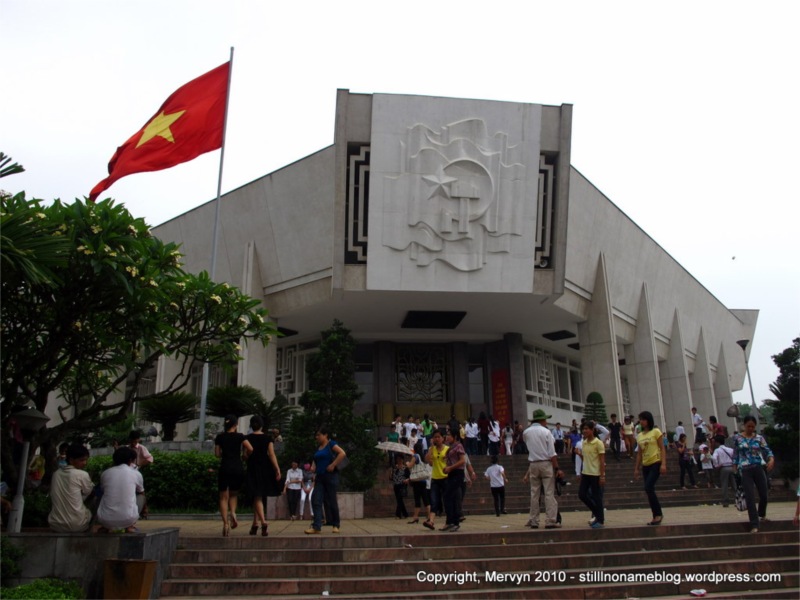
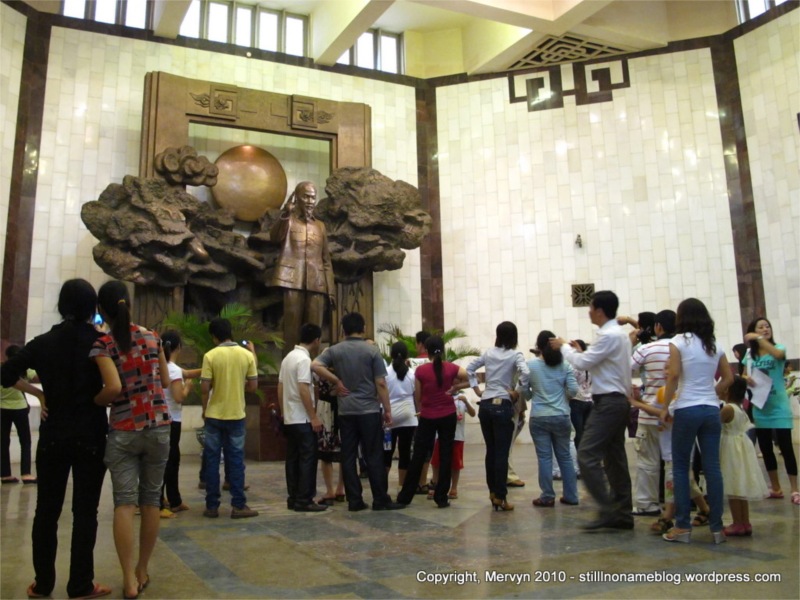
The Ho Chi Minh Museum is a bit surreal. I skipped all the historical stuff and headed upstairs where there’s a big statue of the man himself, just in case you haven’t seen what he looks like since you’ve been in Vietnam. There are also modern art depictions of various events associated with the man. They are very symbolic. So symbolic that they’re indecipherable.
There seems to be inadequate air circulation in the museum. As you know, this greatly affects my enjoyment of a place. Sadly, this was true for this museum, which could have been fun what with all the strange art. Given the conditions, though, I hustled through and headed out of the complex.
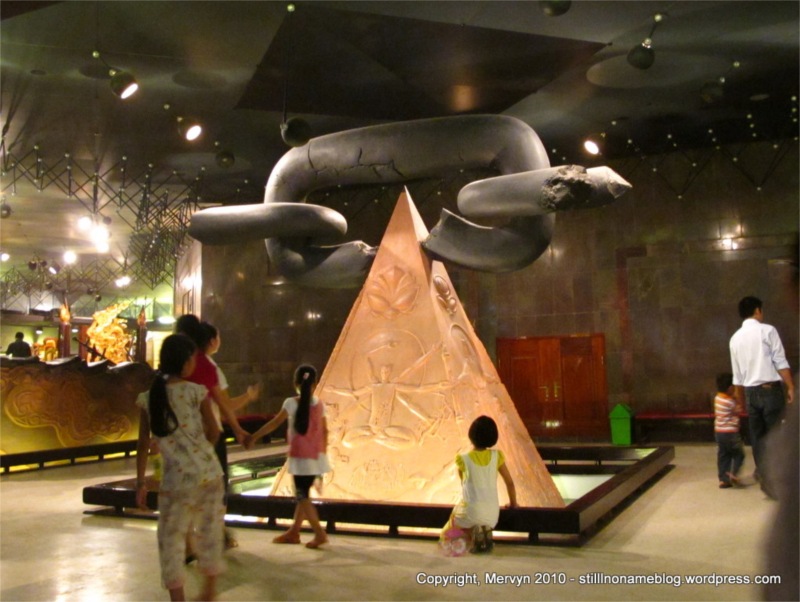
I was hot and just HCM’ed out enough that I skipped the stilt house. Oh well.
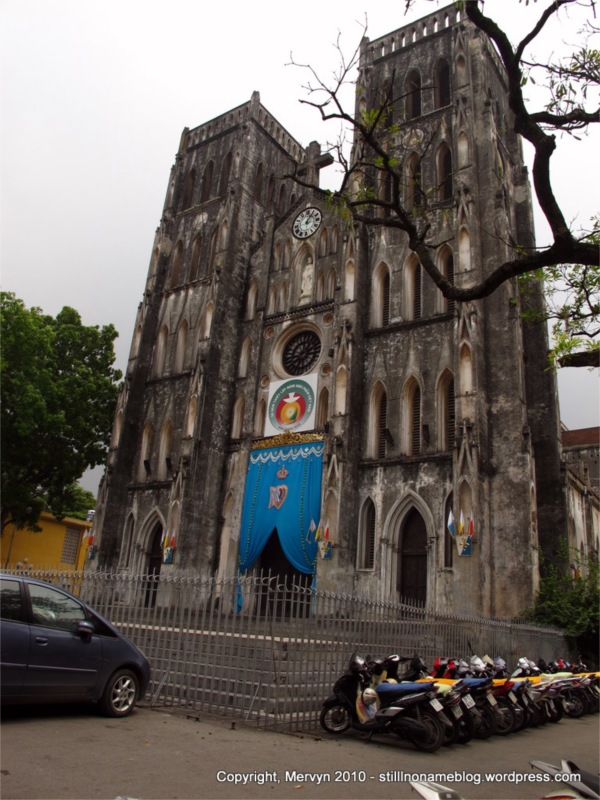
From there, I put my motorbike to good use by buying a train ticket to Nanning, China at the train station, visited a café near St. Joseph’s Cathedral, then hit a movie on the south side of town.
Yup. I indulged myself and saw Iron Man 2. A quick review: it didn’t suck. That may not seem like high praise, but I intend it to be. It should have sucked. The trailers suggested that there were going to be too many new characters, too much mindless action, and too many subplots. It felt like the previews to Spiderman 3.
Iron Man 2 worked, though. As a popcorn flick, it moved and kept me interested. It never felt slow or belabored. The dialogue was snappy and Downey nailed Tony Stark once again. Mickey Rourke was menacingly effective, a feat considering that the only thing that still moves on his face are his lips, and those just barely.
Hopefully, the next sequel pares down the cast a bit. If there’s even one more new character this thing will die of bloat.
I read that Ho Chi Minh wanted to be cremated and his ashes scattered over anonymous rice fields in Vietnam. Now he’s better preserved than a jar of pickles encased in amber. Tourists come the world over to gawk and the debate the authenticity of his corpse. What a way to go, no?
Made me think that I should get my death orders straight, so let me take the chance to get this in writing. If you can find my body, cremate me. The scatter me somewhere random. Maybe in a garbage dump or somewhere over the Pacific.
If you feel you have to put me somewhere I’ll be “close,” then sprinkle me in the garden in the family backyard where you’ll grow crops from my remains and eat me during dinner someday. If I’m going to be close, I’d like to be real real real close. Otherwise, cremate and scatter.
If you can’t find my body, don’t spend a ton of money looking for my cell bits. Hell, don’t spend any money on a search. My body don’t care. Leave me there to scare some hikers a few years from now. The thought of that more than outweighs any sentimentality I might feel about me being “found.” In fact, it’ll brighten up my last few moments of consciousness.
Whew. Wasn’t that fun? No?
Then go see Iron Man 2. It probably sucks less.
GALLERY: Click through to today’s gallery to see more modern art, coffee and a café, and more pictures of the birdhouse pagoda.
Day 87 – Water Puppets Are Awesome
Dateline: Hanoi, Vietnam – Saturday, May 29, 2010
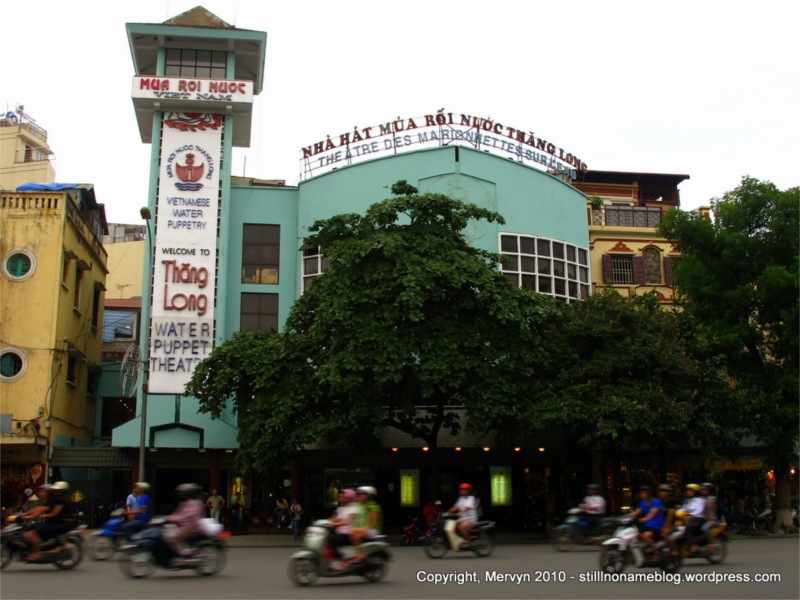
Today was the first day I’d be traveling alone since Hue because Michelle and Ruben were headed to Sapa. I decided to book a seat at that night’s water puppet show. Just another wild Saturday night for me.
I spent the day writing and doing errands. As night fell, I grabbed dinner then hit the puppets at 9:15 p.m.
Turns out water puppets are awesome. Hey, I’m as surprised as you.
The art of Vietnamese water puppetry supposedly grew out of the rainy season. Farmers would use the flooded rice fields as a stage for entertainment. The wooden puppets usually depict humans and animals and most have articulated limbs. The mechanisms that control movement are hidden in the murky water. Some puppets are attached to underwater poles while others sit on floating platforms and are then attached to poles. Most of the time, the puppets appear to float on the water.
Sounds like a recipe for a good time, right?
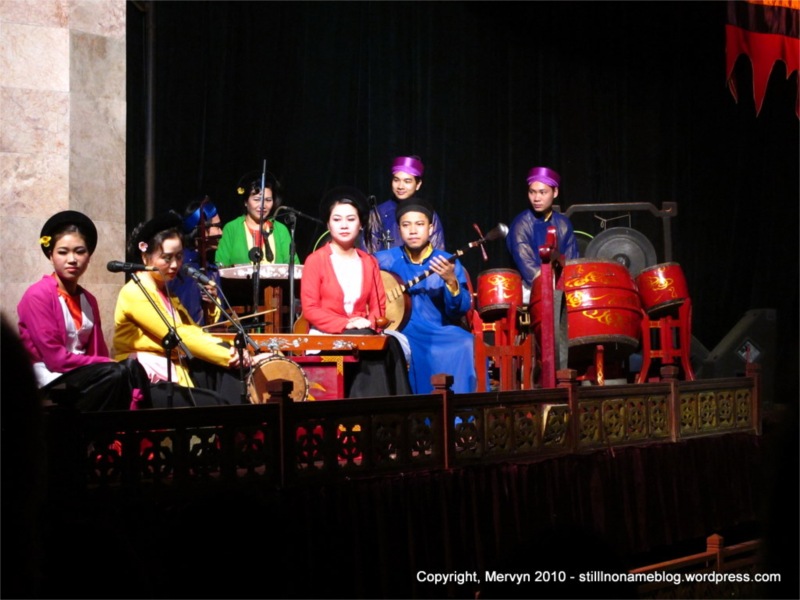
The theater darkened over the water stage and the Vietnamese musical troupe plied us with a traditional (I think) tune. I couldn’t take my eyes off the lady playing a weird Vietnamese one-string instrument called a dan bau. I couldn’t understand how it worked. The lady sat at a long wooden instrument with a wooden bulb on one end that had a twisted wooden stick jutting out of it. Her left hand wiggled the stick left and right while her right hand seemed to pluck at spots in the air. I could only make out the sound of the instrument when it had a solo. Otherwise, I couldn’t match any sound to her movements. I want to play with one so badly. I want to understand. The musical part of my brain demands it.
Then the puppets came on. They’d run through a short vignette accompanied by the orchestra. The puppeteers would provide voices while the females in the bad would act as the chorus, often answering what the puppeteer or narrator said. At least that’s what I think was going on—it was all in Vietnamese.
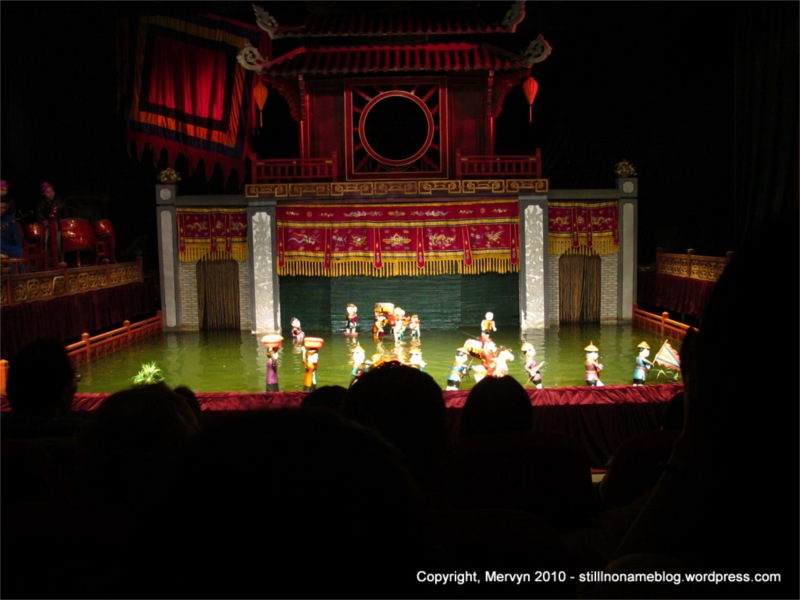
The best part was watching the puppets move through the water. As primitive as the articulation is on the puppets, they move surprisingly lifelike. The fish puppets moved like fish. You’d swear if you threw a lure into the water, you’d pull one that you could take home and grill and eat.
The dragons in one vignette chased around a ball in the water, batting it back and forth. At one point, a puppet caught a fish while standing on a boat. One second, the fish puppet was swimming in the water; the next it was on the human puppet’s hook. Creatures would emerge from the murky water. Puppets paraded around the edge of the pool. Boats would bob in the water as if buffeted by waves. Human puppets would swim through the water paddling their arms.
Who knew you could do so much with wooden puppets? This is all the more remarkable considering some of these things weighed over 25 pounds.
All the while the band played along in perfect time, sometimes providing sound effects for the action on the water.
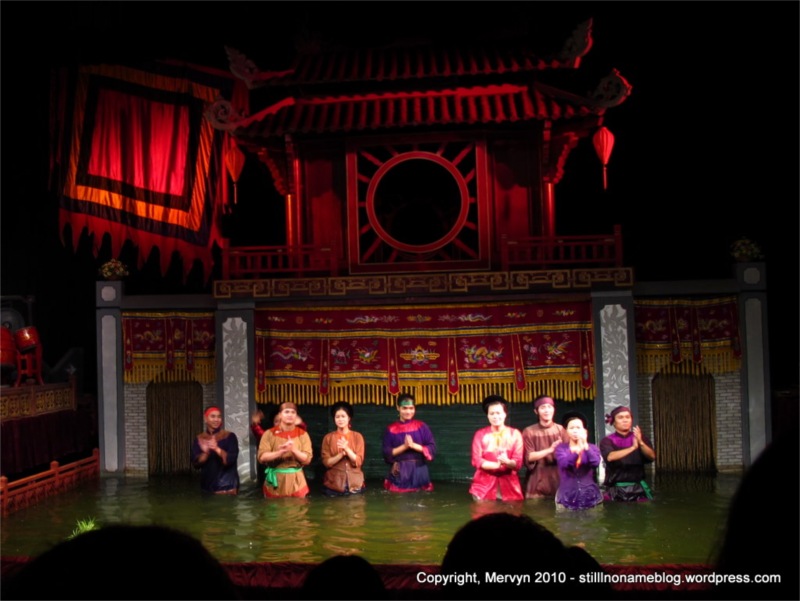
When the show was over, the puppeteers emerged from behind the partitions to receive their applause. I was surprised at the depth of the water, which was nearly waist high. Back in the day, I guess puppeteers would often suffer from waterborne diseases. All the ones at this show wore hip boots, presumably to prevent worker’s comp claims.
Best of all, the show’s not that long. It actually leaves you wanting a bit more, which is the sign of good entertainment. It doesn’t wear out its welcome.
The kids loved it, too. You could hear kids oohing and aaahhing along with the adults. One little French girl kept running up to the edge of the pool to lean over to get a closer look. Her dad kept having to retrieve her when she started to lean over into the pool.
Best of all, it cost only 60,000 dong ($3.05). That’s some good value for the money. There are shows that run frequently in the afternoon. Pick up your tickets early in the morning so you can get good seats. If you’re taking pictures, the best seats are probably a bit to the right of center in the second or third row. From there, you could probably take pictures of the puppets with the band in the background.
Be sure to pick up a free program from the stand by the entrance to the seating area itself. It explains what’s happening in each vignette. I wish I had.
Even then, I had a good time. Next time you have a chance to spend Saturday night with some puppets, I say go for it. Just be sure your puppeteer rubbers up beforehand; no sense in having disease on your conscience just so you could watch.
GALLERY: Click through to see close-ups of puppets, pictures of traffic, shots of a martyrs’ memorial with an adjacent big board counting down the days to Hanoi’s 1,000th anniversary, and pictures from one of Hanoi’s night markets.
Day 86 – Review of Vega Travel’s Halong Bay Tour
Dateline: Halong Bay, Vietnam – Friday, May 28, 2010
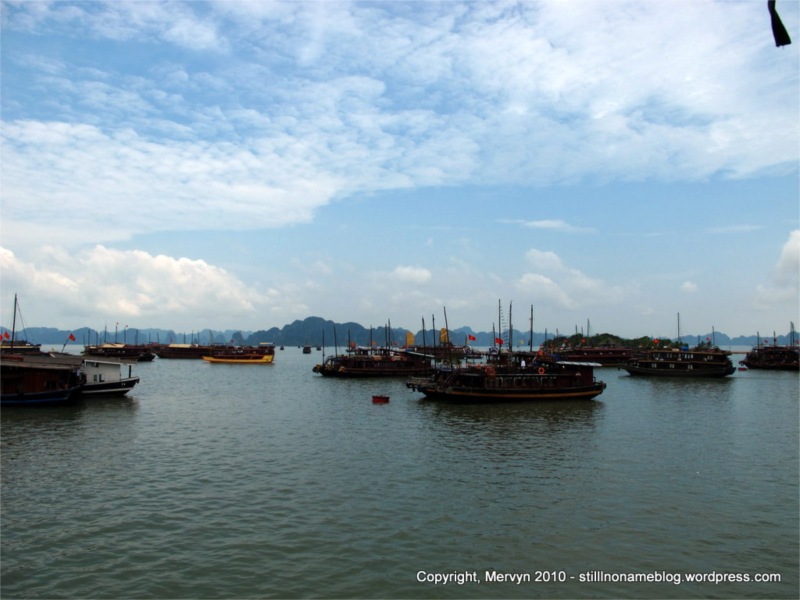
Today was essentially a travel day back to Hanoi from Halong Bay. We checked out of the hotel on Cat Ba Island, boarded our small boat to get to the larger sleeper boat. From there we headed back to port for lunch in Halong City. Then, we hopped a mini-bus back to Hanoi. Ruben, Michelle, and I then grabbed a cup of coffee at My Burger My (it makes sense in Vietnamese).
I checked into a hotel, dropped off laundry, wandered the weekend street market, then ran into Michelle and Ruben having a kebab at a street hawker stand. I joined them for dinner, then we parted ways for good. They were headed for Sapa in northwest Vietnam; I’d be in Hanoi until Tuesday when I’d leave for China . Just another ordinary travel day.
Not much in the narrative that’ll stir the bones. I’ll take this opportunity then to write a short review of our Halong Bay tour that we booked with Vega Travel. There’s a lot of confusion out there about booking tours in Hanoi for Halong Bay. The quality of tours varies greatly as do the prices. We ran into many people who were more confused after shopping for a tour than before they started.
Here’s my little attempt to add some information on at least one proprietor. If you’re thinking of booking a tour with Vega Travel, here’s one person’s take on their service, itinerary, and facilities. You also might find it helpful to browse the previous two entries to get a better idea of what would be on your itinerary.
My take:
Tour Company: Vega Travel
Tour Booked: Three-day/Two-night
Price: $106 USD
Itinerary:
See today and the last two entries. We were supposed to get time to swim on the last day (today), but for some reason the big boat never stopped. Just as well, from our perspective, since we were all pretty pooped.
Our Guide:
Our guide’s name was Hien. His English was excellent and he provided us with interesting information without being oppressive. Some guides talk too much or too little. Our guide was like baby bear was to Goldilocks—he was just right. He’s the best guide I’ve had on this trip so far. Very approachable. He really tried to make himself available for questions.
The Facilities:
If want to see pictures, take a look at the galleries at the bottom of the previous two entries. From a backpacker’s perspective, the facilities on the boat were excellent. As I said in a previous entry, the bathroom was luxurious for my budget standards. The beds were comfortable, the air conditioner cool, and the dining room restaurant quality.
There were little bugs in the room, but that’s probably just the perils of staying on a boat that runs constantly during tourist season. The two young Brits traveling on Mom and Dad’s dime thought this was a huge deal. I did not. I doubt most boats in the “mid-range” tours like this are going to do much better.
I consider this to be the cost of doing business on a restricted budget. To get much better, you’d probably have to bump up to the high end which costs upwards of $200. If that’s your bag, you can probably stop reading here and book with one of the luxury operators.
I was equally happy with the hotel on Cat Ba Island. Most companies book with the same hotel. I think it’s called the Holiday View Hotel, a high-rise overlooking the island harbor. As promised we had views of the water.
Here’s the biggest quibble of the trip. Michelle and Ruben offered to share a room with me so that I wouldn’t have to pay $15 extra for a single room. As is her way, Michelle grilled the guy at Vega about what we’d get for three people. The guy at the office promised a suite with a double bed and a single. He even showed us a picture of the suite. Looking at the picture, Michelle noted that there was only one bed. The guy said the room was such that you couldn’t fit both beds in the picture. We were assured the room was big. We booked believing we’d get a suite.
When we got to Cat Ba, we found two twin beds in our room and that our room was definitely not a suite. Michelle went down to complain to our guide. While she was downstairs, the hotel staff brought in a rollaway bed.
Downstairs, Michelle discovered that Vega Travel had booked us in a smaller room and not in a suite. With the help of our guide, Michelle talked to the boss man who said we could get the suite only if we paid extra. That’s fine and dandy for them to say, especially after they had our money.
Now, from an absolute perspective, the fact that we were in a smaller room with a rollaway bed was fine. If that’s what we’d been promised, we’d have been fine with it. Our problem was that we’d been promised something else.
It’s possible this was a mix up between the sales guy and the bosses. Regardless, Vega Travel needs to do a better job of telling people what they’re actually going to get. The room was fine. We just wished we hadn’t been promised something else.
The Good:
There was a good mix of structured and unstructured time. We were given the opportunity to kayak twice. In both instances, we were not rushed, forced to stay with our guide, or restricted to an area around the boat.
Vega Travel did a good job of setting up an itinerary that missed crowds. We weren’t with loads of other boats when we kayaked on the first day. We saw only one other group of tourists. The early morning on Dao Ti Top meant we were up there, by ourselves, ahead of the loads of tourists. The second day kayaking trip, I was the only kayak in the water for as far as I could see.
The trek on our second day was an unexpected highlight. The only time we saw any other tourists was when we hit the main road that leads to the dock. That’s sort of unavoidable.
The trek let us see that married farmer guy who lived on his own on the banks of the inland seawater lake. That was quite special. Moreover, the hike was challenging enough to be fun but not so demanding that it wasn’t enjoyable. A very good balance.
The Bad:
Really, it’s just the room thing. Oh, and the crew rifling through our bags while we were on the trek. Our guide did warn us to take all our cash so, in the end, nothing went missing. You wouldn’t have left cash unattended in your bags anyway, would you?
The Food:
Great food all around. Always more than we could eat. There’d always be two more courses than we were expecting. Everyone was happy after every meal. They even prepared special dishes for one of our group who was allergic to shellfish.
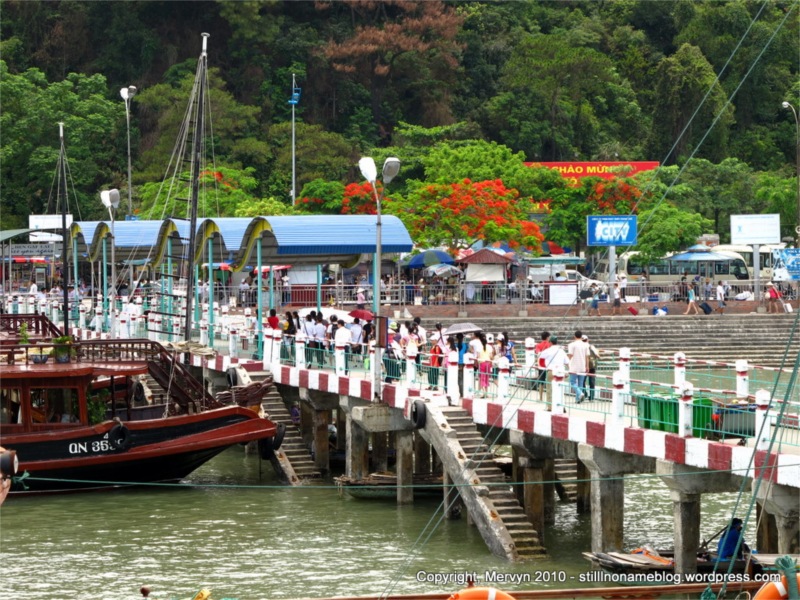
Conclusion:
I can easily recommend Vega Travel with one caveat: just know what to expect. You’re booking a mid-range tour. If you want a five-star hotel on the water, you’re going to pay a whole hell of a lot more. If you’re looking for comfortable accommodations, a knowledgeable guide, and a good mix of free time and structured activities, this tour is for you. There’s the added bonus that you’ll be doing things in places where you’re not constantly surrounded by other tourists.
Oh, and don’t expect a suite if you’re sleeping three to a room. I’m just saying.
GALLERY: Click through to see more pictures of Halong Bay, a lady paddling a boat through the port, and a random picture of a Vietnamese person pedaling a bike past a rice field.
Dateline: Halong Bay and Cat Ba Island, Vietnam – Thursday, May 27, 2010
Once again, I’m going light on the words and letting the pictures do the talking. Halong Bay can pretty much speak for itself.
A bit of context, though. Our itinerary for the day involved a pre-breakfast hike up Dao Ti Top for some views of the bay. From there we left seven of our twelve passengers for a smaller boat. The seven had only booked a two-day/one-night tour while we’d booked three-day/two-night sojourns. This left the younger Brit couple with Michelle, Ruben, and me for the rest of the day’s activities.
The big boat headed back to Halong City to drop off the seven and presumably pick up another load of tourists. We headed off for a trek on Cat Ba Island. Our smaller boat picked us up on the other side of the hills and took us to the resort area of Cat Ba for some free time and dinner on our own. We spent the night at a high-rise hotel.
I can’t let the day go without three quick anecdotes though. I’ll sprinkle them amongst the pictures.
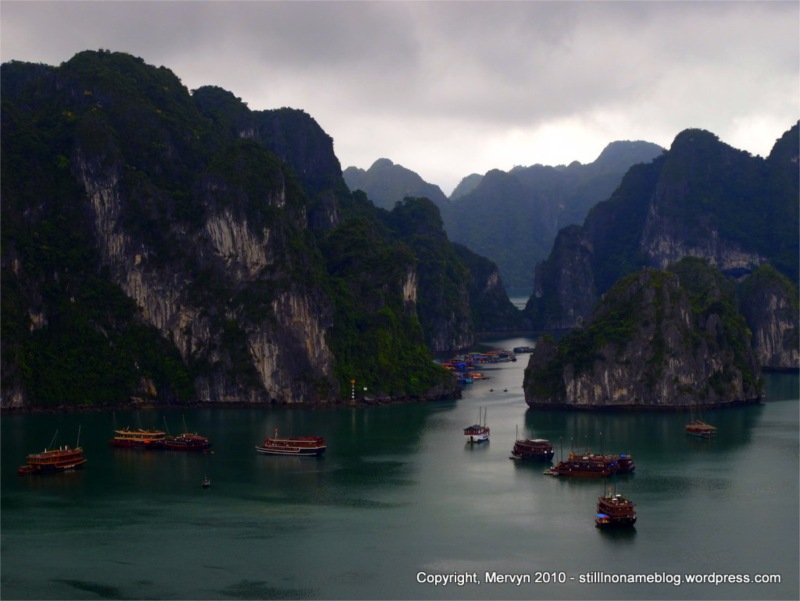
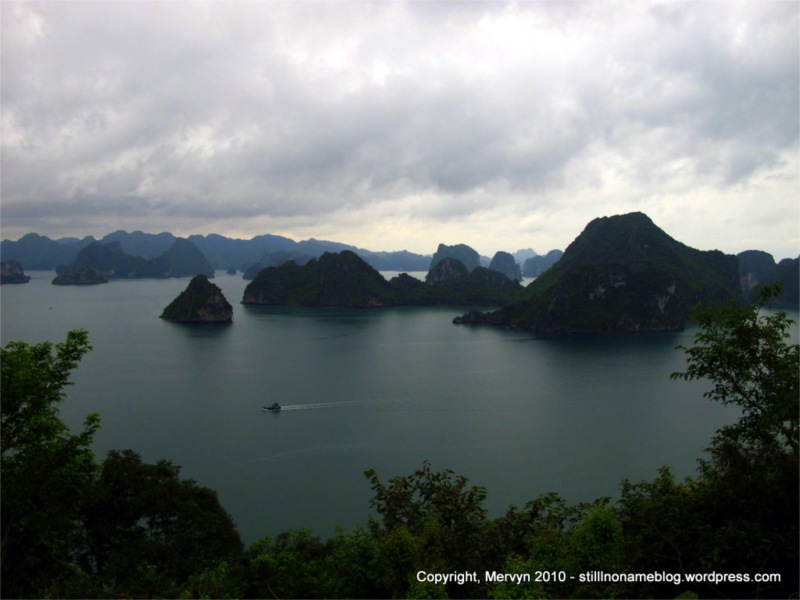
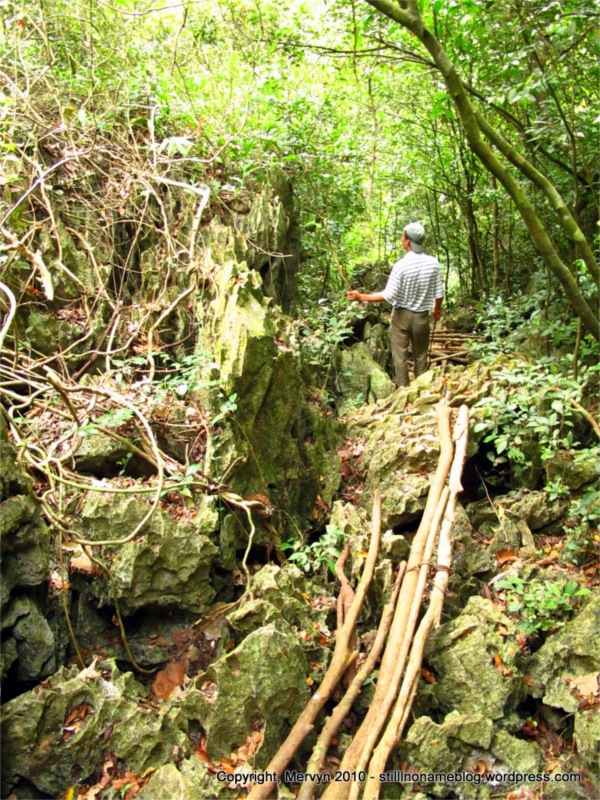
First up, the trek. Our boat pulled up to a little inlet on Cat Ba and dropped us off for our trek. The trek went straight up the side of the island and then descended into a landlocked salt lake. Water from the ocean seeped through the rock and settled inland. There, we found a middle-aged farmer tending to his clam field. He chatted with our guide and moved on.
As we circled the lake along the side of the hill, we came across the farmer’s home. A simple elevated bed with a mosquito net, a table and chairs, and various tools of his trade. Set off to the side was a small kitchen area. All of it sat under a thatched roof in the middle of a small patch of tapioca plants and fruit trees. Turns out he lives here year round working the lake, just like his parents had for 21 years of their lives.
He collects cans to string up in the trees so that at night he can wake up and rattle them to scare off the monkeys that try to eat his fruit.
He rarely leaves this little valley. Did I mention his wife lives in Hanoi? Tough life, to say the least. I wonder what he thinks as he watches tourists march through his valley, past his lake, and through his abode. He didn’t seem like he minded and even greeted us in Vietnamese as we descended on him. I wonder if I’d do the same if I were in his position.
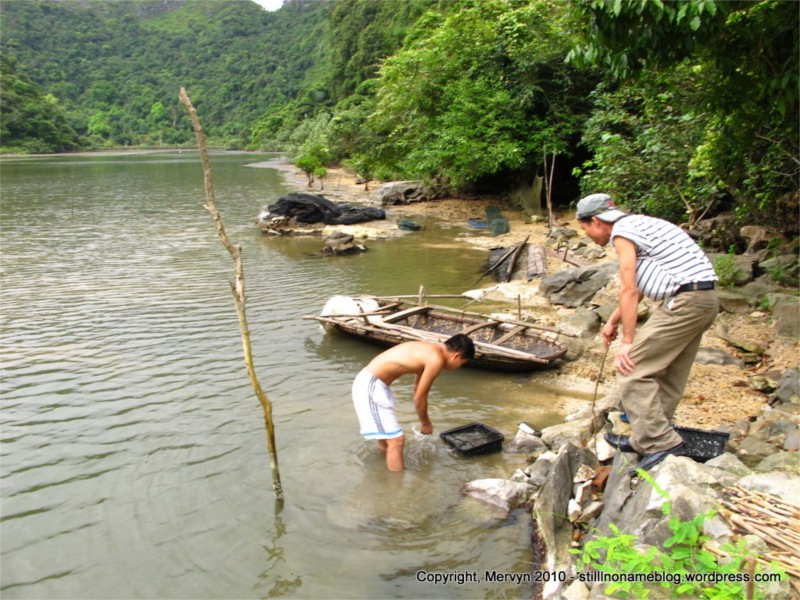
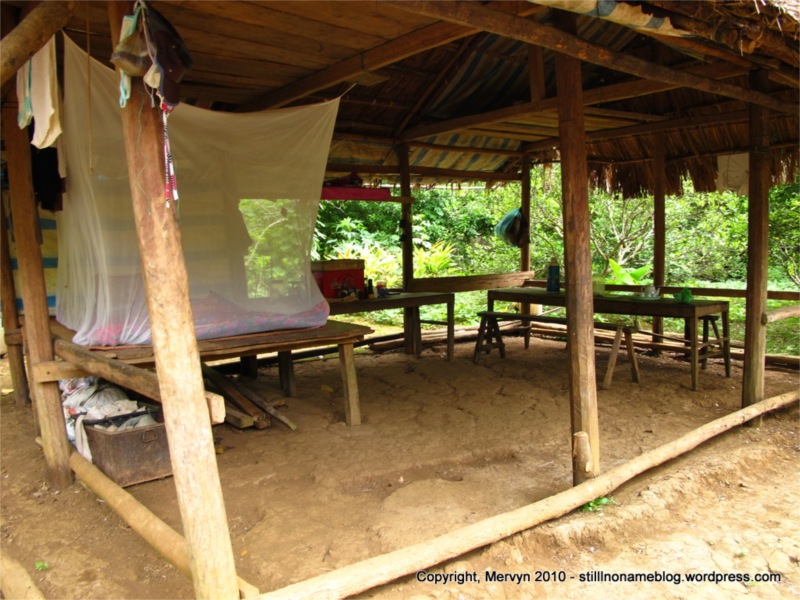
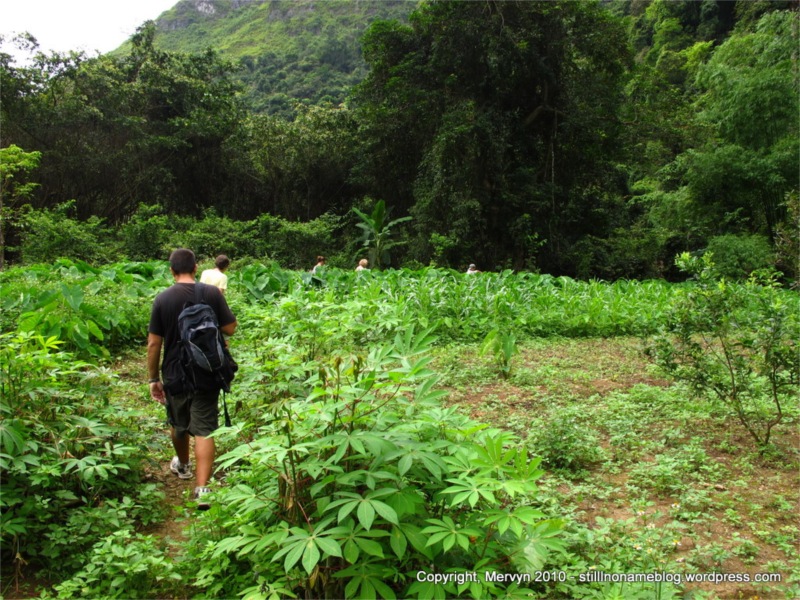
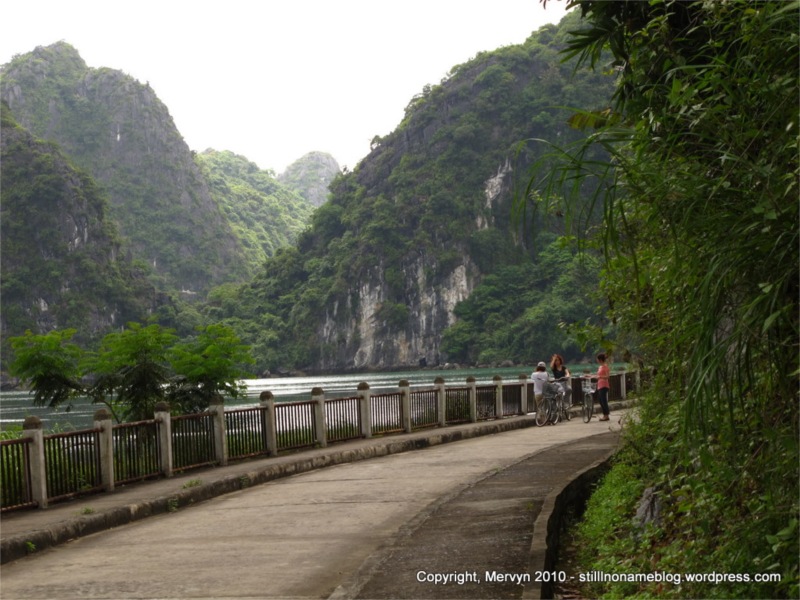
Second up, what happened on the boat while we were on the trek. Our guide reminded us multiple times to take all our money with us on the hike. He may have been on to something. When we got back to the boat the Brit couple noticed that their stuff had been gone through. Things that had been packed in specific ways were now in disarray. The boat crew had gone through our bags. Nothing was missing, but that’s probably because we took all our cash with us. Because of this, we could all shrug it off as the perils of traveling in a poor country. Lucky we had our guide on our side.
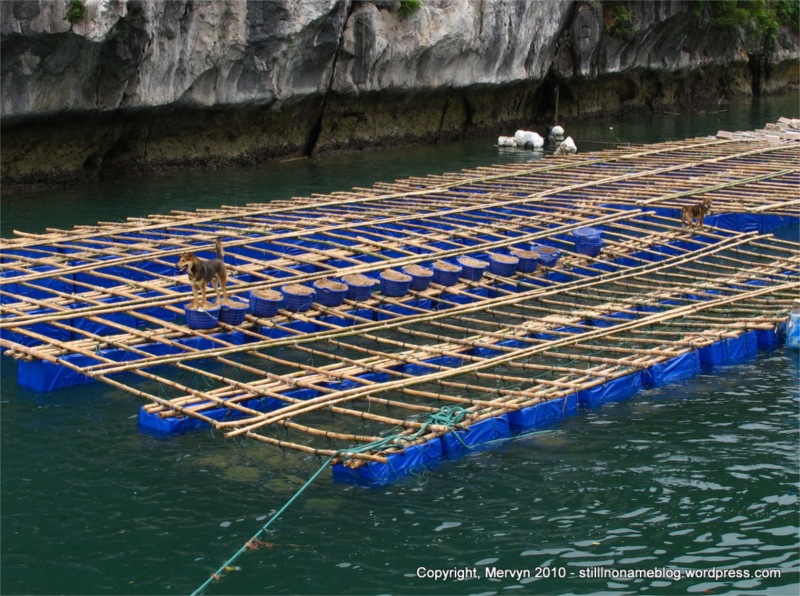
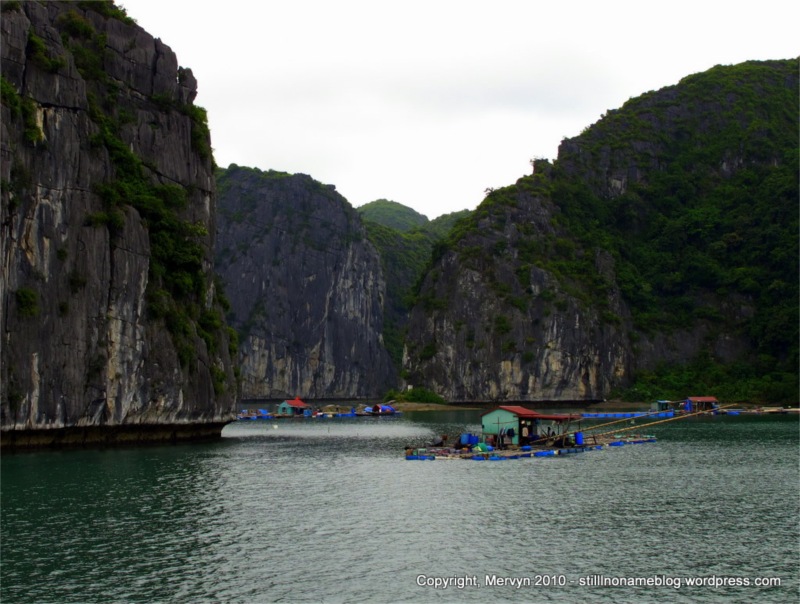
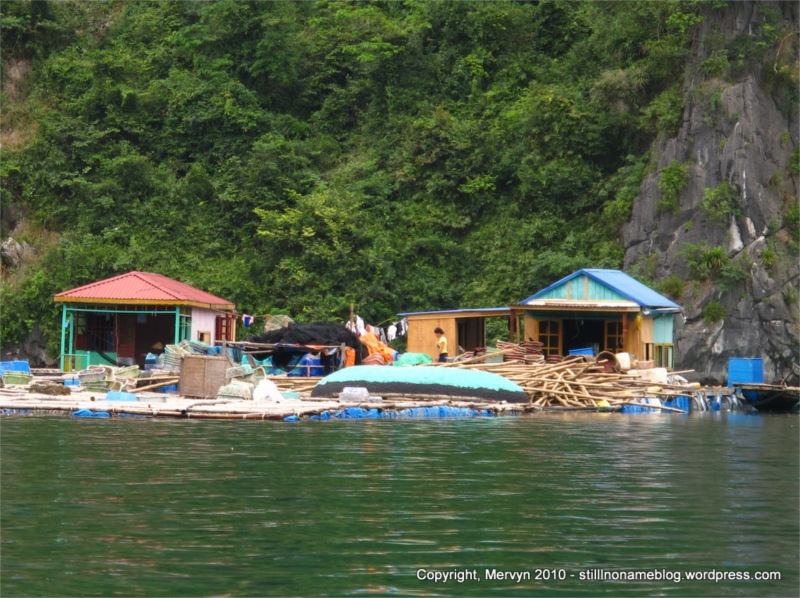
Finally, let’s talk about these claim/fishing houses. They’re wooden houses of varying sizes scattered throughout Halong Bay. The homes sit on pontoons and bamboo. Sometimes they sit alone, isolated. Other times they’re clumped together into little floating villages. Since this is the 21st century, some even have satellite dishes.
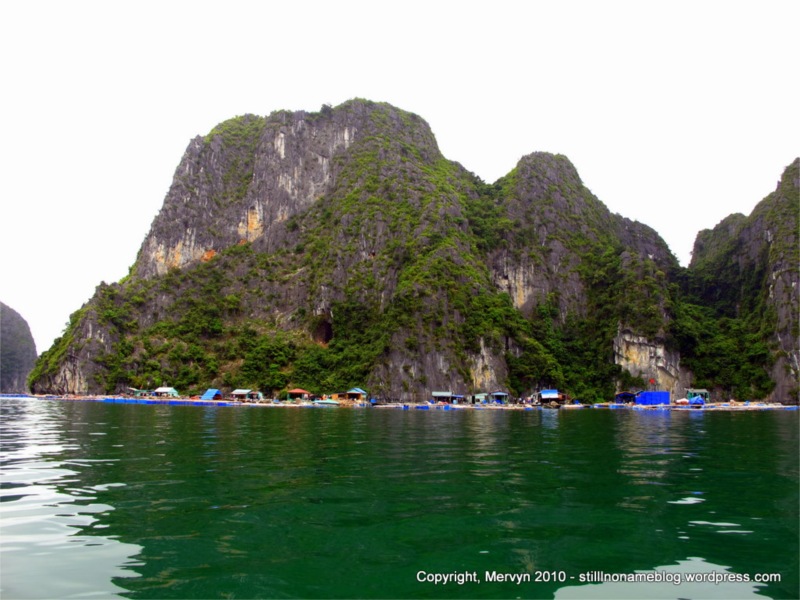
They absolutely fascinate me. After lunch, I took a kayak to paddle around the bay while the others lounged and swam near our boat.
Here’s what I learned on my little sortie. Whole families live on these things. I could see little kids in the houses. Most houses appear to be one main room, sometimes with a smaller closet room to the side. The farmers use baskets to plant and harvest clams. They fill the baskets with dirt, shells, and other unidentified items that no doubt make clams grow quickly. They then plant the clams and dangle the baskets in the water where the clams can grow.
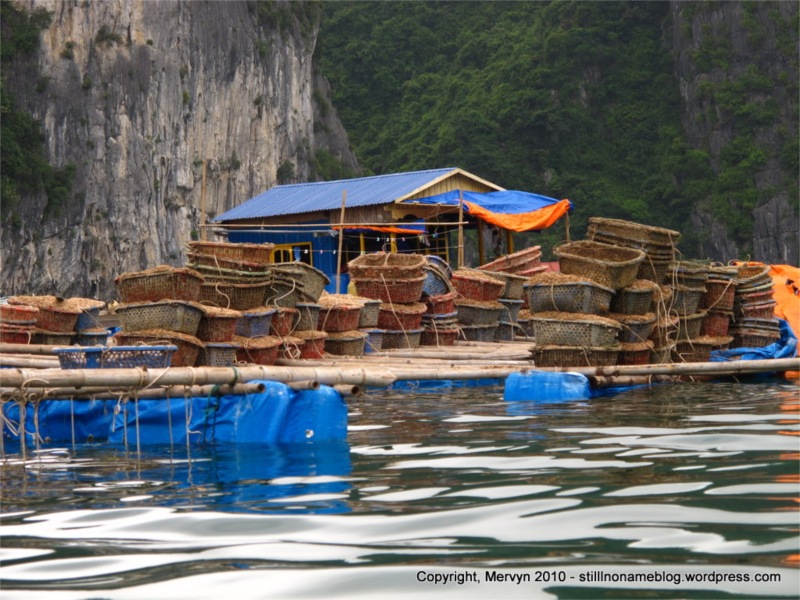
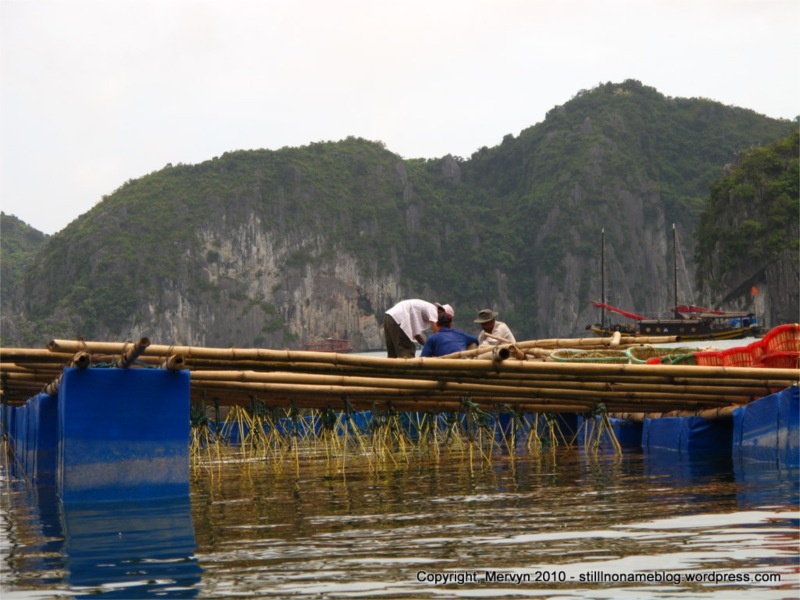
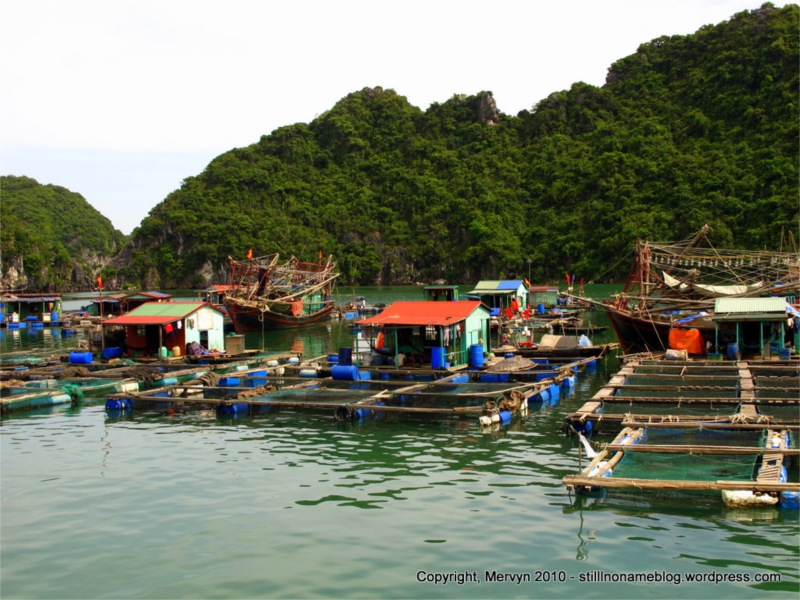
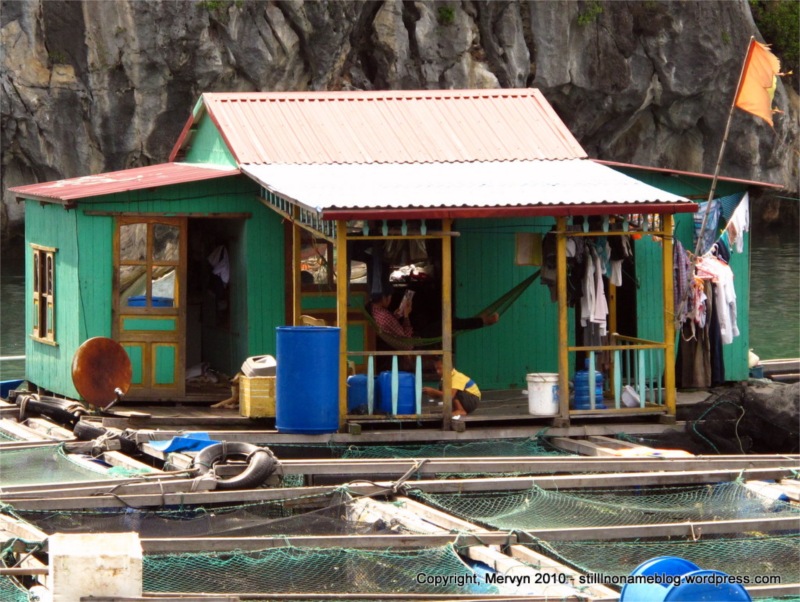
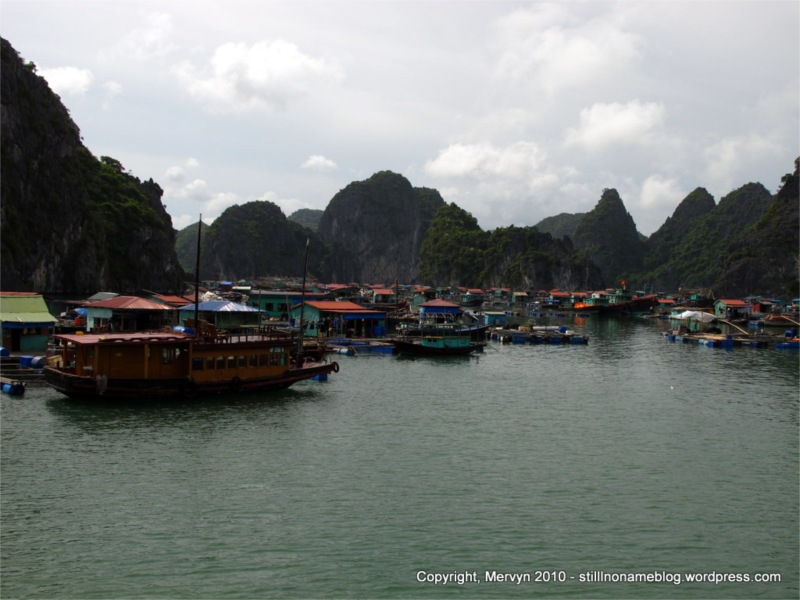
The houses and farms thrive here because the sea is sheltered by all the rock formations. Clam farming works best in calmer ocean. These floating farms wouldn’t last very long in even moderately choppy waters.
It’s a very different life. I’ve heard a rumor that some of these people will never set foot on dry land in their lives. The fact that I feel like this concept just can’t be true is a testament to my strong socioeconomic bias. Who lives like this nowadays, what with cities and port towns so near with their fancy hotels, internet, and dry land? It’s not like all those luxuries are in far off Netherlands—they’re just round the corner. Park your boat and try it sometime.
I know it’s not that simple, though. Not everyone can just traipse off and drop exorbitant amounts of money on indulgences like dinner and a movie. Also, what’s so different between us and them? Tell one of them that we spend half our lives in tall office buildings high above the ground and they’d probably look at us funny. Tell them that we’ve never killed our food with our own hands and they’d probably ask, “Why not? I mean, you easily could, if you wanted to, so why haven’t you tried?”
Then again, the idea might not be so foreign since they’ve probably caught reruns of “Everybody Loves Raymond” on satellite TV.
We live in a strange world.
GALLERY: Click through to see today’s gallery which includes pictures of Mervyn standing awkwardly in front of beautiful scenery, the Vega Travel boat’s room and bathroom, the view from Mervyn’s room on Cat Ba Island, and lots of bonus pictures of trekking, the married guy’s hut, and the floating fishing and clam villages of Halong Bay.
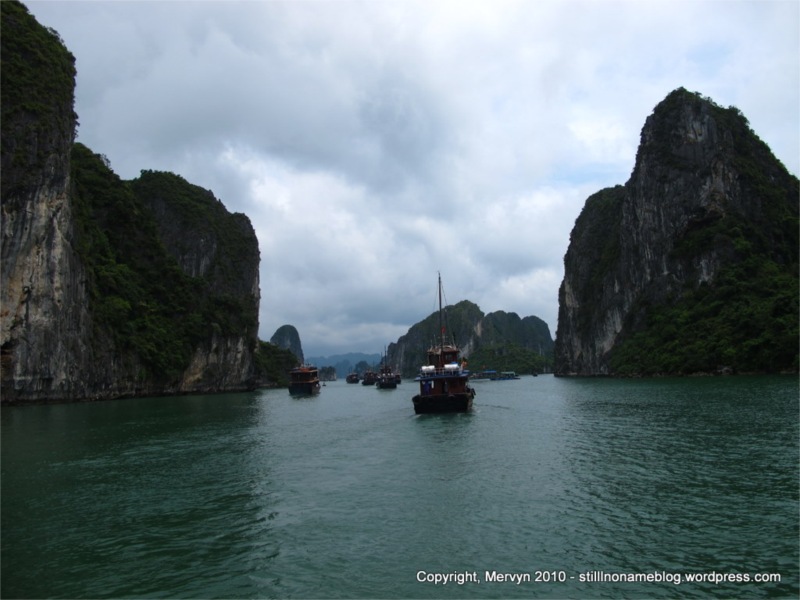
Dateline: Halong Bay, Vietnam – Wednesday, May 26, 2010
As I mentioned yesterday, Michelle, Ruben, and I booked a tour with Vega Travel to Halong Bay. This was only after extensive internet research (read: reading horror stories about tours that only made things more confusing) and Michelle grilling the hell out of the guy at the Vega office. She asked about everything short of how thick the mattresses were. She was much more thorough than I’d have been.
Which, actually, is a good thing considering how many of these trips seem to end poorly. Today was Day 1 of our three-day/two-night excursion. We left early on a mini-bus to the Halong City port. After an obligatory rest stop at a souvenir shop/restaurant we arrived at our destination.
We were joined by Claire and Chris, a Brit couple on holiday; a Spanish couple; a female Aussie paramedic; a younger British pair on an extended trip where, as it later became apparent, they were spending someone else’s money; and a German couple. Just as promised, there were twelve people. Vega delivered on its first promise. Definitely a good sign.
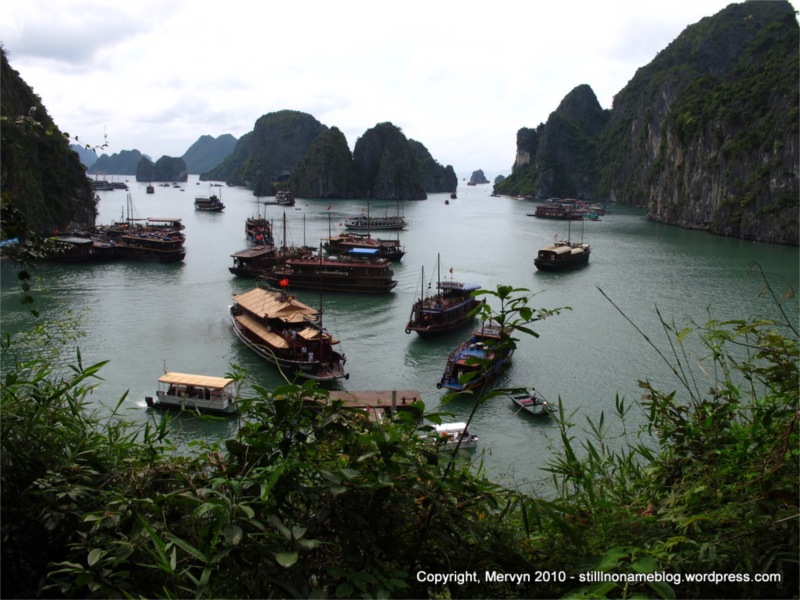
When we boarded the boat we found a nice dining room with proper tablecloths and heavy silverware. Below the main deck, I found one of the best rooms I had on this trip so far. The bathroom was, by far, the best I’d had in months and not just because it had a sink. The toilet was shiny porcelain and there was a huge rain-type showerhead coming out of the wall.
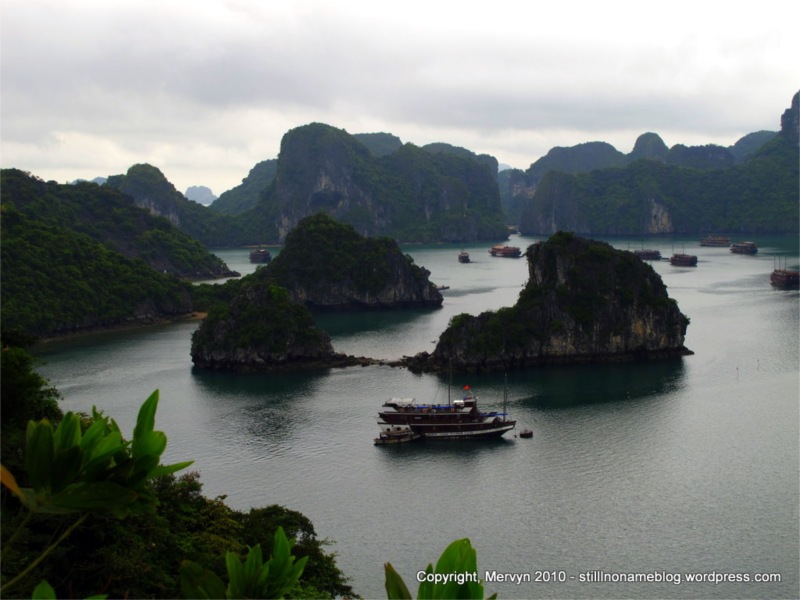
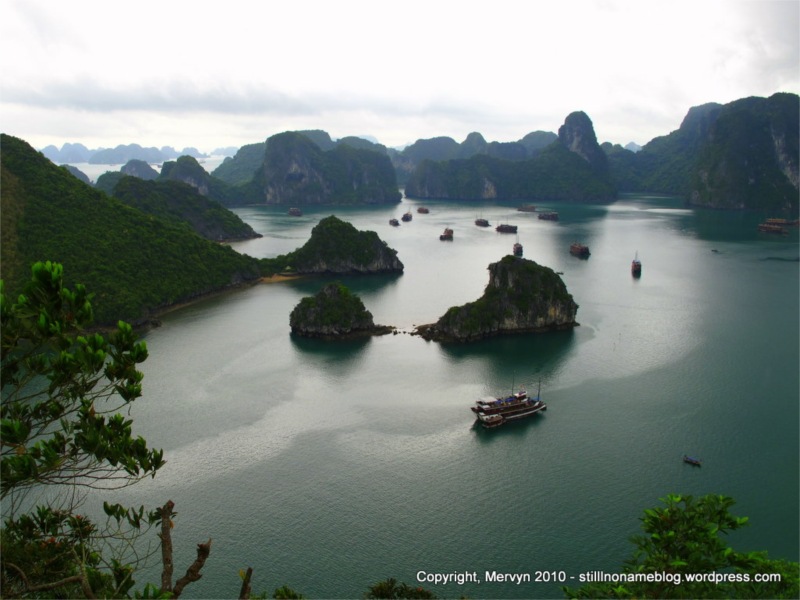
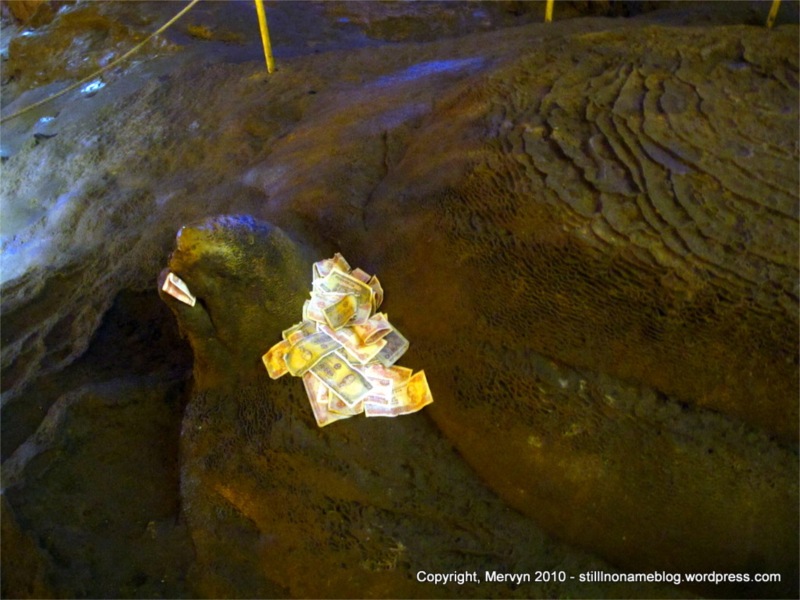
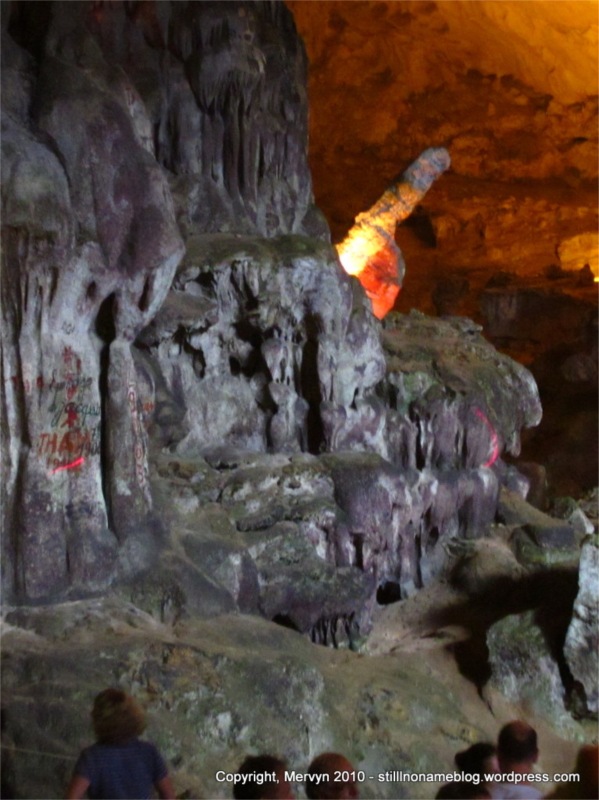
I’m going to go light on the words these next couple of days and let the pictures do most of the talking. To add some context, our itinerary today included a visit to Hang Sung Sot or “Surprise Cave”, a kayak trip through an island cave passage into a lagoon in the middle of an island, a swim, and lots of eating.
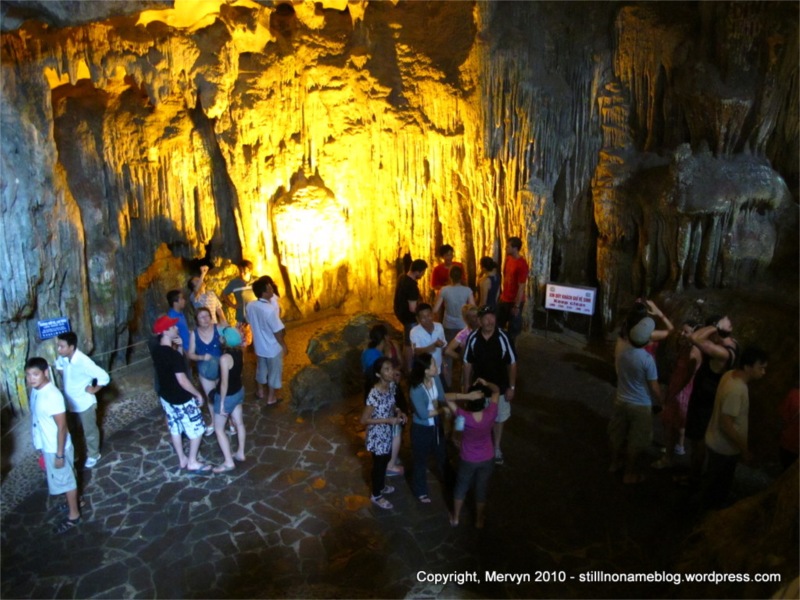
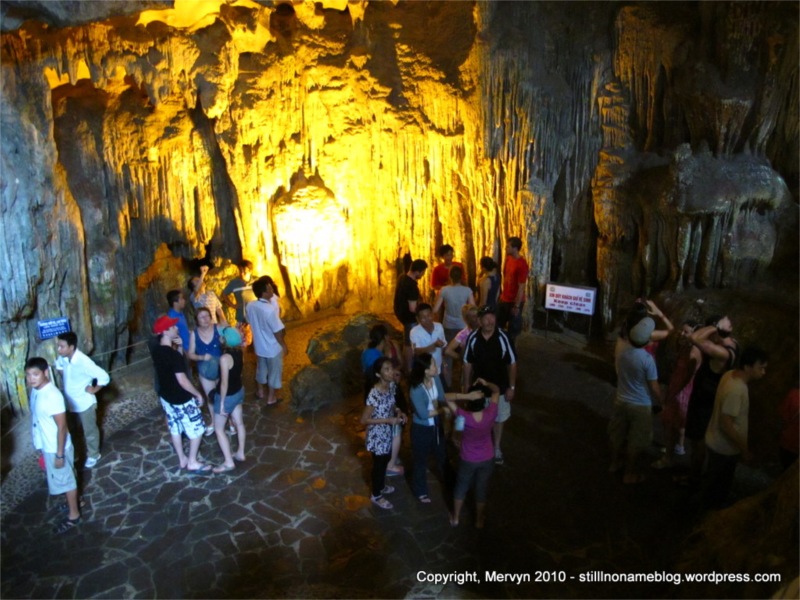
Halong Bay itself is like the Grand Canyon or Dodger Stadium. I remember that, when I was a kid, I’d watch Dodger games on TV or listen to Vin Scully, Ross Porter, and Don Drysdale on the radio broadcasts. TV gave me fleeting images of what the stadium looked like. Vin and the boys let me fill in the blanks with their descriptions and accounts of the game. I could hear the sounds of the crowd, the ice cream vendors, and the crack of the bat. By the time I went to my first Dodger game, I figured I knew what sitting in a seat would be like.
I was wrong. When I walked through the tunnel to our upper deck seats, I remember thinking the field looked a lot closer than it looked on TV. The colors seemed more vivid. I felt like I could pick out individual blades of grass and grains of red infield dirt. I’d spent years imagining the stadium, seeing it in pictures, hyping it up in my head and yet, when I saw it for the first time, it still wowed me.
That, my friends, is Halong Bay. I’d seen Railay in Thailand and figured I knew what I was in for. I’d heard the hype and thought I’d be impervious. When I got there, it was like walking through that opening in Dodger Stadium all over again. I caught myself just shaking my head and silently mouthing the word, “Wow.”
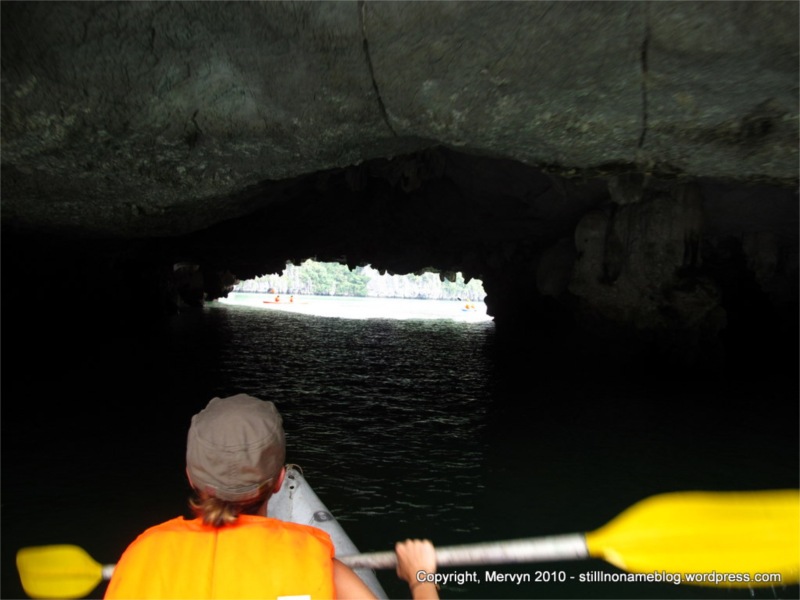
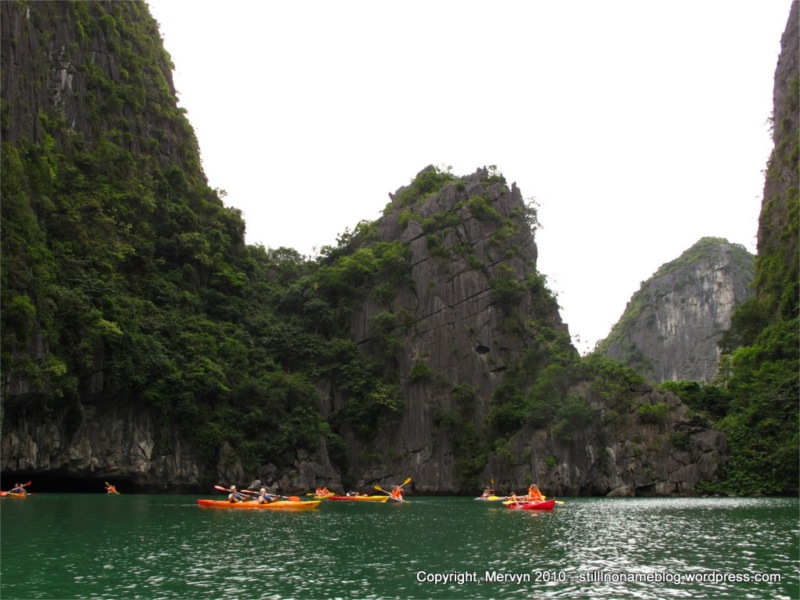
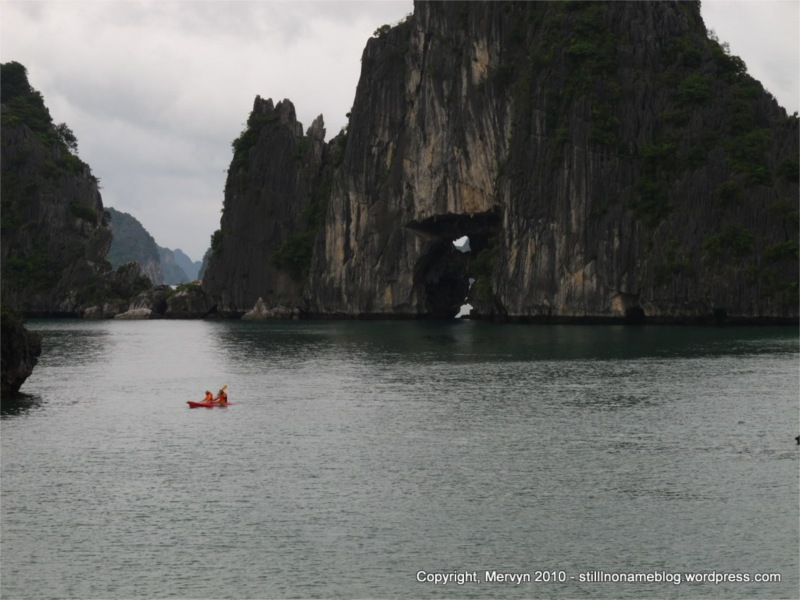
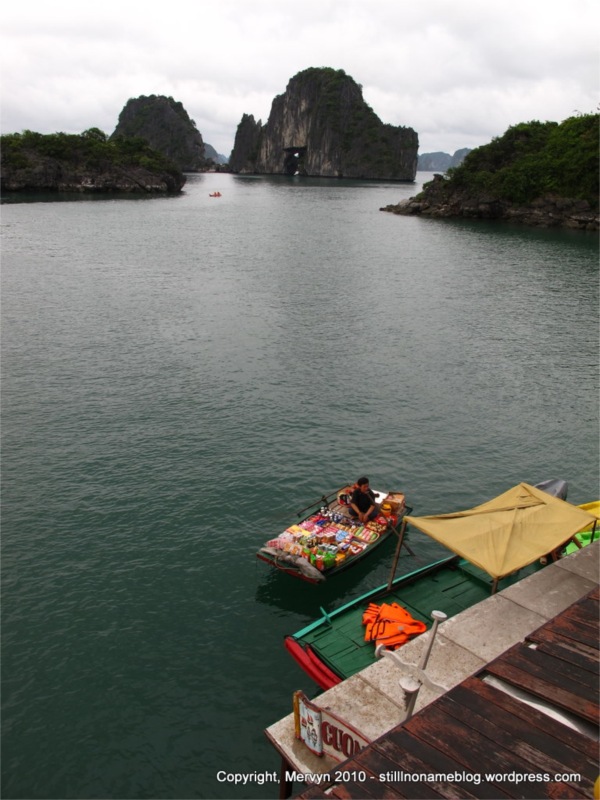
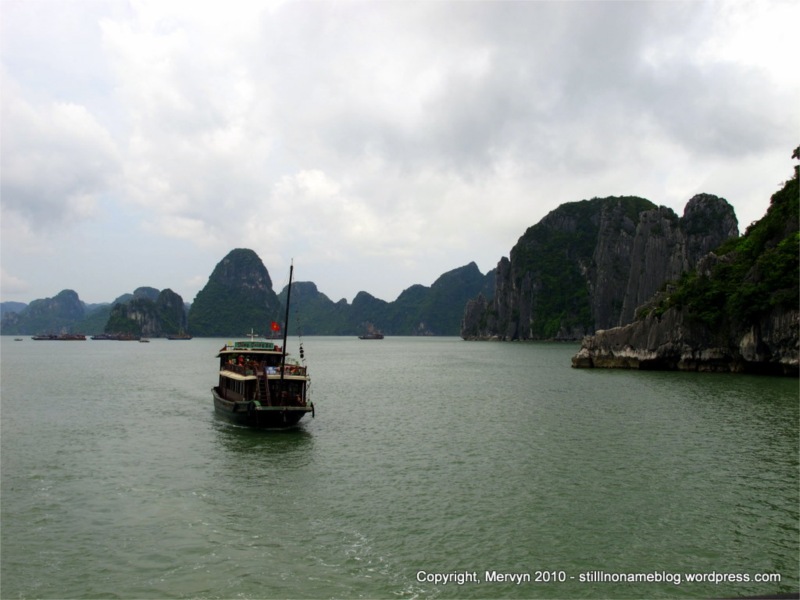
The rock formations jut out of the water, just like in Railay, but here there aren’t just a few, there seem to be thousands. For as far as the eye can see, stone stabs out of the water. I felt like Aragorn at Helm’s Deep, staring out the sea of besieging orcs. I knew the landscape must end, but I just couldn’t see where. We’d round one island and off in the distance, in haze, you could see layer upon layer of more.
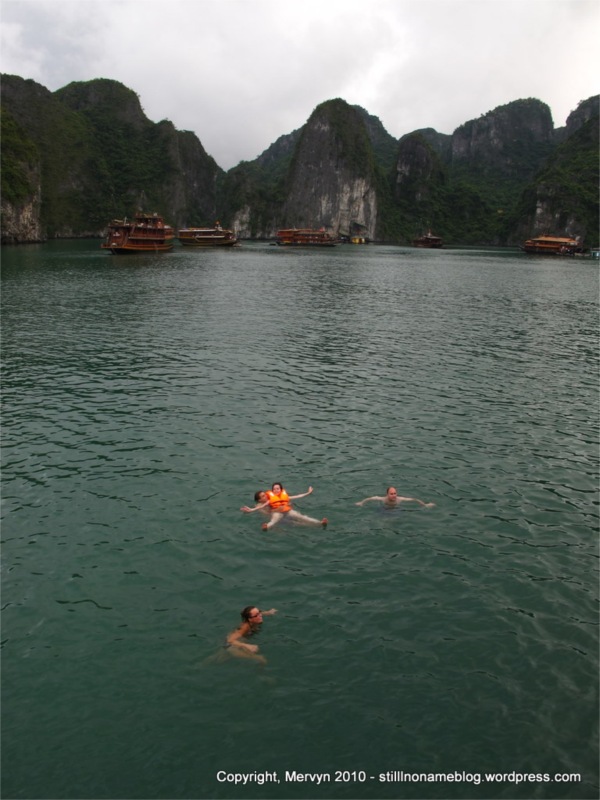
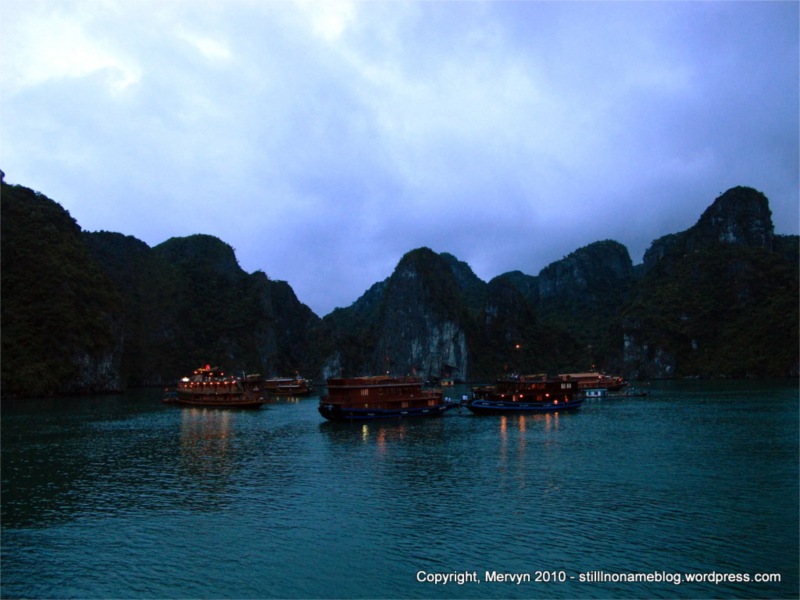
If you get a chance, you should visit this place. It’s already well-touristed, but that’s for a reason. Get here before it gets even more crowded. It’s well worth the trip.
GALLERY: Click through to today’s gallery to see pictures of Mervyn under and overexposed, squinting into the camera with a terrible non-haircut, and lots of bonus pictures of cave and bay stuff.
Day 83 – Smile, You’re in Prison! (Hanoi Hilton)
Dateline: Hanoi, Vietnam – Tuesday, May 25, 2010
Today, Ruben, Michelle, and I all rented bicycles to tour Hanoi. Bicycles (or “bikes” for short) are two-wheeled devices that function as a mode of transportation. The human rider sits upright on a metal frame and uses pedals to propel the bike forward. The word “pedal” comes from the root word “ped” which means foot. That means pedal bikes, unlike motorbikes, are powered by the rider’s feet.
What a fascinating concept. Using my foot power to maneuver Southeast Asia traffic.
When we set off for Ho Chi Minh’s Mausoleum, we lucked out. Hanoi offered relatively cool weather compared to Saigon. The sky was overcast, so at least we didn’t have to deal with the sun.
The bicycles ended up mitigating that piece of luck, though. Bicycles take effort, especially if you have to stop and restart. Hanoi’s confusing streets forced us to stop at nearly every intersection to check the map or ask for directions. I am not exaggerating. Six-pointed roundabouts and curved one-way streets made going in a straight line impossible.
We eventually made it in sight of Ho Chi Minh’s mausoleum and found a place to park our bikes.
“No lock. Back by 11:30,” said the guy who handed us a claim stub for our pedal bicycles. It was 9:45. The time constraint didn’t seem to be a problem.
Turns out we were further from the entrance than we thought. We had to walk 10 minutes to get to the main entrance.
Also, this Uncle Ho guy seems pretty popular. The line to get in to the complex stretched a couple hundred meters from the main gate. Who knew how long the line was once we eventually got inside. Also, the complex is only open until 11:30 a.m. After waiting in line for 10 minutes and getting nowhere near the entrance, I opted to go back and watch the bikes while Ruben and Michelle stayed in line to try to get in. I figured I’d be in Hanoi for a few days after our Halong Bay tour, so I could always come back. Michelle and Ruben were heading straight to Sapa in northern Vietnam, so this was their one shot.
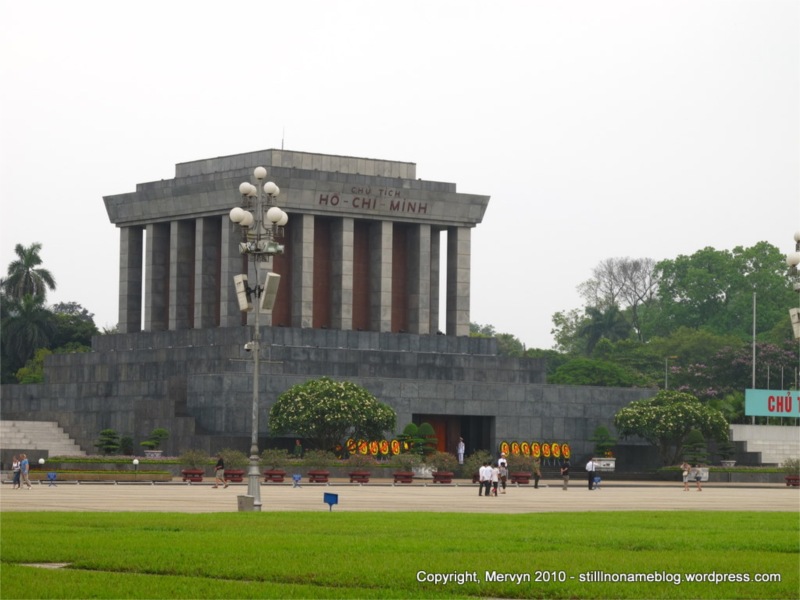
I ended up hanging out near the bikes with a horde of school kids who seemed to be waiting for their bus after a visit to their country’s George Washington/Thomas Jefferson. I did get a nice shot of the front of the mausoleum. Turns out I could have visited Ho Chi Minh’s body. Michelle and Ruben got back a bit after 11:30, though they did say the guards made them run through the grounds to the mausoleum itself because the complex was closing for lunch.
We headed back to the city center, passing a random giant statue of Lenin. We stopped in at Vega Travel and booked a three-day/two-night tour of Halong Bay.
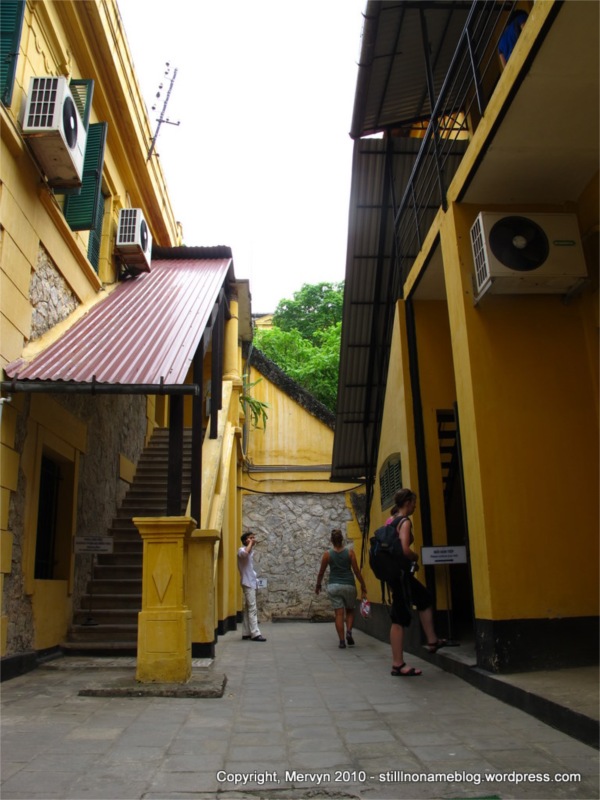
Next stop, the infamous Hoa Lo Prison or, as the American POWs called it, the “Hanoi Hilton.” As with all things in Hanoi, this required some hunting. Down an anonymous-looking street were the remains of one of the most famous prisons in American history.
Though, to hear the Vietnamese curators tell it, this place wasn’t so bad for Americans, especially when compared to how the Vietnamese prisoners had it.
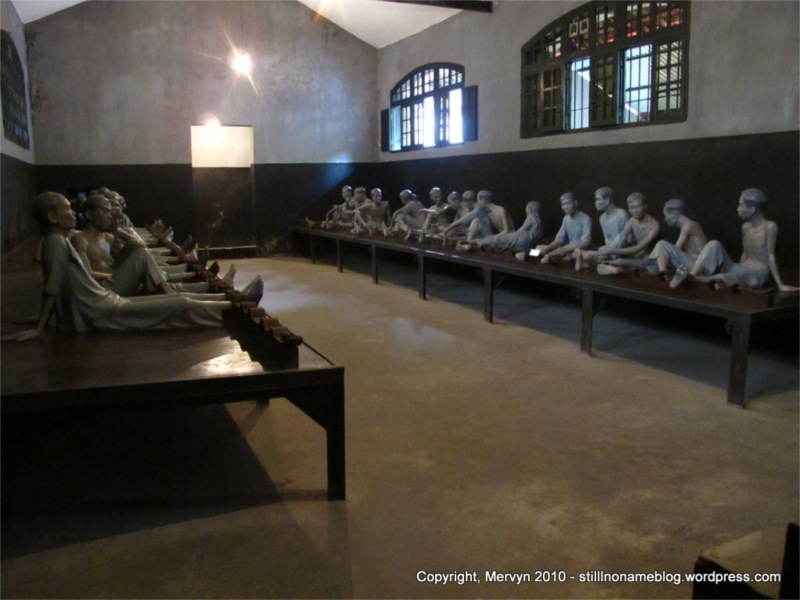
Not sure if you knew (I didn’t), but Hoa Lo Prison was used by the French to imprison Vietnamese dissidents. The huge bulk of the exhibits in the museum are devoted to recounting the horrors experienced by Vietnamese heroes at the hands of the occupying French. In one room sat a guillotine used to behead Vietnamese revolutionaries. Pictures of the severed heads featured prominently. There were life-size statues in a stockade in a large holding room and locked in cramped cells. The same cells that would later hold American soldiers.
Exhibits detail the torture suffered by freedom loving Vietnamese in Hoa Lo. Pictures show vaguely French-looking guards beating prisoners. The French even incarcerated and tortured women, doing things like pulling off fingernails and performing Chinese water torture. No atrocity is left to the imagination. Creepy mood music fills many of the eerie, concrete rooms. It’s got production value.
Most of the prison has been torn down, but the section that remains is quite well preserved. Two small rooms recount the American experience in the Hanoi Hilton, equaling the amount of floor space devoted to documenting opposition to the Vietnam-American War and subsequent visits to the prison by famous POWs (John McCain features prominently).
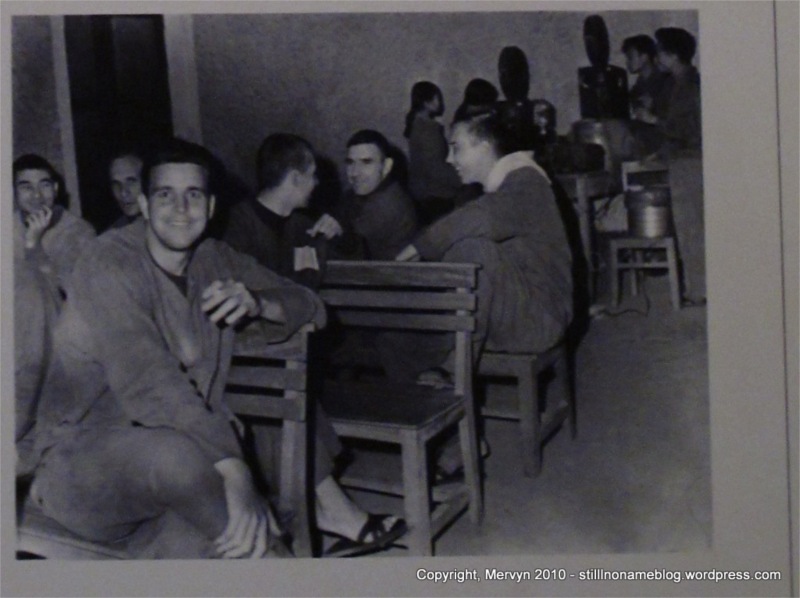
If you believe the exhibits, life in the prison wasn’t so bad for Americans. They got to keep their own belongings including toothbrushes, blankets, cups, plates, books, and tobacco. They regularly got mail from home. They had volleyball, basketball, and chess tournaments. A video even explained that the American’s were so lucky to have been prisoners under the Vietnamese and suggested they got little souvenirs when they returned home. It made it seem like summer camp but with more armed guards.
Pictures show GIs playing pool and smiling for the camera. Quite surreal, really. It’s a slanted view for sure. I have a feeling the former POWs might have a different story.
It made me wonder, though, how much of our own history we whitewash. Our culture is different of course–there are more incentives to encourage more honest self-reflection. Things like book deals and fame. That doesn’t mean that we always get the whole truth. Imagine if the Vietnamese people only heard the version of Hoa Lo Prison shown in the exhibits. Imagine if the only version of history we heard were what we read in our textbooks.
After we’d had our fill, I parted ways with Michelle and Ruben until dinner. I pedaled with my feet to the train station to scout ticket prices to Beijing (expensive). Then I headed back to the Old Quarter to return the bike and grab a cup of coffee.
Tomorrow: Halong Bay.
GALLERY: Click to see today’s gallery which includes John McCain’s flight suit, a giant statue of Lenin, and lots more pictures of happy smiling GIs in prison.
Day 82 – The Drunken Streets of Hanoi
Dateline: Hanoi, Vietnam – Monday, May 24, 2010
Hanoi seems built to confuse and overwhelm. The traffic and motorbikes seem thicker than Saigon’s. The streets are just as French and confusing but are also narrower and more closely spaced, which gives the city’s center a more claustrophobic feel. Houses in the Old Quarter are narrow owing to a quirk in local tax law, so there seems to be a different street side shop every 6 inches. It gives you the odd sensation that you’ve walked half a mile even though you’ve only gone 30 feet.
The streets behave like career criminals, never able to go straight for every long. At one point tonight, a Malaysian guy approached Michelle, Reuben and I and pleaded, “Please, where are we? Do you know how to get to the church? I can’t find my hotel.” That’s when we realized he was with five other friends. Even for the directionally gifted, negotiating this city is like trying to follow one noodle in a plate of spaghetti in white sauce. And I thought Saigon was bad.
Hanoi’s dizzying atmosphere matches its reputation amongst backpackers. Guidebooks warn of deceitful hotel proprietors who copy the names of reputable hotels and try to pass off their inferior product to unsuspecting travelers. The same goes for travel agencies, where the once trusted name of the Sinh Brothers travel agency is pasted on nearly every other tour and travel provider shop—and in Hanoi, that’s a lot of shops.
If you want to experience true confusion, just try doing what Rueben, Michelle, and I tried to do today: book a tour of Halong Bay. We wanted a 3-day, 2-night tour with decent food and accommodations and a good guide. We visited agency after agency and got prices ranging from $39 to $450 with an array of promises. Everyone claimed to have good food and good value.
Backpacker forums online told a different story. Proprietor’s promising 13 people on a boat and actually stuffing 30 people on board claiming, “These 17 people don’t count since they’re on a 2-day tour and you’re on a 3-day.” The promise of guides that speak English but can barely hold a conversation. Pictures in brochures that look nothing like what’s actually been booked on a Cat Ba island. Some proprietors will basically lie to you. Like a Hanoi street, they’ll lead you to believe you’ve made a good choice, just to curve left, double back on you, and leave you feeling double crossed, frustrated, and confused.
In the end, we collected what information we had, Googled the hell out of the companies to try and find reviews, and decided to wait a day to book our tour. We’d arrived in Hanoi at 7 a.m. dazed and tired after a bumpy ride on the night bus from Hue, and determined that making a decision in our addled state probably wouldn’t be best.
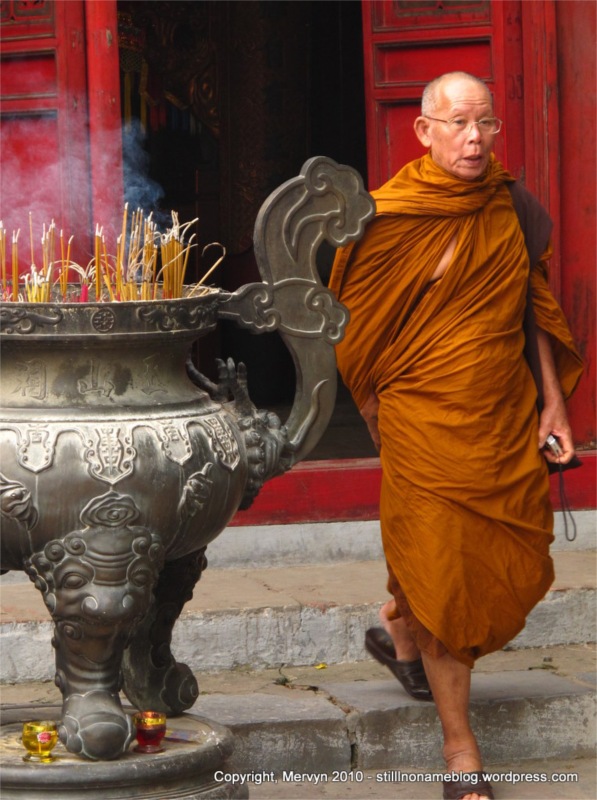
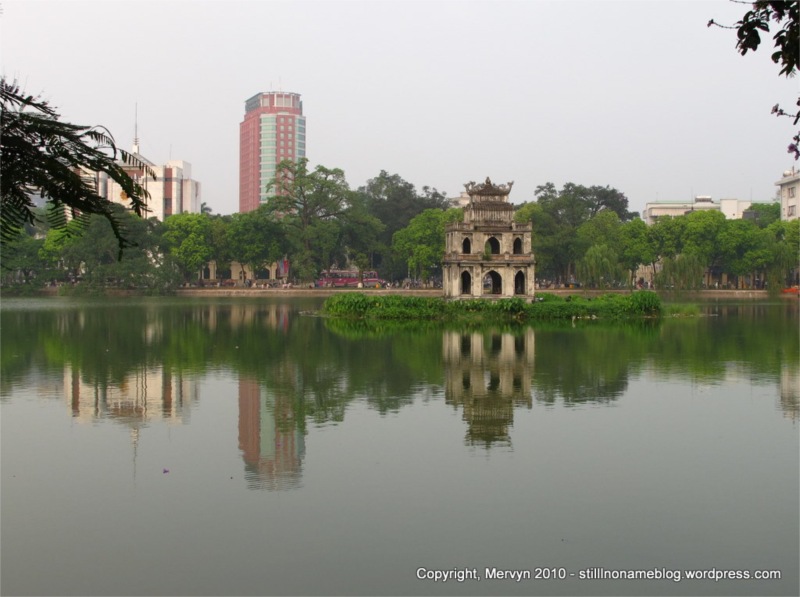
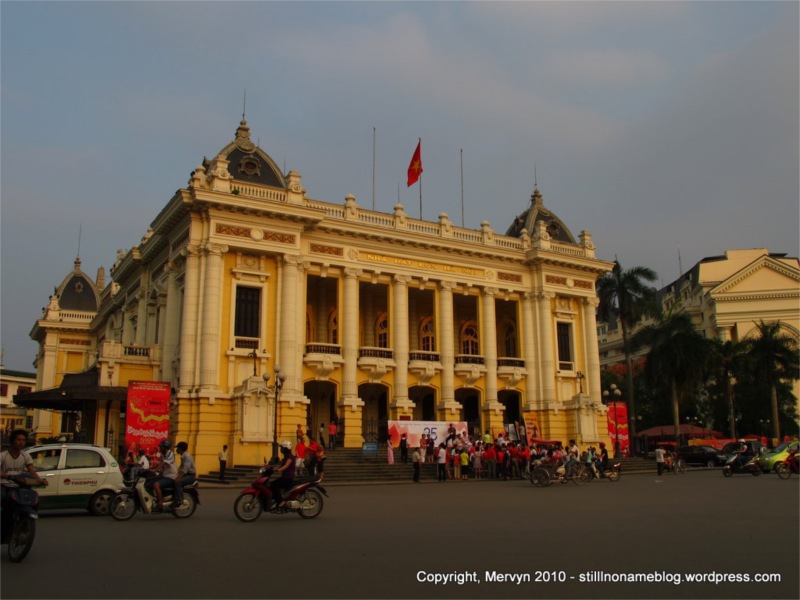
Instead, we opted to walk around Hoan Kiem Lake and explore the Old French Quarter. We stumbled into a pagoda that I mistook for a more famous landmark. We saw the iconic Tortoise Tower in the middle of Hoan Kiem Lake. We came across the Hanoi opera house. We even found a giant statue of some guy who seemed kind of famous.
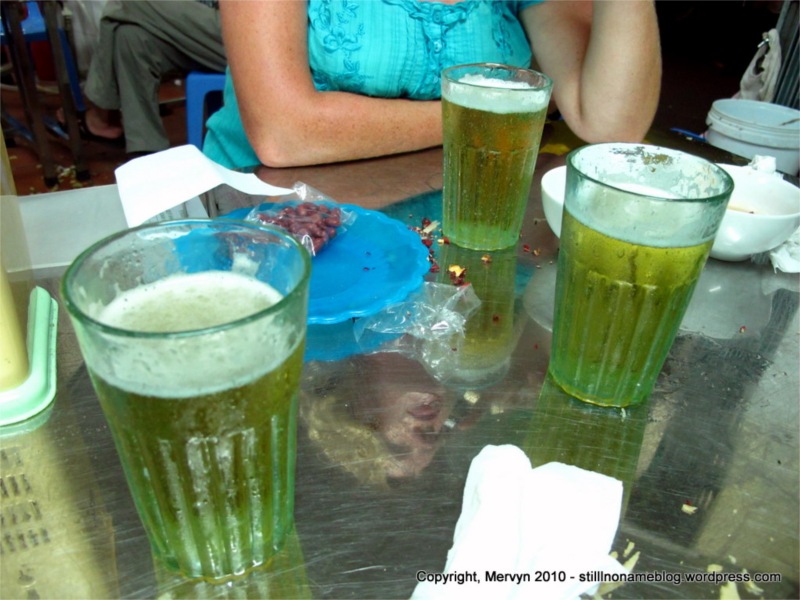
To sort out our confusion, we decided to spend the evening hopping between local Bia Ha Noi shops. These local joints serve only local brew and offer a real taste of Hanoi. The places we hit had no other Westerners. We were probably being overcharged, but at the rock bottom price of 6,000 dong (35 cents) a glass, we decided not to raise a fuss.
After visiting shop after shop, we hit the streets to look for a late dinner. This was no small task. Hanoi seems to close early, so finding cheap eats is a challenge, especially when the streets are like a maze. We stumbled across a kebab stand serving tasty meats on bread for 15,000 (80 cents) a pop. Other Westerners looking for food grabbed a late night bite. This is the Hanoi equivalent of Los Angeles’s hot dog stands.
We retired for the night, resolved to untangle Hanoi tomorrow. And to do one of the more harrowing things I’ve done this trip: book a trip to Halong Bay.
GALLERY: Click today’s gallery to view pictures of old men playing Chinese chess, a statute of some famous dude, and even more pictures of Turtle Tower.
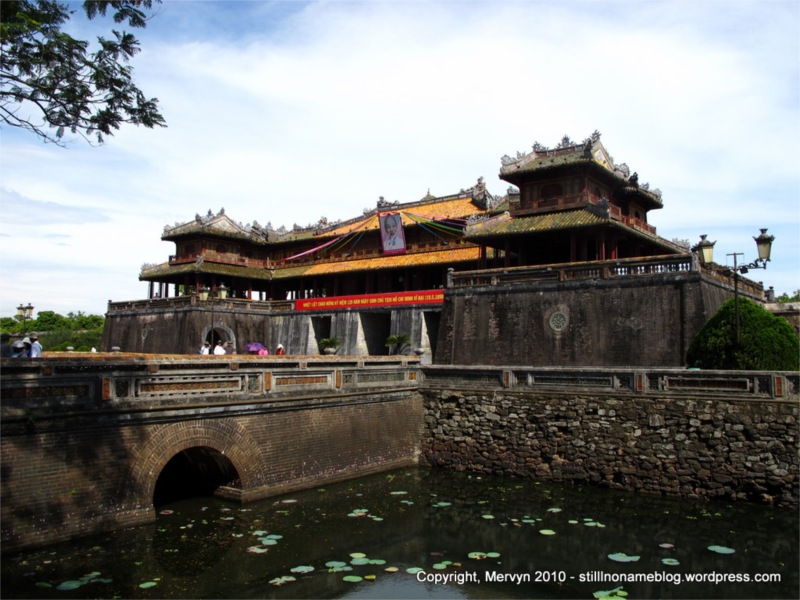
Dateline: Hue, Vietnam – Sunday, May 23, 2010
Hue is the former capital of the rulers of pre-communist Vietnam. Located on the shores of the Perfume River, the city was founded in 1802 by the first of the Nguyen emperors, Gia Long, and served as the dynastic capital until 1945. This means the buildings aren’t particularly old, but they do have some history. As a tourist, the main draw is the Citadel, which sits on the north bank of the river. Contained within the citadel is the Imperial Enclosure, home of the emperor. In the surrounding areas are pagodas and various imperial tombs.
That sounded like a lot, especially considering I’d given myself only a day-and-a-half to do the whole area. I got up at 6 a.m., rented a motorbike for $3 and zipped off to the Imperial Enclosure to do my tour in what I hoped would be the cool of the morning. The plan was to meet up with Reuben and Michelle at 11 a.m. after they visited the Imperial Enclosure so that we could visit the Thien Mu Pagoda and at least one of the emperor tombs.
It felt like nearly everything was being renovated. The whole right side of the complex was covered in scaffolding and, even though it was only 7 a.m., the place was filled with the sounds of circular saws and hammering.
Despite all that, my walk around the complex was almost meditative. The sun wasn’t blazing in the sky and there were almost no tourists since it was so early. One thing broke the tranquility, though: stifling heat.
That’s nothing new. It’s hot in Southeast Asia. You deal with it. What made this remarkable was what was missing. When you build a Citadel with protective walls and a moat, then build another mini-citadel inside that one with more walls and moats for your Imperial Enclosure, you pretty much kill one of the most underrated features of an attractive city: wind.
All those walls and moats get in the way of any breeze. You normally think of wind chill in winter. You know, “Wow, it’s snowing out and wind chill is making it feel 20 degrees colder.” That kind of thing.
Wind chill is a billion times more important in the tropics. The difference between 100% humidity and 90 degree heat with a breeze and without is the difference between lounging on a San Diego beach and munching on a bhut jolokia pepper in the Sahara while being doused in gasoline and lit on fire with a giant magnifying glass. A 2 mile per hour wind is the difference between life and death, oven and refrigerator, a soaked shirt and a merely damp one.
The Imperial Enclosure has no breeze. And its absence dramatically affected my feelings for the place.
Oh, it’s pretty, but when you’re trying not to soak your camera with your own sweat, it makes picture taking less fun. It makes reading signs about history less interesting. It makes standing at the edge of a moat an exercise in self-restraint as you consider hurling yourself into the cool, slime filled waters.
This is a reason, and not an excuse, why I don’t know what I took pictures of that morning. The light was decent since the sun wasn’t directly overhead. The colors were good in the softer morning light. This tourist, however, learned next to nothing about the structures, history, or symbolism. He just put one foot in front of the other and tried not to let skin touch skin lest his own flesh be pasted together forever.
There were houses and a tennis court that an emperor had built in the 1900’s. There was a residence for an empress. There was a Forbidden Purple City area reserved for the emperor alone and where the only servants allowed in were eunuchs so as to protect the monogamy of the royal concubines. It was all fine and dandy and a total blur of plodding and sweating.
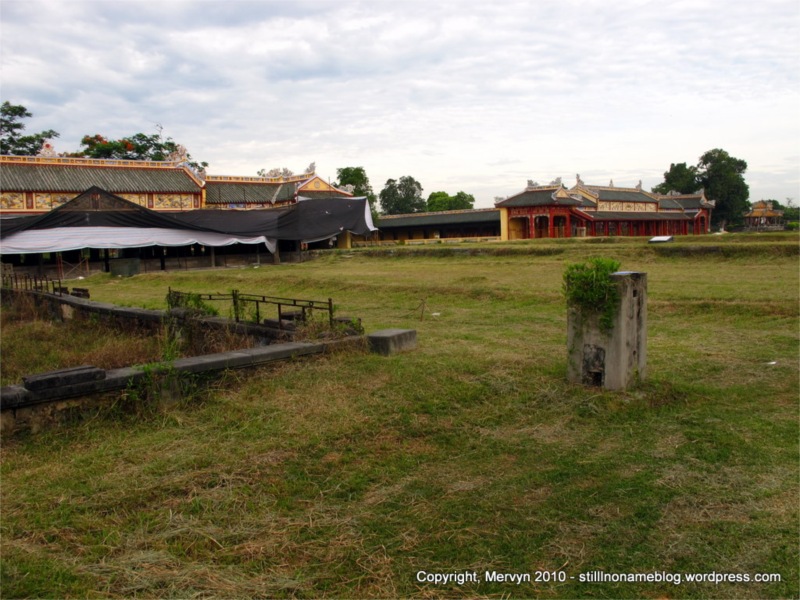
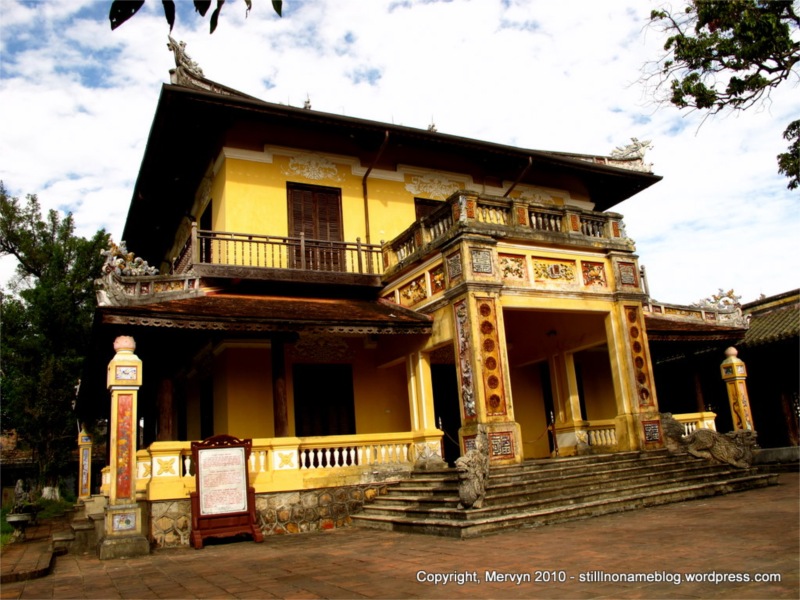
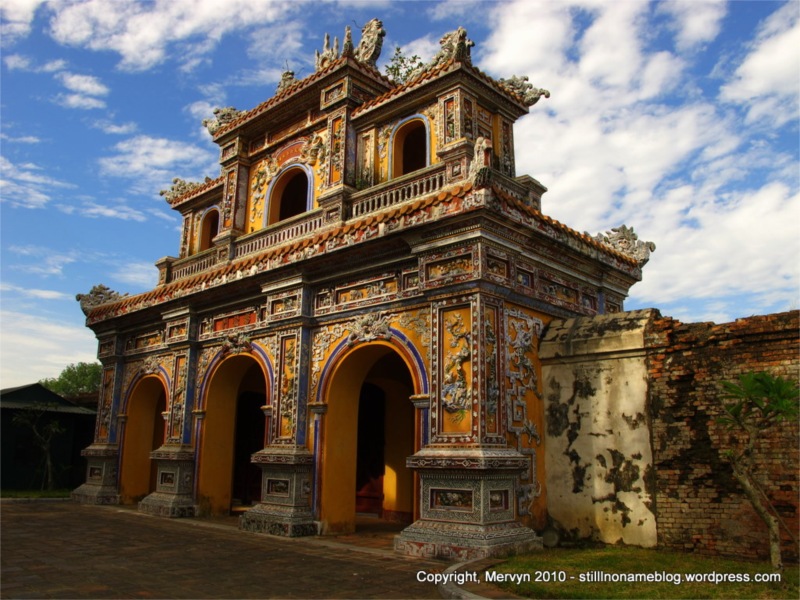
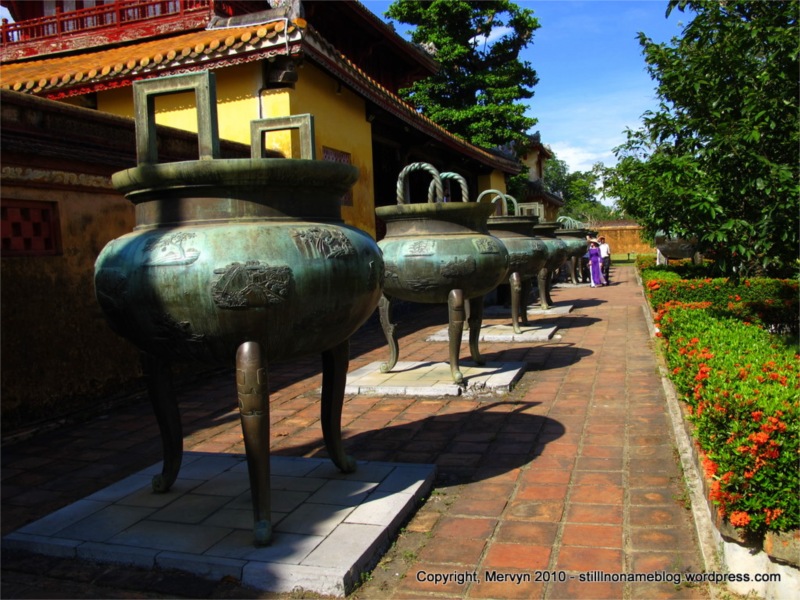
The weather so affected my judgment that my favorite spot on the whole visit was the platform above the main entrance. I was about to exit through the gate whence I’d entered when I noticed a staircase to a platform above. I hiked up and discovered the most glorious breeze coming over the wall of the Imperial Enclosure. I, along with a pack of weary, early riser Vietnamese tourists, sat on some steps beneath a giant Japanese-style drum and soaked in the earth’s natural electric fan. None of us moved for at least 15 minutes.
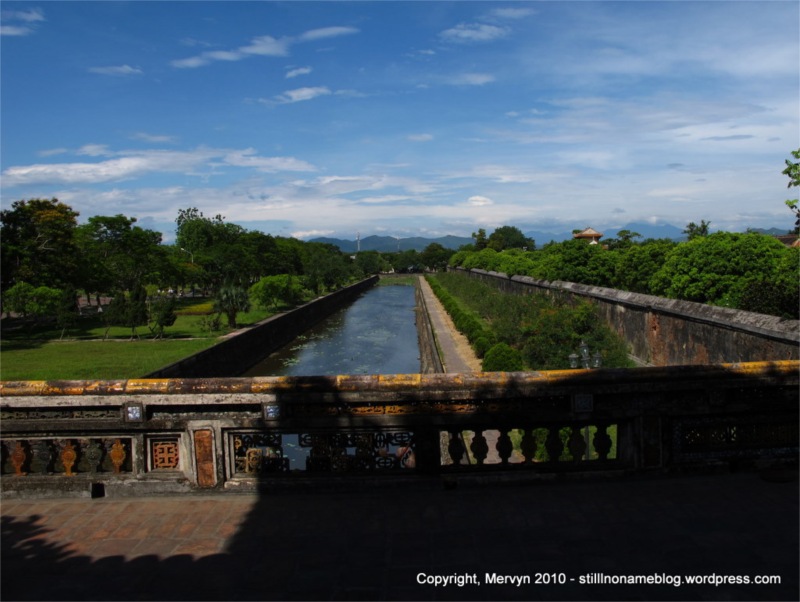
Tourists started pouring into the Imperial Enclosure on organized tours. Most seemed to be Vietnamese or Chinese. After drying off on in the breeze, I headed back to the hotel to hide from the heat and write.
At 11 a.m. I met Michelle and Reuben at the Imperial Enclosure entrance and we caravanned our motorbikes to the Thien Mu Pagoda a couple kilometers west of the Citadel. This pagoda is as iconic a symbol of Hue as the Citadel. It’s a 21 meter tall octagonal tower set on a hill overlooking the Perfume River. Founded in 1601, it’s been destroyed and rebuilt many times. It houses a working monastery and was home to a monk who, in 1963, traveled to Siagon where he performed a self-immolation to protest the policies of South Vietnamese President Ngo Dinh Diem. This monk is better known in the U.S. as the person who’s on fire on the cover of the Rage Against the Machine debut album. They even have the car that Thich Quang Duc (the monk’s name) used to travel to Saigon.
The pagoda complex does have a breeze. I immediately liked it more than the Imperial Enclosure. In the back, young monks rested in the grass under the shade of the trees. One had even climbed a tree to find a branch on which to nap. I half expected them to be attacked by ninjas and to watch an awesome kung fu fight scene. Maybe it’s just me. . .
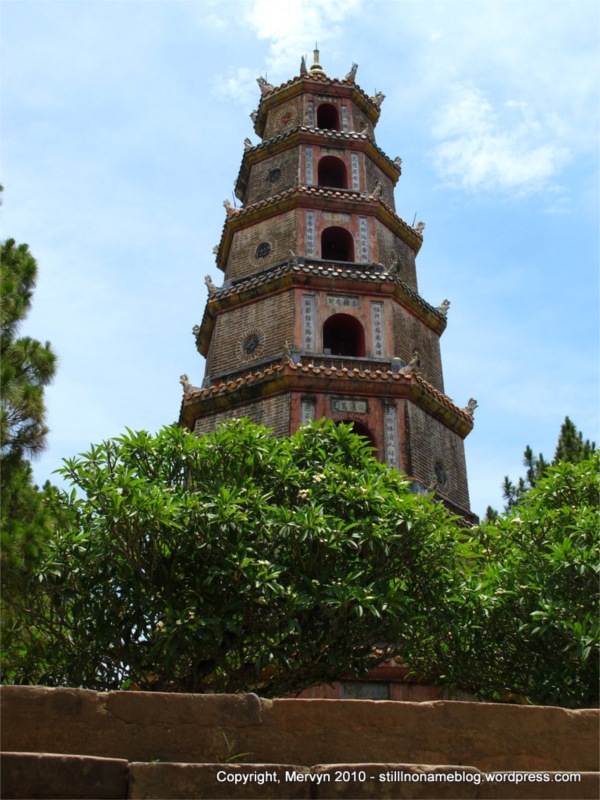
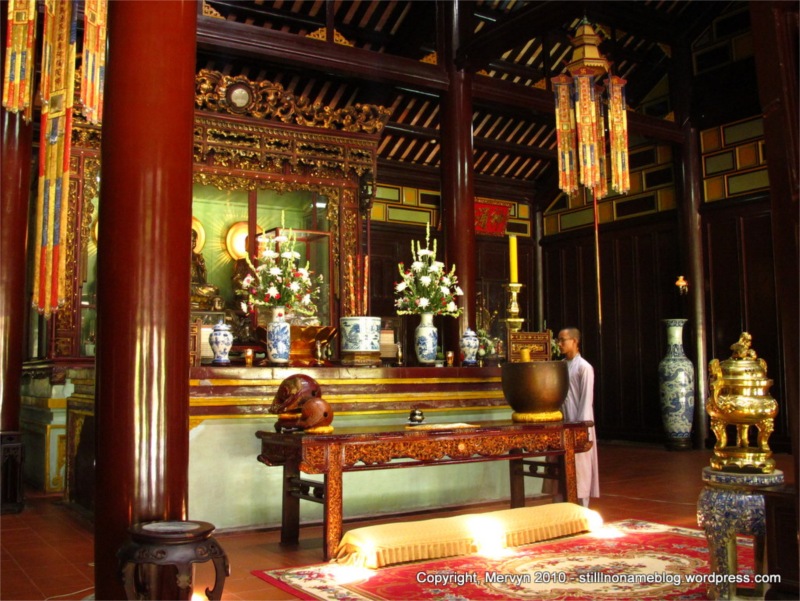
We headed out to another pagoda which, for the life of me, I cannot name. I get this way when I have more than one activity in my day. My brain is small, like a rotten walnut.
We stopped for lunch at a local place. So local, in fact, that no one spoke any English and we had to order food by pointing and praying.
We did not pray hard enough. We ordered two duck dishes after matching words from the menu to my Vietnamese phrasebook. They contained, as Reuben put it, “the saddest parts of the duck.” It was mostly bones with bits of tough, stuck on meat. We had to fight for anything tasty. We ended up eating all of the one vegetable dish we ordered and half eating the rest. And it was not cheap. And the power cut out halfway through our meal so we lost the electric fan. It was a failure of a meal.
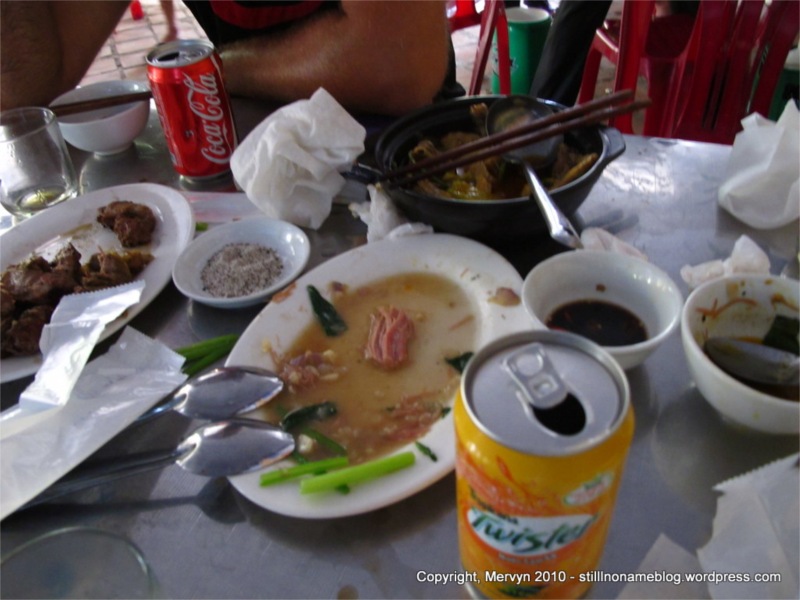
After confusing the locals, we set off for the tomb of Emperor Tu Duc. This was actually quite peaceful. Each Nguyen emperor constructed his own tomb during his lifetime. Tu Duc also used his as a retreat while he was still alive. Set off in a forest, highlights included the Minh Khiem Chamber which was used as a theater, the tomb for the empress, and a tomb for his adopted son. My favorite by far was Sung Khiem Pavillion where the emperor would hang out with his concubines and compose or recite poetry. It overlooks a lily-filled pond. The emperor apparently had concubines designated specifically for trips to his tomb. I like to think of them as his emo hos.
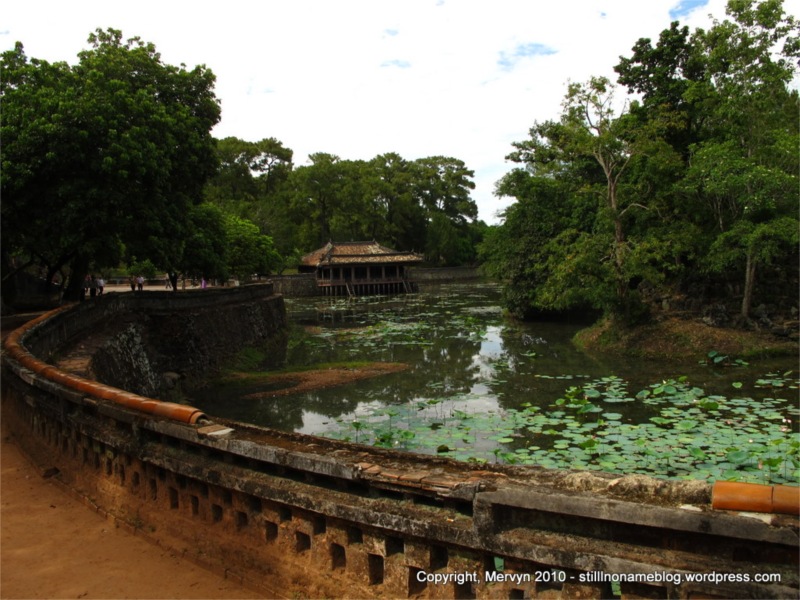
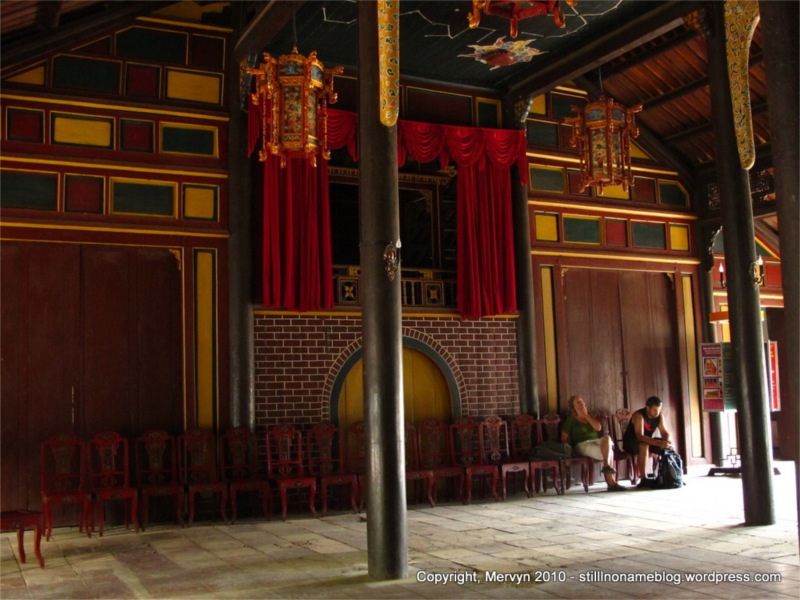
Finished with the tomb, we headed back to Hue. I took a quick shower in the hotel’s public bathroom, then Michelle, Reuben, and I all ended up on the same night bus to Hanoi.
My day-and-a-half in Hue finished off with a spectacular sunset over rice paddies taken in from a half-reclined position on the Hanoi night bus. A quite busy day. I felt a bit tired and hot. Indulging myself in a way the former emperors could not, I turned the vent from the bus’s air conditioner to my face and blasted myself with some freezing artificial breeze. Better to be an unemployed American today than a dynastic ruler 100 years ago.
GALLERY: Click through to today’s gallery for bonus pictures including sleeping monks in trees, a sunset over rice paddies, and Mervyn playing emperor sans poetry readings and concubines.
Day 80 – How’s Your Capitalism Treating You?
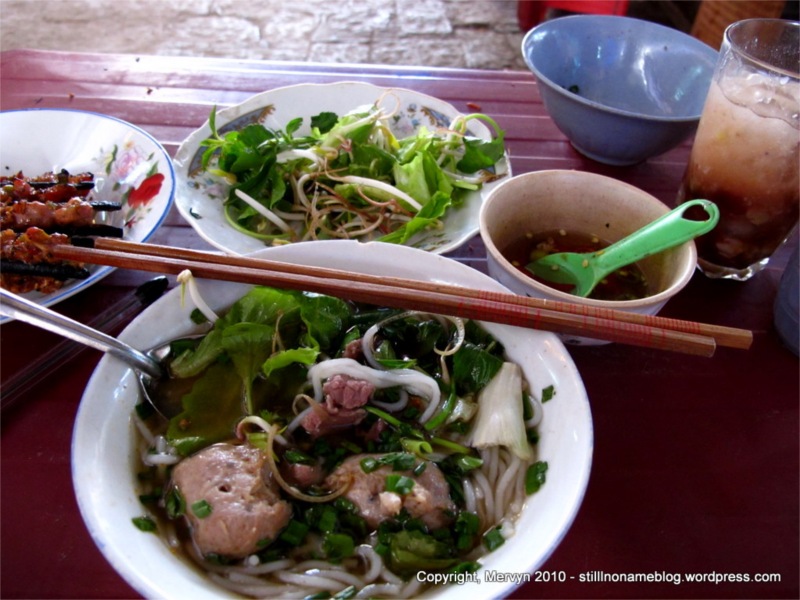
Dateline: Hue, Vietnam – Saturday, May 22, 2010
I’ve been outspoken that in Vietnam there’s no such thing as overcharging. I stand by that; if you willingly agreed to a price, then whatever you paid for it is worth it to you, even if later you find out someone else paid a lot less.
Not getting what you paid for, being lied to about what you’re getting, or paying for something you didn’t agree to are totally different things. That’s not someone taking advantage of a market inefficiency or working for price discovery. It’s a plain old swindle.
Here in Vietnam, I’ve had a pretty good experience. Of course, I’ve been overcharged. This mostly happens when I’ve just arrived at a place. After a bit of experience though, as I learn the market, I slowly am able to find the best price. There have been few cons.
That’s surprising considering the horror stories about Vietnam. Tales of cab drivers taking people to hotels that imitate reputable institutions; tour operators lying about the amenities included on a tour; or hotels pressuring patrons to buy tours from them or else kicking them out into the street. With all my good fortune, I’ve admittedly let my guard down.
I arrived on the morning bus from Hoi An to Hue (pronounced: hway). The ride was relatively uneventful, though again, I did find a bit more of the Top Gear road I’d found a few days earlier. It made me wish that I could make my way up the coast on a motorbike instead of a giant bus. We arrived in Hue around noon and I checked into the second hotel I visited, took a quick shower to wash off the travel grime, then headed out to find some food.
I opted to hit the Dong Ba Market to grab a bite to eat. This is an outdoor market that’s geared towards locals. It sells produce, meat, and household supplies. It’s the Hue version of Wal-Mart, but run by a hundred small-time proprietors. I wandered the stalls looking for a hawker stand.
I decided to take up an older lady’s offer for a bowl of pho. Immediately things started going awry.
She insisted that I sit at a table instead of at the little mini metal counter of her food stand. Without me asking, another older lady in the stand next to her plopped down a glass of sweet halo halo-like drink and some ice. Not necessarily a bad thing, because I needed a drink.
The bowl of pho came out and I started eating. Then the hawker lady put two beef balls in the pho. Okay, that’s fine. Then she brought out a plate of shrimp wrapped in rice paper. Then pork skewers, which the lady started pulling off the skewer real friendly like. Then some fried spring rolls. Then fresh vegetable spring rolls half-dipped in peanut sauce. I declined each successive offering.
After the second dish, I knew I was going to be in trouble. This lady was going to charge me for everything, even the stuff I didn’t ask for. I finished the pho, and out of curiosity tried one pork skewer and one rice paper wrapped shrimp. Mediocre at best.
I got up to leave and immediately the battle was joined. I asked how much and she said, “80,000 dong.” Now, this isn’t a lot of money in absolute terms. It’s only about $4.50. But, I’d had a bowl of pho with beef balls at a hawker stand with one pork skewer and a rice paper wrapped shrimp. At most, I expected to pay 30,000 dong or about 30% of what she wanted. This is even knowing that 30,000 is a bit more than the locals pay.
I threw up my hands and said, “80,000?” Pointing and saying numbers, I showed her I’d only eaten the pho, one pork skewer, and one rice paper shrimp. As I argued, I asked the drink lady how much and she said, “20,000 dong. “ A bit much, but fine. I paid her.
I went back to arguing with the first lady. She then pulled out some paper money and started matching a bill to each item. First she waved off 20,000 for me paying for the drink. Pseudo-generosity, since I’m sure she didn’t include that item in her 80,0000 quote. She then held a 20,000 note over the pho. Okay, I’m with her there.
Then a 20,000 note over the bowl that used to contain two beef balls. Not fine. Two beef balls is as much as a small bowl of pho. Then she held a 20,000 note over the uneaten skewers and the shrimp. As I suspected, she was trying to get me to pay for what I hadn’t eaten. She tried to get me to pay for the fresh spring rolls too, but she dropped that when I pointed out I hadn’t eaten them at all.
I argued a bit more, but she kept pointing and holding up money. I gave up, realizing that this was way more trouble than it was worth. I looked at the other hawker ladies and shook my head. I looked at my pho lady and said, “Really? Still 60,000?” She nodded.
I handed her the money in disgust and that was it.
In the cool, rational world that is some time after the incident, I can see where I made my error. I should have asked what the price was before I sat down. Then, no matter what she put in front of me, I’d have just been able to pay what I’d agreed on. That was in my control.
That doesn’t absolve this woman, who’s probably my mother’s age, from her deceit. She pretended to be friendly, “helping” me eat by putting food in front of me, but she knew I could never eat it all. She also knew I had a language deficit and that, at the end of the day if things go bad, she has home court advantage. She could get away with a lot of stuff that I, as an interloper, cannot. Best part is, the whole thing went down so fast that I’m positive this lady had done this before.
In the end, I learned my lesson. Little old ladies can be just as deceitful as any other operator. You can’t let your guard down just because she seems friendly and helpful. And, always agree to a price before you sit down.
The day wasn’t all nasty experiences that for a time made me irrationally hate senior citizens. I ran into Michelle and Reuben, the Irish/Spanish couple I met on the Mekong Delta tour. I’d run into them in Hoi An, as well. Seems we’re on the same travel trail up the Vietnam coast. We agreed to meet up tomorrow to rent motorbikes and visit the historic citadel and nearby emperor’s tomb.
Tonight, we had dinner at an outdoor local spot by the river, sipping on local beer that was “brewed by Danish technology” which could mean that something in the brewing process, perhaps a metal spoon or a thermometer, was owned by a Dane.
As we sat in our little plastic chairs at our little plastic table with hordes of Vietnamese around us, I told them Reuben and Michelle my story. After a good, rueful laugh, we made sure to ask for menus. As I flipped through the pages with prices and items, I sneaked a peak at all the waiters and waitresses. Nary an old woman in their midst. And just like that, I let my guard down, just a little.
GALLERY: Click to see today’s gallery which includes pictures of the Top Gear road, pictures of a gate to the old citadel, and a giant flag pole.
 The Overpacker