Dateline: Beijing, China – Sunday, June 20, 2010
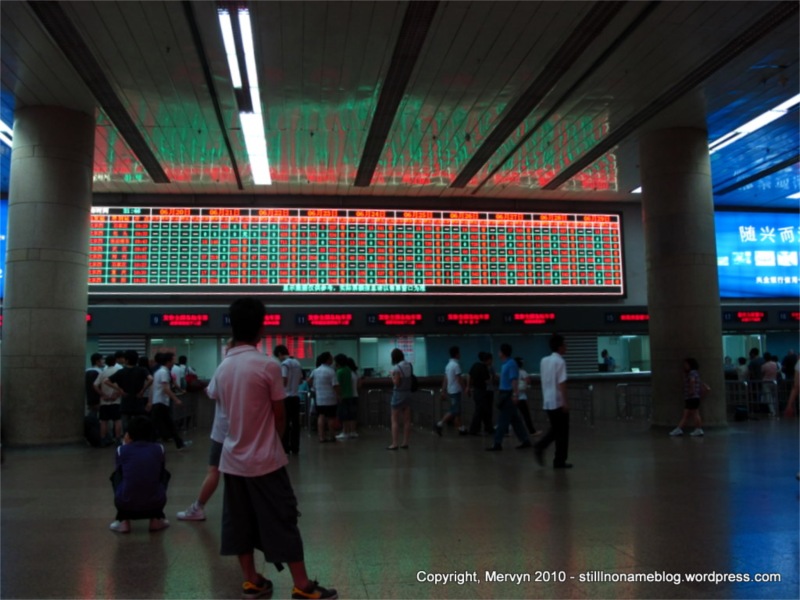
Ah, yes. After nearly 33 years of traveling, to my memory I’ve never missed a flight, train, or bus. I’ve missed connections, but those were due to weather. I’ve been bumped from flights, but that’s the airline’s problem, not mine. I’ve come close a couple of times, but have made it every time. Guess there’s a first time for everything.
I started off well enough. Got up late, packed my hand laundry from the night before, enjoyed my private bathroom with proper Western toilet. I loaded up my stuff and met April and Lillian for a Peking duck lunch. April headed off to the airport, I hung out with Lillian at her place, doing some major entry writing and picture culling. Read more…
Dateline: Beijing, China – Saturday, June 19, 2010
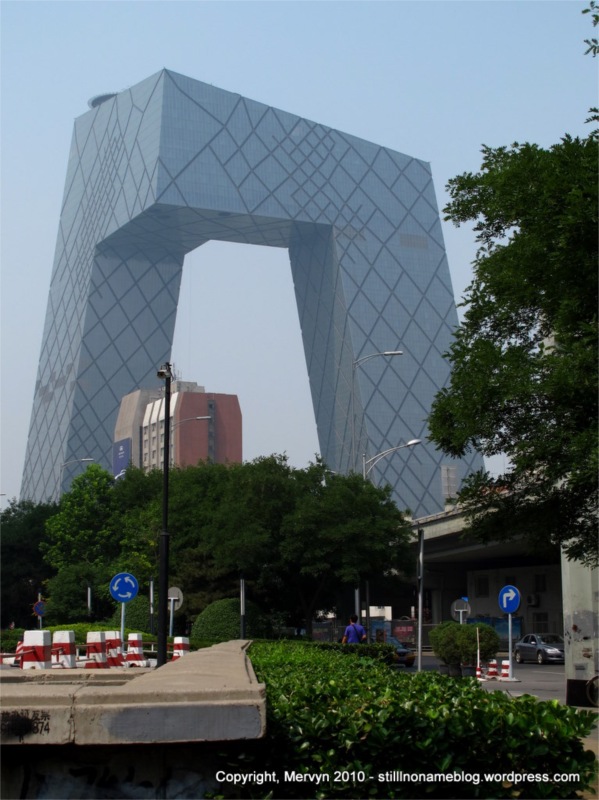
Getting lost coming out of subways is really easy. It’s even worse when you can’t remember which subway station need to go to. That’s the scenario today when April and I tried to find Din Tai Fung for lunch. I’d been there before, but for some reason I couldn’t get the subway station right this time around. This was especially frustrating since I was hungry.
There was one upside. We stumbled across one of the iconic, funky office buildings in Beijing. Unfortunately, I don’t know it’s name [Ed. China Central Television Headquarters], but I do know that it’s famous. Read more…
Day 107 – World Sport (A Return to 798)
Dateline: Beijing, China – Friday, June 18, 2010
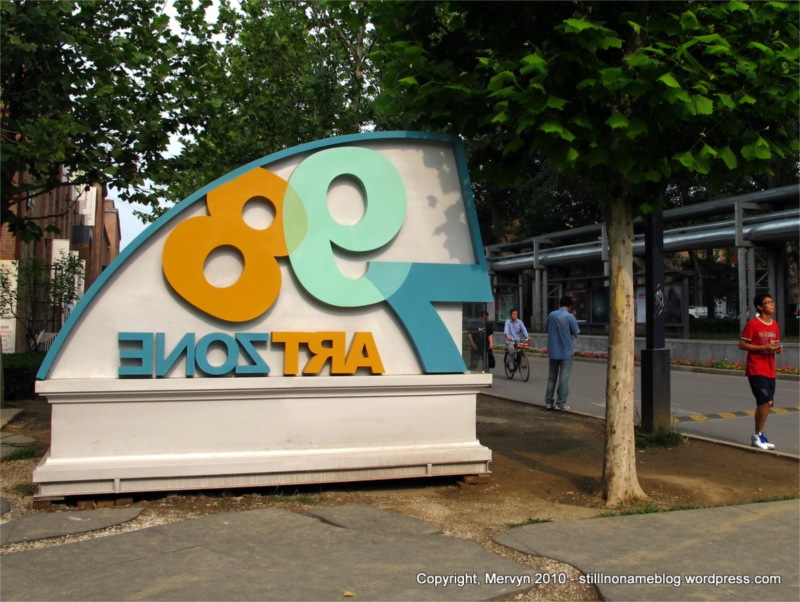
Yesterday was a trip to Beijing’s 798 Art District. Today was a return, this time with Lillian’s out-of-town friend April. But first, Game 7 of the Lakers-Celtics series. You knew this was coming. Read more…
Day 106 – Art Amongst The Factories (798 Art District)
Dateline: Beijing, China – Thursday, June 17, 2010
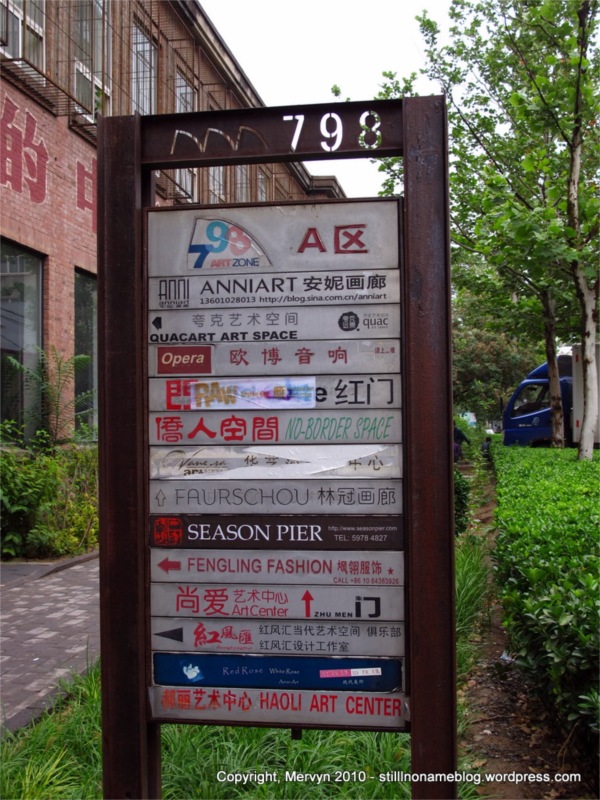
Beijing is a great city if you love history. The Forbidden City, the Great Wall, Lama Temple, all are gateways into the past. Beijing is also great if you like big wide boulevards and lots of cars and smog. It’s a modern city to rival any other.
Beijing, I’ve discovered, is a lot like Los Angeles. If you try to take it in on your own, you get one impression of the city, but when you go with a local you get another. If you visit L.A. on your own, you think it’s all traffic and sprawl. Miles of freeway with a bland assortment of buildings in between. Visit with someone who knows where to look and you’ll find interesting neighborhoods tucked into surprising places. A little taqueria that serves the best BRC burritos, a cluster of Korean restaurants that serve the best bulgogi this side of the Pacific, or a hidden park with joggers and families out with their kids. Like L.A., Beijing’s treasures are there to be discovered, you just have to know where to look. Read more…
Day 105 – Victory! (NBA Finals, Game 6)
Dateline: Beijing, China – Wednesday, June 16, 2010
Game 6. A blowout. Instead of going to The Den, I watched the game in the hostel. No English audio, but the video is much better. Chinese TV is using the NBA TV feed, which means there are fewer commercials. The Den used a Filipino channel to get the English audio. The price, however, was having Filipino TV producers. They’d use the ABC feed, but layer over their own commercials. They’d cut away from those highlight packages that you normally see in America to show a commercial where a transvestite hawked donuts (seriously). They’d time their commercials poorly and cut back to the game already in progress. They’d cram commercials into 20 second timeouts.
After watching the Chinese feed today, I realize that these practices were as annoying as hell. Watching a regular broadcast, even with Chinese announcers and no crowd noise, was much better. I also avoided all the Celtic fans and Laker haters that dominate The Den. Big plus.
With the Laker win, the series is going to seven games, a rare NBA treat. For now, let’s just say I’m optimistic about our chances, but I wouldn’t be surprised if Boston wins. I’m prepared for anything.
And that’s it. Spent some time writing, buying a train ticket, and trip planning. Call it a vacation day from my vacation. Periodically need one of those.
GALLERY: What, you want pictures of Mervyn shopping and writing? Come back tomorrow, when Mervyn hopes to visit Beijing’s modern art district.
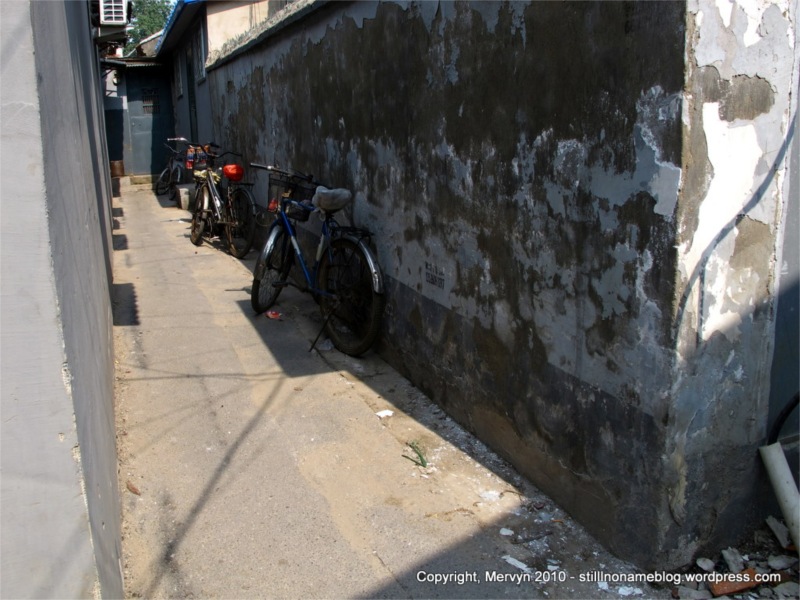
Dateline: Beijing, China – Tuesday, June 15, 2010
Everyone expects China to “succeed.” It’s the most populous nation on the planet and therefore has the largest market and workforce. It’s blessed with natural resources. Its people are industrious . Everyone is clamoring to board the train fitted with the largest economic engine on earth. The Chinese government can, when it puts its mind to it, kick some major ass, even at little things like putting on the most awe inspiring Olympic opening ceremonies ever. China has nukes. China is the dragon. The juggernaut. It will not be denied. It is the new superpower.
Not so fast, buddy. After being here for a couple of weeks, it’s not so clear to me that “success” is a foregone conclusion. One major hurdle to that success: a surprisingly fragmented society.
We in the West aren’t sensitive to the amount of regionalism in China. We see hundreds of men pounding on drums at the Olympics or the images of thousands of Beijingers on bikes and, because to our eye they “all look same,” we unconsciously think that China is as uniform and united as that massive drum troupe.
That’s not entirely inaccurate. The majority of people are ethnically Han Chinese at 92% of the population. Everyone in China shares the same writing system. Chinese people all live in Asia and are within China’s borders. You know, so they’ve got stuff in common.
But there are major divisions. The population is split by eight major Chinese dialects and numerous regional accents that can make auditory comprehension difficult. There are also 56 ethnic minorities recognized by the government as “Chinese.” Each minority has its own peculiar culture, look, and language (each not counted as one of the eight major Chinese dialects).
A Uyghur, for example, is most likely Muslim, doesn’t speak Mandarin (China’s official language), can look Russian, and has probably never met an American. A Cantonese probably doesn’t speak Mandarin and probably has a relative living in the United States. Someone from Sichuan probably doesn’t speak Mandarin, looks more Southeast Asian than Han and likes their food spicier than a Thai person. And don’t even think about asking a Taiwanese if they’re from China.
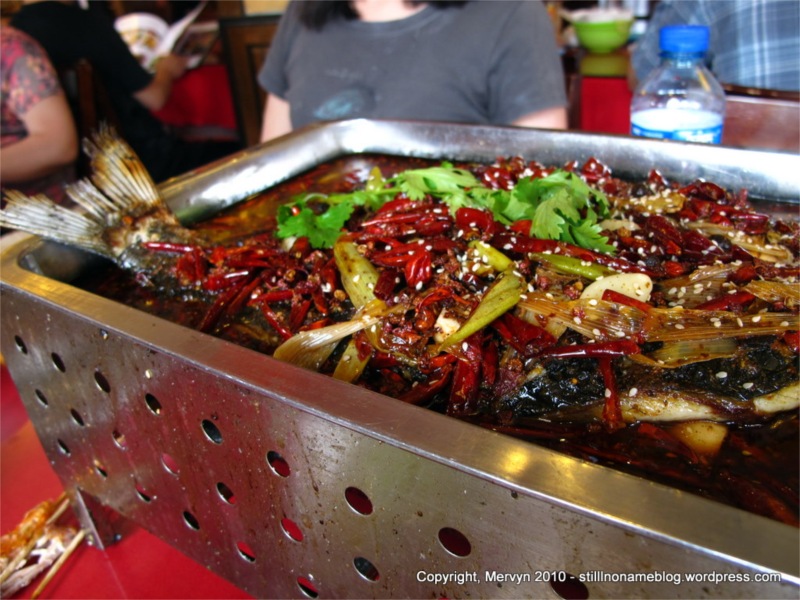
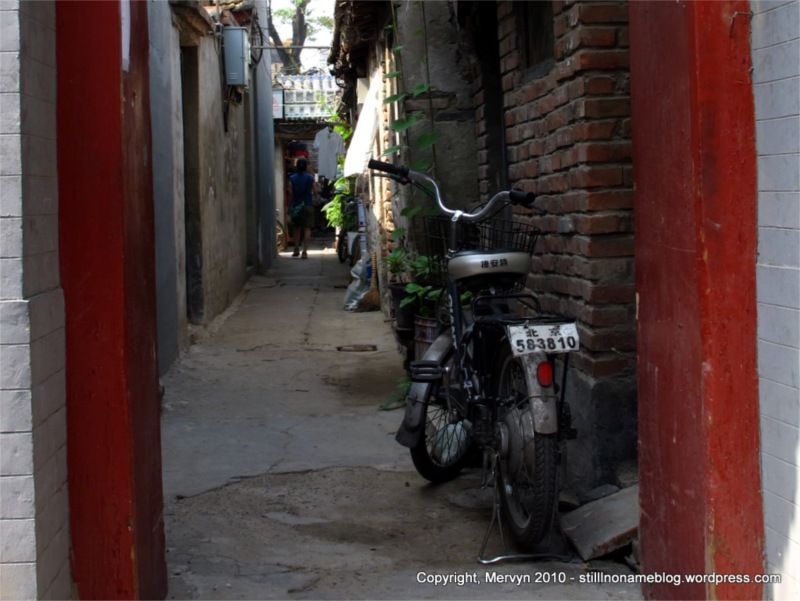
All these differences come to light dramatically in Beijing. Beijing is the second largest city in China and attracts a lot of out-of-town job seekers. It’s diverse in the Chinese sense of the word—residents don’t represent a lot of different races, residents represent a lot of different Chinese races. How these various people treat each other is a window into China’s divisions.
While the city is Chinese diverse, it’s hard to call it inclusive. If, say, your parents are from Sichuan, you moved here when you were 2 years old, you’ve lived in Beijing your whole life and speak Mandarin with a Beijing accent you will still never (I repeat never) be considered to be from Beijing. Beijing citizens will always identify you as Sichuan.
People actively defend the purity of their region by identifying outsiders and denying them insider status. The concept of accepting differences does not come naturally to Chinese people. They are very aware of place and heritage. They are so aware of other Chinese people’s origins to the point that it’s not just that other Chinese people come from different parts of the same country, but it’s as if those people come from different countries altogether.
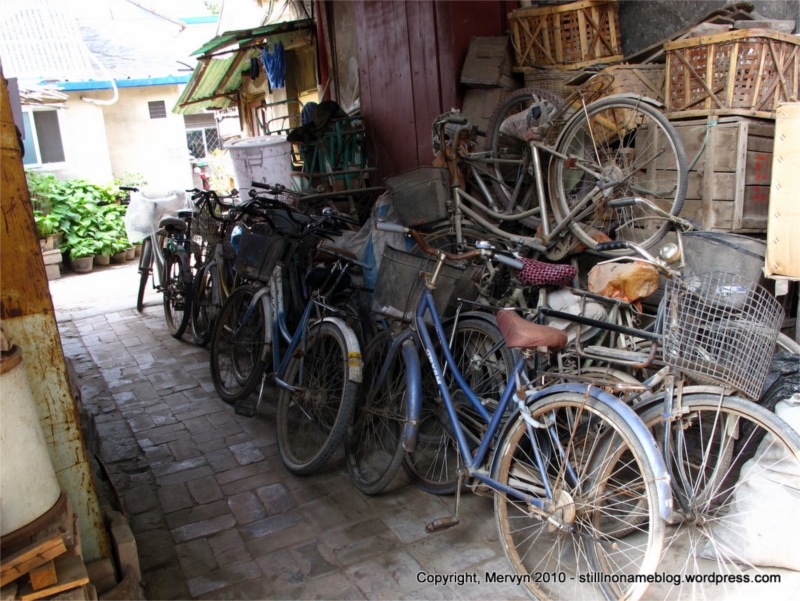
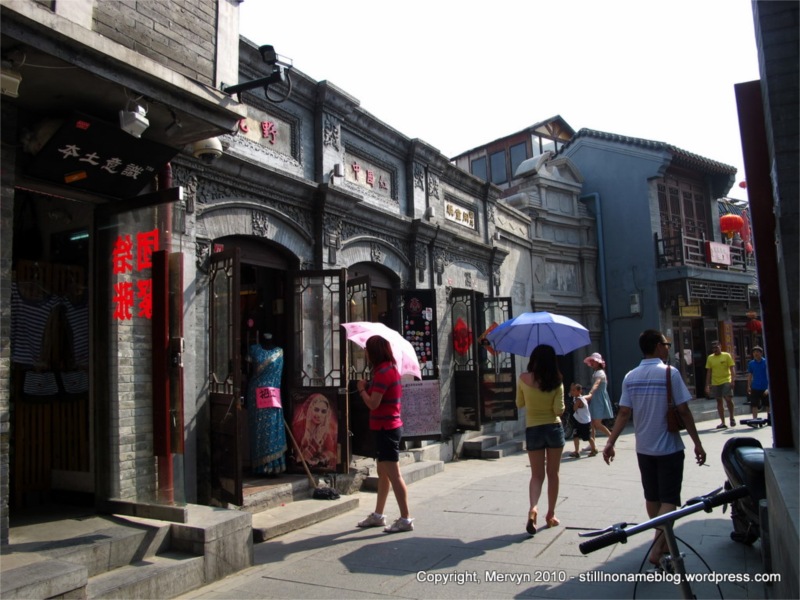
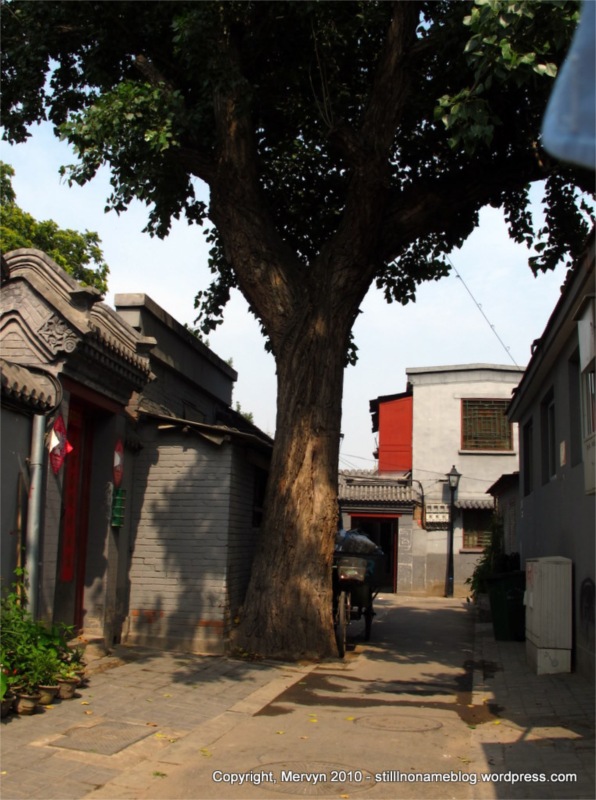
Max saw a documentary on the English CCTV government run channel that looked at a guy whose family was from the city and a girl whose family was from the country. The drama: whether they could make their relationship work. The parents were worried that the girl would drag their son down despite the fact that she’d lived in the city for nearly her whole life and (here’s my favorite part) she made more money than him. To them she wasn’t an insider and therefore she could never fit in.
It’s not just that she’s “country” and he’s “big city.” Status and heritage matter. He is a city insider by virtue of his birth. She will always be an outsider because of her parents. The reason why the above situation warrants a documentary is that most guys from a big city like Beijing won’t consider dating a girl who is not native (in the Chinese sense of the word). In this country, who your family is and where you’re “from” is huge (probably 1 or 2 on the “List of Date Questions That Matter”).
Until recently, government policy perpetuated this hyper-regionalism. If I remember correctly, until about a decade ago, Chinese people weren’t allowed to move from city to city without applying for a government permit, which wasn’t easy to get. Chinese people basically had to immigrate within their own country.
From the government’s perspective, this policy made sense. They didn’t want people flooding to the large cities to look for work and, in the process, overwhelming the existing infrastructure. There are 1.5 billion Chinese people. If just 0.001% of them decided to move to Shanghai, it would swell the city’s population by 1 million people.
The effect, however, was to further isolate one region from the next, creating one more barrier to uniting the country. A Beijinger wasn’t just a Beijinger because of language, food, and culture. She was a Beijinger because the government made her one. A Beijing citizen practically lived on an island.
The Chinese government is aware of the regionalism and works hard to combat it. Regional differences is one of the reasons that the Chinese government exerts so much control over its population (the others probably include greed, a desire to maintain power, and genuine benevolence). It’s a fight to keep all these people thinking that they’re part of one country. If there were a free press, for example, certain regions might start thinking they could make it on their own and create political unrest. Tight control over the Internet, movement, and protests means the government can isolate dissidents and keep a handle on all these diverse, self-interested, often far off, peoples. And there are a lot of peoples to handle.
In fact, history shows that keeping control over all these regions is a bloody, costly affair. Qin Shi Huang, the first emperor to unite China, enslaved hundreds of thousands of people in order to conquer six major kingdoms. He managed to standardize measurements and, more importantly, writing. (Short aside: This legacy lives on today. When two people from different dialects meet, even though they can’t understand what the other person is saying, they can write to communicate.)
Despite his monumental efforts, China was destined to split and reunite many times after his death. It doesn’t take a historian to surmise that these divisions and reunifications weren’t always peaceful, contractual affairs. There’s a history of various kingdoms splitting off to go it on their own. Unity seems more the exception than the rule.
That’s the danger China faces rights now. So long as the current government can give the people what they want—decent standard of living, jobs, peace, economic growth—citizens will put up with restrictions on the media, Internet, protests, and domestic and international travel. They will buy the idea that restrictions keep the peace. Some Chinese actually welcome these restrictions. They don’t trust their fellow citizens with the freedom to read or write or watch whatever they want. They fear giving other Chinese people avenues to create trouble and disturb the peace and prosperity.
If, however, the government can’t deliver on the basics of stability and growth, you’ll probably see more turmoil. All the geographic, cultural, and language differences will crop up. People will start to wonder what good it is to have power centered so far away in Beijing and to have their lives run by people who aren’t them.
China recognizes this danger, of course. They’ve created incentives to move Han Chinese—the ethnic majority—to the more unruly regions like Tibet in order to dilute the power of dissatisfied minorities. They crush any signs of insurrection to preserve peace and stability. They are hypersensitive to criticism–they do not want to appear weak or unable to provide. They adapt quickly when people demand it—note the difference between the government’s reaction to SARS (secrecy, denial), the Chinese people’s angry reaction, and the subsequent response to H1N1 (aggressive, more open).
Personal freedoms aren’t a high priority for the government or its citizens. They have bigger fish to fry. The country needs a tremendous amount of economic growth to keep the people happy and cannot afford to be distracted by political unrest or troublemakers. If the government says unity is necessary to growth and that unity requires personal restrictions, then the people will put up with restrictions so long as the government delivers growth.
I’m not defending their practices. I’m not sure what’s best for this country. I do, however, think that it shows that China’s success is not a foregone conclusion.
The government certainly doesn’t think so. It recognizes China’s divisions. If people started doing what they thought was best for themselves, the government believes it might undermine a unified China. The government believes a unified China is essential to success.
I tend to agree. The reality is that certain parts of China might be able to go it on their own and—considering they have a different language, culture, and religion—they might just give it a try. China cannot be the juggernaut we think it is without the natural resources of the more remote, dissident parts of the country. It cannot dominate without all its people pulling together. China’s power lies in its people and its resources. It will be a struggle to gain respect from the world as it is. No matter how you define “success” it will be harder to come by if the country is splitting at the seams. In essence, China is fighting on two fronts: working to gain respect and status amongst the world’s nations and simultaneously working to unite a historically divided country.
Success is likely, but it’s no sure bet.
[Ed. The predictions in this article are presented for entertainment purposes only and should not be construed as gambling advice. The opinions expressed herein are not the opinions of this website, its advertisers, the editorial staff, or anyone at all other than maybe the author, a man who has spent a total of 15 days in China and hasn’t read more than a cursory treatment of this country’s long, complex, rich, proud, glorious history—administer grains of salt as necessary.]
GALLERY: Click through to today’s gallery to see pictures of food including China’s version of French fries, bonus hutong pictures, and a picture of Mervyn’s travel companions on appropriately sized bikes.
Day 103 – Olympic Stadia and the Unstoppable World Cup
Dateline: Beijing, China – Monday, June 14, 2010
Kobe and I are about the same age. As a Laker fan, I’ve been watching him play since his rookie year. He was starting up in the NBA and I was getting used to dorm life in college. Over the past 14 years, I feel like I’ve learned a bit about him as a basketball player.
As a fan, you can see when he’s about to erupt. Kobe will dribble the ball across the half court and the Laker faithful know he’s going to jack up a three. He has this look about him that says, “I’m going to score, consequences be damned.” If he hits the three, you know what’s coming next. He’s going into attack mode. For the next few possessions, he’s going to take the whole opposing team on his own. It’s like he’d hate to think that, win or lose, the team didn’t try to do it with its most potent weapon. He believes he’s the team’s best weapon, so he’s going to use it. Over and over again.
Over the years, this means we Laker fans have been treated to some amazing feats of basketball. It’s like watching that great white shark from the “Planet Earth” series take down a seal. You just shake your head and say, “Damn. . .” Just ask Dwayne Wade about that. He was in attendance at today’s Game 5 and when Kobe went on this 19 straight Laker point tear, he did the same thing we fans have been doing for years.
Kobe jacked up long threes, hit fading turnaround jumpers from the baseline, and knocked down off balance floaters in the lane. Some shots were just bad shots. Bad ideas. Shots that a player with a conscience would feel terrible about. Not Kobe. They all went in. It was nasty.
Unfortunately, when Kobe goes on one of these streaks, his teammates tend to zone out. They end up watching him like we fans do. When it comes time for them to help out, they aren’t in the rhythm of the game. It’s like they have to get up off their mental couches, switch off their mental TVs, and jump into a basketball game while still wearing their pajamas. They’re just not ready.
I think that’s what happened last night. The Lakers had turnover problems, shot problems, bench problems. Kobe took over the 3rd and kept them competitive, but the rest of the team wasn’t ready. I can’t remember a Pau Gasol play from the second half. He should have been demanding the ball. Screaming at people to get him involved. He is their second best weapon and, for two quarters last night, he disappeared.
Ah well. This series isn’t over. There are two Laker home games coming up. The Laker bench will play better at home. The Celtic bench shouldn’t be as much of a factor. My guess is that the Laker turnovers go down and the offense starts to click. Fewer 4-minute scoreless stretches.
That said, I can’t say I’m optimistic. I’m a Laker fan, but I still stand by my gut feeling that the Celts are going to pull this out. I hope not. If nothing else, this series has renewed my hatred of Celtic green. When the Celtics beat L.A. back in 2008, I consoled myself with the fact that KG and Ray Allen finally got their rings. I liked them as players.
These days, not so much. They have their hardware. If I have to put up with listening to loudmouth Boston fans crow about how their team owns ours, I’m going to be sick. I don’t want to hear all the Laker-haters say that my team sucks and is all flash and no heart. More than the joy of winning, I loathe the horror of losing. The Lakers are a high profile team and people just love to pile on when the going gets tough. Hey. I can’t help that I root for this team. I was born this way. You don’t choose to be a fan, circumstances dictate it. Just ask Cubs or Cavalier fans.
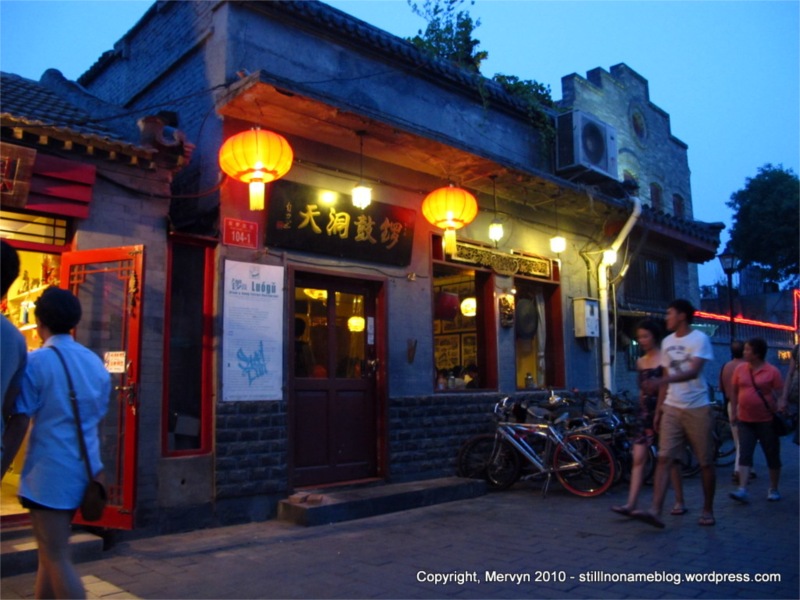
Okay, enough basketball. Let’s talk food and Olympics. Max and I had dinner at Drum and Gong Fusion Restaurant in Nanluogu Xiang, one of Beijing’s more famous alleyways. Rumor has it that this area (or portions of it) will be developed. I have no idea why. It’s not an authentic hutong (far too snazzy and commercial for that), but it does retain a lot of the flavor. I hope the rumors aren’t true.
We ended up sitting outdoors on the roof. The restaurant claims to be fusion, but everything on the menu seemed to be strictly Chinese. It didn’t even seem like they were fusing different kinds of Chinese food (Sichuan and Taiwanese, for example). Our dishes: sweet and sour fried fish (whole), beef and vegetable grilled then steamed in lotus leaf, pork stuffed eggplant, and bullfrog clay pot. Everything was delicious. If you don’t know, bullfrog is a lot like chicken except the meat is a lot softer. It was served with the bones so working to get at the tasty bits took some work.
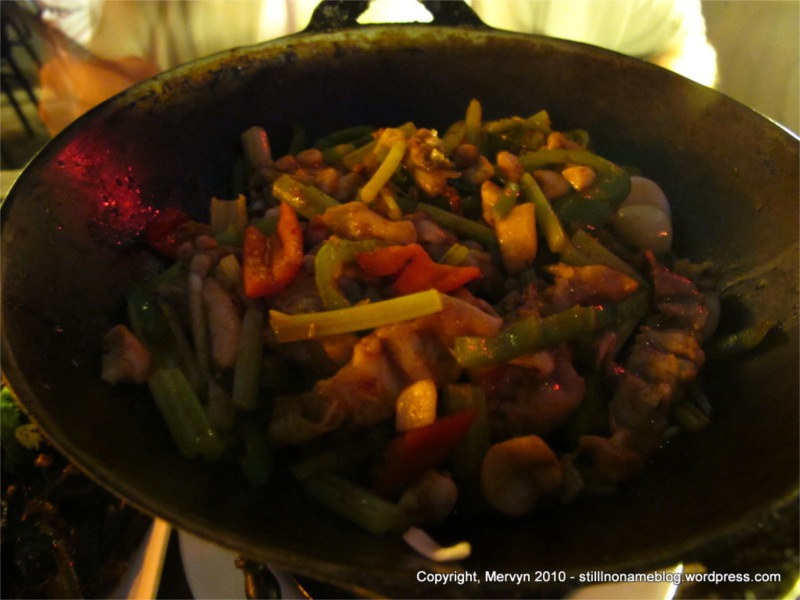
The beef in lotus leaf was especially tasty. I’ve had sticky rice and pork in lotus leaf at dim sum and didn’t find it memorable. The beef, though, was nice. The fragrance of the lotus leaf was lightly infused into the meat. It wasn’t overwhelming, just a subtle hint. Enough to lighten the meat flavor.
The surprise of the night though was the haw juice. My Chinese friends all know what haw flakes are, having eaten them as kids. The little cardboard-like disks are pink and have a slightly sweet taste to them. No one, however, has been able to tell me what haw flakes are made of. I’ve joked that they’re leftover pig parts, dried and compressed and seasoned with a bit of sugar then sold to kids as “candy.”
Turns out I was wrong. Apparently, haw is a kind of wild berry. At least according to the picture on the bottle of the haw juice. It tasted like liquid haw flakes, which is really weird since I always assumed haw flakes got most of their flavor from some chemical preservative.
An awesome discovery all around, though. The haw juice alone would have made for a great meal. The fact that the dishes were delicious and that we got to sit outside put it over the top.
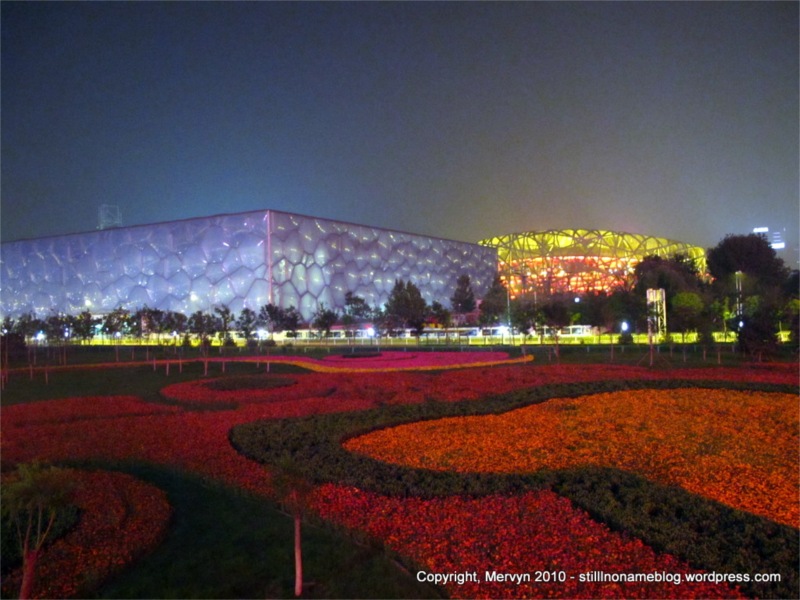
Afterwards, we took a cab to the Olympic Stadiums. They were closed, but we were able to walk around the outside. The Water Cube wasn’t lit up, but looked impressive nonetheless. It’s a lot bigger than I expected. The Bird’s Nest was about what I thought it would be. Too bad they’d closed off the park area and weren’t allowing pedestrians.
When China hosted the Olympics, they decided to go big. The boulevards are wide. The stadium area is something like three miles long and dotted with venues and parks. Every event had its own stadium. Fencing, wrestling, ping pong, each got a separate building. I didn’t realize that, during the Olympics, you weren’t allowed to walk within three blocks of the stadium area unless you had an event ticket. China also sent somewhere around 1 million migrant workers home for the duration of the games.
It’s modern building on a grand scale. Imposing, impressive, lots of lights and a bit over the top. In other words, very Beijing.
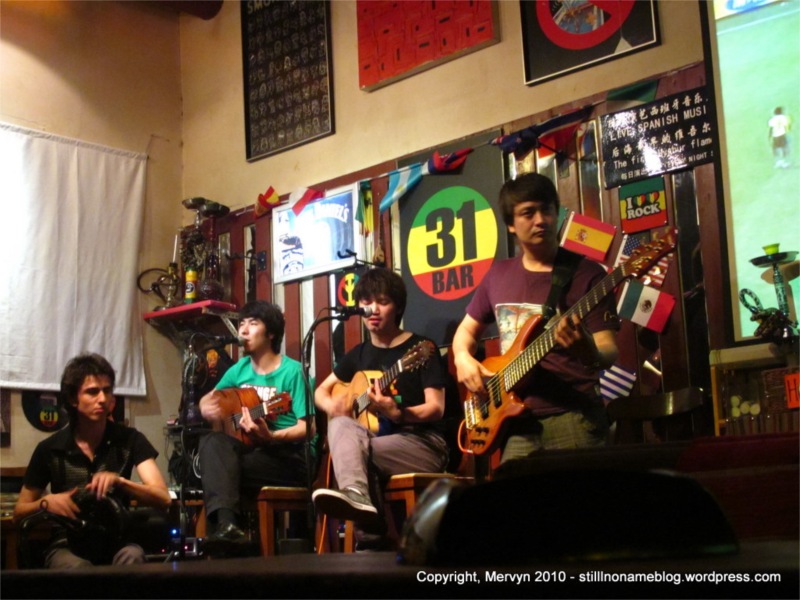
As a night cap, we went back to Houhai and 31 Bar to listen to Uyghurs play Spanish music. If there was any doubt that World Cup fever’s captured Beijing, our walk to 31 Bar confirmed it. Every restaurant and bar had at least 3 TVs tuned to the live game. Everyone was watching. During the whole walk to 31 Bar at the back of the lake, we had an uninterrupted view of the game. Even our Uyghur buddies were into it. The bar projected the game next to the band on a giant screen. Nothing stops World Cup. Nothing.
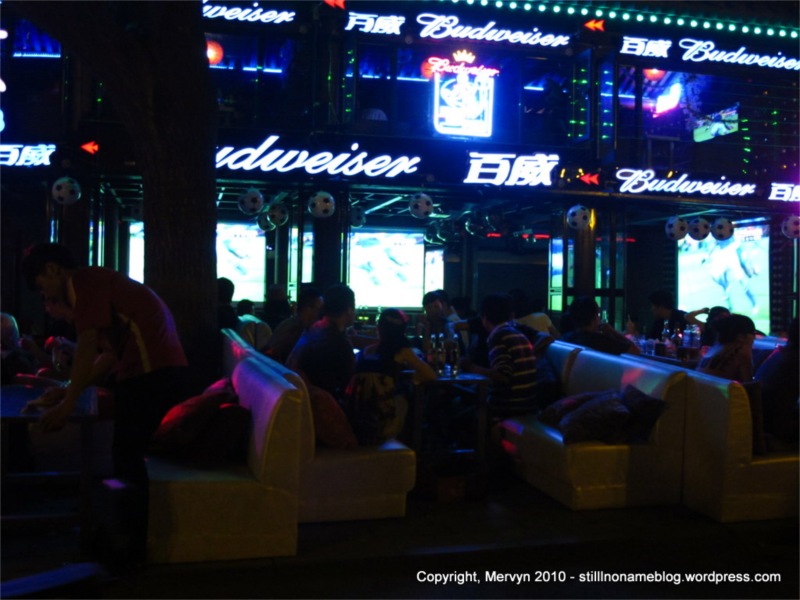
GALLERY: Click through to today’s gallery to what haw really looks like and to see more pictures of the Olympic Stadium, some taken by squeezing the camera through the fencing.
Day 102 – Mo’ Pants, Mo’ Problems
Dateline: Beijing, China – Sunday, June 13, 2010
For the past three and a half months I’ve been alternating between two pairs of pants: brown trousers and khaki cargo convertible pants. Go back and check the pictures. I’ve practically worn through them over the last 102 days. I also haven’t worn anything other than shades of brown.
Because of that, I decided I’d buy a pair of cheap jeans from a local clothing bazaar that’s near Stanlitun called the Yashou Clothing Market. Five floors of clothing madness with little stalls for everything you could ever want from bags to shoes to jewelry. I think every Asian country has one of these, usually near a high end Western-style mall. It’s clothing for the people.
I ended up buying some fake jeans from a girl who all too quickly agreed to my second offer on price. While waiting for my change, I chatted with a Filipino guy who told me, in Tagalog, that I could have paid half. Ah well. That’s the way it goes. I keep thinking, “What am I willing to pay?” instead of “What are they willing to sell it to me for?” While I like to think I’m getting better at this bargaining thing, I’m pretty sure I’m mediocre at best.
I wandered around the mall looking for a t-shirt to go with the two that I’ve been wearing since the beginning of the trip. No dice.
I was reminded why I’m not much of a shopper. By the third store, I just wanted to go online, click though tons of t-shirts, and pick one and have it shipped to me. I wanted to stop walking around, trying to find stores, looking at labels to see if the shirts were blends (not 100% cotton, which takes forever to dry), and waving off sales people. I’m an impatient shopper. I can spend three minutes at most digging through a sales rack before I start to wonder whether it’s all worth it. I have no idea how women do it. I have no idea why they do it for fun.
Perhaps it’s sort of like those guys who think walking around the beach with a metal detector hunting for “treasure” is fun. They’re in it for the discovery and for the thrill of finding something cool and unexpected.
I don’t get those metal detector guys, so I still have no idea what would make it fun. When I shop, I know what I want and I just want someone to give it to me. “Blue t-shirt, blended fabric, medium size, non-hideous picture or logo, right now.” I think this attitude is why I sometimes overpay. If I’ve found something I want, I can’t stomach the idea of walking away from it and having to hunt for it again at some other stand. If you’re not willing to walk away, you end up paying a bit of premium.
For dinner I met Lillian and her friend April at a Taiwanese restaurant near the Worker’s Stadium. It was pouring rain and I ended up putting my rain slicker to good use. I put my camera in my rain coat and totally forgot to take pictures of food. That means I only vaguely remember what we ordered. I do remember it was good.
That’s that. A lazy day tourist day. Nothing to report. Even less to photograph. It’s the privilege of traveling leisurely. You can take days off from sightseeing to do “normal” junk, all without the dread of having to go to work the next day. The price: wearing the same pants and t-shirt combo for 100 straight days.
GALLERY: None. Weren’t you paying attention?
Day 101 – Gimme A Hutong (Plus, Clubbing in Beijing)
Dateline: Beijing, China – Saturday, June 12, 2010
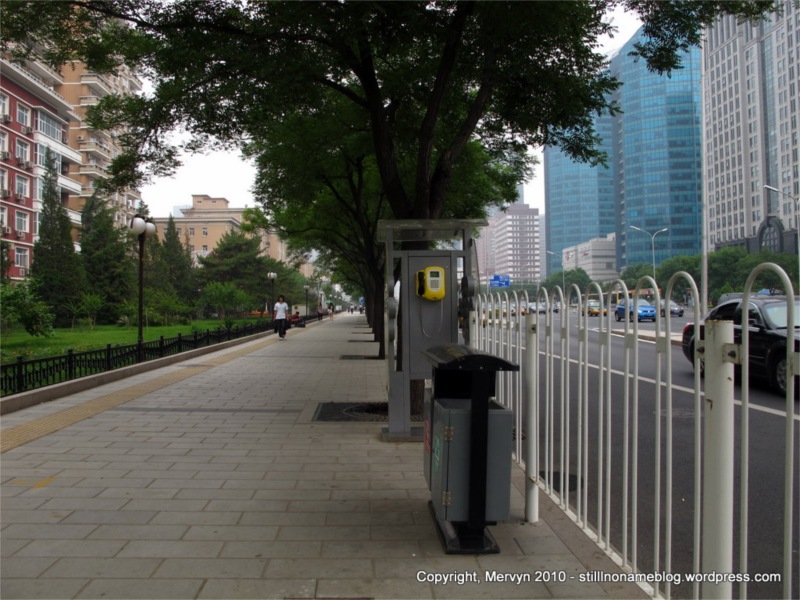
I complained about Beijing being impersonal and having lost its soul. It’s been seven days and nothing I’ve seen has changed my mind. The city is a gigantic sprawl. The buildings are so far back from the road that, when you walk down the sidewalk, it’s hard to feel like you’re making progress because it doesn’t feel like you’re passing anything. Traffic is mostly cars and is always constant. The smog here makes L.A. look like British Columbia—sometimes, when I stare down the road, I can barely make out the next traffic light.
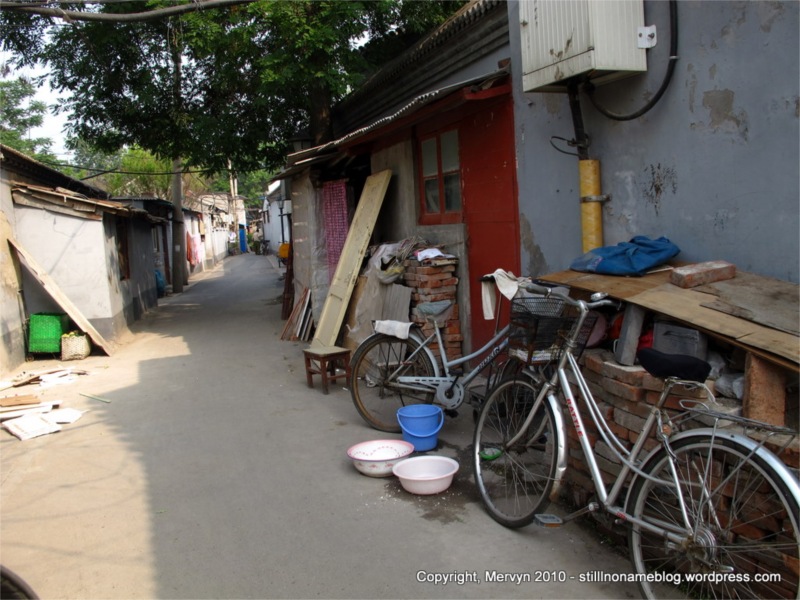
Today, I hoped I could find a bit of what’s left of old Beijing. Rumor has it that there are places where you can still find the old town. Between the big buildings and new developments, some neighborhoods have survived. These hutongs, or alleyways, tend to run east-west to protect from dust storms that come from the north in the spring. The hutongs tend to be narrow, usually just wide enough to accommodate one car. I’ve heard that some are much smaller, with barely enough room for two pedestrians to pass. The hostel I’m staying at is actually in a hutong.
Hutongs are scattered around town, so the best way to explore them on your own is to rent a bike and duck into a hutong if it looks interesting. I decided to combine this with a bike tour suggested by my tour book which ended around Houhai Lake. I rented a bicycle (20 rmb or $3.10) and headed off to the Forbidden City.
Being on a bike changes Beijing. You’re no longer on an urban death march to nowhere. The city shrinks just enough to make it feel accessible. You can pedal, coast, and enjoy your self-made breeze. Just keep an eye out for cars which, you’ll discover quite quickly, do not stop on right hand turns even if you’re directly in front of them.
The route took me past the south palace moat which I didn’t realize doubled as a park. Willows lined the road and rustled in the wind. Chinese people lounged by the water in the shade.
Even though it looks like it might be restricted, you can bike right past the Meridian Gate, which is where most people start their visit to the ticketed portion of this national landmark. For a split second, I felt like I was in old Beijing, pedaling along cobblestone in the shadow of the palace wall. A bit farfetched, perhaps, but maybe not, since the last emperor reigned into the early 1900’s.
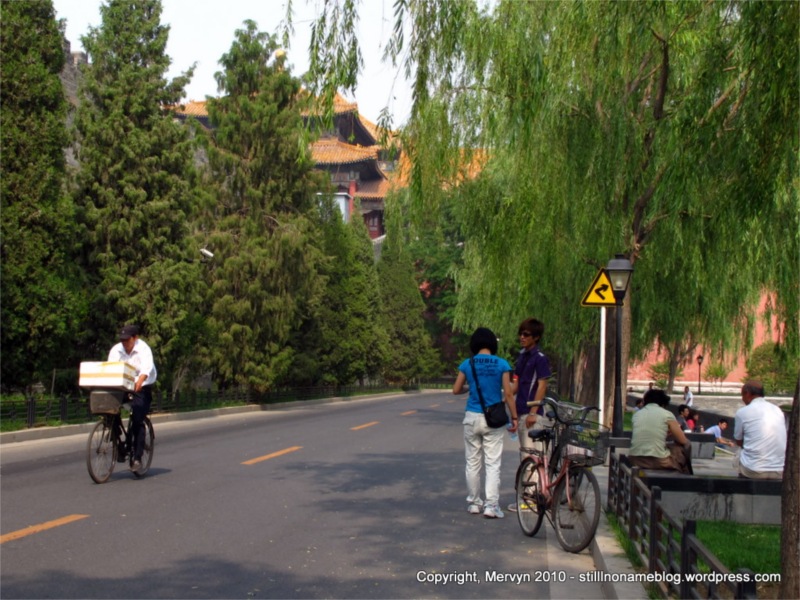
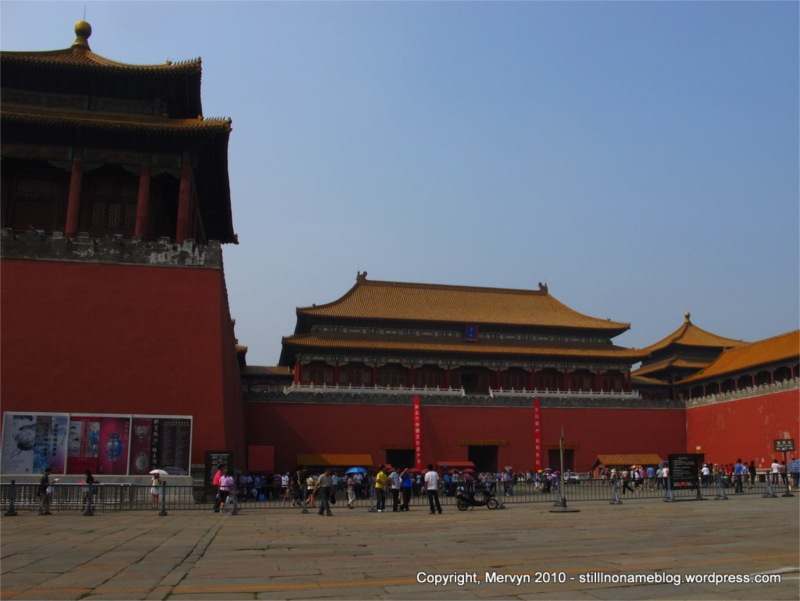
I headed up the west side of the Forbidden City wall and up past Jingshan and Behai Parks. I finally made it to Houhai Lake, which is where Max and I hung out at 31 Bar (which I mistakenly remembered as “Club 31”) and listened to Earth’s first Uyghur flamenco band.
The lake is much different during the day. First off, I didn’t get propositioned for lady bars every 20 feet. Also, it’s not as pretty as at night when all the lights are on and reflecting off the lake. It felt much more like a park. A group of people were swimming back and forth between the lake’s edge and a small island in the middle. Almost all the men were in speedos. Beijing’s more like Europe when it comes to swimming with your junk properly cradled.
I headed to the north end of the lake and started ducking in and out of the surrounding hutongs. This is the Beijing I imagined. As I pedaled down the narrow passageways I passed small storefronts, laundry, bicycles, piles of bricks, kids being pushed in strollers, children walking home still in school uniforms—really, just people living their lives.
New Beijing doesn’t really have that. Everything is hidden behind walls or is far from the street. Above ground, most people are in cars or cabs, isolated from the rest of humanity. The bustle all happens underground, in the subways, where you’ll see groups of people forced together out of necessity. It’s way too much like Southern California, actually.
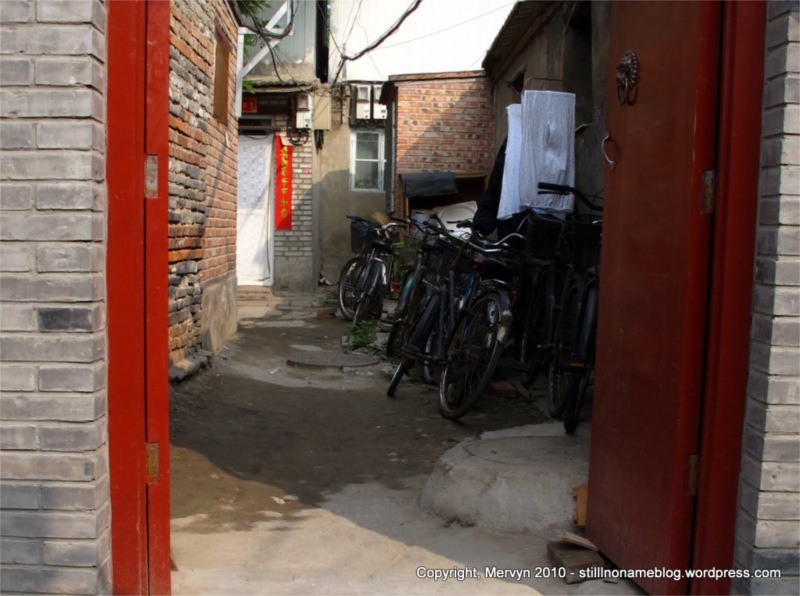
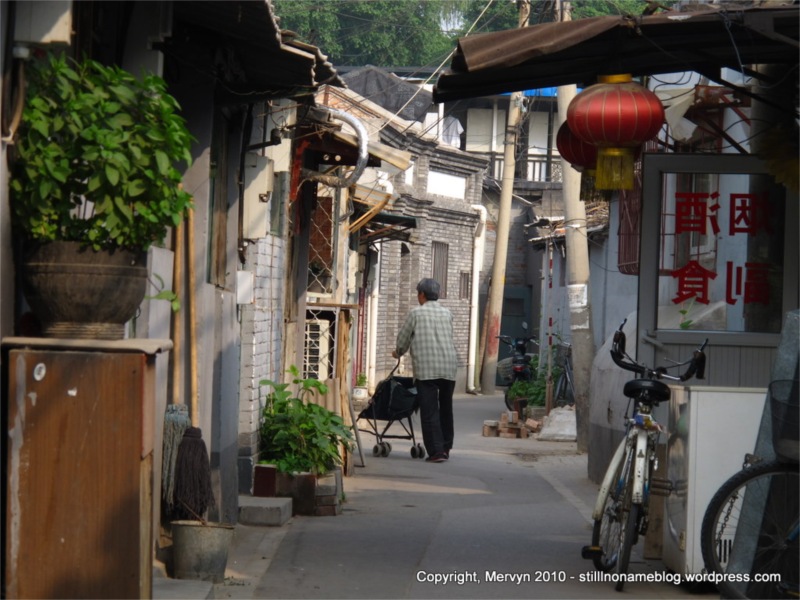
My favorite scene was a group of people playing mahjong in a little open air storefront. There were about five automatic tables. Each foursome stared at their tiles intently while the tables rattled as (I presume) the tiles were mixed up underneath. Things like this really make you feel like you’re seeing into the heart of a city. You can see the people, not just glass, brick, and steel. Peek into a little courtyard and you can see bicycles leaned against a wall. Glance into a doorway and you can find families chatting while cooking dinner. Men were on the street, giving each other a hard time about something. Each little human interaction provides a glimpse into local culture.
The hutongs are so intimate, in fact, that I couldn’t bring myself to take pictures while there were hordes of people around. It’s not like I could discreetly shoot from across the street. The alleys are so narrow that I’d be in someone’s face with a camera if I wanted to take a picture. I’m a tourist but not that much of a tourist.
As I rode past the Drum Tower and the Bell Tower (burned down and reconstructed, more than once, I think), I thought to myself that this is what I’ll miss when I go back to the States. I will miss the energy that you feel when you live your life around other people. I will return to the land of the car and the suburb and the yard and the high fence. When I go for my jog, I won’t see people chatting with their neighbors or walking to the local restaurant to grab a bite to eat. People back home aren’t forced to live together. They can maintain their own personal spaces, moving from their homes, into their garages, into their cars, then into their offices and back home again.
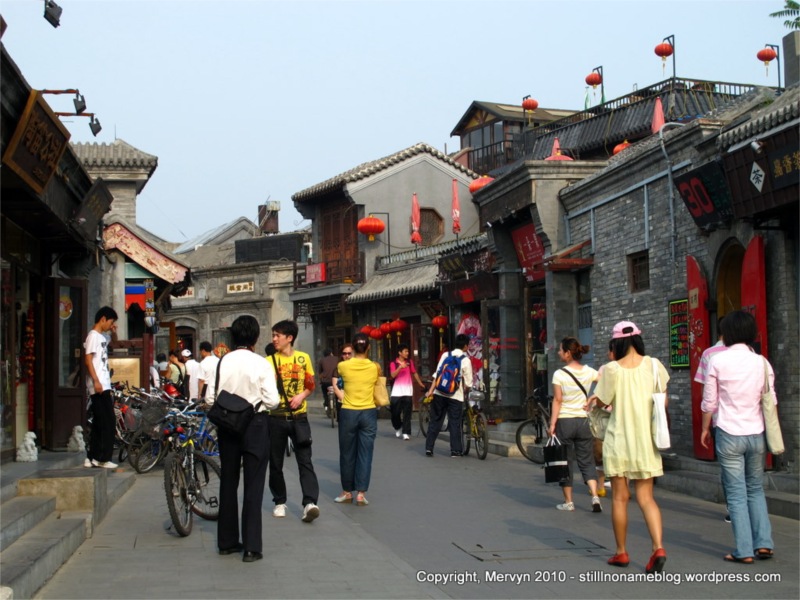
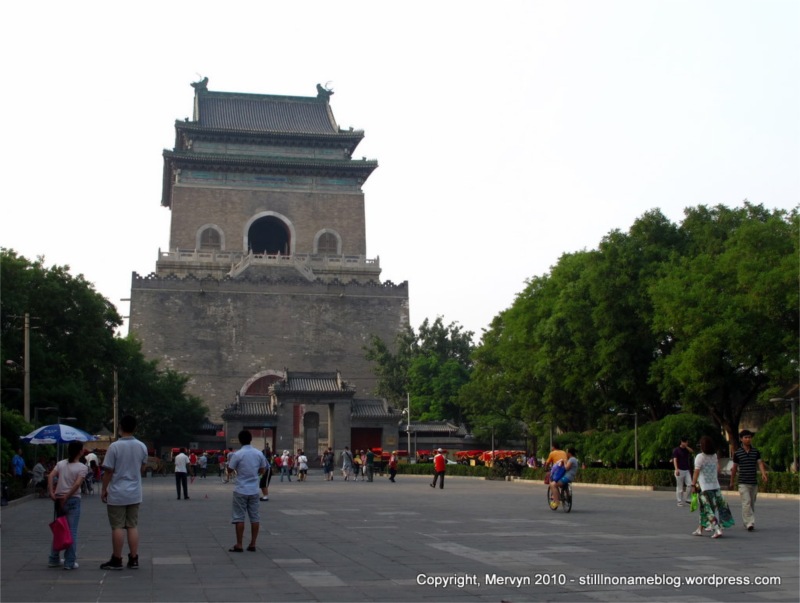
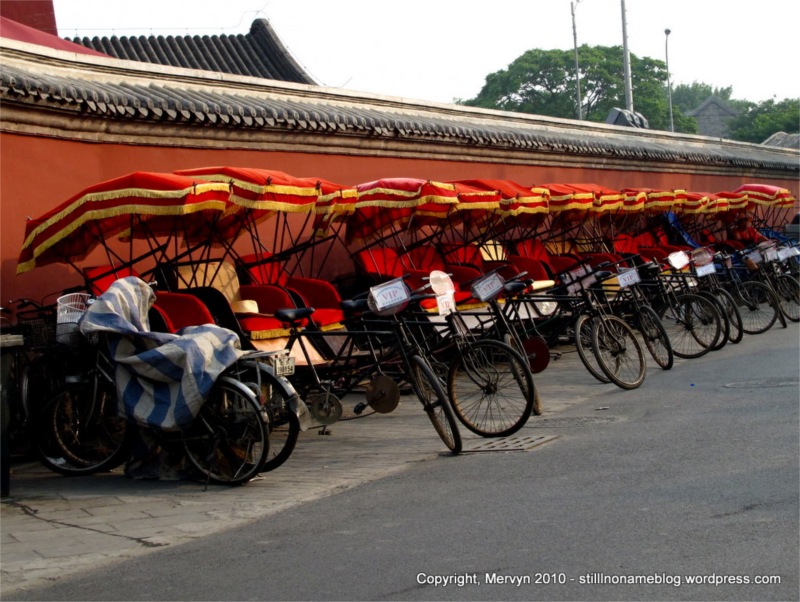
Here in the hutongs, then, is one of my favorite things about Asia. A sense of community. If Beijing has its way, though, this could be all gone in a generation. The only hutongs left will be those that are turned into shops catering to tourists. I’m not against progress, development and poor people getting their share of the pie but, in keeping with the food theme, I do wish there were a way to have my cake and eat it, too.
I biked my way along a six-lane road through the busy Beijing traffic and back to the hostel. I took a nap, accidentally overslept, and met Max, his buddy, and their girlfriends a bit late for dinner. A leisurely meal of Japanese. Later, we hit a place called Fu Bar which in America means one thing and in China means “Happy Bar.” Love it. In English, it’s a bit edgy. In Chinese, it sounds like a place where you might bring your kids. The place initially was a failure because it was set up like a speakeasy—you walked through a hot dog restaurant, down a staircase, and hit a light switch to open a passageway in the wall to the bar.
This kind of place is the opposite of Chinese. As Max’s girlfriend put it, if you’re the coolest, most successful place in town (or want to be), why would you want to hide it? Again, I’m not sure the idea of understatement’s quite taken hold China. The place wasn’t packed, but as we left, more people were coming in. Not surprisingly, most were ex-pats.
We headed to a giant hip hop club and got our groove on. The music was actually pretty good. It seems like most of their stuff is circa 2002, which means me the old guy actually recognizes and enjoys it. If you forgive the occasional forays into Lady Gaga and the like, it was fun.
Go with me on a tangent for a second: I want you to rate yourself as a dancer on a scale of 1 to 10. Got it? Okay. Now, when you come to China, take whatever number you had in mind and add 10. I’m serious. I felt like I was the love child of Michael Jackson and Gene Kelly—I had moves, baby. If you can keep a beat and have a good time, you’re ahead of the game.
Clubbing is apparently a bit of a niche thing in China. Here, the vast majority of people come to lounge on couches and drink. And we’re not talking small VIP areas like in L.A. No, the difference here is that 90% of the floor space is couches and cushy chairs surrounding tables and only 10% is devoted to dance. People sit around, order plates of fruit, and buy watermelon sized bottles of Chivas that just sit on the table (I didn’t notice anyone drinking any). If you like, you can have the club store the bottle for you so that next time you can drink what you didn’t finish.
Ordering drinks is different, too. Chinese don’t usually order one beer or one shot. They order six or seven, have them brought out at once then, work their way through them one by one. The whole scene seems to be geared to making sure everyone understands that you have a bunch of money to throw around on booze. People don’t seem to talk much. The dancing is ancillary.
What tripped me out even more on this night was the World Cup. China is so obsessed with football (soccer) that everywhere we went TVs were tuned to the games. Bars, restaurants, big outdoor TVs in the shopping centers and stadiums. And, get this, in the club. Where you’d normally see videos playing on screens that sort of match the music, they were showing a live World Cup match. Guys were dancing, drinking, and all facing forward watching the game. All while sort of paying attention to all the attractive women around them.
I admit it, since the TV was on, it was hard not to watch. In fact, a lot of the girls couldn’t help watching either. Hip hop was blasting through the speakers and white guys were running around on screen kicking a ball. Bizarre.
On my end, I had a good night. Max ran into his friend, a DJ, and we hung around to hear some of his set. As Max promised, the guy was good. Not only was his music good, he actually did work. His transitions were well thought out—he wasn’t just pushing “Next” on his iPod.
I guess that’s the price of progress. My having a good time tonight is kind of a result of the wild growth that’s destroyed my favorite part of Beijing: the hutongs. There are many steps in between, of course, but I wouldn’t be surprised if, at some point, the place where the club is now used to be a small neighborhood.
For now, I’ll enjoy what’s here, both the old school hutong version of Beijing and the new school, capitalist, indulgent side of the city.
GALLERY: Click through to today’s gallery to see pictures of more people’s hutongs, guys swimming in a lake, the giant red painted Drum Tower, and a picture of one of Mervyn’s red palms—because of the handle bars, silly.
Day 100 – Hot Pot with Not So Much Spam in It
Dateline: Beijing, China – Friday, June 11, 2010
Another day in Beijing; another Laker game and another morning in The Den. This time there were even more Celtic fans, which made this loss more annoying. I’ll leave it at this: every time I saw Farmar and Brown in the backcourt (which happened too much in the fourth quarter) I just expected a turnover. I think the game was lost when, for about 8 minutes in the fourth quarter, all the Lakers did was turn the ball over. Game 5 is on Monday morning (my time). I have a feeling I’m going to watch.
After the game I had a quick lunch at a sandwich shop near the Vietnam Embassy. Since this is Beijing, near meant 1 km away, which, in this town, means it’s within walking distance. At 2 p.m. I picked up my passport and my Vietnam visa. I wandered nearby Ritan Park and from there it was an afternoon of writing before dinner.
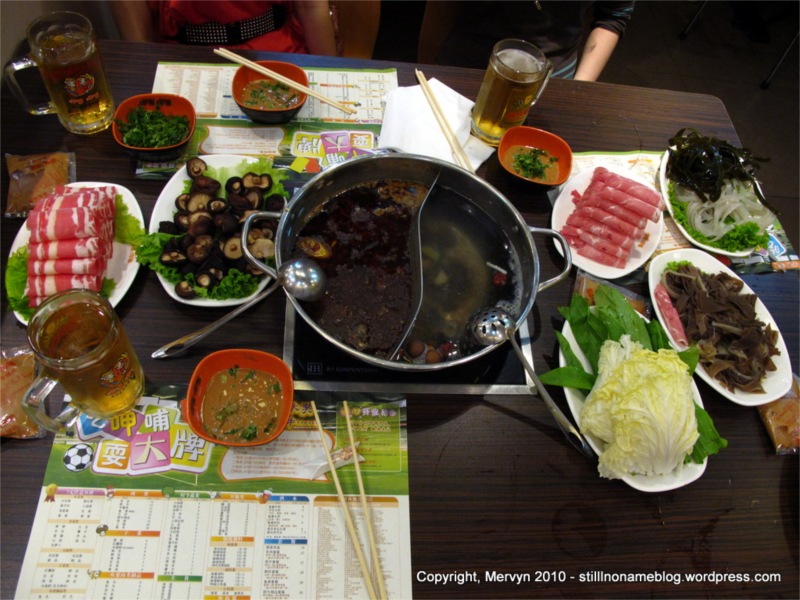
Ah, dinner. Let’s get to that, shall we? I met Lillian and Yoyo at Xiabo Xiabo, a hot pot chain restaurant. Back home, a couple of married friends of mine host hot pot once a month. This means a bunch of us sit around a bowl of boiling broth, cooking meat and vegetables, and steaming up all the windows in the little apartment. Hot pot usually ends up being a 4 hour eating binge with about six breaks to recharge our appetites. It almost goes without saying that I love hot pot.
Which puts Xiabo Xiabo in my wheelhouse. It combines two of my favorite food elements: food cooked at your table and food eaten out of a communal container. I love being able to grill, boil, roast, or fry your own food to taste. It’s a big reason why I love Korean barbecue. I also think that eating out of a shared dish instantly makes you closer friends—you have to absolutely trust someone if you’re all going to being jabbing chopsticks into a common bowl or ripping Ethiopian flat bread with your bare hands.
After a long wait, we were finally seated and were able to order our plates of meat and vegetables. Lamb, bacon, beef, tripe, tofu, and the occasional green leafy thing all ended up in the boiling broth. Yoyo tried to order brain and blood, but they were out. Of course. They’re Chinese hot pot favorites, after all.
As we wound down, Lillian asked if I wanted more meat. I said I could handle one more meat plate. In keeping with my previous hot pot overeating experiences, she ordered four.
When our second meal came out, we discovered that Lillian had inadvertently ordered Spam. Yoyo had asked Lillian (in Chinese) whether she wanted to try “canned meat.” Feeling adventurous, she said yes and that’s how we ended up hot potting America’s favorite compressed meat product (not counting Chicken McNuggets).
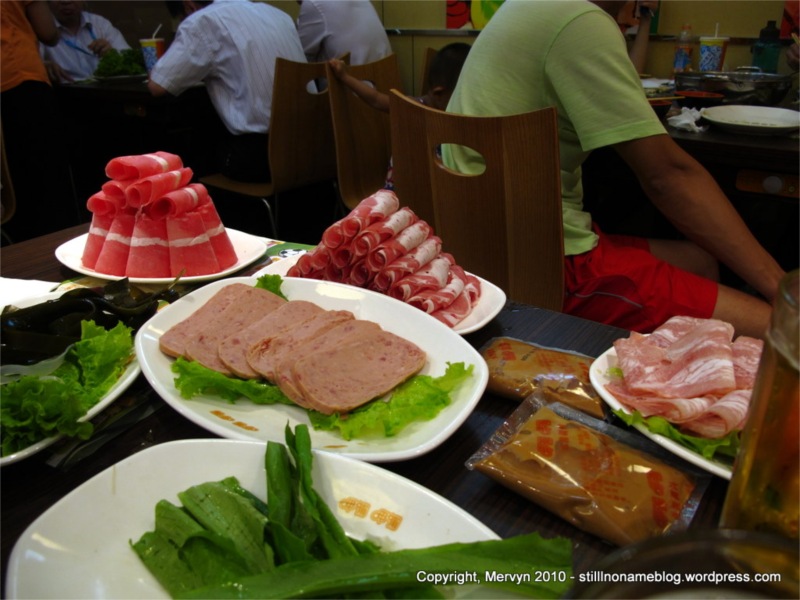
We stuffed ourselves silly and ended up being the last patrons to waddle out of the joint. Classic hot pot, even though there wasn’t any pig’s blood.
GALLERY: Click through to today’s gallery to see an artificial rock formation that Mervyn will install in his make-believe mansion and to see old guys happily flying kites in Ritan Park, proving that men will congregate and shoot the shit around any activity, even if that activity is less productive than fishing (at least acquires food) and slightly more pointless than golf (at least provides competition and produces a winner). It’s good to be a man.
Day 99 – Built For Your Benefit (The Forbidden City)
Dateline: Beijing, China – Thursday, June 10, 2010
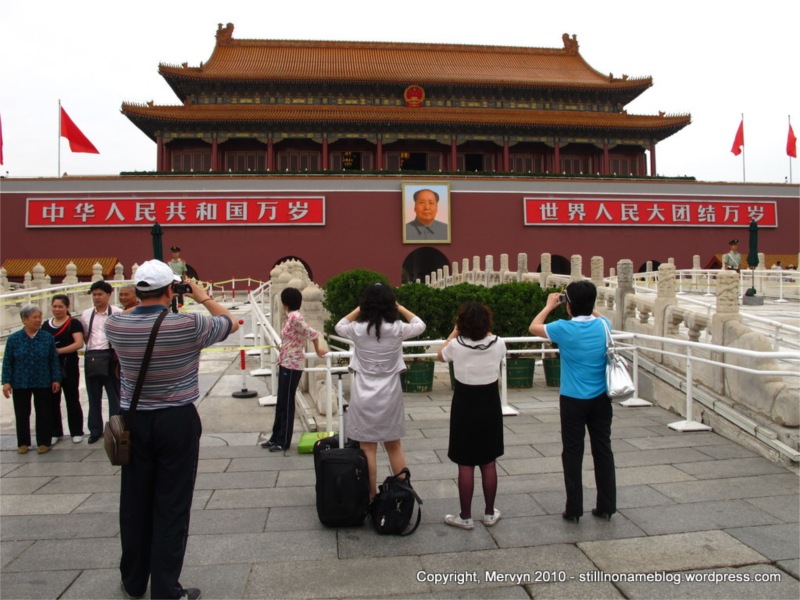
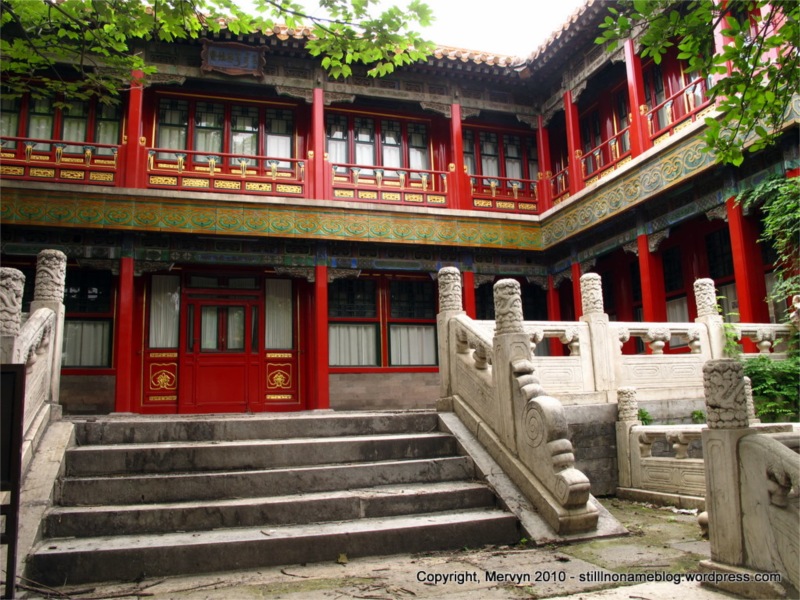
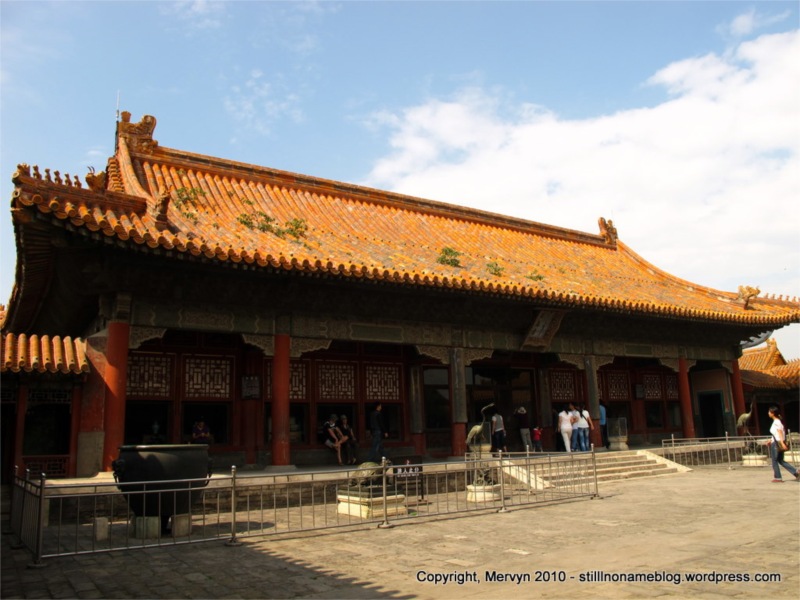
First off, you probably know that the Forbidden City got its name because it was the home of the emperor and commoners were not allowed inside. What you might not know is that emperors resided in the compound until the early 1900’s. The place has an ancient feel, but you also get the sense that its caretakers have no qualms slapping on a new coat of paint or replacing old artifacts with replicas. For a region with as long a history as China, a hundred years ago is like yesterday. For example, under the eaves of one of the big gates, the government had installed two gigantic big screen televisions that displayed images and video about the site on a loop complete with loud music and commentary. Just like Tiananmen Square, the curators didn’t just let the monument speak for itself, they made sure you understood its importance with as much flashing lights and sound as possible.
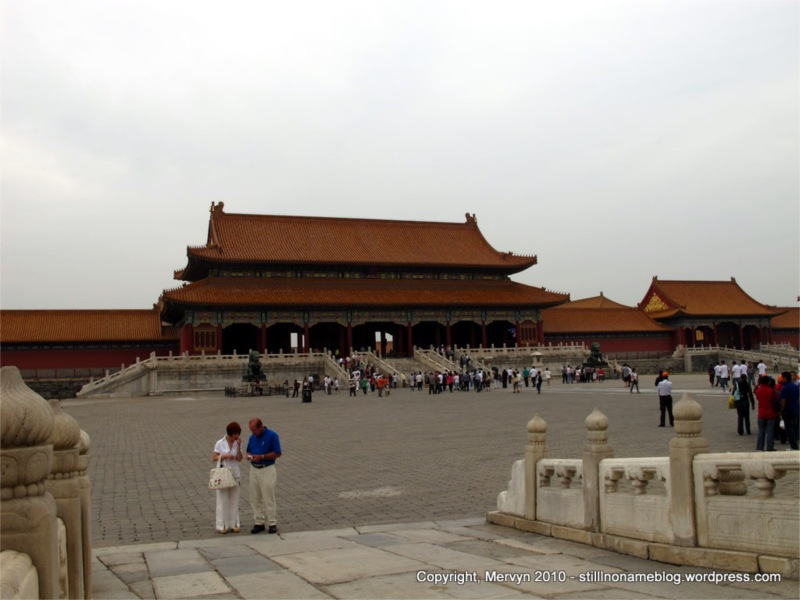
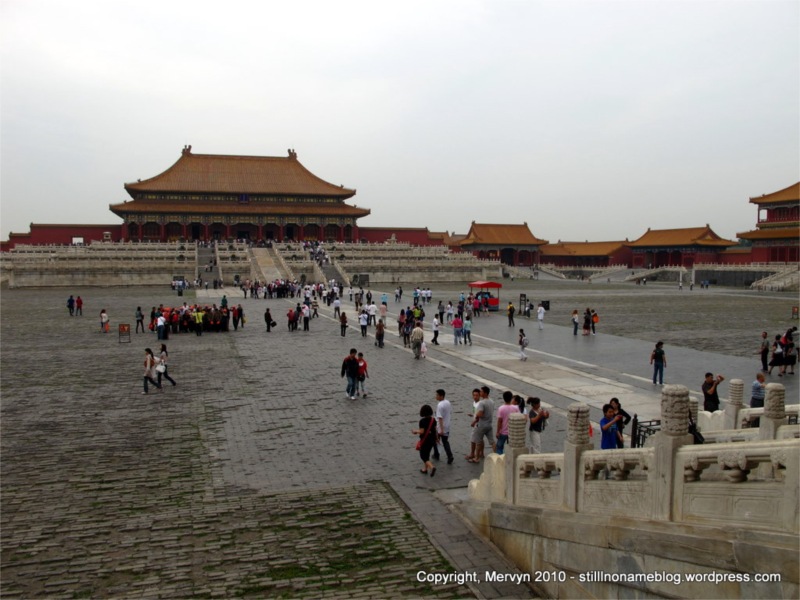
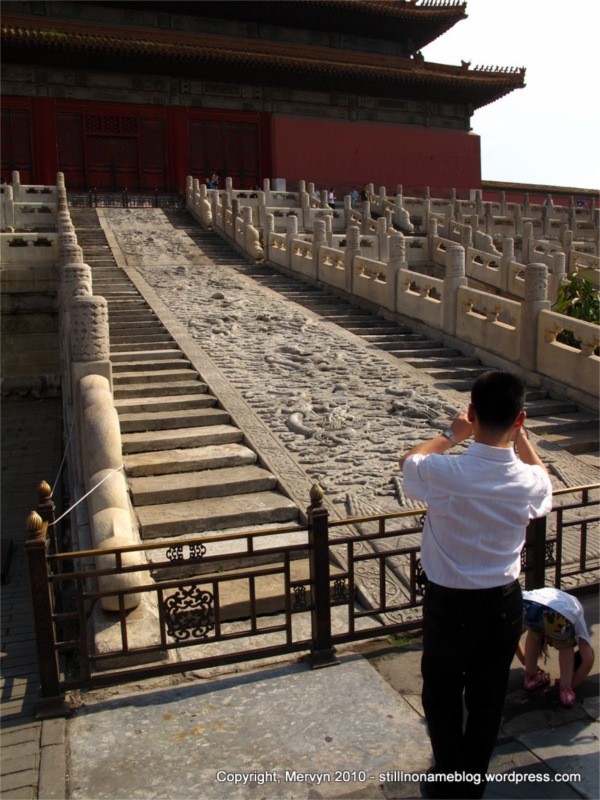
The ancient city at the center of its modern successor is a kilometer long and about 500 meters wide, which means there’s a lot of walking. The place was constructed in order to put visitors in awe of the emperor. Advisors, consorts, governors, and dignitaries that visited the palace would be greeted by huge stone laden open spaces and grand pavilions. This is no subtle expression of power; it’s in your face, look-how-big-my-palace-is over the top.
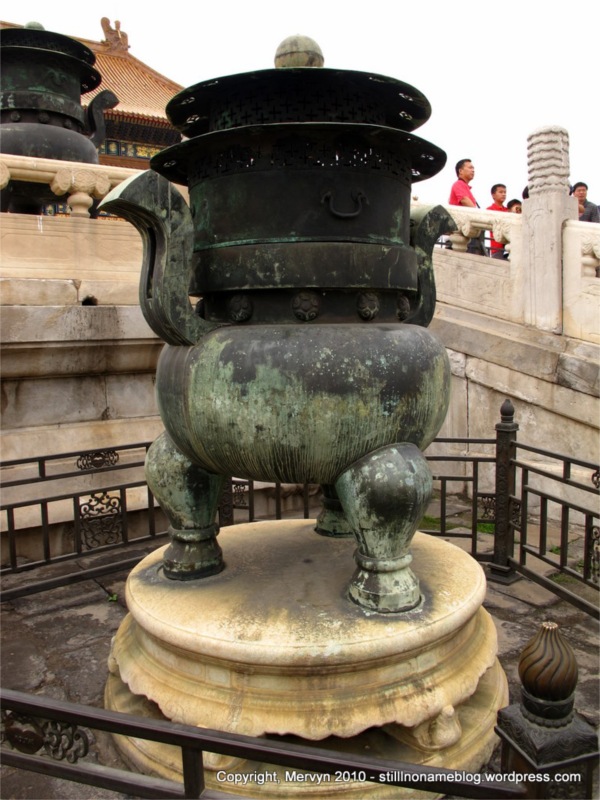
There were even giant copper or brass urns that the emperors filled with burning incense or wood to create smoke in order to give the courtyards a mysterious, mystical feel. It’s the old school equivalent of installing a ton of fog machines in your house. These guys made sure you stood in awe.
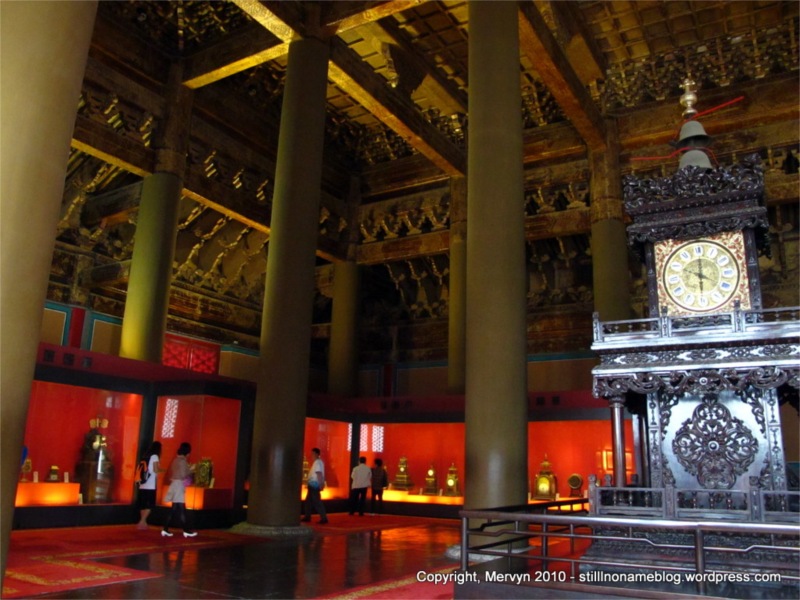
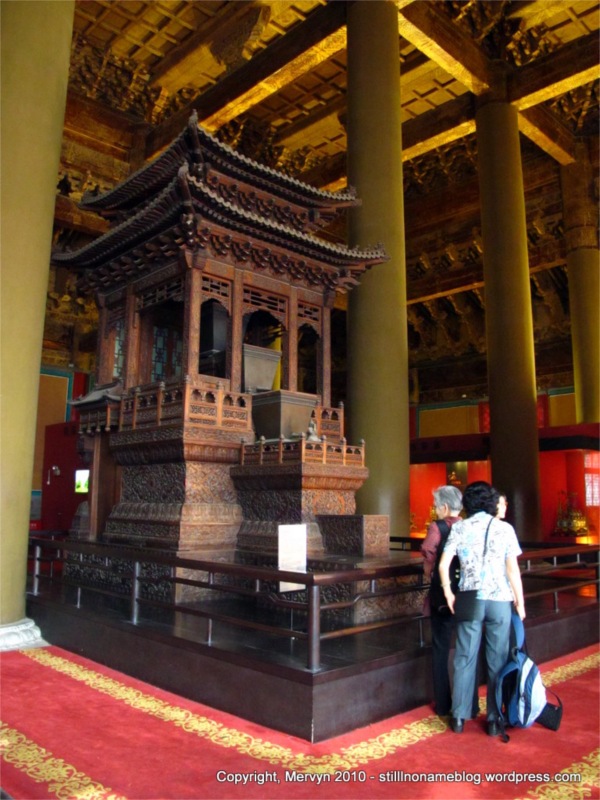
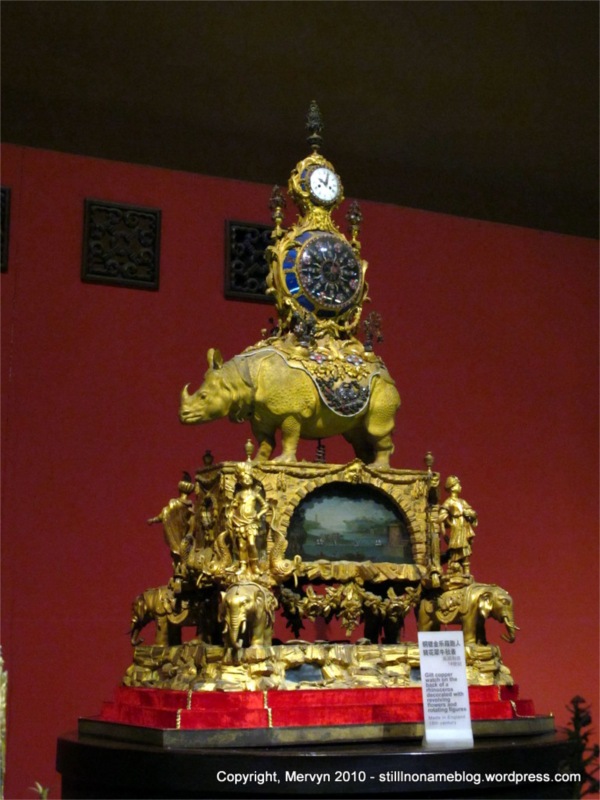
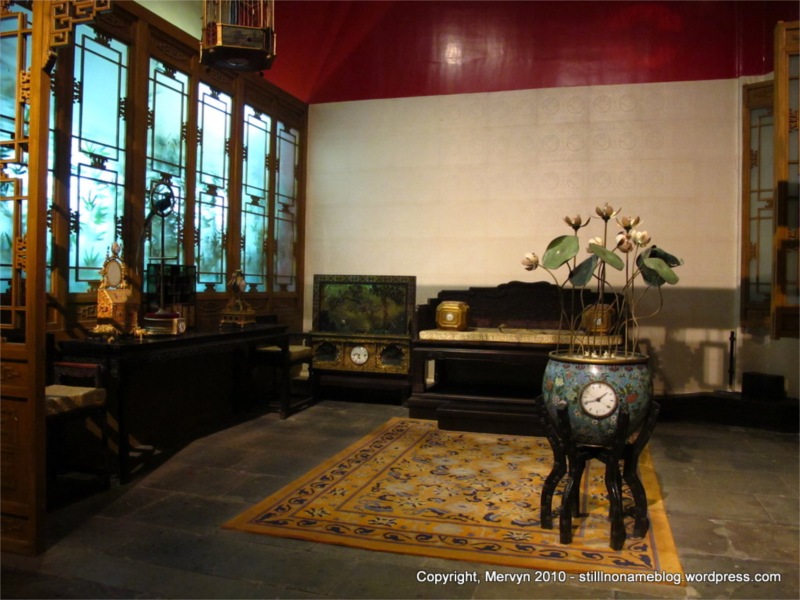
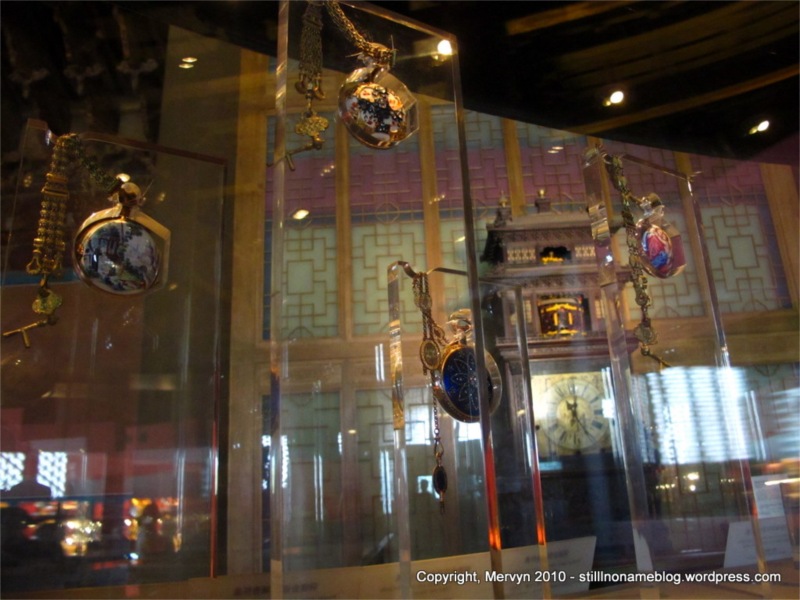
All this majesty is pretty and all, but these days, the vast expanses means a visit involves a lot of walking. Also, after a while, the various halls and pavilions start to look the same. What kept me engaged were all the fanciful names of each of the structures. Here are some of my favorites, only one of which is fake:
Hall of Norms of Government
Hall of Character Cultivation
Hall of Joyful Longevity
Hall of Mental Cultivation
Pavilion of Prolonging Splendor
The Palace of Abstinence
Lodge of the Proper Places and Cultivations of Things
Did you pick out the made up one? Take your time. I’ll wait. Hah, I lied. They’re all real. Pretty wild, huh?
I opted for an audio tour, which meant I got to hang an electronic map thing around my neck and walk around with one headphone in my ear. The lady speaking in my ear was a godsend. Without her I’d have had no context for what I was seeing. Without context it really is just a bunch of buildings that all look same.
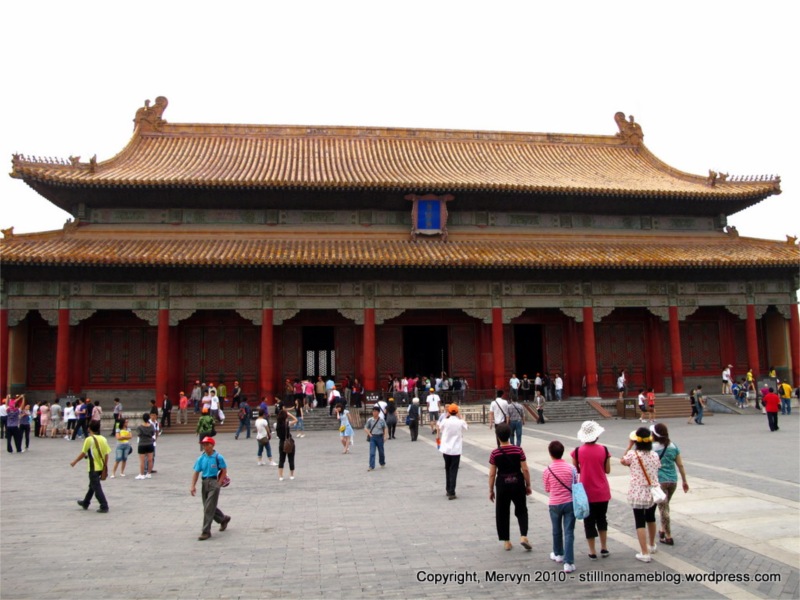
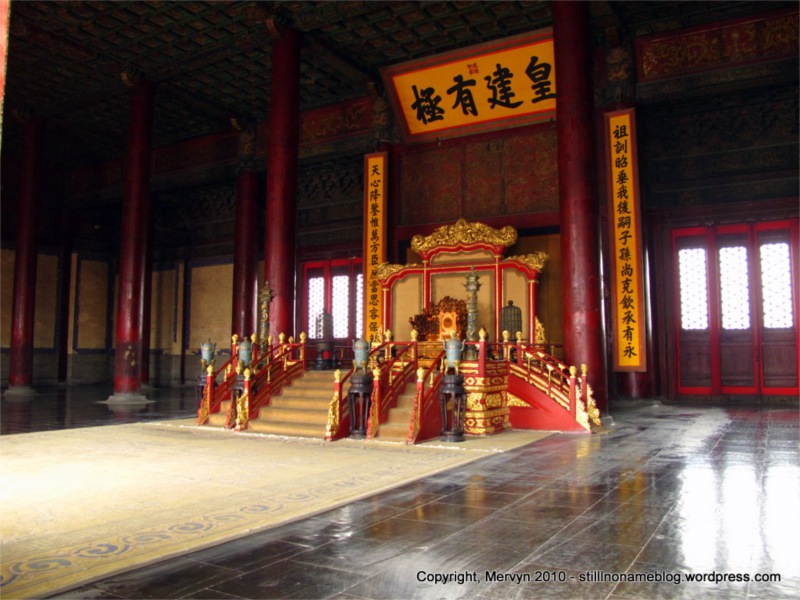
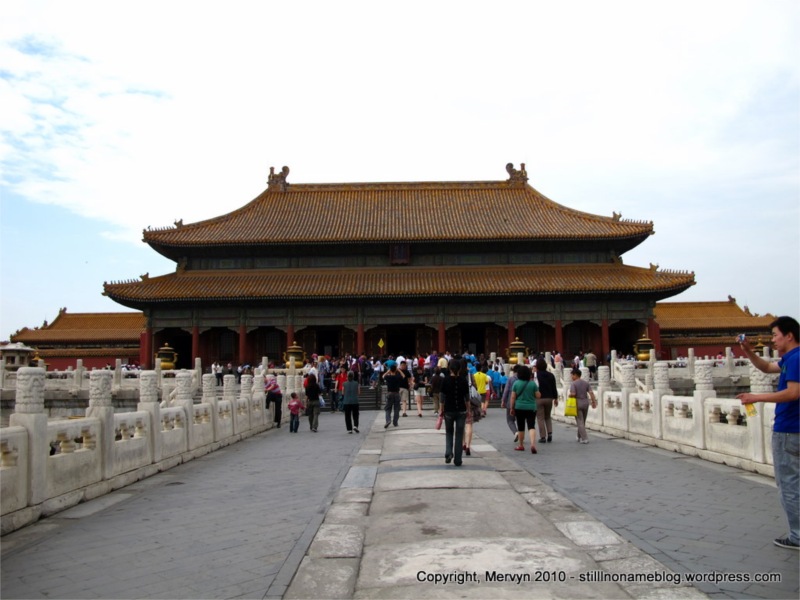
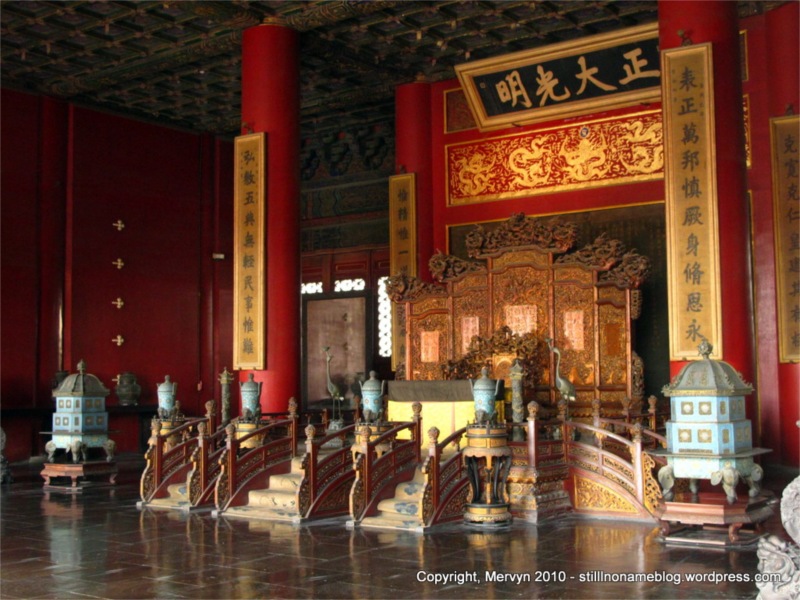
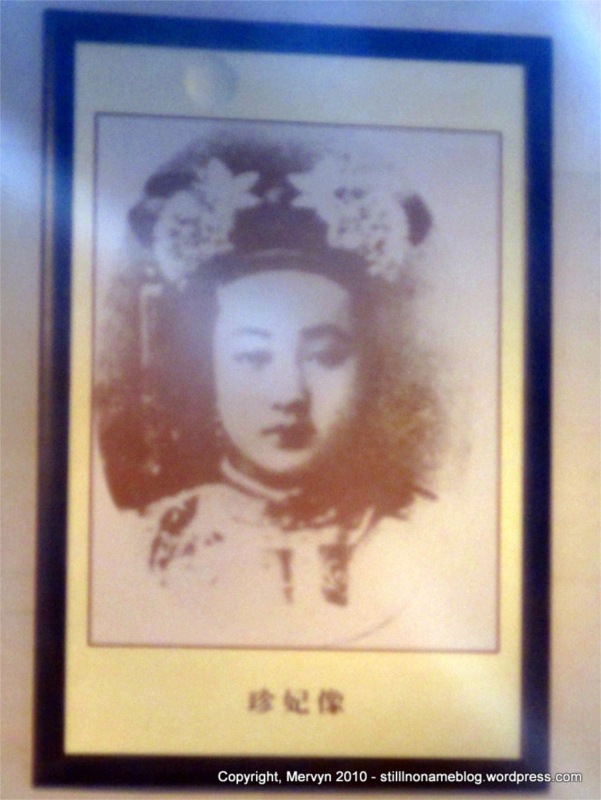
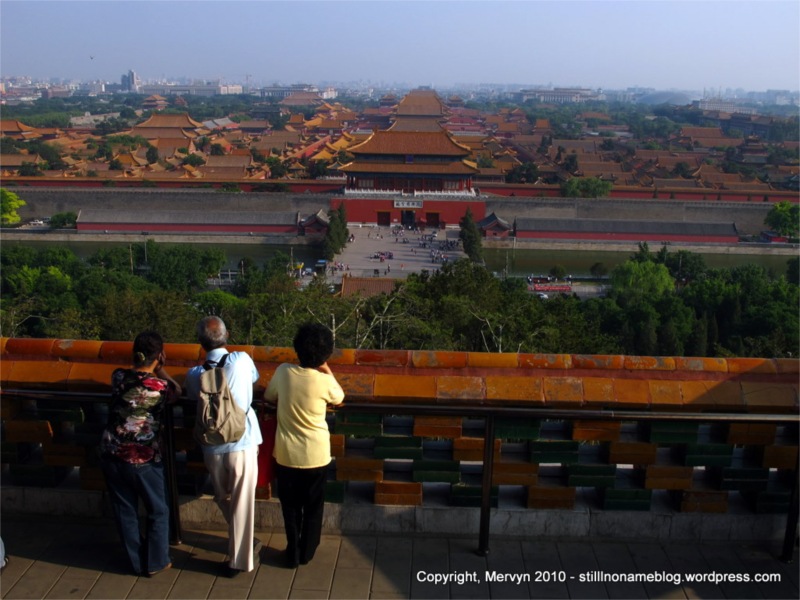
Walking out the north end of the Forbidden City and hiking up the hill in Jiangshan Park for an overview of the city, I realized that visiting the Forbidden City was like visiting an old school version of Beijing. In the same way that Beijing seems to be a huge exercise in impressing visitors, the Forbidden City served the same function for the ancient rulers. Everything was on a grand scale, a bit over the top. Its creators worked hard to provide evidence that you, an outsider, should be impressed. There was also an evident fondness for wide open spaces. You had to go out of your way to find intimate spaces—in the Forbidden City, that meant going to the smaller palaces on the east side where the empress and the concubines lived. It’s not a place where you fee intimacy or warmth. It’s a place you go to be impressed.
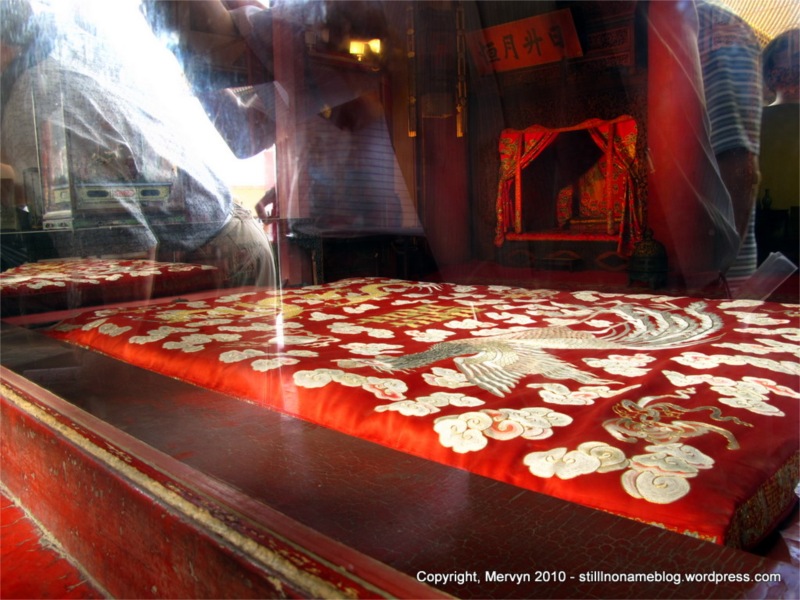
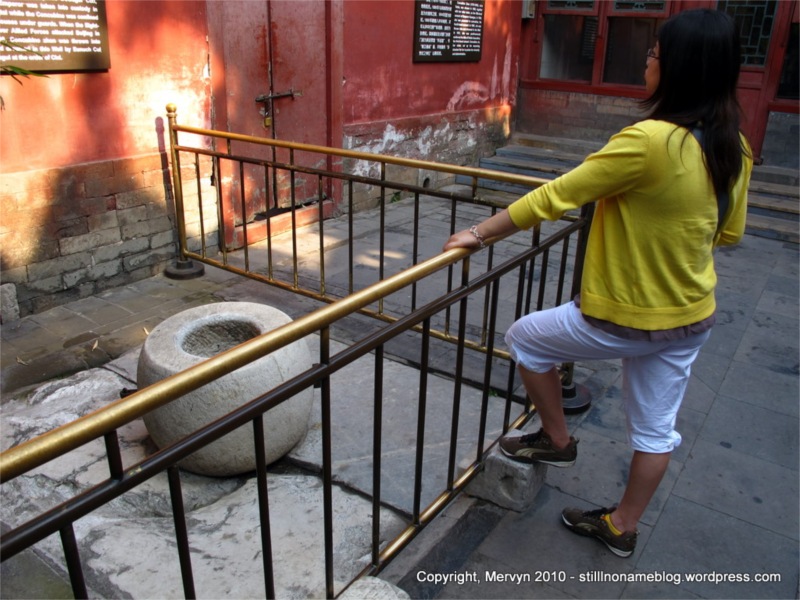
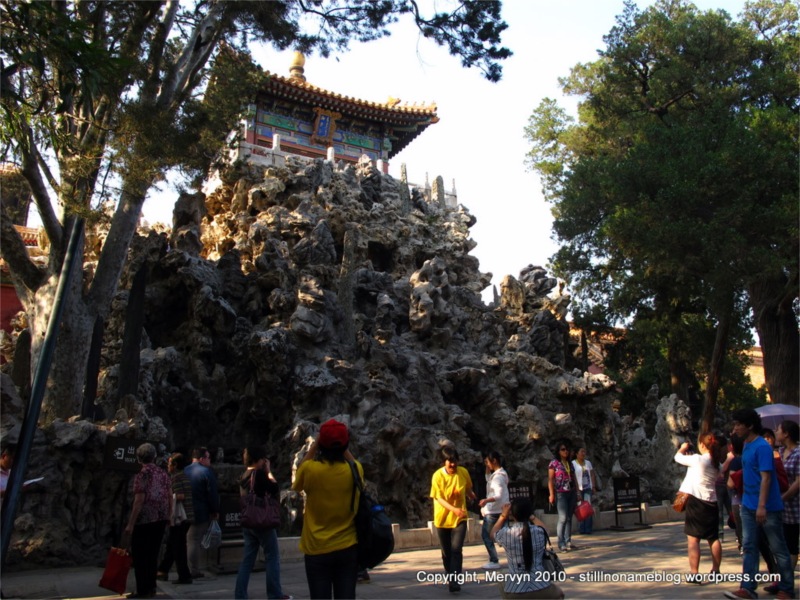
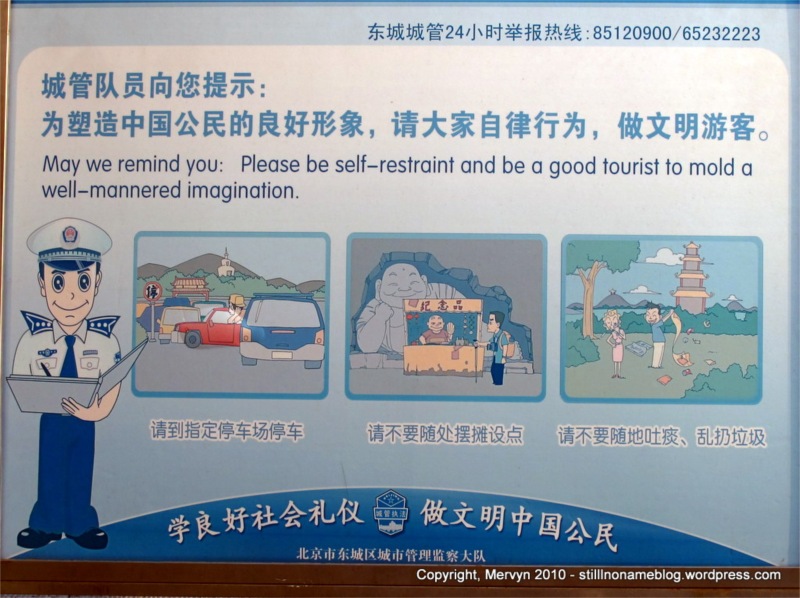
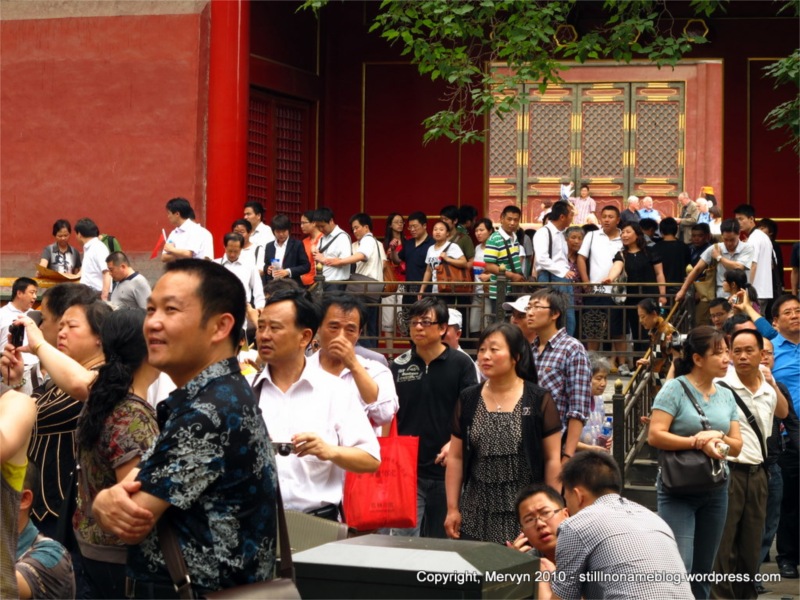
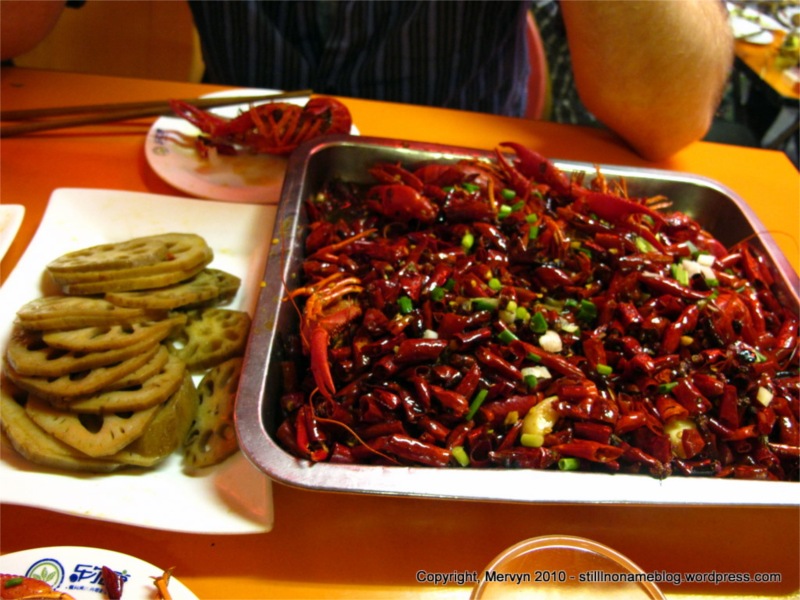
In the evening, I joined Max for a meal of spicy crawfish and fixin’s on Ghost Street at a more local place than I’d been the night before. While eating inside, the cops came by and systematically shutdown all the outdoor seating on a street famous for its curbside seats. Go figure.
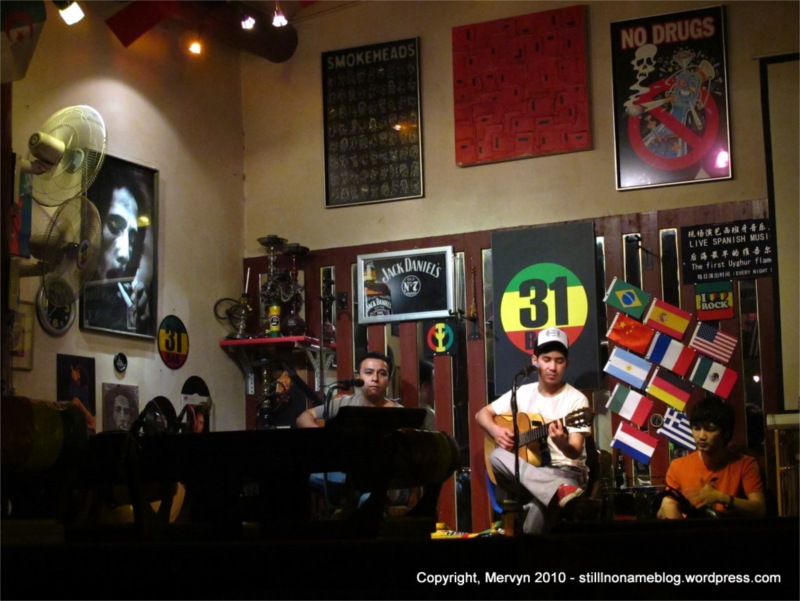
Afterwards we lounged out in the Houhai area of town. We skipped the places crowded with Chinese and Western tourists and hung out in a place called Club 31, a place run by some Uyghur (pronounced: WEE-gers) , a Chinese ethnic minority. A band played Spanish music while we drank. A sign said that they were the first Uyghur flamenco band. I believe them. Even if they weren’t the first, they were good, Spanish vocals included.
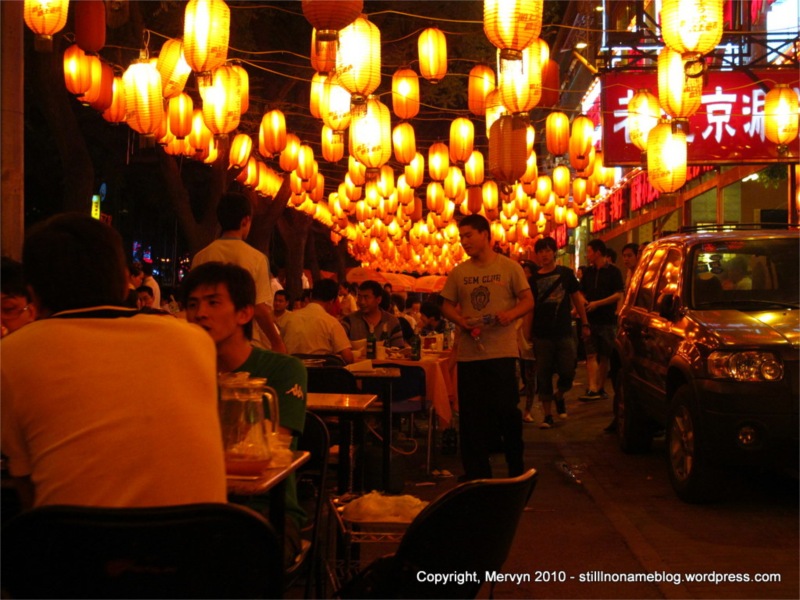
I think really that’s what Beijing is all about. Like L.A., it can feel like a concrete jungle sprawl, lacking in small spaces to relax and meet people. In the end, you have to seek out the oases in the urban desert, probably with the help of a local. You have to cut the city down to size.
It really is still more Tracy Flick than I’d prefer, but I am adapting. A few more Uyghur bands and I might actually start to really like the place.
GALLERY: Click through to today’s gallery for numerous bonus pictures including some of signs that prove Mervyn didn’t just make up those pavilion names, one of Mervyn decked out with the audio guide, pictures of a Chinese guy and a White guy dressed up in silly clothes, and a picture of Obama as Mao.
Dateline: Beijing, China – Wednesday, June 9, 2010
I got up early again today and watched Game 3 of the Lakers-Celtics series. I won’t trouble you with the details as if you care. You know how the game turned out and, if you don’t care, you won’t even notice.
A brief observation about ex-pat Celtic fans. I got a chance to see a few more at this game than the last because more people watched the game with me over breakfast. So far as I could see, I was the only Laker fan.
Boston fans complain a lot. For example, one guy spent the whole game whining about how Ray Allen sucked, even though: (1) he basically won Game 2 for the Celtics and (2) every time he fired up a shot, every Laker fan on the planet expected it to go in. The game was close almost the whole way and this guy would scream, “Oh my God! He sucks! Take him out!” every time Ray would touch the ball.
Boston fans also seem to believe that the world favors the Lakers. Celtic fans would cry foul play at every call that went against the Celtics. They’d scream at Laker players for flopping and bemoan the refs’ bias for the Lakers. At one point, a guy complained that no Celtics were being shown in a commercial featuring prominent past and present NBA stars even though it was a Nike ad featuring Kobe. It was almost sad how oppressed the Celtic fans feel, this despite the fact that they have a wealth of talent and are achieving beyond their wildest expectations—if you’d asked a Celtic fan if they thought they’d make the championship game two months ago, they’d have laughed in your face.
When the Lakers won Game 3, I quietly walked out of The Den choosing to revel in my team’s victory in silence. I’m still not convinced. While I root for the Lakers, I’d have bet on the Celtics when the series started. Nothing in this game made me want to change my bet.
After the game, I went to the Vietnamese consulate to drop off my passport to get a visa for Vietnam. I’m planning on going back in July and decided to get it done now instead of waiting for the end of the month in Nanning. If traveling has taught me anything, it’s that if you have a chance to do something now—take a picture, visit a museum, buy toilet paper—you’d better do it now because there’s no guarantee you’ll get a chance to do it later. The regret you feel for not doing something is infinitely more than doing something and having it not turn out “perfect.”
My passport safely in Vietnamese hands, I decided to hit Beijing’s Underground City. Apparently, in the 1960’s, Chairman Mao believed that the future was underground (probably something to do with nuclear war) so he had an underground city constructed beneath present-day Beijing. There are supposed to be thousands of kilometers of tunnels, some running to the Forbidden City, the airport and, supposedly, the city of Tianjin which is 130 km outside Beijing. Caverns containing shops, theaters, and hospitals. It sounded awesome.
I found the entrance in an anonymous-looking building in a small street behind some tall residential-looking buildings. Turns out it’s closed. When I walked into the office, I found four old people playing cards. When I asked about the underground city, one pointed at a sign on the front door which warmly welcomed me to the underground city, then told me that it was closed and that it would hopefully be open “maybe next year.” Fail.
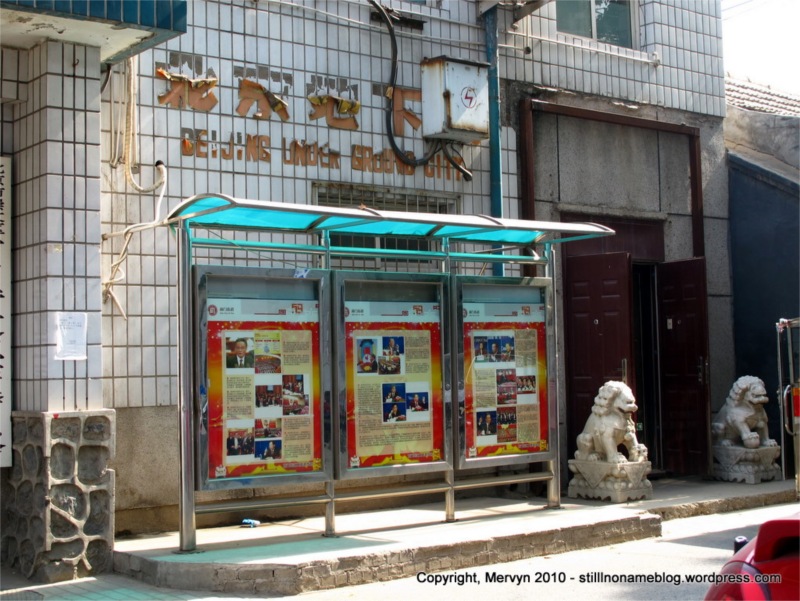
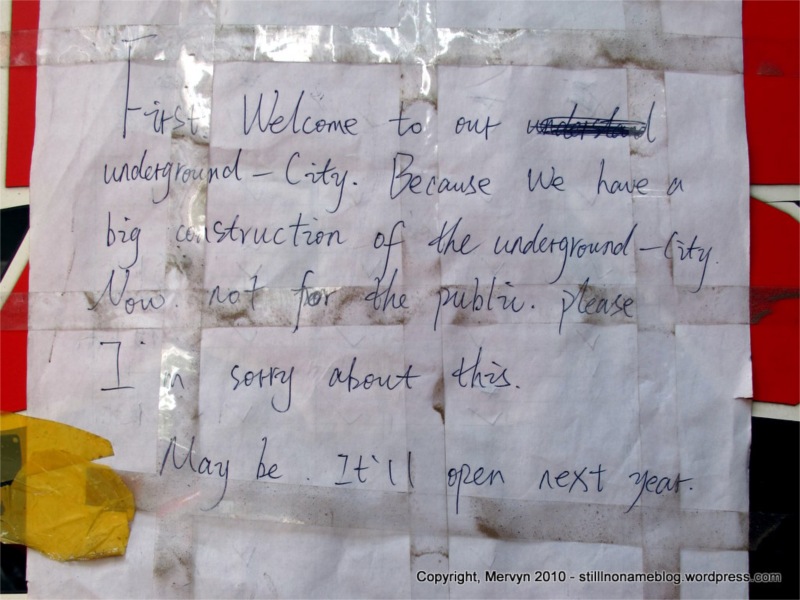
I went back to the hostel and hung out until dinner. My friend Lillian and her language partner Yoyo met me on Dongzhimennei Dajie more commonly known as “Ghost Street” because of all the red lanterns hung out in front of the restaurants. Here, locals dine on all manner of Chinese cuisine from different parts of the country, most sitting out on tables and chairs set up in front of the restaurants.
Our destination was a bit more upscale. Wuyutai Neifu Cai specializes in Nei Fu style Chinese food. It has a fancy entrance and a stage area for performances. It does not have any outdoor seating.
I had a list of three things that a food critic recommended that visitors try. Two were straightforward: buckwheat noodles and spareribs. Right off the bat, we knew we were in trouble. Yoyo is local Chinese. While the buckwheat noodles were straightforward, she couldn’t find spareribs on the menu. We ordered something that looked close.
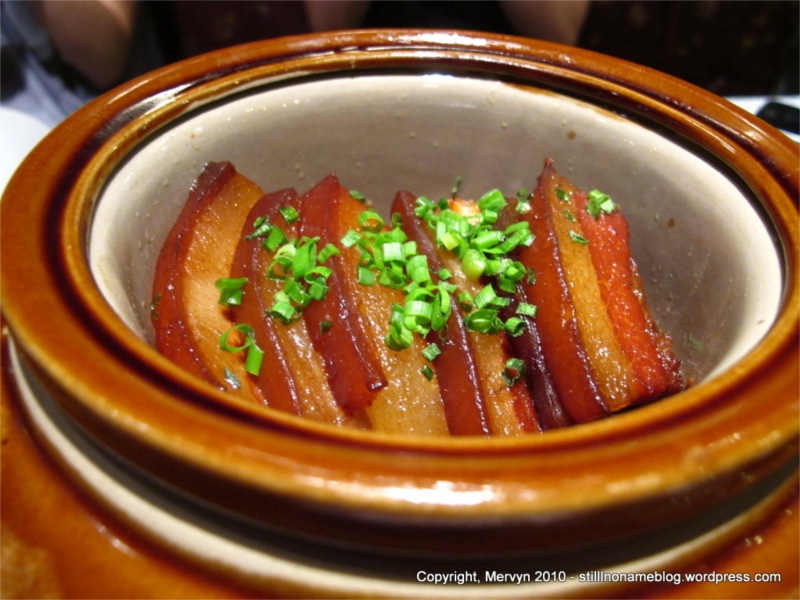
Even worse was finding the pork belly. According to Yoyo, Chinese do not differentiate between different cuts of animal meat. There’s just pig meat and pig bones. “Pork belly” is much too specific. We ended up finding it based on the pictures. The English name of the dish confirmed Yoyo’s contention. The dish was called “Meat served with Pancakes.” The menu did not even identify that the meat was pork. Guess Chinese just go by what’s edible (everything) and what’s not (everything else).
The meal was quite delicious. Unfortunately, when the staff saw me taking pictures, they told us that photos were not allowed. I snuck a few pictures, but they turned out a lot blurrier than normal. Yoyo also pointed out that we made terrible rule breakers because every time I took a picture we all stopped talking and then giggled when I quickly hid the camera. I think that’s what’s poker players call a “tell.”
The pork belly was succulent and very rich with almost equal amounts of fat and meat. It’s a good thing they were wrapped in the pancakes similar to those used for Peking duck, otherwise it would have been like munching on straight butter.
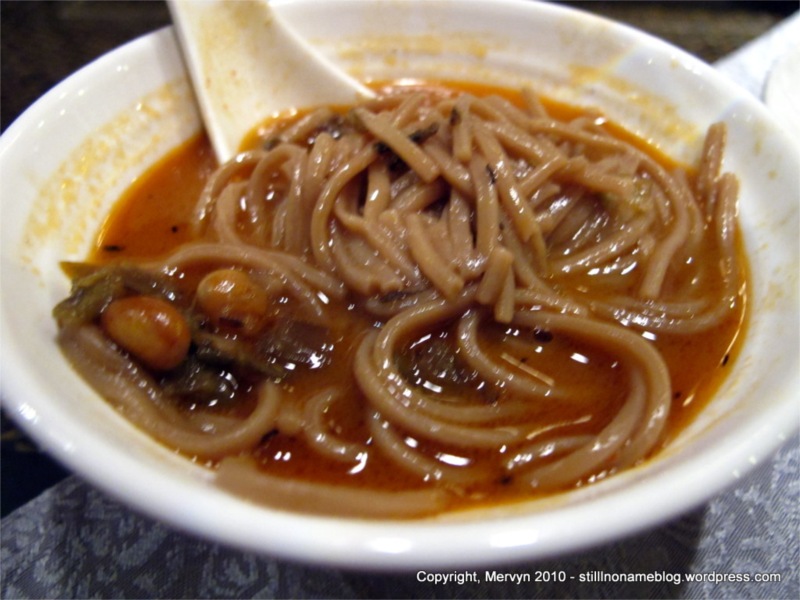
The highlight by far was the buckwheat noodles. They were hearty with an earthy flavored broth. They felt rustic but somehow sophisticated. I think it’s because, even though they felt substantial, they didn’t feel starchy or wheaty, which sometimes can happen when you have noodles in a thinner broth.
In addition to the two highlights, we also had turnip cakes, meat in pepper oil, and a vegetable salad which, for some reason, had hunks of papaya in it. All good. Also, way too much to eat and more expensive than my backpacker budget normally allows.
No matter. It was a good experience.
When we hit the street we decided to finish our meal with the opposite of upscale. I guess Beijing (perhaps all of China?) has a thing for a yogurt drink served in a brown glass jar with a thin paper lid. To drink, you just punch a straw through the top and sip away. It’s supposed to help with digestion. I liked it just because it was a bit sour.
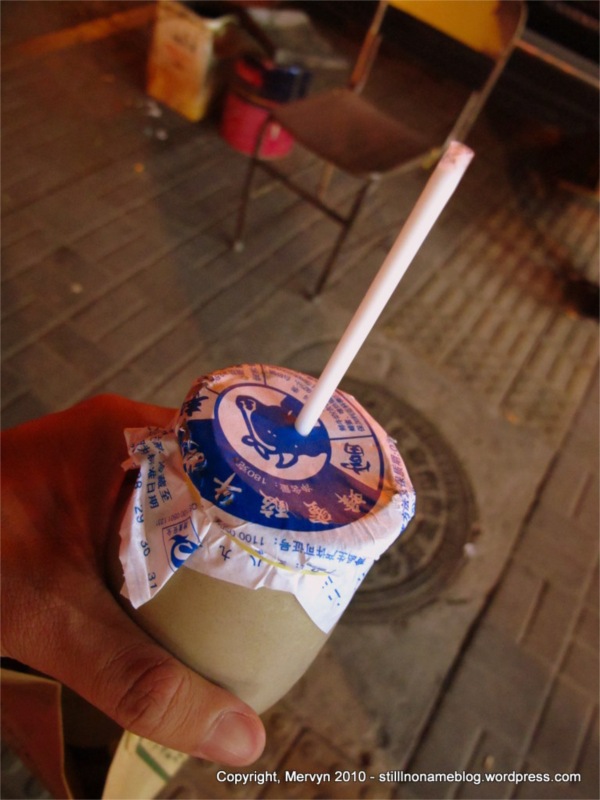
Note that the glass jar is not clear and the yoghurt is not brown colored—that’s just the glass. I kept expecting to see the brown draw down as I sipped. Nope.
You can return the jar to the purveyor or you can take it home. Lillian said she’s found quite a few good uses for the things.
High class, street. All in one night. Doesn’t get much better than this.
GALLERY: Click through to see more pictures of Ghost Street and of Nei Fu food.
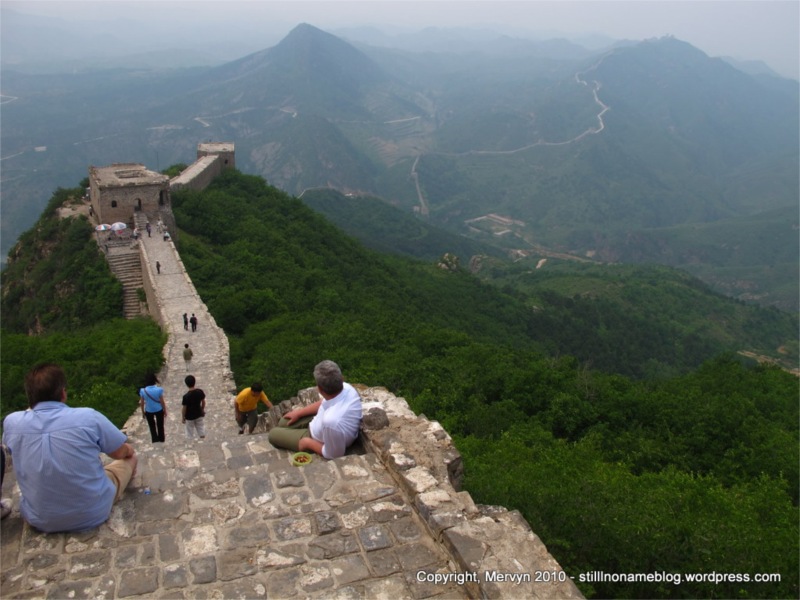
Dateline: Simatai Section of Great Wall, China – Tuesday, June 8, 2010
The Great Wall is big and long, you know, just like my posts. That presents a bit of a problem. When you go to see the Great Wall, what part of the Great Wall should you go see?
Most tourists hit the Badaling section which is thirty minutes outside Beijing and can practically be reached by subway. I didn’t want to deal with crowds and wanted to go to Simatai, a section two hours out that hasn’t been restored (much) and has fewer tourists. The challenge was getting there. A cab supposedly cost 500-700 rmb for the day. That’s way too much for just me.
Enter the Indians. Last night I was hanging out in the hostel lobby when I overheard three middle-aged Indian guys asking the front desk about going to Simatai. Like a good traveler, I butted my way in and asked if I could tag along. They were happy to oblige. They promised to secure transport and we’d meet at 7 a.m. in the morning. Sounded good to me.
At 1 a.m. I got a call from one of the guys that we’d instead meet at 8 a.m. When I showed up at the lobby at 8 a.m. I got a text that we’d be meeting at 9 a.m. No problem. As long as I didn’t have to pay full price for a cab, I didn’t care.
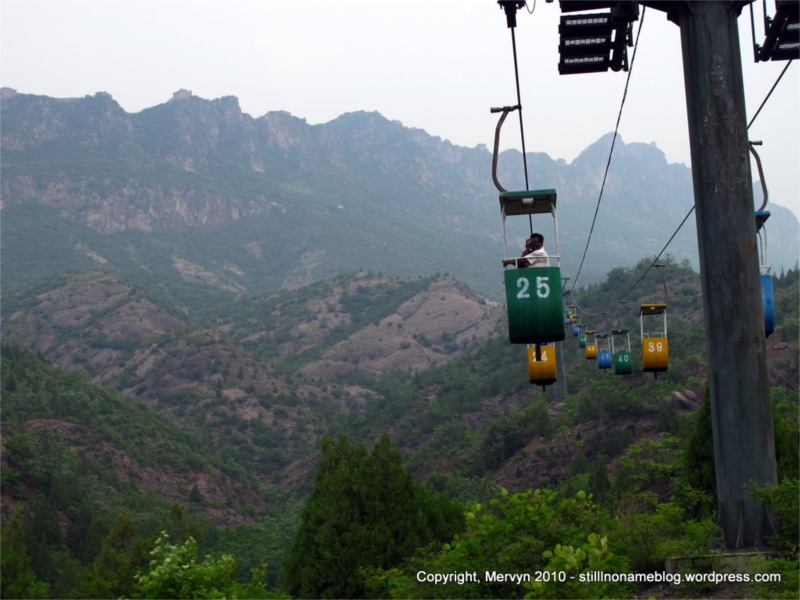
By 9 a.m. we were on the road. Everyone fell asleep in the van and we all came to about 10 minutes before we hit Simatai. Turns out this section of the wall is on the crest of a high mountain and you have to hike up a couple of kilometers before you can actually set foot on the wall. The Indians decided to take a sky tram up and I joined them. Turns out this was a fantastic idea.
The sky tram offered fantastic views and skipped a long walk up a paved road. I came to walk on the Great Wall, not on some fire road. If I wanted to do that, I could have just stayed at home.
I skipped out on a shorter ride on a funicular-type thing—I wanted to do a little walking (and save a few rmb). This also turned out to be another fantastic idea. The ride was too short to justify the cost and I caught the guys just moments after they disembarked.
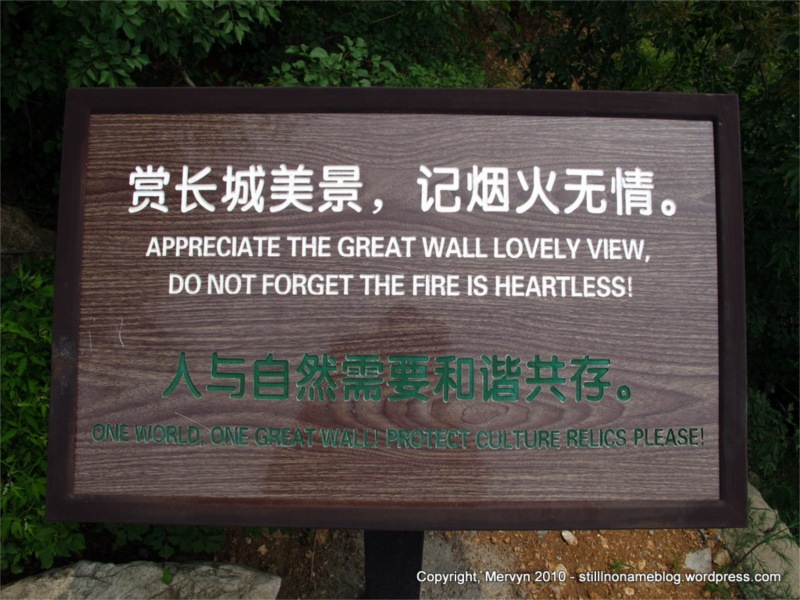
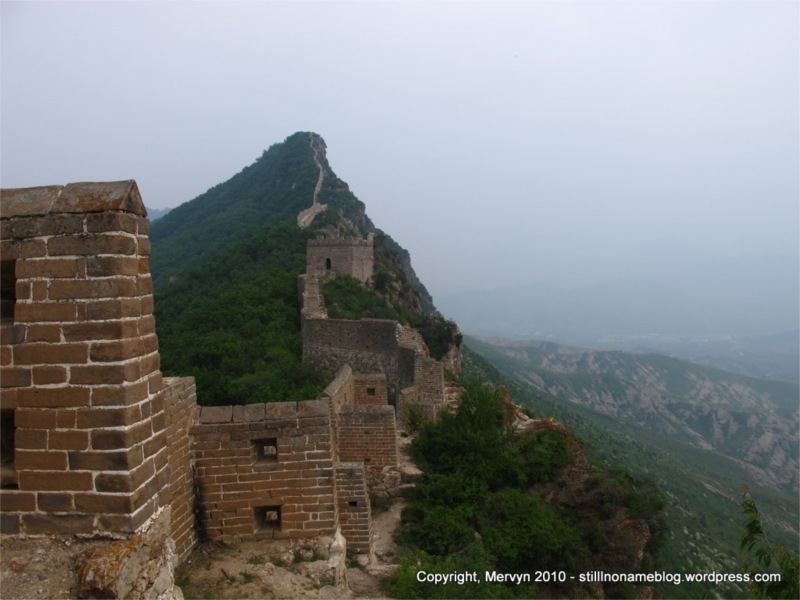
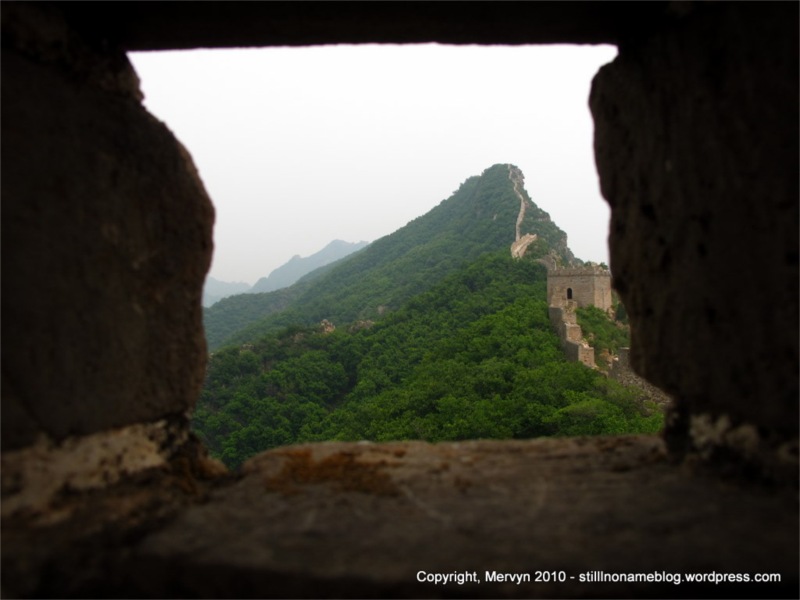
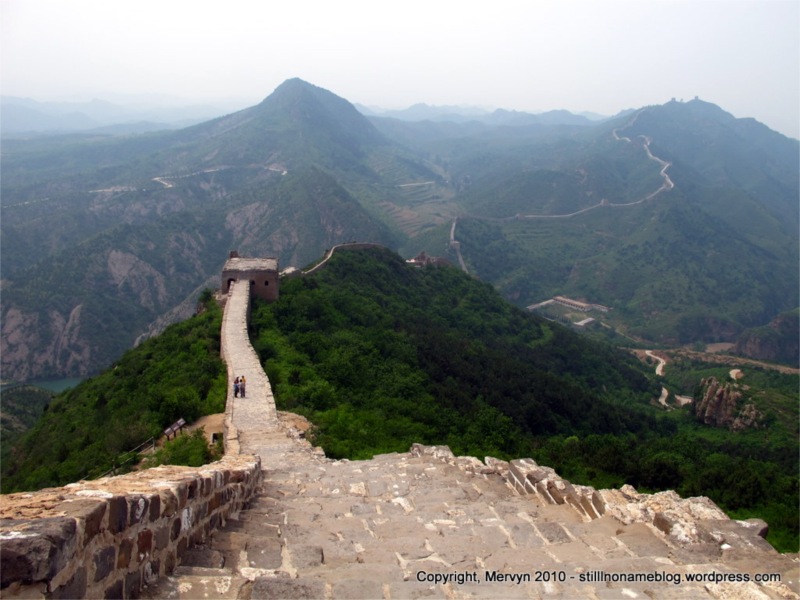
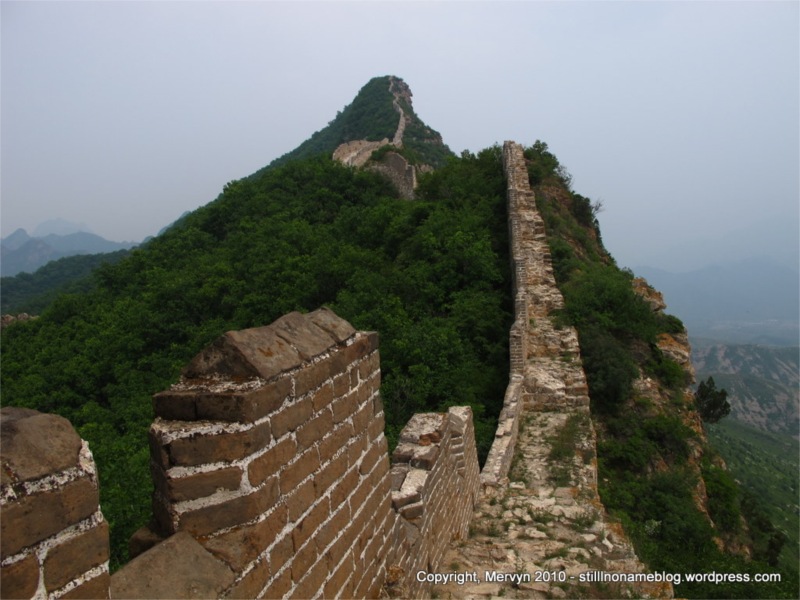
I left my new friends to walk up to a more remote part of the wall while they rested from one of the climbs. After I cleared the first watchtower, I was totally alone. The wall was much older here. Sections were falling down. This part of the wall is on a razor edge of the mountain. The wall faces down a steep slope and is backed by a cliff. If invaders breached this section, they’d have to fight along the edge of the wall to find a part of the mountain where they could descend and start a proper invasion.
The Chinese used this inevitability to their advantage. First off, they didn’t really put much work into making a high battlement. The wide walkway narrowed to what amounted to a catwalk on the side of the mountain. The piled stones were almost short enough to climb with a ten foot ladder. This section might more appropriately be called “The Great Fence.”
Second, they had walls that ran perpendicular to the main wall. As invaders moved along the wall trying to find a way down the mountain, the Chinese guards could shoot arrows at them through holes bored through the perpendicular walls.
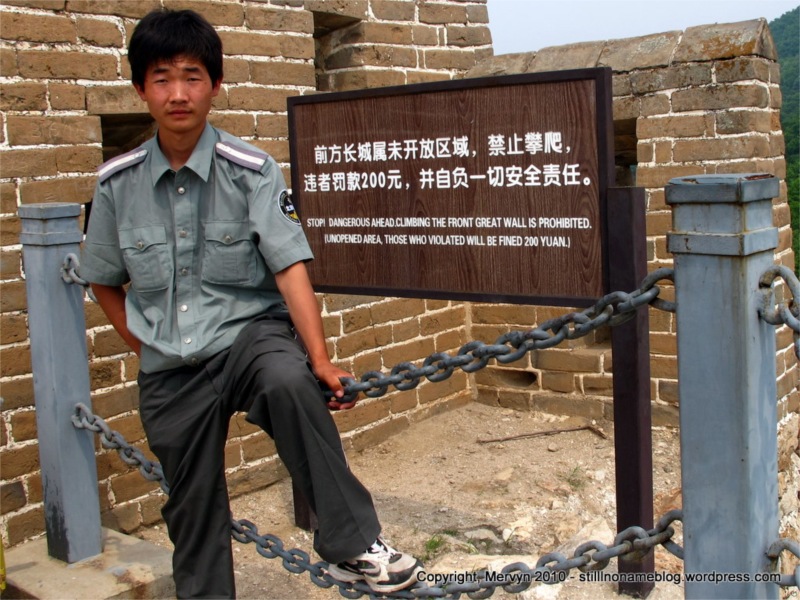
I got to the end of the public area of the wall. A sign warned that people who walked along a chained off section of wall would be fined 200 rmb ($33). A teenage kid in a uniform stood watch by occasionally looking up at me from his cell phone.
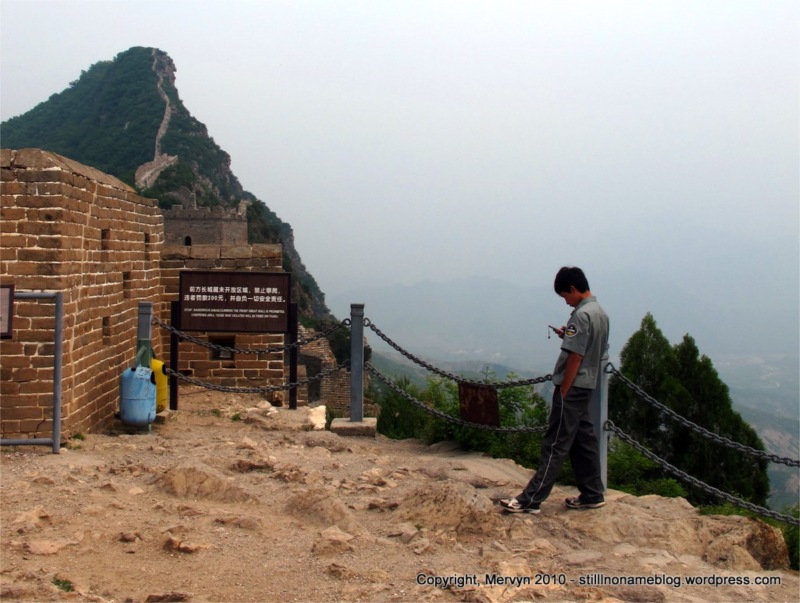
I stood there, admiring the awesome view into the valley, wishing I could hike further along the wall. The kid gestured at the chain blocking the way and said, “You go?” I asked if he was letting me and he said, “Two hundred.” Ahhhh. Turns out the fine was just a starting point for negotiation.
I told him no and offered 50 rmb. I immediately regretted my offer. I should have gone with 10 rmb and worked from there. He laughed, and said, 200. We went back and forth, I walked away once. He came down to 70 rmb. I said, 60 and he let me walk away again, this time a little further. When it was clear I was willing to leave he said, “Hello! Sixty!”
With that, he accompanied me over the chain and we walked along a dilapidated section of the wall to the next tower. From there it looked like a section of the walkway further along had collapsed. Hard to tell, though.
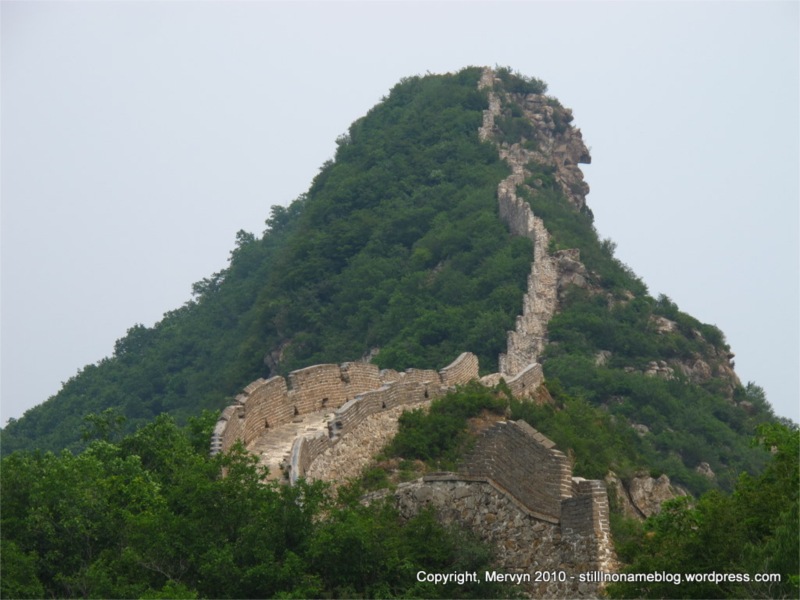
I left my “guide” and rejoined the Indian guys about four towers back. They’d bought some souvenirs and as we hiked down the wall they bought even more stuff off some old ladies. The ladies claimed there was no work on their farm and so were selling souvenirs. I think this moved them to purchase more than they would otherwise. Me, not so much. I’ve been on the road too long to buy sob stories or to pick up nicknacks just for the sake of getting someone off my back. Siem Riep will do that do you.
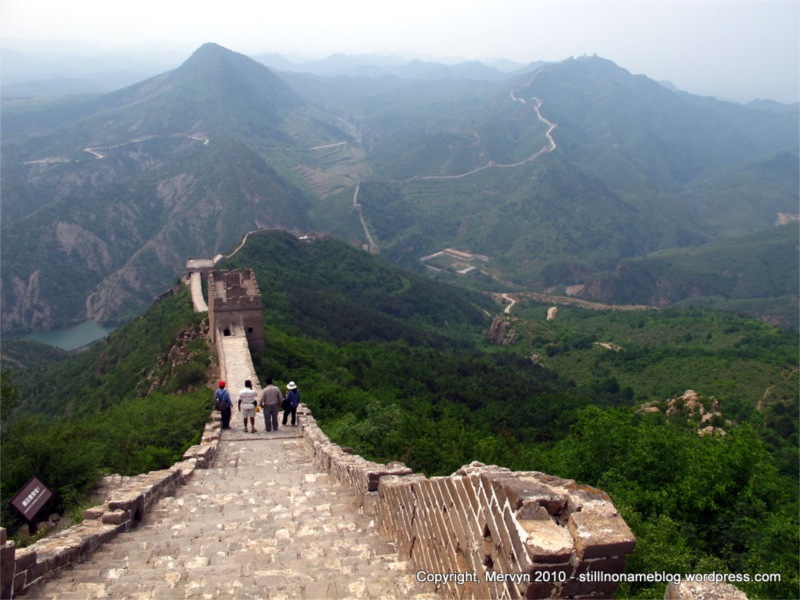
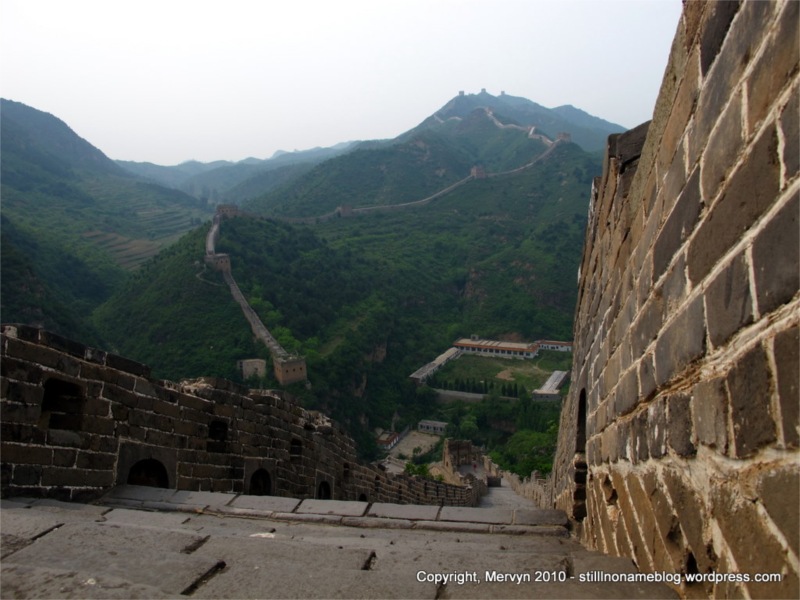
I hiked down to a rope bridge but turned back when I heard it cost 5 rmb. I’ve been on bridges before and the view off this one didn’t seem to justify the price. The Indians had stopped up the hill to wait for me and when I rejoined them they bought me a large bottle of beer. They wouldn’t accept my money when I tried to pay.
Two English girls heard me talking about the bridge. Their guide had told them not to pay the guy sitting on a chair waiting at the end of the bridge. They just walked past him and didn’t pay. Wish I’d known that before I’d hiked down and back up for nothing.
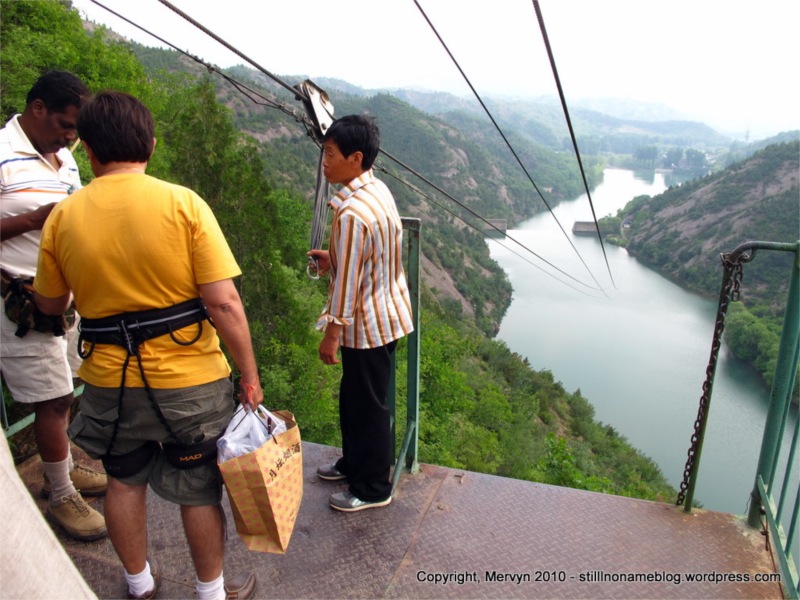
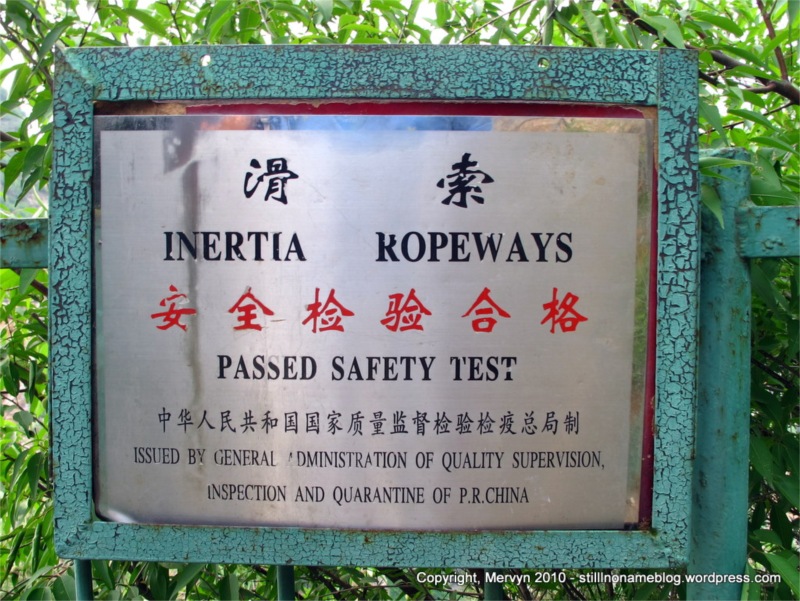
Instead of hiking back down to the parking lot, my group opted to take a zipline down. For some reason, there’s one set up over the lake next to the Simatai section of the Great Wall. I’ve never been on a zipline, so I threw down the 40 rmb ($6.50) for the experience. When am I going to get a chance to zipline next to a Chinese national treasure? I paid for all four of us since the guys had paid for my beer. I figured we’d sort it out back at the hostel and this way I’d at least not be in their debt. An older lady put us in rock climbing harnesses, hooked us into a cable, and sent us off down the mountain.
I’ve sky dived, jumped off rocks into the ocean, snowboarded, and gone scuba diving. Ziplining does not feel anywhere near as dangerous and any of these things. It was actually peaceful coasting down the mountain and over the lake water. The most exciting part was when the harness from the guy before me whizzed past me on the other side of the rope on its way back up the mountain.
We boarded the van back to Beijing, fell asleep, and woke up right as we hit the hostel. The Indian guys insisted on getting a snack of fried potato wedges from a nearby hole in the wall. I again offered to pay, they insisted I not. Here’s where it started to get really weird.
We got back to the hostel and I handed the Indian guys money for the van. They said, “No no no. It’s okay,” pushed the money back to me. I said, “Sure it’s okay, but this is better,” and forced the money into the guy’s hand.
Then he said, “Then we must pay you for the zipline.” Then he gave me money for the zipline. I got confused with the math, they kept insisting that I had paid enough, and I finally relented.
Now, hopefully someone can help me out on this. These were full-on Indian guys with the head bobble every now and then and everything. Am I missing some cultural thing where I’m supposed to keep insisting that I pay or that I pay for something and they pay for something and we don’t worry about “splitting” the costs perfectly evenly? I say this because the youngest of the three kept trying to pay, but the two older guys kept telling him “no” in Hindi and even playfully wrestled him down to the ground when he got insistent.
I was totally out of my element. In the end, I paid about half of what I would have paid if we’d split the cost of the van evenly. Worked out for me, I guess.
I’ll tell you this, I didn’t expect to have to maneuver Indian bill-splitting culture while in China.
GALLERY: Click through to today’s gallery to see even more pictures of the Great Wall and pictures of Mervyn (inevitably) squinting into the camera.
Dateline: Beijing, China – Monday, June 7, 2010
Today was Game 2 of the NBA Finals. The second meeting between my Los Angeles Lakers and their archrivals, the Boston Celtics. As per normal, I planned on catching the game.
As per not-so-normal, I’m in China. This presents a couple challenges. First, the time difference. The game started at 8 p.m. Eastern time Sunday, which translates into 8 a.m. Monday morning Beijing time. Second, where to watch the game. I’m in a hostel dorm room, so that means no TV with satellite.
The first problem was easy. I got up at 7 a.m. this morning. For the love of the game, no? The second was a bit more complicated. When I’d gone out with Max on Friday night we’d happened upon a sports bar called The Den. They’re open 24 hours, which means they’d probably have a TV tuned to the world’s premier basketball league championship.
The problem was getting there. Armed with a map and knowledge of where on the map I wanted to go, I hopped in a cab filled with optimism. I wouldn’t need any Chinese to communicate because I had a Chinese/English map and a finger with which to point, right?
Wrong. The driver and I had a lively “conversation” about where I wanted to go. He looked at the map a total of eight times. I pointed at the same spot nine times. I repeated the name of the district printed in on the map. He repeated something that sounded kind of like what I’d said.
In the end, we got to an intersection I recognized and I had him drop me off. Total cost of that near misadventure: 15 rmb ($2).
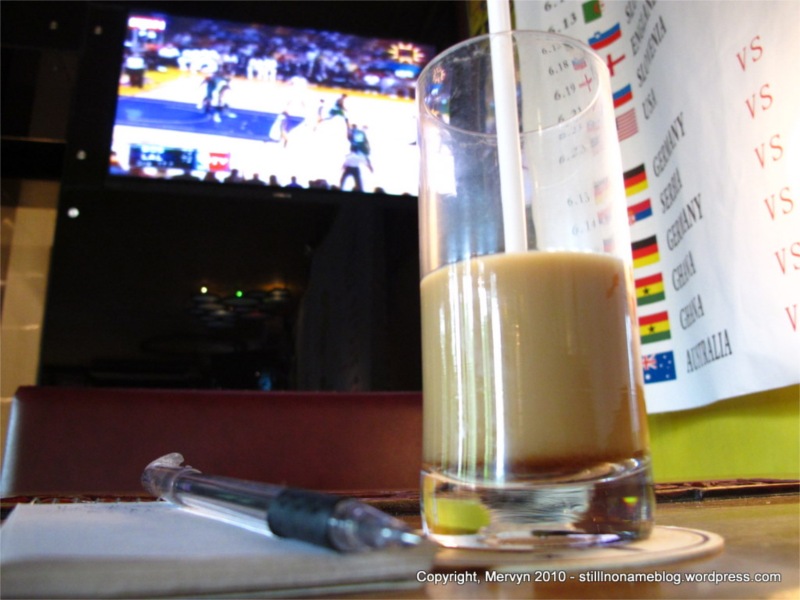
The Den was open. An HD TV on the wall was tuned to the game. The feed was not, however, HD, which meant everyone looked fat and hazy. No matter. I could watch the game. Even though I was a bit late, I was the only one who settled in front of the TV.
The night before, I’d had visions of drinking mugs of beer while still half asleep. The Den is a sports bar, after all. What else was I supposed to order so that I could justify my seat?
Sadly, my excuse to get boozed before the double digits of the morning came up lame. The Den has a breakfast menu. Instead of Tsingtao, I had an omelet and orange juice.
What follows is a bulleted list of observations. If you’re more into food, feel free to skip ahead.
• The game video feed was from ABC, but the announcers were from the Philippine broadcast. The announcers sounded like they’d come from my family potluck. Weird. One announcer said the he expected a big game from Rasheed Wallace because he’d previously won a championship. Apparently these guys had only read the media guide and hadn’t spoken to any Celtics fans, who this season have learned not to expect anything from Rasheed other than a patch of white hair.
• Not only were the announcers Filipino, so where the commercials. One showed a group of men lovingly taking an egg and hand raising a rooster to become a cockfighter. Seriously. There was a scene where the smiling men unleashed their bird on an opponent in the middle of a horde of enthusiastic gamblers. The product: Sabong Nation. The slogan: The Winning Formula. The viewer: transfixed. Animal rights activists: absent.
• Ron Artest gives me heart palpitations. At one point in the first quarter, he caught a pass behind the three point line and dribbled more than four times. By the third dribble, I almost passed out I was so terrified. My favorite Ron Ron moment: when he dribbled around for 20 seconds when the Lakers were down 5 with 2:30 to go, all to just jack an off balance, long two-pointer. Do we really have two more years of this? It’s like watching a game with defibrillator paddles duct taped to your chest and a five-year-old’s finger on the charge button; you have no idea when you’re going to get the shock of your life.
• Every time Bynum or Gasol caught a pass I’d thrill a little. It’s been years since Kwame Brown, but I still instinctively expect every toss to a big man to turn into a turnover. Years of Hands of Stone Kwame will do that to you.
• The officiating was terrible. I’ve never seen so many “no touch” fouls. Guys getting ringed up even though they made negligible contact. Garnett, Kobe, Gasol, and Davis were all victims. Some seemed to be make up calls for previous bad calls. It was like watching a giant snowball of poop roll down hill—bad calls kept piling up on each other.
• The Lakers didn’t deserve to even be in this game. After getting destroyed by Ray Allen’s 27 first half points (why hasn’t anyone learned you can’t cheat inside when guarding him) Kobe almost single handedly dragged L.A. back in with a ridiculous three-pointer to end the half. Somehow the Lakers led for a minute in the third quarter. Eventually, though, they capitulated. Too many early mistakes to overcome. I’m tempted not to watch the next game. It feels like every time I’ve caught a game while overseas, they lose. I only get good results when I watch replays. This trip is beginning to make me superstitious.
• I had an iced coffee after breakfast. It was terrible. Weak and watery. The Vietnamese do it much better. Note: If you’re going to make an iced coffee, you need to start with boiling, thick, sludge coffee. If you just drop ice cubes in regular coffee, it tastes like backwashed java. Ick. I still drank the whole thing.
I left with a bitter taste in my mouth, unfortunately not from the coffee. I headed back on the subway. Unlike before the game, I wasn’t in a rush to get anywhere.
After napping in the afternoon and doing some internet errands, I was ready for dinner. I opted for Din Tai Fung, a place renowned for its steamed buns. As with all things in China, it’s nearly impossible to find if you only speak English. I called the restaurant and spent 10 minutes on the phone trying to get directions. I gave up and asked a Chinese guy downstairs to help me out. Within a couple of minutes he showed me where to go on a map and wrote out the name of where I wanted to go in Chinese. It made me feel like a little kid who has to have his homework pinned to the back of his shirt.
For all you out there looking for directions to Din Tai Fung, let me help you out. I’m doing this because I was once like you, Googling the hell out of the name and the address, trying to find it on an internet map. No luck.
To get to Din Tai Fung, take the subway to Dawanglu station. Exit to Shin Kong Place which is sometimes referred to as China Central Place. It’s a high end mall near the northeast corner of the subway station. Walk through the mall north. You’ll get near the end after passing a bunch of cosmetic counters. Just when you’re about to exit, look for elevators to the right. Unlike the elevators in the main mall, these go to the sixth floor and all the restaurants. If all else fails, ask someone at Information using exaggerated gestures and unnecessarily slow English.
Doesn’t seem hard, but each step of those directions was hard won through trial and error. Learn from my mistakes. Or, ask for directions sooner than I did.
When I finally got to Din Tai Fung, I found the place buzzing with people. The menu has English and professionally produced pictures. I ordered half orders where I could, then waited for my food.
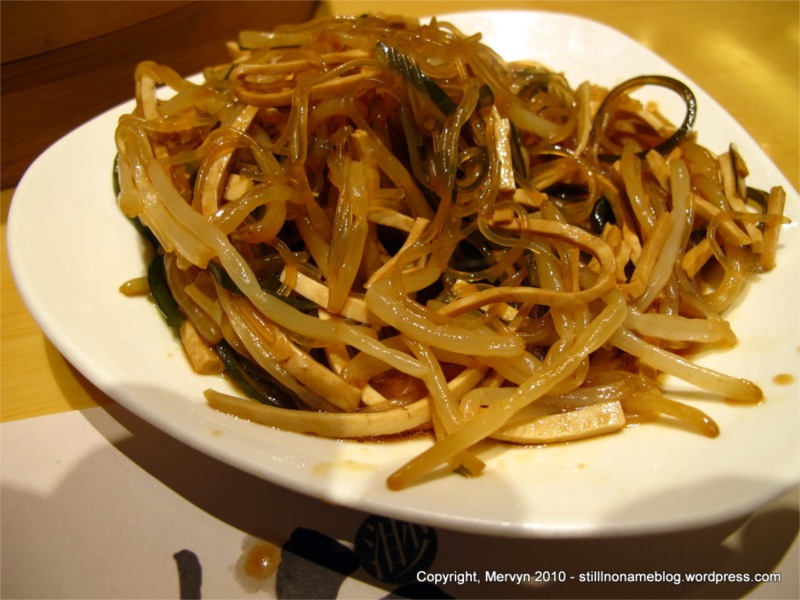
First up was shredded bean curd with bean sprouts. Basically, slivers of tofu with crunchy white veggies. This was surprisingly good, considering I ordered it just so I could have something with a vegetable in it. It was salty and a tad spicy, served cold. It was almost refreshing.
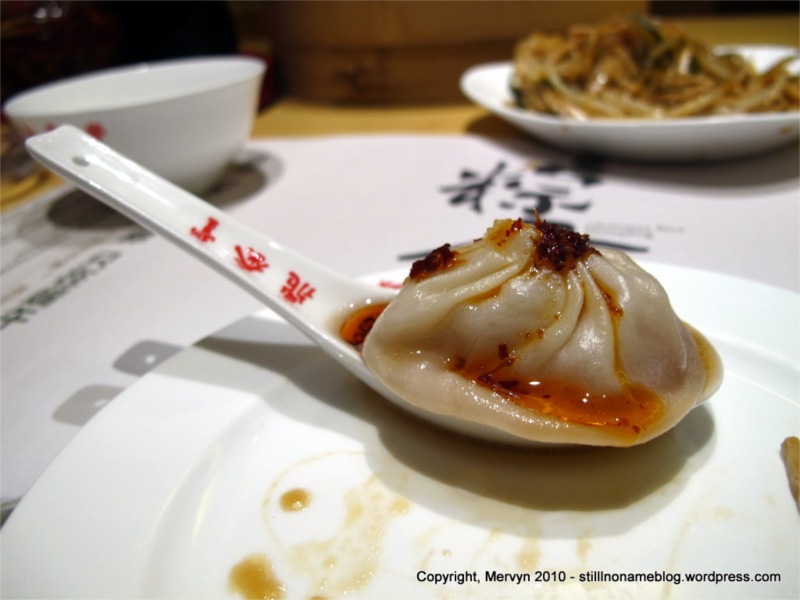
Next up were a half order of pork dumplings. These were small balls of pork and soup wrapped in steamed dough. Thanks to years of sneaking out for dim sum with another associate at my former firm, I knew that I was supposed put the dumplings in a spoon, pierce the skin to release the soup, then drizzle the spoon with hot sauce. From there, I pop the steaming dumpling in my mouth, chew, and sip at the soup left in the spoon. The pork was pretty standard. What set it apart was the skin of dough. It had body and a rich but subtle flavor of. . .dough, I guess.
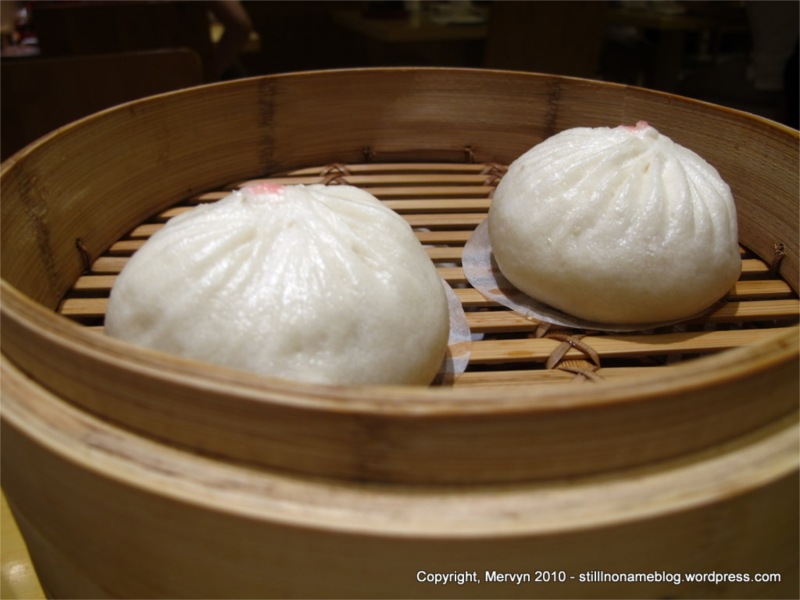
While I slurped and poked, the pork buns came out. Just like the dumplings, the pork itself was good, but unremarkable. In fact, I think it could’ve used a bit more seasoning. The flavor was almost too subdued. The star, though, was the fluffy white bun. It was almost a meal in itself. A bit sweet. A bit salty. Never tough, even though I let the second one sit out for a few minutes as I polished off the pork dumplings. If you’d steamed up balls of the stuff, I probably could’ve eaten just that.
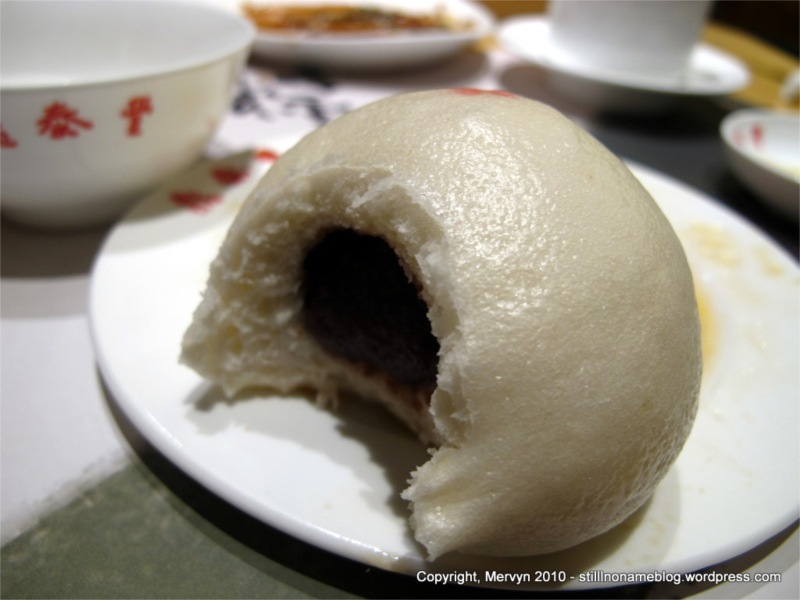
Finally, I ended with red bean paste buns. Same deal as above, but instead of a salty meaty center, I was treated to a sweet, deep red ambrosia. Here, subtlety was an asset. The red bean paste wasn’t too sweet. It had been mixed in such a way that there was no grit or graininess. It was smooth and silky and paired wonderfully with the fluffy, slightly sweet white bun.
Mission accomplished. And, like any good restaurant, there were a few items on the menu that I wanted to try on a return trip. It might just happen. It’s one of the few reputable restaurants in the city which I know how to get to.
GALLERY: Click through to see one or two extra pictures of food. Exciting, no?
Day 95 – No Lamas in This Lamasery
Dateline: Beijing, China – Sunday, June 6, 2010
When you hear about something called the Lama Temple, what comes to mind? Me, I think llamas. Those hairy, long necked, spitting, hooved animals that nimbly climb mountains. The temple was probably made to venerate the noble beast, which is probably revered here like the turtle is in Vietnam.
This is incorrect. Apparently, in China lama has to do with the Dalai Lama and a particular sect of Buddhism practiced in Tibet. Who knew?
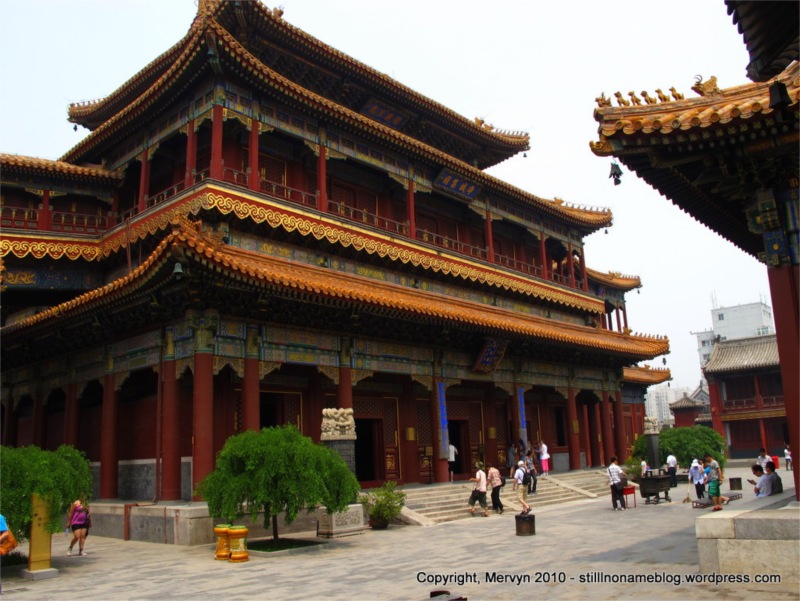
Today I visited the Lama Temple, which is apparently the most renowned Tibetan Buddhist temple outside of Tibet. It used to be the emperor’s residence, but was converted to a “lamasery” in 1744. If you’d asked me to define “lamasery” before today, I’d have said, “A place where humans raise baby llamas.”
I wasn’t planning on visiting the lamasery. I’ve been a little templed out and, left to my own devices, I’d have figured it was just another place where Buddhists burned incense and bowed a lot. Max recommended it, so I forked over the 25 rmb ($3.85) admission and ambled in.
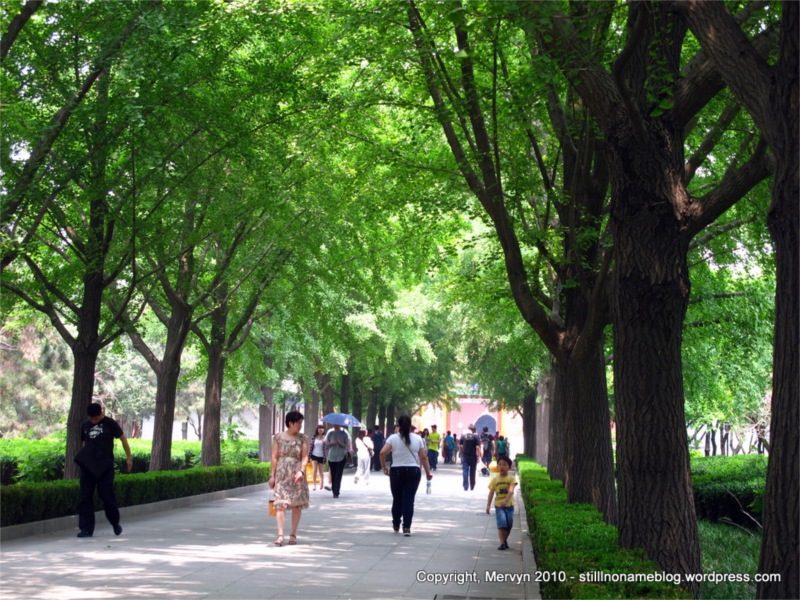
The entrance is a tree-lined walkway, so right off the bat my relationship with the lamas was off on the right foot. I contend that there aren’t enough tree-lined anythings on earth. The more things we can line with trees, the happier I think we’d be. There’s something about the shade, the rustle of leaves, and the green roof supported by pillars of trees that speaks to me.
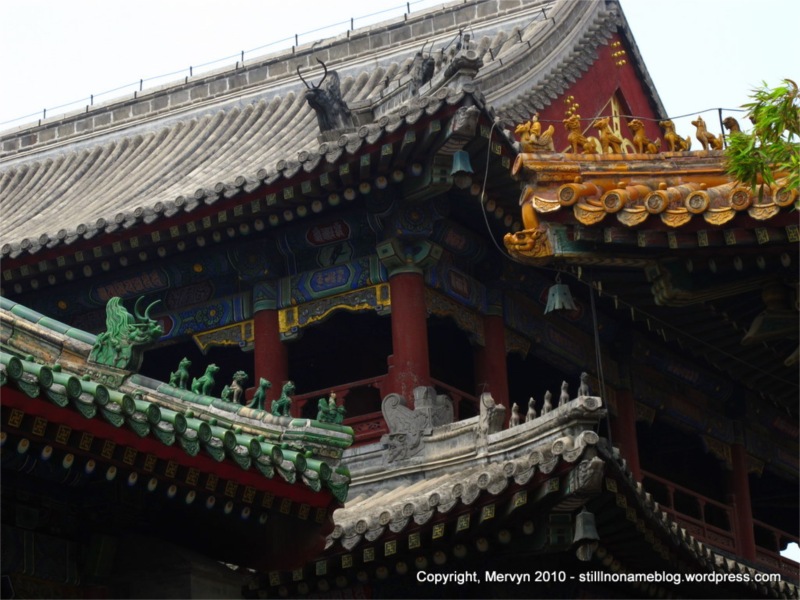
The temple is arranged on a north-south axis and has large buildings in the center surrounded by a series of smaller buildings. The place is quite lovely, though signs ask that you “Please do not burn incense or film inside.” I had no intention of burning film inside or out.
First up was a big bellied Buddha (that’s what the sign said) then three depictions of Buddha, two of which represented the past Buddha and the future Buddha. Everywhere, people were lighting incense and bowing, sometimes kneeling and sometimes standing.
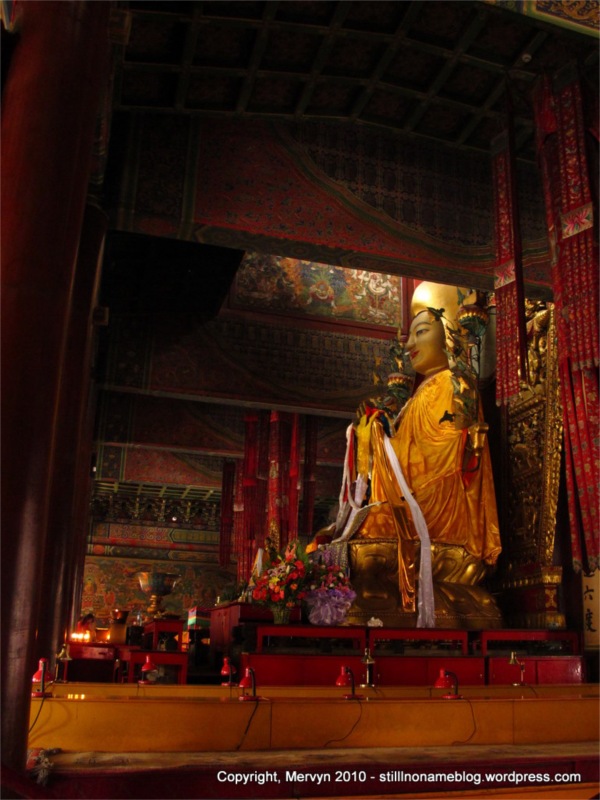
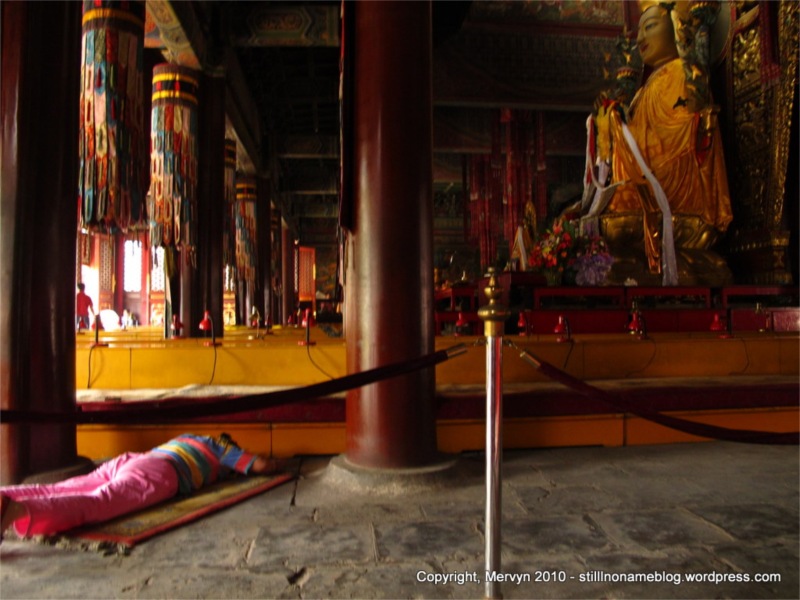
There as a giant, cloaked Buddha in the next pavilion. Staring up at the ceiling, I saw intricate drawings of Buddha in various scenes, probably depictions of events in his life. Off to the right, an older woman did a hardcore version of the bow. She’d laid down a mat and would stand, raise her arms, then bend at the waist, place her hands on the ground and kneel, then lay down prostrate, arms outstretched. Then she would stand up and repeat the process.
Every time she went into the prostrated position, she would bang her head against the ground hard enough that, standing 10 feet away, there was an audible thud as her head hit the stone. She had a mat and a small pad where her forehead made contact, but I can’t imagine it was painless. When I circled back 45 minutes later after exploring the temple, she was still at it. She was getting an NFL season’s worth of head collisions in a very short span. I’m not sure if she was doing penance, but if she was, I’d have to suggest she switch to Catholicism—5,000 Hail Marys has to be less mind numbing.
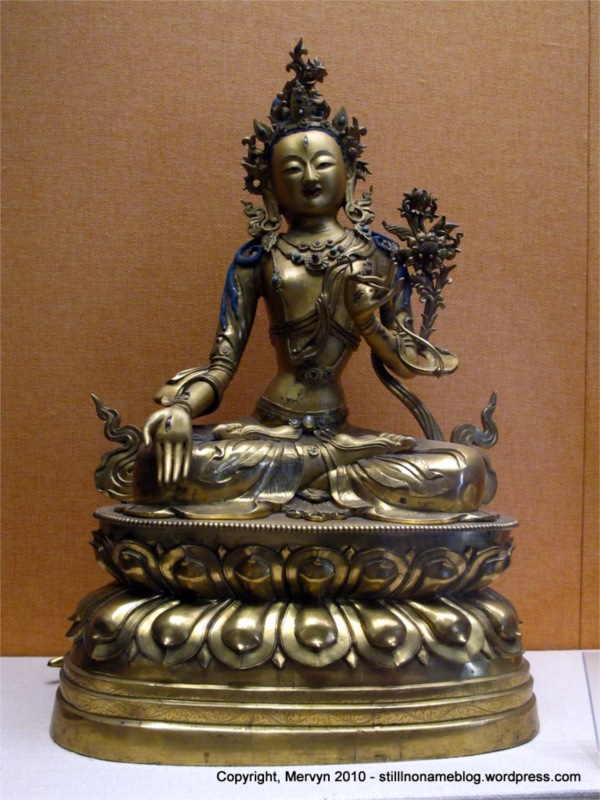
The surprise of the visit were two buildings on the east and west sides of the complex. These held many effigies of various Buddhist characters. The Lord of Hell and the Mahakala featured prominently. One of my favorites was the White (or Green?) Tara, which had an eye staring out of the palm of its hand. Looking through the images, you can see where Bayonetta and Guillermo Del Toro got the ideas for much of their bizarre imagery. Pan’s Labyrinth has heavy lama influence. The Tibetan lama, mind you.
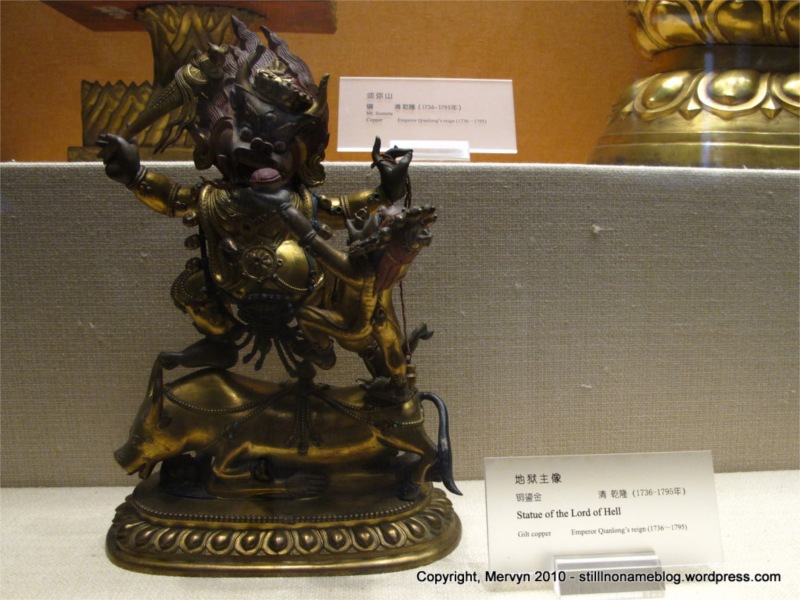
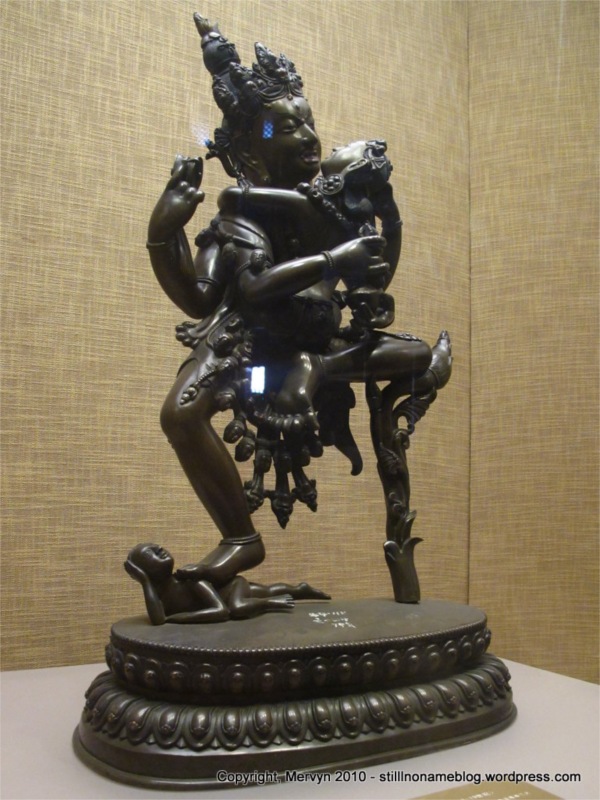
It took me a moment, but I started to realize that the statues might have a bit of a prurient bent to them. At first, I thought the images depicted characters with heads and torsos protruding from their chests. Many of the effigies depicted creatures with many arms and it was hard to tell where one creature started and ended. Some of the less bizarre depictions had me doing a double take. It wasn’t one creature with two heads, it was two creatures with two heads, one straddling the other. The statues didn’t move, of course, but it seemed pretty clear they were straddling each other quite vigorously. Reading my guidebook, I realized that these were tantric statues, which I gather is Buddhism’s form of kama sutra. Who knew monks were so kinky.
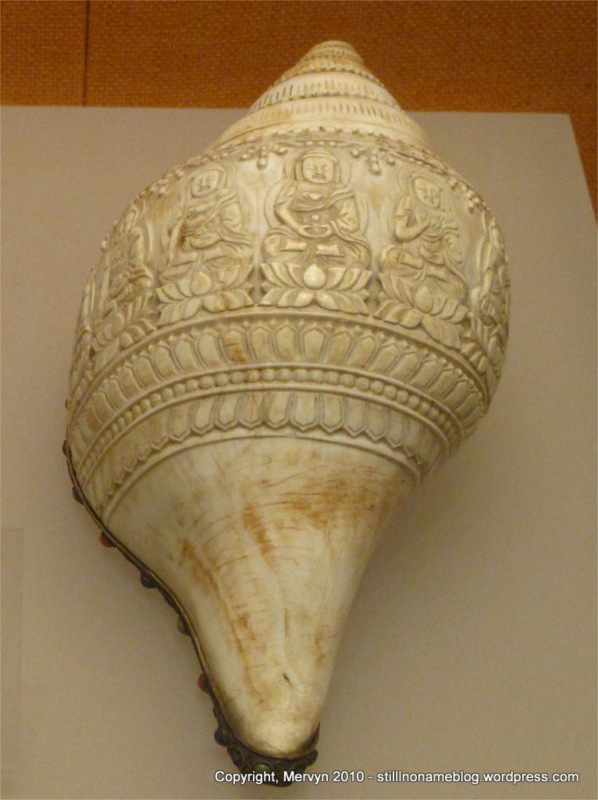
It was just statues having many-armed sex, either. There was clothing from various costumes, crowns, and other sacred objects. A series of conch shells were quite remarkable. Some had been carved with images of Buddha. Another two conch horns had been incorporated into brass handles. One statue looked like it was eating brain out of someone’s skull. For a brief moment, I wished I’d sprung the extra $3 for the audio tour. Then I got over it. My version was much better.
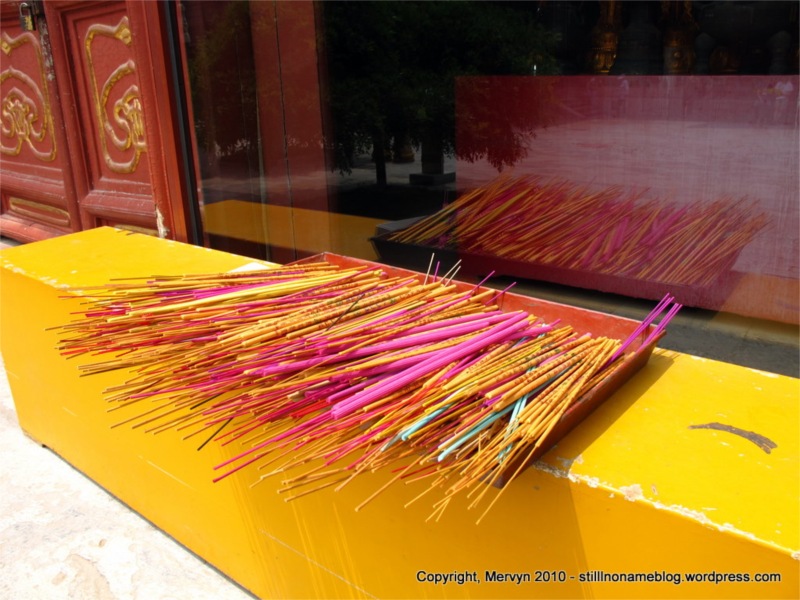
One thing I found fascinating was the offering of incense. Signs indicated that incense was not to be burned inside the buildings. People, however, still went through the ritual of bowing while clutching incense in their prayer folded hands. The unlit incense sticks were then laid down on a table in front of the sacred effigy. Who wants to bet that these get recycled? I guess it’s the thought that counts and not the use of the lighting of the incense.
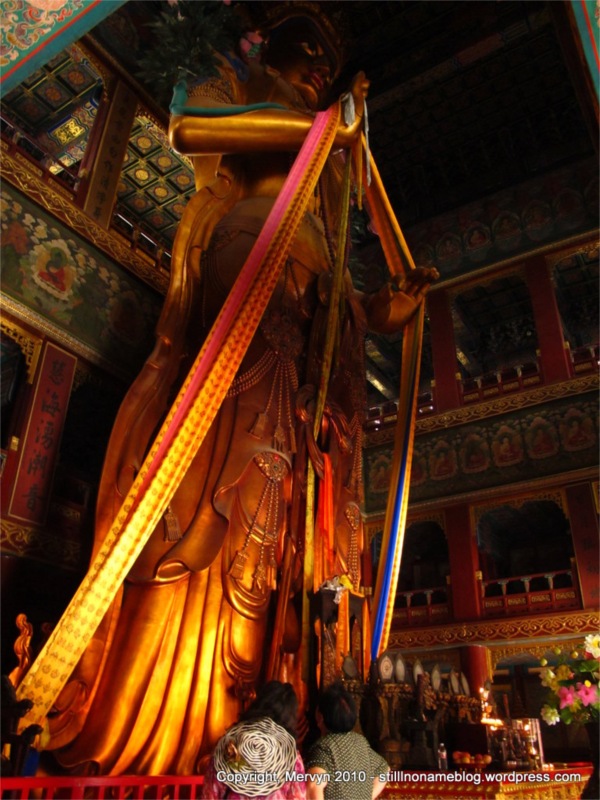
A big attraction here was an 18 meter tall Buddha carved out of a single tree. It was massive. A sign said the tree was a sandalwood, but I had no idea any tree got so big besides Sequoias. Perhaps it’s not one solid piece of wood. Maybe all the wood just came from one tree. I wasn’t able to run any tests on the wood fibers so I can’t be sure.
As I sat on a bench trying to plan where to eat, I got a small reminder that I’m not in Kansas anymore. A little kid pulled down his pants, squatted down on a planter, and proceeded to take a dump, all under the watchful eye of his father. No one paid them any attention except me. When his son was done, the dad wiped his bottom and picked up the poop with a plastic bag like his kid was a dog. Again, no one seemed to think was out of the ordinary. I was fascinated.
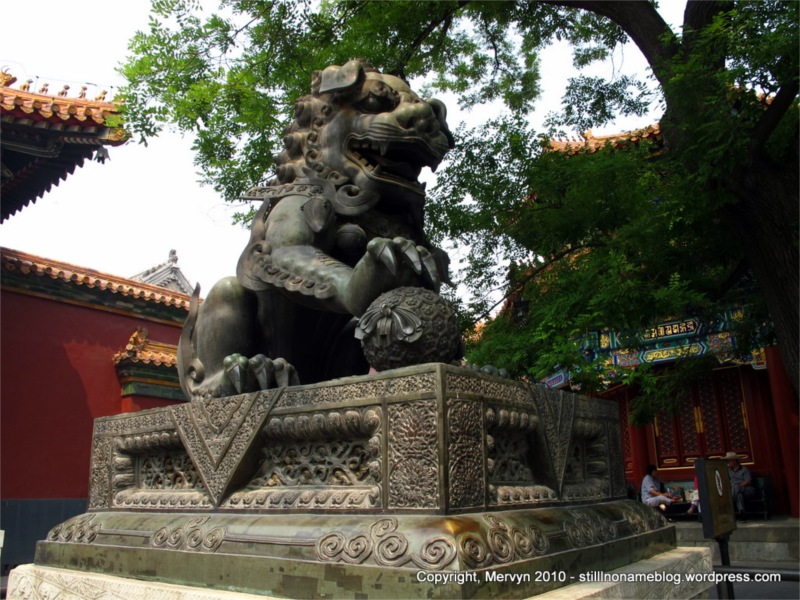
For dinner I headed over to Ritan Park and a leisurely meal at Xiao Wwang’s Home Restaurant. Beijing attempted to thwart my attempt to find the restaurant. First, the city set the exit to the subway under an overpass with few features or signs. The big blocks made it difficult to determine what street was coming next. I got turned around, found a river that was in the opposite direction of where I meant to be, then wandered around a group of foreign embassies while I tried to find the park. I must have walked 3 miles. I know I walked for at least an hour.
By the time I found my destination, I was starving. I hadn’t eaten all day and it was late afternoon. I scarfed down a meal of spicy fried chicken wings and fried string beans with ground pork. The portions were huge, apparently intended for family style eating. The chicken wings were decent, but they didn’t hold a candle to San Tung’s version in San Francisco. The string beans were limp and overcooked for my taste. I wanted to have dessert, but by the time I got a waiters attention, I was full. I sprung an extra 2 rmb for two takeaway containers so I didn’t waste half of what I’d ordered.
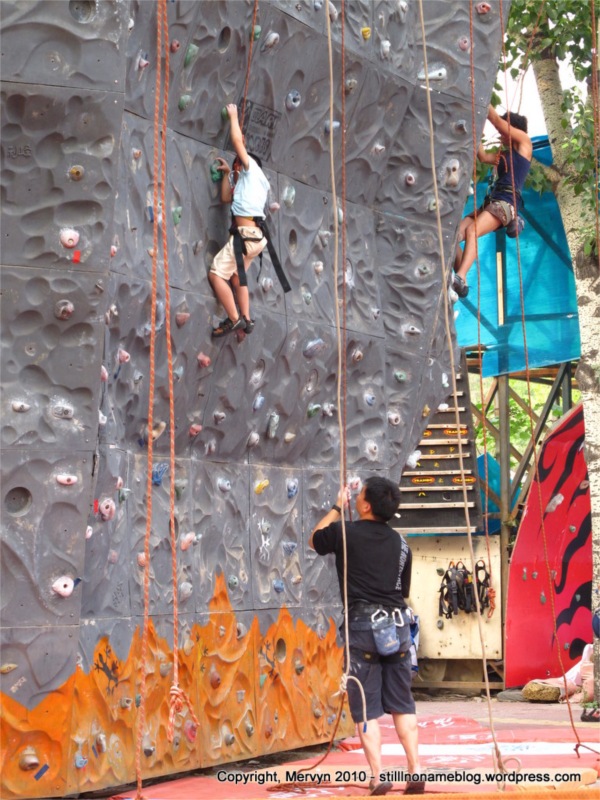
I walked back through the park and stumbled on an impressive outdoor climbing wall. A little kid, in the smallest harness I’ve ever seen, managed to climb 10 feet off the ground. In adult proportions it probably equaled 20 feet or so. I bet his tiny hands are stronger than my violin-playing. girly digits. Not hatin’, just sayin’.
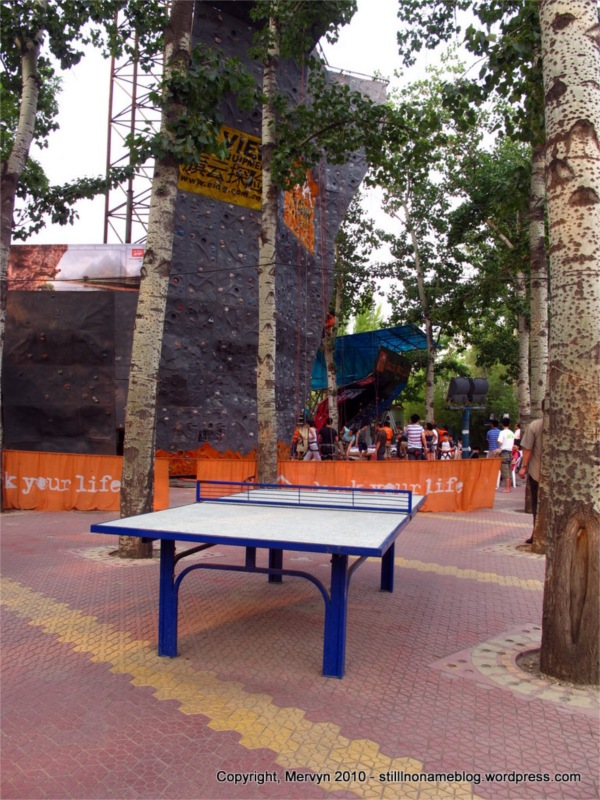
I’ll have to come back to Ritan Park. It was a breath of fresh air after the past two days of Beijing’s concrete jungle. Wandering the city got me thinking that Beijing has more in common with parts of Tokyo than Hanoi or even Bangkok. It feels manufactured in a way. You can feel the planning. Even less so than Tokyo, it’s not meant for walkers. It’s just big expanses of concrete and asphalt. Very little in the way of life at the street level. All of the energy and activity is far from the road, somewhere behind the 200 foot setbacks, hidden behinds walls and gates, tucked in buildings and sheltered in invisible alleys.
It’s too bad, really. It makes the city less approachable. A few more narrow streets and chaotic, haphazard boulevards might do the city some good. Give it some character. For now, I’ll have to settle for a park or two and the occasional lama.
GALLERY: Click through to today’s gallery to see more brass statutes, pictures of temples, pictures of food, and a holy blue effigy that looks like it stumbled out of a cartoon.
 The Overpacker